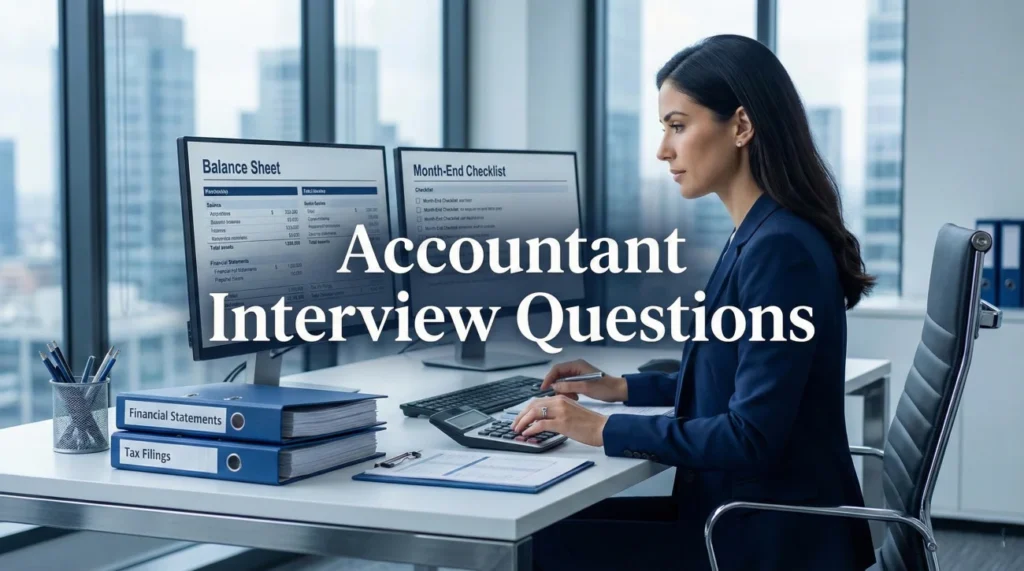
What Accountant Interviews Evaluate
Accountant interview questions assess your understanding of accounting principles, technical proficiency, and ability to maintain accurate financial records. Interviewers evaluate your knowledge of GAAP standards, experience with month-end close procedures, and competence in preparing reconciliations and financial statements. They want evidence that you can ensure compliance while meeting tight deadlines.
This guide covers GAAP fundamentals, month-end close processes, journal entries and accruals, and financial statement preparation. The accounting profession is expected to see steady demand over the coming years, and many teams continue to look for candidates who can close books accurately, support audits, and communicate clearly under tight deadlines.
GAAP Principles and Standards
Q: What is GAAP and why is it important?
GAAP stands for Generally Accepted Accounting Principles, a set of standardized guidelines for financial accounting used in the United States. It ensures consistency and comparability in financial reporting across different companies. Many employers look for professionals with solid GAAP knowledge and comfort with compliance-oriented reporting.
GAAP provides the framework for recording transactions, preparing financial statements, and disclosing financial information. It includes principles like revenue recognition, matching expenses to revenues, and full disclosure. Following GAAP ensures that financial statements present a true and fair view of a company’s financial position. Non-compliance can result in audit failures, regulatory penalties, and stakeholder distrust. Understanding GAAP thoroughly is essential for maintaining the integrity of financial statements.
Q: What’s the difference between GAAP and IFRS?
GAAP is rule-based while IFRS (International Financial Reporting Standards) is principle-based. GAAP provides specific rules and detailed guidance for various scenarios, while IFRS relies more on general principles requiring professional judgment. This fundamental difference affects how accountants approach complex transactions.
Key differences include inventory accounting: GAAP allows LIFO while IFRS does not. IFRS permits revaluation of fixed assets to fair value while GAAP generally requires historical cost. Revenue recognition approaches differ, though ASC 606 and IFRS 15 have converged significantly. Financial statement formats vary: IFRS requires specific line items while GAAP offers more flexibility. Development costs can be capitalized under IFRS if certain criteria are met, but GAAP typically expenses them. Understanding these differences matters for multinational companies or those considering international reporting.
Q: Explain the difference between accrual and cash accounting.
Accrual accounting records revenues when earned and expenses when incurred, regardless of when cash changes hands. Cash accounting records transactions only when cash is received or paid. GAAP requires accrual accounting for most businesses because it provides a more accurate picture of financial health.
For example, if you deliver services in December but receive payment in January, accrual accounting records the revenue in December when earned. This matches revenues with related expenses in the same period, following the matching principle. Cash accounting is simpler and often used by small businesses, but it can distort financial performance if significant receivables or payables exist. Understanding when accruals matter, especially for revenue recognition and expense matching, is fundamental to accurate financial reporting.
Q: How do you stay current with accounting standards?
I maintain subscriptions to professional publications and FASB updates to track new standards and interpretations. I complete continuing professional education (CPE) requirements through courses focused on recent standard changes. For example, recent Accounting Standards Updates can add or refine disclosure requirements, so I review effective dates and implementation guidance early.
I participate in professional bodies like the AICPA which provide technical guidance and implementation resources. When new standards emerge, I assess their impact on our financial reporting and develop implementation plans. I maintain a network of peers to discuss interpretation challenges. For instance, updates in areas like crypto asset accounting can change measurement and presentation expectations, so I track guidance and consult implementation resources. Proactive learning ensures compliance and positions me to advise on complex transactions correctly.
Month-End Close Procedures
Q: Walk me through your month-end close process.
I follow a structured close checklist prioritized by risk and materiality. I start by ensuring all transactions are posted and cutoffs are clearly communicated to the team. I reconcile cash and revenue accounts first as they’re high-risk areas. Then I move to other balance sheet accounts, leveraging recurring journal entries and templates to reduce manual work.
I ensure all ledgers are updated, outstanding invoices reviewed, and accruals and prepayments confirmed. I prepare the trial balance and generate financial statements including profit and loss and balance sheet. I aim for a five-day close by preparing throughout the month with scheduled accruals, daily cash posting, and interim reconciliations. I document variances and create commentary for leadership explaining significant fluctuations. A well-organized close process ensures accuracy while meeting tight deadlines.
Q: How do you handle tight month-end close deadlines?
I manage tight deadlines through prioritization, preparation, and clear communication. I create a detailed schedule with incremental goals and prioritize tasks by materiality and risk. Staff accountants handle routine accounting tasks like preparing journal entries, maintaining general ledgers, and reconciling accounts as the backbone of the close process.
I prepare throughout the month rather than waiting until close: scheduling accruals, reconciling accounts continuously, and addressing issues as they arise. I communicate dependencies and deadlines clearly with team members and other departments. I use templates and recurring entries to reduce manual work. When unexpected issues arise, I assess impact and communicate proactively with stakeholders about any delays. I document the closing checklist to ensure nothing is missed. Consistent processes and advance preparation make tight deadlines manageable.
Q: How do you ensure accuracy during the close?
I follow a systematic approach combining controls, review, and documentation. I double-check entries and reconcile accounts regularly. I implement peer-review processes and second-pass checks to catch errors early, especially on high-risk accounts and manual journal entries. I maintain reconciliation trackers for all balance sheet accounts with supporting schedules.
I investigate variances to the penny, adding notes for outstanding items and ensuring each reconciliation ties to source documents. I verify that journal entries have proper support and approval. I compare current period results to budget and prior periods, investigating significant variances. I ensure financial statements balance and flows between statements connect correctly. Attention to detail and systematic verification catch errors before financial statements are finalized.
Q: How do you prepare for audits?
Audit preparation involves organizing all financial records, ensuring books are up-to-date, and verifying that transactions have proper documentation. I gather supporting documents like invoices, contracts, tax returns, and bank statements. I check reconciliations and trial balances for completeness and accuracy.
I prepare audit schedules summarizing key accounts with supporting detail auditors typically request. I ensure compliance with accounting standards and resolve discrepancies in advance to make the audit smoother and quicker. I review internal controls and document any changes during the period. I anticipate auditor questions based on significant transactions or judgmental areas. In interviews, I emphasize audit readiness: clean support, clear reconciliations, and responsive collaboration with auditors. Proactive preparation reduces audit duration and minimizes adjustments.
Journal Entries and Accruals
What types of journal entries do you regularly prepare?
I prepare various journal entries including standard recurring entries, accruals, adjusting entries, and correcting entries. Standard entries record routine transactions like payroll, depreciation, and amortization. Accrual entries record expenses incurred but not yet paid and revenues earned but not yet received, ensuring financial statements reflect actual economic activity.
Adjusting entries at period-end update accounts for items like prepaid expenses, deferred revenue, and depreciation. They ensure financial statements reflect the correct amounts according to the matching principle. Correcting entries fix errors discovered after initial recording. I also prepare reclassifying entries to move amounts between accounts for proper presentation. Each entry includes the date, accounts affected, amounts debited and credited, and supporting documentation explaining the transaction.
Explain how you handle accruals and prepaid expenses.
Accruals record expenses or revenues in the period they occur regardless of cash timing. For expense accruals, I estimate amounts based on contracts, purchase orders, or historical usage when invoices aren’t received by period-end. I document the basis for estimates and flag them for true-up when actual amounts are known. Over-accruals occur when estimates are too high; I reverse the excess in the following period.
Prepaid expenses are payments made for goods or services to be received in future periods. I record the initial payment as an asset, then expense the appropriate portion each period. For example, annual insurance paid upfront is recorded as prepaid, then one-twelfth is expensed monthly. I maintain schedules tracking prepaid balances and amortization. Proper handling of accruals and prepaids ensures expenses match the periods they benefit, following GAAP’s matching principle.
What’s your process for bank reconciliations?
I reconcile cash early in the close process, using direct bank feeds but validating against statements and the general ledger. I start by comparing the bank statement ending balance to the GL cash balance. I identify timing differences: outstanding checks issued but not yet cleared, deposits in transit recorded in the GL but not yet at the bank, and bank charges or interest not yet recorded in the GL.
I adjust the GL for bank items like fees and interest, then prepare a reconciliation showing how the bank balance and book balance reconcile after adjustments. I investigate any unreconciled differences immediately; reconciling to the penny is essential. I document explanations for outstanding items, especially those aging beyond normal clearing periods. Regular reconciliation catches errors, identifies fraud, and ensures cash balances are accurate for financial reporting and cash management decisions.
Financial Statements and Reporting
Q: Describe the three main financial statements and how they connect.
The three main financial statements are the Balance Sheet, Income Statement, and Cash Flow Statement. The Income Statement shows revenues, expenses, and net income over a period. The Balance Sheet presents assets, liabilities, and equity at a point in time. The Cash Flow Statement shows cash inflows and outflows from operating, investing, and financing activities.
These statements connect through several linkages. Net income from the Income Statement flows to Retained Earnings on the Balance Sheet and is the starting point for operating cash flows. Changes in Balance Sheet accounts between periods explain movements in the Cash Flow Statement. The ending cash balance on the Cash Flow Statement equals cash on the Balance Sheet. Understanding these linkages helps identify errors and explain financial performance comprehensively.
Q: How do you handle revenue recognition?
Revenue recognition under ASC 606 follows a five-step model: identify the contract, identify performance obligations, determine the transaction price, allocate the price to obligations, and recognize revenue when obligations are satisfied. This framework applies across industries and requires careful analysis of contract terms.
For subscription or SaaS revenue, I recognize revenue ratably over the subscription term, creating deferred revenue schedules driven by start and end dates. For services with milestones, I recognize revenue upon delivery and client acceptance. For products, revenue is typically recognized at delivery when control transfers to the customer. I ensure systems capture information needed for proper recognition timing. Revenue recognition requires judgment; I document conclusions and ensure consistency across similar transactions.
Q: What experience do you have with fixed asset accounting?
I maintain fixed asset registers tracking acquisition cost, useful life, depreciation method, and accumulated depreciation for each asset. I ensure capitalizable costs are properly identified versus expenses; GAAP has specific thresholds and criteria. I calculate and record monthly depreciation systematically.
I perform periodic physical inventories to verify assets exist and are in use. I process disposals, recording any gain or loss. I track leased assets under current guidance distinguishing operating and finance leases. For impairment, I assess indicators and test carrying values against recoverable amounts when necessary. I prepare supporting schedules for auditors and ensure disclosures meet GAAP requirements including depreciation methods, useful lives, and asset categories.
Q: How do you communicate financial information to non-financial stakeholders?
I use analogies and visual aids to simplify complex financial information. I focus on what the numbers mean for business decisions rather than technical accounting details. I translate financial results into operational terms stakeholders understand, connecting revenue trends to sales activity or expense variances to specific operational changes.
I prepare clear commentary explaining significant fluctuations and their causes. I use charts and graphs to show trends rather than presenting tables of numbers. I anticipate questions and prepare supporting detail without overwhelming the main message. I avoid jargon, explaining accounting concepts in plain language when necessary. Effective communication ensures financial insights actually influence decisions rather than being ignored because they’re not understood.
Accounting Knowledge Check
Test Your Accounting Expertise
1. What is the main goal of the month-end close?
- To minimize journal entries
- To produce accurate, timely financial statements with supportable balances
- To avoid variance analysis
- To finalize budgets
2. GAAP is best described as:
- Rule-based with detailed guidance
- Principle-based with minimal rules
- Optional for U.S. companies
- Only used in tax accounting
3. Which inventory method does IFRS not allow that GAAP permits?
- FIFO
- LIFO
- Weighted Average
- Specific Identification
4. Accrual accounting records revenue when:
- Cash is received
- Revenue is earned
- The invoice is paid
- The bank deposit clears
5. The matching principle requires:
- Assets equal liabilities
- Expenses are recorded in the same period as related revenue
- Debits always exceed credits
- Cash inflows match cash outflows
6. Deferred revenue represents:
- Revenue earned but not billed
- Cash received for goods or services not yet delivered
- Bad debt expense
- A prepaid expense
7. A trial balance primarily verifies that:
- All transactions are complete
- Total debits equal total credits
- Revenue is recognized correctly
- Cash balances are reconciled
8. Which is the best starting point for reconciling cash?
- Accounts receivable aging
- Bank statements (or validated bank feeds) versus the general ledger
- The income statement subtotal
- The budget forecast
9. Net income flows from the Income Statement to:
- Accounts receivable
- Retained earnings on the Balance Sheet
- Accounts payable
- Fixed assets
10. Under ASC 606, the first step in revenue recognition is to:
- Recognize revenue at invoicing
- Identify the contract with the customer
- Allocate price before identifying obligations
- Recognize revenue only at cash collection
11. A prepaid expense is usually recorded as:
- An asset that is expensed over time
- A liability that is reversed monthly
- Revenue until services are delivered
- Equity until year-end
12. Depreciation is best defined as:
- A cash outflow each month
- Systematic allocation of an asset’s cost over its useful life
- Market value decline
- Repair and maintenance expense
13. What is the purpose of a bank reconciliation?
- To increase revenue
- To explain differences between bank and book balances and confirm cash accuracy
- To avoid audit requests
- To replace variance analysis
14. Which is a common close control to reduce errors?
- Posting entries without support
- Documented approvals and review of manual journal entries
- Skipping reconciliations
- Only checking totals, not details
15. Contra accounts typically have:
- The same balance direction as related accounts
- The opposite balance direction of the related account
- Always a zero balance
- Only debit balances
16. In fixed asset accounting, capitalizable costs are those that:
- Are any costs over a small amount
- Provide future economic benefit and meet capitalization policy criteria
- Are paid in cash
- Are related to payroll only
17. The Cash Flow Statement connects to the Balance Sheet because:
- It replaces the income statement
- Changes in balance sheet accounts explain cash movements
- It only reports revenue
- It is the same as the trial balance
18. What is a good practice when estimating accruals?
- Never document the basis
- Document assumptions and true-up when actuals arrive
- Avoid using contracts or POs
- Book accruals only after invoices arrive
19. For non-financial stakeholders, strong communication is:
- Leading with accounting jargon
- Explaining implications for decisions in plain language
- Avoiding visuals
- Sharing raw tables without context
20. In an audit, the most helpful thing you can provide is:
- Only the general ledger export
- Clear support, reconciliations, and a clean trail of approvals
- Only verbal explanations
- Screenshots without context
❓ FAQ
📜 What certifications should I highlight?
CPA is highly valued in public accounting and many corporate roles. CMA (Certified Management Accountant) is useful for management accounting and corporate planning positions. Highlight progress toward certification if you haven’t completed it yet. Advanced Excel or data analytics certificates demonstrate technical proficiency. Industry-specific certifications may matter for specialized roles. Continuing education shows commitment to staying current.
🔧 What software should I know?
Proficiency in Excel is essential, including VLOOKUP/XLOOKUP, pivot tables, and ideally macros and Power Query. ERP experience matters: QuickBooks for smaller companies, NetSuite, SAP, or Oracle for larger organizations. Know your way around accounting software matching the company’s size and industry. Familiarity with data visualization basics and analytics tools adds value. Companies increasingly value automation skills and comfort with cloud-based systems.
🎯 How do I demonstrate attention to detail?
Provide specific examples of catching errors and implementing controls to prevent recurrence. Describe your systematic approach to reconciliations and review processes. Mention implementing peer review or other verification steps. Discuss how you document work and maintain audit trails. Quantify improvements when possible, such as error reduction percentages. Your interview responses should be precise and well-organized, demonstrating the detail orientation you claim.
📊 How do I discuss month-end experience?
Describe your specific role in the close process and the volume of transactions you handle. Mention close timeline achievements, such as reducing close from seven days to five. Discuss specific reconciliations you prepare and their complexity. Explain how you handle tight deadlines and unexpected issues. Show understanding of how your work connects to financial statements and supports audit requirements. Demonstrate process improvement mindset.
🌟 How do I stand out from other candidates?
Research the company’s industry and any specific accounting challenges they might face. Prepare examples demonstrating both technical skills and soft skills like communication and problem-solving. Show you understand business context, not just debits and credits. Ask thoughtful questions about their processes, systems, and team structure. Demonstrate awareness of recent accounting standard changes relevant to their business. Show enthusiasm for accuracy and continuous improvement.
Advancing Your Accounting Career
Preparing for accountant interview questions requires demonstrating technical proficiency alongside practical experience. Articulate your understanding of GAAP principles, month-end close procedures, and financial statement preparation with specific examples showing accuracy and efficiency. Show how you maintain compliance while meeting deadlines.
Bring examples of reconciliations, close checklists, or process improvements you’ve implemented. Prepare to discuss your experience with specific accounting software and your approach to handling complex transactions. Demonstrate the combination of technical knowledge, attention to detail, and communication skills that distinguishes effective accountants. For comprehensive interview preparation, explore accounting career resources to position yourself for a role that leverages your financial expertise.
⚠️ Disclaimer: The interview strategies, sample answers, and negotiation tips provided in this guide are for educational purposes only. Hiring decisions are subjective and vary by company and industry. While these strategies are based on professional HR standards, they do not guarantee a specific job offer or result.