The Keeper of the Verbatim Record
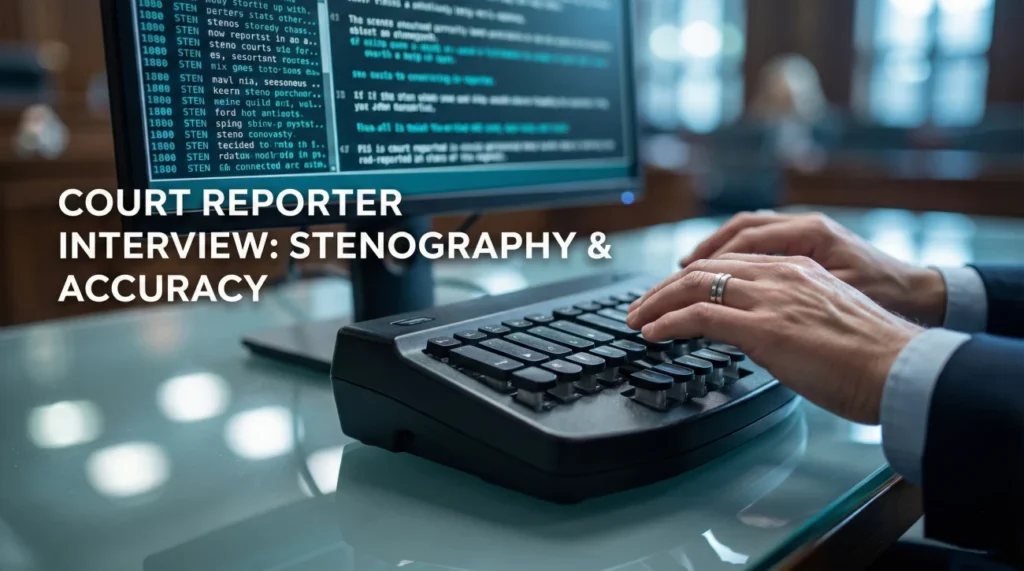
In a world of digital recordings and AI transcription, the human Court Reporter remains the gold standard for judicial accuracy. You are the only person in the room whose sole job is to capture every spoken word, verbatim, regardless of speed, accent, or interruption. Whether in a high-stakes trial or a complex deposition, the official transcript you produce is the legal truth upon which appeals and judgments are based.
Hiring managers for court reporting agencies and courthouses are looking for elite technical skills combined with unflappable professionalism. They need to know if you can write “realtime” for a deaf participant, if you can interrupt a shouting match to protect the record, and if your dictionary is robust enough to handle medical or technical jargon instantly. Prepare to answer court reporter interview questions that test your speed, your software proficiency, and your ethical boundaries. This guide explores the deep technical and procedural knowledge required to secure your place behind the steno machine.
Stenography Skills and Realtime Writing
Q: What is your current writing speed, and how do you maintain accuracy at high speeds?
I currently write at 240 words per minute (WPM) with 98% accuracy, which exceeds the RPR (Registered Professional Reporter) standard. Speed is useless without control. To maintain accuracy during rapid-fire testimony, I rely on “briefs” and “phrases” rather than stroking out every word phonetically. I practice daily with high-speed audio to keep my fingers conditioned. If the speakers overlap or become too fast for a clean record, I have the confidence to interrupt professionally and ask them to repeat or speak one at a time. My priority is always the integrity of the record, not just keeping up.
Q: Describe your experience with Realtime reporting.
I provide Realtime feeds regularly for judges and attorneys using CaseViewNet or Bridge. Realtime requires a different mindset than standard reporting because my raw notes are visible instantly. I spend significant time “dictionary building” before a job, entering case-specific names and terms so they translate correctly on the screen rather than appearing as untranslated steno strokes. I am comfortable setting up the local network or serial cables to connect to the attorneys’ laptops. I understand that a clean Realtime feed is a premium service that adds immense value, allowing counsel to mark text and review testimony instantly.
Q: How do you manage your steno dictionary?
My dictionary is my most valuable asset. I am constantly adding new entries. Every time I encounter a new term or name, I “global” it immediately after the job so it translates correctly next time. I have separate sub-dictionaries for specific fields like medical malpractice, construction defect, and intellectual property. This prevents conflicts; for example, “PAT” might mean “patent” in an IP case but “patient” in a medical case. I back up my dictionary to the cloud and an external drive daily. Losing my dictionary would be like a carpenter losing their tools, so I protect it rigorously.
Q: What CAT (Computer-Aided Transcription) software do you use?
I am proficient in [Insert Software, e.g., Case CATalyst, Eclipse, or Stenograph]. I use the advanced features to speed up editing, such as “include” files for standard title pages and certificates. I use “AudioSync” to record a backup audio track that links directly to my steno notes. This allows me to click on a specific stroke and hear the corresponding audio instantly during the editing process, which is a lifesaver for checking mumbled words or heavy accents. I keep my software subscription current to ensure I have the latest updates and support.
Q: How do you handle a situation where you made a mistake in the realtime feed?
In realtime, errors happen. If it is a minor typo that does not affect meaning, I keep writing. If it is a significant mistranslation (like “did” instead of “didn’t”), I might quickly stroke a correction if there is a pause. However, I never let fixing a past error cause me to miss the current testimony. I explain to clients beforehand that the realtime feed is a “rough draft” and the final certified transcript will be perfect. After the session, I prioritize fixing those specific errors in the final edit.
Deposition and Courtroom Procedures
Q: What is your process for marking exhibits during a deposition?
I take charge of the exhibits to ensure the record is clear. When an attorney hands me a document, I affix the exhibit sticker immediately, ensuring it doesn’t cover any text. I write the exhibit number and a brief description in my steno notes (e.g., “Marked Ex 1 – Contract”).
I maintain a separate index sheet on my laptop to track every exhibit number to prevent duplicates or skipped numbers. If an attorney tries to discuss a document without marking it or identifying it for the record, I politely clarify: “Counsel, are you marking that as Exhibit 5?” This ensures the transcript reader knows exactly what document is being discussed.
Q: How do you handle “off the record” discussions?
I am very strict about the “off the record” rule. I stop writing ONLY when all parties agree to go off the record. If one attorney says “Off the record” and the other says “Keep it on,” I keep writing.
When we do go off, I lift my hands clearly from the machine to signal I am not reporting. I note in my file “Discussion off the record.” When they are ready to resume, I ask, “Are we back on the record?” before I start stroking again. I never include off-the-record chatter in the transcript unless a judge specifically orders it later.
Q: How do you prepare for a technical expert witness deposition?
Preparation is key for technical jobs. I ask the hiring attorney for a “Notice of Deposition” and any previous transcripts or expert reports beforehand. I research the witness online to find their CV and publications.
I enter the technical terms, chemical names, or acronyms into my job dictionary before the deposition starts. I also ask for a spelling list of proper names at the beginning of the day. If the expert speaks at a blistering pace about complex topics, I rely on my preparation to brief the terms accurately rather than finger-spelling everything.
Q: What do you do if two attorneys are speaking over each other?
This is the “unreportable” zone. I cannot write two voices at once. I wait a few seconds to see if they stop. If they continue, I interrupt firmly but professionally: “Counsel, I cannot report both of you at the same time. One at a time, please.”
I do not apologize for interrupting; it is my duty to protect the record. If they ignore me, I continue writing what I can hear, usually the witness or the louder attorney, and insert a parenthetical (simultaneous colloquy) in the transcript. However, my goal is always to control the room enough to get a clean record.
Q: Describe your procedure for swearing in a witness via Zoom/remote connection.
Remote swearing-in requires verifying the witness’s visibility and identity. I ask the witness to position their camera so I can see them clearly. I ask them to raise their right hand visible in the frame.
I administer the oath slowly and clearly, ensuring the audio is stable. I also verify on the record that there is no one else in the room coaching them, which has become a concern in remote depositions. I make a note in the transcript that the oath was administered remotely pursuant to the relevant state emergency orders or statutes.
Q: How do you handle readbacks?
A readback request puts the spotlight on me. I stay calm. I scroll back in my software to find the requested portion. I read my steno notes (or the English translation on screen) clearly and at a moderate pace, projecting my voice.
I do not read the “umms” or false starts unless specifically asked for “verbatim” readback, as usually they just want the substance of the question. I ensure I read the complete question and answer context. After reading, I ask, “Does that satisfy the request?” before going back to the current record.
Ethics and Professionalism
An attorney asks you to “clean up” the witness’s grammar in the transcript. Do you do it?
Absolutely not. My duty is to produce a verbatim record. If the witness says “I ain’t gonna go,” I write “I ain’t gonna go.” Changing it to “I am not going to go” alters the testimony and potentially the jury’s perception of the witness’s education or credibility.
The only exception is minor punctuation or dropping “umms” and “ahhs” in a non-verbatim setting, but I never change the words spoken. I would politely explain to the attorney, “I am certified to produce a verbatim transcript and cannot alter the witness’s sworn testimony.”
You realize after the deposition that you forgot to swear in the witness. What do you do?
This is a serious procedural error. I would immediately contact the hiring attorney and inform them of the oversight. I cannot simply add the oath to the transcript if it didn’t happen.
Often, the attorneys can stipulate that the testimony serves as sworn testimony despite the error, or they may need to reconvene briefly to have the witness reaffirm their testimony under oath on the record. Hiding the mistake would be unethical and could cause the entire deposition to be thrown out of court later.
An attorney offers you a “gift” or extra payment to expedite their transcript over others. How do you respond?
I must remain neutral and impartial. I can accept an “expedite fee” if it is a standard service charge listed on my rate sheet and available to all parties. However, I cannot accept a personal gift or an “under the table” payment to favor one side.
I would adhere to the “Gift Giving” rules of the NCRA (National Court Reporters Association). If one party orders an expedited transcript, I must notify the other parties and offer them the same expedite service at the same time. I cannot provide the transcript to the paying side first while making the other side wait.
You hear confidential attorney-client privilege conversation during a break because they forgot to mute the mic. What do you do?
I stop writing immediately. I take my hands off the machine. I do not record it. If I am the host of the Zoom meeting, I might mute them or alert them verbally: “Counsel, your microphone is still on.”
If anything was inadvertently captured in my notes before I stopped, I delete it or redact it from the final transcript. It is my ethical duty not to record privileged communications. I would presume they intended to be private and protect that privilege.
Court Reporter Skills Quiz
20 Practice Questions
1. What does “CSR” stand for?
- Certified Stenography Reporter
- Certified Shorthand Reporter
- Court Service Recorder
- Computer Stenotype Reader
2. The standard speed for Q&A certification is:
- 200 WPM with 95% accuracy
- 225 WPM with 95% accuracy
- 250 WPM with 98% accuracy
- 180 WPM with 90% accuracy
3. What is a “brief” in steno?
- A short legal document
- A short stroke for a word/phrase
- A small break in testimony
- A type of machine key
4. “Colloquy” refers to:
- The witness’s answer only
- Discussion between attorneys/judge
- The final jury verdict
- The swearing in of the witness
5. Which is a CAT software?
- Adobe Photoshop CC
- Microsoft Excel 365
- Case CATalyst
- AutoCAD Design
6. A “parenthetical” is used to:
- Mark the end of the day
- Note non-verbal actions (nodding)
- Correct a spelling error
- Highlight important text
7. “Striking” from the record means:
- Deleting the words physically
- Noting the judge ordered it disregarded
- Hitting the machine keys hard
- Closing the court session
8. Who owns the official transcript?
- The hiring attorney
- The court reporter / agency
- The witness who spoke
- The public library
9. What is “scoping”?
- Looking for new clients
- Editing the steno translation
- Setting up the microphone
- Swearing in the jury
10. A “rough draft” transcript is:
- A certified final copy
- An uncertified, unedited copy
- A copy for the judge only
- A handwritten summary
11. “CART” stands for:
- Court Audio Recording Tape
- Communication Access Realtime Translation
- Computer Aided Reporting Tool
- Certified Advanced Realtime Typist
12. Which hand does the witness raise?
- The left hand
- The right hand
- Both hands
- No hand required
13. “Untranslate” refers to:
- Foreign language spoken
- Steno strokes not in dictionary
- Silence in the room
- A redacted sentence
14. What is the “certificate page”?
- The bill for the job
- Reporter’s signed verification
- The witness’s ID card
- The exhibit list cover
15. “Shadowing” means:
- Blocking the light
- Writing along with another reporter
- Hiding from the judge
- Following a witness home
16. Which organization issues the RPR?
- American Bar Association
- National Court Reporters Association
- Federal Judicial Center
- State Supreme Court
17. “Globaling” a word means:
- Searching the internet for it
- Defining it for the whole transcript
- Translating it to Spanish
- Sending it to the world
18. A “condensed” transcript puts:
- 1 page per sheet
- 4 pages per sheet
- 10 pages per sheet
- The whole day on one page
19. “Errata sheet” is for:
- The reporter to fix billing
- The witness to correct testimony
- The judge to change the law
- The jury to take notes
20. What protects your backup files?
- Leaving them on the desk
- Encryption and Cloud storage
- Printing them out once
- Deleting them after 1 week
❓ Frequently Asked Questions
🎙️ Is digital recording replacing stenographers?
While digital recording is used in some lower courts, stenographers remain the gold standard for complex litigation, high-stakes trials, and real-time needs. A digital recorder cannot ask a witness to repeat a mumbled word in real-time, nor can it provide an instant text feed to a deaf participant. The human element ensures a cleaner, more accurate record.
📜 Do I need a certification to work?
In most states, yes. You typically need the CSR (Certified Shorthand Reporter) license issued by the state board. The national RPR (Registered Professional Reporter) certification is also highly valued and allows you to work in states that accept reciprocity. Federal courts often have their own hiring standards.
💰 How are court reporters paid?
Official reporters (court employees) typically receive a salary plus page rates for transcripts. Freelance reporters (depositions) are paid an appearance fee plus page rates. Income is heavily dependent on how many pages you produce. A fast, efficient reporter who takes daily copy jobs can earn significantly more than a standard 9-to-5 salary.
🎒 Do I need to buy my own machine and software?
Yes, as a freelance reporter, you are an independent contractor. You must purchase your own steno machine (like a Luminex or Diamante), your laptop, and your CAT software license. These are significant investments, often totaling $5,000-$10,000, but they are tax-deductible business expenses.
🚑 Can I specialize in medical or technical reporting?
Absolutely. Many reporters build a niche in medical malpractice, patent law, or construction defect cases. Developing a specialized dictionary for these fields makes you faster and more accurate, allowing you to command higher rates and become the “go-to” reporter for specialized firms.
The Silent Virtuoso
Court reporting is often called “playing the piano of the English language.” It requires a unique combination of manual dexterity, linguistic processing, and absolute focus. You are the silent virtuoso in the courtroom, capturing history as it happens. When you walk into the interview, carry yourself with the quiet confidence of someone who knows they are the smartest listener in the room.
Focus on your technical specs: your speed, your software mastery, and your dictionary management. But also emphasize your professionalism. Show them that you are the neutral guardian of the record, impervious to pressure and dedicated to the truth. With these court reporter interview questions, you are ready to prove that the human record is still the best record.
⚠️ Disclaimer: The interview strategies, sample answers, and negotiation tips provided in this guide are for educational purposes only. Hiring decisions are subjective and vary by company and industry. While these strategies are based on professional HR standards, they do not guarantee a specific job offer or result.