
- What Motivational Interviewing Is: An evidence-based, collaborative counseling style that helps people resolve ambivalence and find their own reasons to change across addiction, healthcare, criminal justice, social work, and mental health.
- The MI Spirit: Built on Partnership, Acceptance, Compassion, and Evocation so you support autonomy and draw out motivation instead of confronting, persuading, or “fixing” for the client.
- Core Skills (OARS): Use Open questions, Affirmations, Reflective listening, and Summaries to build rapport, strengthen self-efficacy, and keep the client doing more of the talking and meaning-making.
- Change Talk And Resistance: Learn to spot and reinforce Desire, Ability, Reasons, Need, Commitment, and Steps, then roll with sustain talk using reflections, reframes, and focus shifts rather than arguments.
- From Talk To Action And Interviews: Transition to planning only after commitment grows, and demonstrate competency by explaining MI principles in plain language, walking through OARS, and showing how you handle ambivalence in scenarios or role-plays.
A Collaborative Approach to Change
Motivational interviewing (MI) is an evidence-based counseling approach helping individuals resolve ambivalence about behavior change by exploring their own motivations rather than confronting, persuading, or directing. Originally developed for addiction treatment, MI now applies across healthcare, criminal justice, social work, and mental health supporting changes in substance use, medication adherence, lifestyle behaviors, criminal thinking, and other areas where ambivalence prevents action.
This guide establishes foundational MI competencies. You’ll learn core MI spirit principles distinguishing this approach, techniques eliciting change talk and exploring ambivalence, strategies for rolling with resistance without confrontation, and practical application across counseling contexts including addiction recovery and reintegration programs.
The Spirit of Motivational Interviewing
MI represents fundamental shift from traditional advice-giving or confrontational approaches, requiring different relational stance.
Four Core MI Principles
MI spirit embodies essential attitudes and values guiding all interactions beyond specific techniques.
| MI Principle | Meaning | Practice Application |
|---|---|---|
| Partnership | Collaborative relationship between equals, not expert-recipient hierarchy | Ask permission before advice, explore client ideas first, acknowledge their expertise about own life |
| Acceptance | Absolute worth, autonomy, accurate empathy, affirming strengths | Respect choices including continued problem behavior, find genuine positives, understand perspective deeply |
| Compassion | Actively promoting client welfare and wellbeing as priority | Genuine concern for best interests, willingness to prioritize their needs over your agenda |
| Evocation | Drawing out client’s own motivations and resources rather than installing yours | Ask what they think rather than telling, assume wisdom within them, elicit rather than educate |
MI vs. Confrontational or Directive Approaches
Understanding what MI is not clarifies the distinctive approach and prevents common misapplications.
- ❌ Not confrontation: MI avoids arguing, warning, or challenging about problem severity
- ❌ Not advice-giving: MI doesn’t lead with expert recommendations or prescriptive solutions
- ❌ Not persuasion: MI doesn’t convince through logical arguments about why they should change
- ❌ Not assessment: MI isn’t primarily gathering information or conducting diagnostic interviews
- ✅ Is exploration: MI helps client examine own values, goals, and behavior discrepancies
- ✅ Is elicitation: MI draws out client’s own arguments for change they already possess
- ✅ Is autonomy support: MI respects ultimate choice belongs to client, even if unchanged
💡 Pro tip: The “righting reflex” is the natural impulse to fix problems and give advice, which MI requires consciously suppressing. When client describes problem, resist urge to immediately suggest solutions. Instead ask: “What have you tried?” or “What ideas do you have about that?” Client-generated solutions create more ownership and motivation than brilliant counselor suggestions they didn’t ask for.
Expert advice: MI practitioners often say “If you’re doing more work than the client, you’re doing it wrong.” If you’re working harder to convince them to change than they’re working to change themselves, you’ve slipped out of MI spirit into expert mode. Periodically check: Am I eliciting their thoughts or imposing mine? Am I curious about their perspective or pushing my agenda? True MI feels more like facilitated self-discovery than teaching.
Core MI Skills: OARS
Four foundational communication skills create the technical foundation for MI conversations.
Open-Ended Questions
Questions inviting elaboration rather than yes/no answers draw out thinking and explore ambivalence.
| Purpose | Closed Question (Avoid) | Open Question (MI Approach) |
|---|---|---|
| Explore concerns | “Are you worried about your drinking?” | “What concerns do you have, if any, about your drinking?” |
| Understand motivation | “Do you want to change?” | “What makes you think you might want to make a change?” |
| Elicit values | “Is your family important to you?” | “Tell me about what matters most to you in life.” |
| Generate ideas | “Have you thought about treatment?” | “What options have you considered for dealing with this?” |
| Explore ambivalence | “Do you see downsides to changing?” | “What would be the hardest thing about making this change?” |
Affirmations
Genuine recognition of client strengths, efforts, and positive qualities builds self-efficacy and rapport.
- Recognize efforts: “You’ve been thinking hard about this” acknowledges struggle even without change
- Highlight strengths: “You’ve overcome challenges before” reminds them of capability
- Appreciate honesty: “I appreciate you being so open with me” reinforces vulnerability
- Note resilience: “Despite everything, you’re still here trying” validates perseverance
- Find authentic positives: Never fake affirmations; clients detect insincerity immediately
Reflective Listening
Reflections guess at meaning rather than ask questions, conveying understanding while inviting elaboration.
- 🔄 Simple reflection: Repeating or paraphrasing what said (“You’re feeling stuck”)
- 🎯 Complex reflection: Adding meaning or emphasizing particular aspect (“The hardest part is disappointing your family”)
- ⚡ Amplified reflection: Exaggerating slightly to elicit other side (“So there’s absolutely nothing good about quitting?”)
- 🔀 Double-sided reflection: Capturing ambivalence (“You enjoy drinking with friends, and you’re tired of the hangovers”)
- 📈 Ratio guideline: Aim for more reflections than questions; optimal ratio about 2:1 in MI
Summarizing
Periodic summaries demonstrate listening, collect themes, and transition between topics or toward action planning.
- Collect key points from extended conversation showing comprehensive understanding
- Reflect ambivalence by including both sides (“On one hand… and on the other hand…”)
- Emphasize change talk subtly by spending slightly more time on reasons for change
- Invite correction or addition (“Have I got that right? What did I miss?”)
- Use summaries to transition: “So far we’ve talked about… Where would you like to go from here?”
Avoid “but” when reflecting ambivalence: “You like drinking, but it’s causing problems” implies one side outweighs other. Instead use “and”: “You like drinking, and it’s causing problems” holds both truths equally. Small language shifts prevent inadvertently pushing client toward defensiveness when genuinely torn between competing values.
Evoking and Strengthening Change Talk
Central MI strategy involves recognizing, eliciting, and reinforcing client’s own statements favoring change.
Identifying Change Talk Types
Change talk appears in predictable categories, each indicating motivation for change differently.
| Change Talk Type | What Client Expresses | Example Statement |
|---|---|---|
| Desire | Wanting, wishing, preferring to change | “I want my family to trust me again” or “I wish I could stop” |
| Ability | Confidence in capability to change | “I think I could do it if I really tried” or “I’ve quit before” |
| Reasons | Specific arguments for change based on values or consequences | “My health is getting worse” or “I’m missing too much work” |
| Need | Sense of urgency or importance of change | “I have to do something” or “This can’t continue” |
| Commitment | Statements of intention or decision to change | “I’m going to call the treatment center” or “I’ve decided to quit” |
| Taking Steps | Actions already taken toward change | “I threw away my supplies” or “I told my friends I’m done” |
Strategies for Eliciting Change Talk
Specific questioning and reflection techniques make change talk more likely to emerge.
- Evocative questions: “What would be the good things about changing?” directly invites change talk
- Elaboration: When change talk appears, ask “Tell me more about that” or “What else?”
- Extremes: “What concerns you most about continuing this way?” emphasizes problem severity
- Looking back: “When were things better?” creates contrast with current situation
- Looking forward: “If you make this change, how will life be different in 5 years?”
- Values exploration: “What kind of person do you want to be?” connects behavior to identity
Rolling with Resistance
When encountering resistance or sustain talk (reasons not to change), avoid arguing; instead redirect gently.
- 🔄 Simple reflection: Acknowledge resistance without challenging (“You’re not ready to commit to that”)
- 🔀 Amplified reflection: Slight exaggeration often prompts client to argue other side (“So quitting is completely impossible”)
- ⚖️ Double-sided reflection: Honor ambivalence (“You see benefits, and you have concerns”)
- 🔍 Shift focus: Move to different topic when stuck (“Let’s come back to that. What about…”)
- 💭 Reframe: Offer different perspective on same information positively
Expert advice: Sustain talk (reasons not to change) is normal, not failure. When clients argue against change, they’re exploring the other side of ambivalence, which is essential process. Your job isn’t eliminating sustain talk but ensuring change talk also gets airtime. If conversation becomes 90% sustain talk, you may be inadvertently eliciting it through confrontation or advice-giving. Back up, return to MI spirit, and let client lead.
MI Applications and Interview Preparation
MI applies across contexts wherever behavior change is desired but ambivalence or resistance exists.
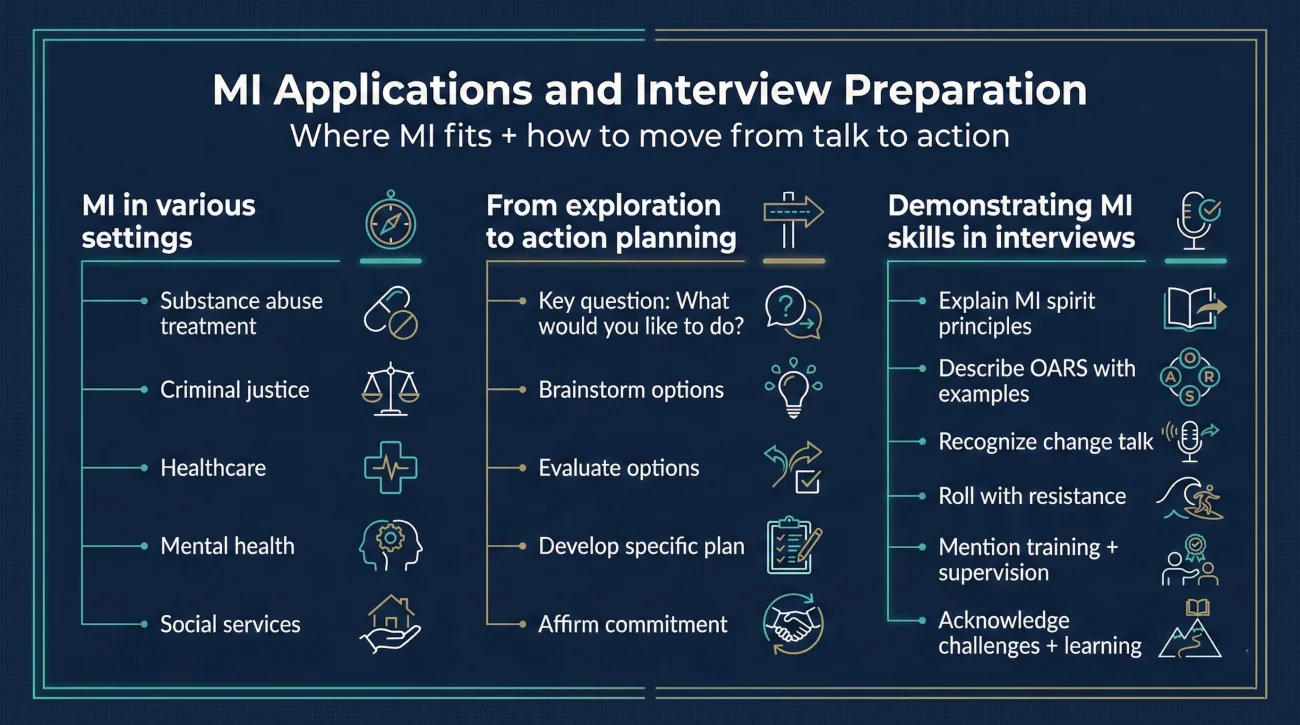
MI in Various Settings
Core MI principles adapt to specific populations and change targets while maintaining essential spirit.
- Substance abuse treatment: Exploring ambivalence about continued use, recovery commitment, treatment engagement
- Criminal justice: Addressing criminal thinking, supporting reintegration plans, increasing program compliance
- Healthcare: Medication adherence, lifestyle changes (diet, exercise), managing chronic conditions
- Mental health: Engaging resistant clients, addressing treatment ambivalence, supporting therapy goals
- Social services: Child welfare compliance, housing stability behaviors, employment preparation
From Exploration to Action Planning
Once sufficient change talk emerges and commitment strengthens, MI supports concrete goal development.
- 🎯 Key question: “What would you like to do?” invites client to propose action
- 📋 Brainstorm options: Generate multiple possibilities before committing to specific plan
- ⚖️ Evaluate options: Explore pros/cons of each option together, supporting informed choice
- ✅ Develop specific plan: Move from general intention to concrete steps with timelines
- 🤝 Affirm commitment: Reflect commitment language, celebrate decision, express confidence
Demonstrating MI Skills in Interviews
Interviews assess MI competency through role-plays, scenarios, or methodology discussion.
- Explain MI spirit principles in own words, distinguishing from advice-giving or confrontation
- Describe OARS skills with specific examples from experience or hypothetical scenarios
- Discuss how you recognize change talk and what you do when hearing it
- Share example of rolling with resistance rather than confronting client defensiveness
- Mention MI training completed (workshops, certification, supervision) and ongoing skill practice
- Acknowledge MI challenges: when it’s difficult, common mistakes you’ve made, continued learning needs
For comprehensive counseling frameworks and behavioral health interview preparation, explore our detailed mental health and addiction career resources.
❓ FAQ
🎯 What if client has no motivation to change at all?
MI doesn’t create motivation from nothing but amplifies existing motivation however small. Everyone has some ambivalence: find the tiny part that sees problems with status quo even while larger part resists change. Ask about downsides of current behavior, times when problem caused issues, ways life might be different. If genuinely zero motivation exists (rare), MI focuses on building relationship and planting seeds rather than forcing change discussion. Sometimes best outcome is client feeling heard and willing to return later when readiness increases.
💼 Isn’t MI too passive when clients need direct confrontation?
Research shows confrontation typically increases resistance rather than motivation. MI isn’t passive: it’s strategic. You actively guide conversation toward change talk while respecting autonomy. MI doesn’t mean accepting continued harm: you can be clear about concerns while avoiding argumentation. For mandated clients, MI acknowledges limited choice (“You have to be here, but what you share is up to you”) while exploring what they might want for themselves beyond legal requirements. Directiveness and MI spirit aren’t opposites: you provide structure while client provides content.
⏰ How long does MI take to learn?
Basic MI understanding comes from workshops (8-16 hours), but proficiency requires ongoing practice with feedback. Learning curve involves: (1) Understanding spirit and principles intellectually, (2) Recognizing MI/non-MI interactions in recordings, (3) Using OARS skills consciously but awkwardly, (4) Integrating MI naturally in conversations, (5) Adapting MI flexibly across situations. Most practitioners need 6-12 months regular practice with supervision developing solid competence. Consider MI as skill refined over career, not mastered quickly. Seek ongoing training, coaching, and feedback preventing drift back to old habits.
📋 Can I use MI with mandated or involuntary clients?
Yes, MI particularly useful with mandated clients precisely because coercion increases resistance. Acknowledge explicitly: “You didn’t choose to be here. Given that you have to attend, what might you want to get from our time together?” Separate mandated requirements (attendance, drug testing) from internal motivation for personal change. Explore how completing program requirements might serve their own goals beyond satisfying court. MI respects autonomy even in constrained situations by focusing on choices they do have within limited options.
✨ How do I show MI competency in interviews without extended role-play?
Describe MI spirit distinctively (partnership, acceptance, compassion, evocation), explain OARS acronym with brief examples, define change talk and give example of recognizing it, discuss rolling with resistance concept. Share real scenario: ambivalent client, how you used MI approach, what changed in conversation. Mention specific MI training (workshops, books, certification) and supervision received. Demonstrate understanding that MI is more than technique: it’s relational stance visible in how you think about and describe clients. Avoid claiming MI expertise unless genuinely trained: interviewers familiar with MI spot superficial understanding quickly.
Final Thoughts
Mastering motivational interviewing requires genuine commitment to MI spirit principles, consistent practice of OARS communication skills, careful attention to change talk recognition and reinforcement, and patient tolerance for ambivalence as normal change process rather than counselor failure. Effective MI practitioners suppress the righting reflex, trust client wisdom, and facilitate self-discovery rather than imposing expert solutions.
⚠️ Disclaimer: The interview strategies, sample answers, and negotiation tips provided in this guide are for educational purposes only. Hiring decisions are subjective and vary by company and industry. While these strategies are based on professional HR standards, they do not guarantee a specific job offer or result.