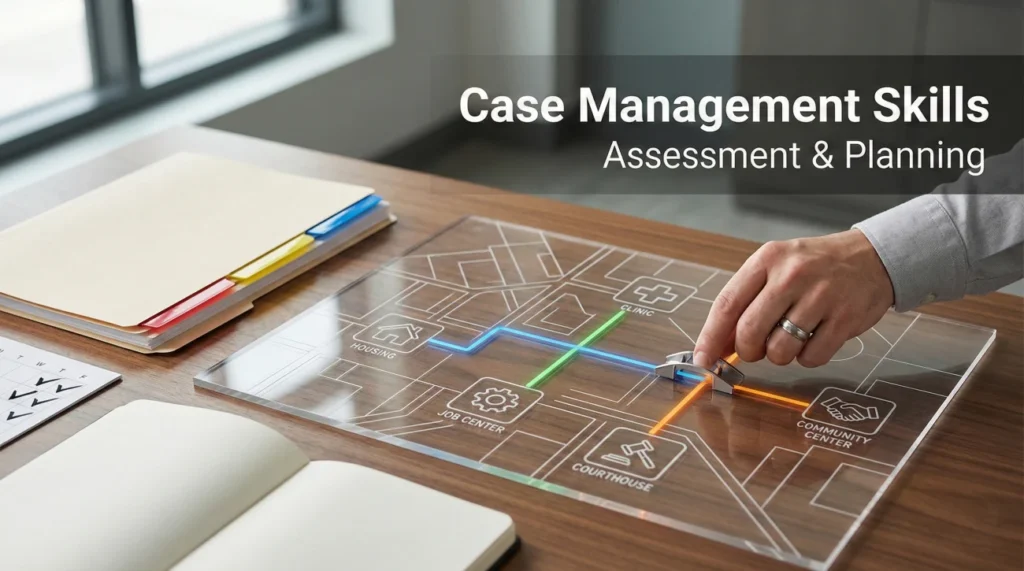
- What Case Management Is: A structured way to assess needs, build a plan, connect services, track progress, and close cases responsibly across social work, healthcare, justice, and community programs.
- Intake And Assessment: Start with rapport, eligibility, urgency and baseline documentation, then assess life domains (basic needs, health, supports, work, legal, safety) while using a strengths-based lens.
- Care Planning That Works: Convert findings into client-owned SMART goals, break them into clear action steps, anticipate barriers, assign responsibilities, and stay culturally aware so goals fit the client’s context.
- Monitoring And Coordination: Review goals regularly, track service engagement, watch for crises, reassess when situations change, and coordinate providers with consent so clients do not fall through system gaps.
- Documentation And Closure: Record observable facts and key quotes, then close cases with clear readiness criteria, advance notice, relapse prevention planning, resource handoffs, and a final summary that supports safe transitions.
The Case Management Process
Effective case management skills enable coordinating comprehensive services for clients navigating complex systems: assessing needs systematically, developing achievable plans, connecting with appropriate resources, monitoring progress toward goals, and determining appropriate case closure. Case management appears across social work, healthcare, criminal justice, and community services requiring adaptable core competencies.
This guide establishes foundational case management methodology. You’ll learn systematic intake and assessment procedures, collaborative care planning approaches, progress monitoring and documentation strategies, resource coordination techniques, and appropriate case closure processes.
Intake and Comprehensive Assessment
Case management begins with thorough assessment establishing baseline understanding of client needs, strengths, and barriers.
Initial Intake Procedures
Intake creates first impression while gathering essential information determining service eligibility and urgency.
| Intake Component | Purpose | Key Activities |
|---|---|---|
| Rapport building | Establish trust enabling honest disclosure, reduce anxiety about seeking help | Warm greeting, active listening, explaining confidentiality, demonstrating respect, managing initial concerns |
| Presenting issue identification | Understand why client seeking services now, what they hope to achieve | Open-ended questions, clarification, identifying immediate crisis, capturing client perspective |
| Eligibility screening | Determine if client meets program requirements, identify appropriate services | Verify demographics, income, jurisdiction, specific criteria, document eligibility basis |
| Urgency assessment | Triage needs, identify immediate safety concerns requiring rapid intervention | Screen for danger to self/others, basic needs gaps, crisis situations, determine priority level |
| Initial documentation | Create baseline record, ensure accurate information, establish accountability | Demographic data, contact information, referral source, presenting concerns, initial impressions |
Holistic Needs Assessment
Thorough assessment examines multiple life domains identifying interconnected needs and available strengths.
- 🏠 Basic needs: Housing stability, food security, utilities, transportation, financial resources
- 🏥 Health and wellness: Physical health, mental health, substance use, medications, healthcare access
- 👥 Social support: Family relationships, social networks, community connections, isolation risk
- 💼 Employment and education: Current employment, job skills, educational background, training needs
- ⚖️ Legal issues: Criminal justice involvement, civil legal problems, immigration status, protective orders
- 🛡️ Safety concerns: Domestic violence, elder abuse, child safety, neighborhood dangers, exploitation risk
Strengths-Based Assessment
Identifying client strengths, resources, and protective factors prevents deficit-focused approach undermining empowerment.
- Personal strengths: Resilience, coping skills, motivation, problem-solving ability, personal qualities
- Support systems: Helpful family members, friends, community connections, faith community, mentors
- Environmental resources: Safe housing, stable employment, accessible services, supportive neighborhood
- Past successes: Challenges previously overcome, skills demonstrated, achievements accomplished
- Cultural assets: Cultural identity strengths, community resources, traditional practices, cultural wisdom
💡 Pro tip: Avoid assessment paralysis conducting exhaustive evaluations before any service delivery. Balance thorough assessment with providing immediate help addressing urgent needs. Clients disengage when endless questions precede tangible assistance. Conduct core assessment first addressing immediate concerns, then gather additional information over time as relationship develops and trust builds.
Expert advice: Never assume assessment captures complete truth: clients withhold information initially due to shame, fear, or testing trustworthiness. View assessment as ongoing process, not one-time event. As relationship strengthens, clients often disclose information radically changing case understanding. Stay curious, revisit assessment periodically, notice discrepancies requiring gentle exploration, and remain open to evolving picture of client situation.
Collaborative Care Planning
Effective care plans translate assessment findings into actionable goals and concrete steps developed collaboratively with clients.
Developing SMART Goals
Well-constructed goals provide clear direction while enabling objective progress measurement.
| SMART Element | Definition | Example Application |
|---|---|---|
| Specific | Clearly defined, concrete, unambiguous | Not “improve housing” but “secure stable apartment lease in safe neighborhood” |
| Measurable | Observable indicators showing progress or achievement | “Attend 3 job interviews per week” enables counting, tracking |
| Achievable | Realistic given client capacity, resources, and timeframe | Client with GED pursuing entry-level job, not CEO position immediately |
| Relevant | Aligned with client priorities, addressing actual needs | Client wants reunification with children, so parenting classes relevant |
| Time-bound | Specific deadline creating urgency and accountability | “Complete substance abuse treatment within 90 days” vs. vague “eventually” |
Breaking Goals into Action Steps
Large goals overwhelm clients unless broken into manageable steps with clear responsibilities.
- Sequential ordering: Identify prerequisite steps (obtain ID before applying for housing assistance)
- Responsibility assignment: Clarify who does what (client completes application, case manager schedules appointment)
- Barrier anticipation: Identify potential obstacles and mitigation strategies proactively
- Resource identification: List specific services, organizations, individuals needed for each step
- Timeline establishment: Set realistic deadlines for each action maintaining momentum
Ensuring Client Buy-in
Plans developed without genuine client participation often fail due to lack of ownership and motivation.
- 🎯 Client-driven priorities: Start with client’s stated goals, not case manager’s agenda
- 💬 Collaborative language: “What do you think would help?” not “You need to do this”
- ⚖️ Realistic expectations: Discuss honestly what’s achievable, avoid promising unrealistic outcomes
- 🔄 Flexibility provision: Allow plan modifications as circumstances change or barriers emerge
- ✅ Incremental wins: Include early achievable goals building confidence through success
Beware cultural assumptions about appropriate goals: independent living highly valued in some cultures but less so in others emphasizing family interdependence. Financial self-sufficiency may conflict with cultural values about elder support or collective resource sharing. Explore cultural context of client’s goals, avoid imposing dominant culture values disguised as professional standards.
Progress Monitoring and Service Coordination
Ongoing monitoring ensures plans remain relevant while coordination prevents service gaps and duplication.
Systematic Progress Monitoring
Regular review enables timely plan adjustments preventing stagnation or unnoticed deterioration.
| Monitoring Element | Frequency | Assessment Focus |
|---|---|---|
| Goal achievement review | Monthly or quarterly depending on case intensity | Progress toward goals, barriers encountered, successes achieved, needed adjustments |
| Service utilization tracking | Ongoing with each client contact | Attendance at referrals, completion of tasks, engagement level, satisfaction with services |
| Crisis monitoring | Continuous vigilance during contacts | Safety concerns, mental health status, substance use, housing stability, new emergencies |
| Formal reassessment | Every 6-12 months or when significant changes occur | Comprehensive needs review, updated strengths assessment, goal revision, closure consideration |
| Documentation updates | After every contact and monthly summaries | Contact notes, progress documentation, service coordination, plan modifications |
Coordinating Multiple Services
Effective coordination prevents clients from falling through cracks between systems while avoiding duplicative services.
- Release of information: Obtain proper consent before sharing information with other providers
- Communication protocols: Establish regular contact with key service providers, share relevant updates
- Team meetings: Convene multidisciplinary staffings for complex cases requiring coordination
- Role clarification: Define who handles what preventing duplication and confusion
- Transition planning: Ensure warm handoffs when transferring cases or closing services
Professional Documentation
Quality documentation serves multiple critical functions beyond bureaucratic compliance.
- 📋 Continuity of care: Enables other professionals to understand case quickly if you’re unavailable
- ⚖️ Legal protection: Documents decision-making, actions taken, mandated reporting, professional judgment
- 📊 Outcome measurement: Demonstrates effectiveness, supports program evaluation, justifies funding
- 🔍 Supervision tool: Allows supervisors to review case management quality, provide guidance
- 💼 Accountability evidence: Shows compliance with professional standards, funder requirements, policies
Expert advice: Document behavior and observable facts, not interpretations or judgments. Write “Client appeared agitated, spoke rapidly, paced during session” not “Client was manic.” Record what client said verbatim for important statements: “Client stated ‘I can’t take this anymore'” vs. “Client expressed hopelessness.” Factual documentation protects you legally while judgmental language creates liability and reduces credibility if records scrutinized.
Case Closure and Transitions
Appropriate case closure ensures clients transition successfully while preventing premature termination or prolonged dependency.
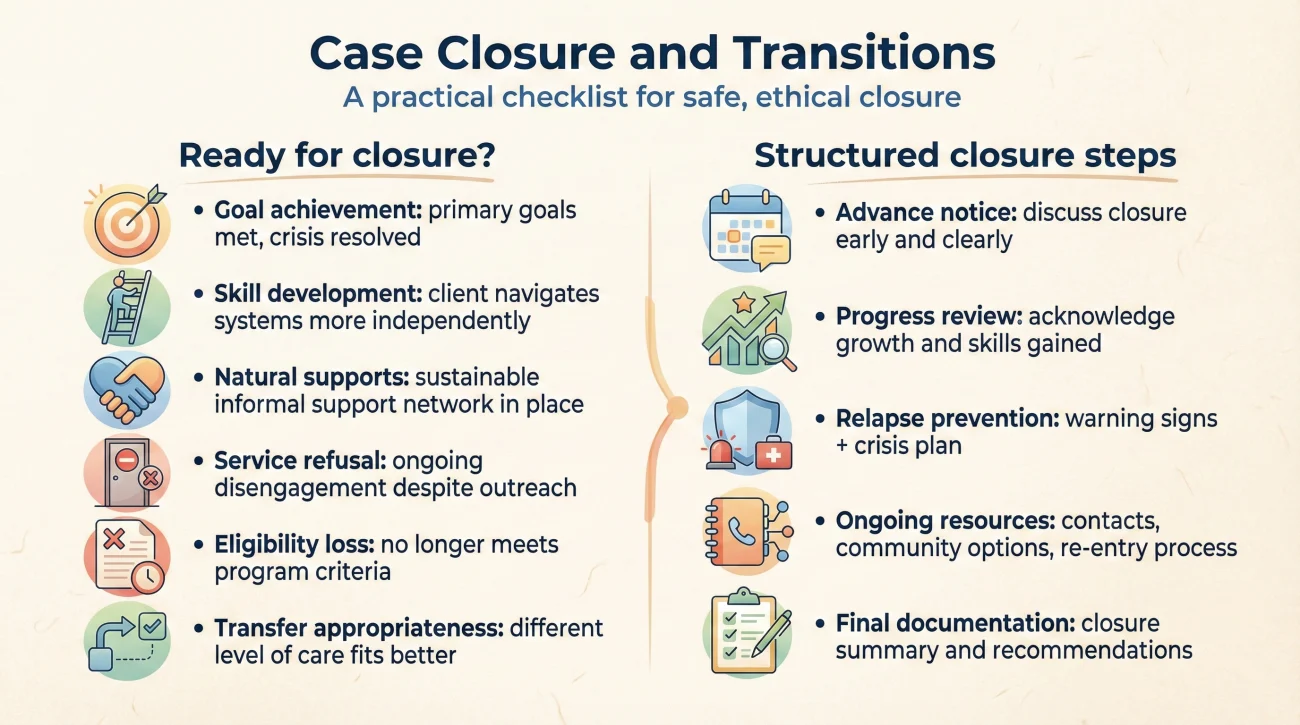
Determining Readiness for Closure
Multiple indicators suggest case closure appropriateness, balancing client independence with ongoing needs.
- Goal achievement: Primary goals met, client stabilized, crisis resolved
- Skill development: Client demonstrates ability to navigate systems independently
- Natural supports: Sustainable informal support networks established reducing professional service need
- Service refusal: Client consistently disengages despite outreach attempts
- Eligibility loss: Client no longer meets program criteria (income increase, moved out of area)
- Transfer appropriateness: Different level or type of care better suits current needs
Structured Closure Procedures
Thoughtful closure prevents abrupt termination damage while celebrating achievements and preparing for independence.
- 🗣️ Advance notice: Discuss closure proactively, avoid surprise termination triggering abandonment feelings
- 🎯 Progress review: Acknowledge achievements, identify skills gained, celebrate growth
- 📋 Relapse prevention: Develop crisis plan, identify warning signs, establish help-seeking strategies
- 🔗 Ongoing resources: Provide list of community resources, emergency contacts, future re-entry procedures
- ✅ Final documentation: Complete closure summary, discharge planning, outcomes achieved, recommendations
Demonstrating Case Management Skills in Interviews
Interviews assess case management competence through scenario questions and methodology discussion.
- Describe systematic case management process you follow from intake through closure
- Share complex case example highlighting assessment, planning, coordination, problem-solving
- Discuss how you balance client self-determination with professional responsibility
- Explain documentation approach ensuring compliance while maintaining efficiency
- Describe handling client who isn’t progressing toward goals, your intervention approach
- Give example of successful case closure and how you prepared client for transition
For comprehensive social work interview frameworks and case management scenarios, explore our extensive social services career resources.
❓ FAQ
🎯 How do I manage large caseloads effectively?
Prioritize based on urgency and risk: clients in crisis get immediate attention, stable cases receive less frequent contact. Use efficient documentation systems (templates, mobile recording). Leverage technology (automated reminders, email communication). Develop strong referral network doing specialized work. Set realistic boundaries about after-hours availability. Triage continuously rather than treating all cases identically. Communicate honestly with supervisor when caseload exceeds safe management, advocating for resources rather than quietly drowning.
💼 What if client goals conflict with program requirements?
Explore whether creative solutions can address both. If not, explain program requirements transparently: “I understand you want X, but program rules require Y. Let’s discuss how Y might actually help you achieve X in different way.” Sometimes clients need education about why requirements exist. When genuine conflict persists, help client access different services better matching their goals rather than forcing fit. Document thoroughly when client chooses not to comply with requirements, protecting yourself while respecting autonomy.
⏰ How often should I reassess cases?
Formal reassessment typically every 6-12 months or when significant changes occur (crisis, goal achievement, service refusal). Informal monitoring happens every contact: notice changes, ask about progress, observe warning signs. High-risk cases need more frequent formal review. Program requirements often dictate minimum reassessment frequency. Balance thoroughness with burden on clients: excessive assessments feel bureaucratic and damage rapport. Focus ongoing assessment on specific concerns rather than repeating entire intake evaluation unnecessarily.
📋 How detailed should documentation be?
Document enough that colleague reading note understands current status, recent contacts, immediate concerns, and next steps without prior case knowledge. Include: date, contact method, who participated, topics discussed, client statements about progress/concerns, services provided/coordinated, plan for next contact. Omit: irrelevant personal details, excessive verbatim conversation, speculation, judgmental language. Remember documentation may be subpoenaed or shared with clients: write professionally assuming it could become public.
✨ How do I demonstrate case management skills without violating confidentiality?
Discuss cases in general terms without identifying details: “I worked with family experiencing housing instability and substance abuse issues. I conducted comprehensive assessment revealing…” Use composite examples combining elements from multiple cases. Focus on your methodology, decision-making process, and skills demonstrated rather than dramatic case details. Interviewers assess professional competence, not entertainment value of stories. Sanitized examples highlighting systematic approach and professional judgment prove your capabilities while maintaining ethical boundaries.
Final Thoughts
Mastering case management skills requires systematic assessment methodology, collaborative planning balancing client goals with professional judgment, diligent progress monitoring, effective service coordination, and appropriate closure processes. Strong case managers demonstrate organization and documentation discipline while maintaining genuine client relationships centered on empowerment rather than dependency.
⚠️ Disclaimer: The interview strategies, sample answers, and negotiation tips provided in this guide are for educational purposes only. Hiring decisions are subjective and vary by company and industry. While these strategies are based on professional HR standards, they do not guarantee a specific job offer or result.