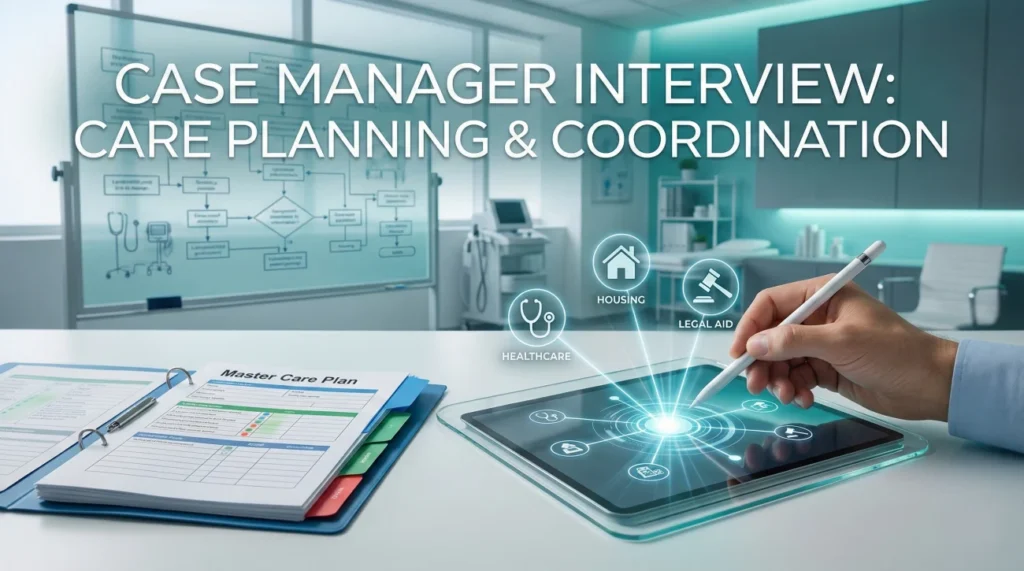
Whether in a bustling hospital, a community mental health center, or a homeless shelter, the Case Manager is the linchpin that holds a client’s care together. You are the navigator for individuals lost in the labyrinth of healthcare, housing, and social services. Your role is not just to provide a service but to coordinate an entire ecosystem of support around the client, ensuring they do not fall through the cracks.
Hiring managers for case management roles are looking for organizational wizards who can juggle high caseloads without losing their humanity. They need to know you can write a SMART goal that actually motivates a client, that you can advocate effectively with stubborn insurance companies, and that you can handle the emotional weight of witnessing chronic struggle. The interview will test your ability to prioritize, your knowledge of community resources, and your resilience.
To secure the job, you must be ready to answer case manager interview questions that delve into your assessment techniques, your approach to difficult clients, and your mastery of documentation. This guide provides the detailed, practical answers you need to demonstrate that you are the steady hand capable of guiding clients from crisis to stability.
Assessment and Care Planning
Q: Walk me through your process for developing a comprehensive care plan.
A care plan is a living document, not a form to be filed. My process begins with a thorough needs assessment, covering medical, psychological, social, and financial domains. I engage the client as a partner; the plan must be theirs, not mine. We identify their top priorities first. Then, I translate those priorities into SMART goals (Specific, Measurable, Achievable, Relevant, Time-bound). For example, instead of “Get housing,” the goal is “Complete three housing applications by Friday.” I assign clear responsibilities: what I will do (provide the list) and what they will do (fill them out). I also include a crisis plan and a review date to adjust the plan as progress is made.
Q: How do you prioritize a caseload of 40+ clients?
I use a triage system based on acuity and deadlines. I categorize clients into three tiers: Crisis (immediate safety/medical needs), Urgent (pending evictions, court dates, discharge deadlines), and Stable/Maintenance (routine check-ins). I start my day by scanning for crises. I then block out time for the Urgent tier tasks that have hard deadlines. I use technology – calendar alerts and task lists – ruthlessly. I also batch similar tasks; if I need to call the housing authority, I do it for five clients at once. I review my “Stable” clients weekly to ensure they don’t slide into crisis due to neglect. Prioritization is a dynamic, daily process.
Q: What is your approach to “Discharge Planning”?
Discharge planning starts on day one. I view my role as working myself out of a job. From the first meeting, we discuss what “success” looks like and what needs to be in place for the client to function independently. I identify the necessary community supports – primary care, support groups, transportation – early on. I test these links before discharge; I don’t just hand them a phone number, I ensure they have an appointment scheduled. I also educate the client on warning signs of relapse or regression and who to call. A good discharge plan is a bridge, not a cliff.
Q: How do you handle a client who refuses to follow the care plan?
I refrain from labeling them “non-compliant.” Instead, I get curious. Resistance usually stems from fear, lack of understanding, or a barrier I missed. I ask open-ended questions: “What gets in the way of making that appointment?” Maybe they don’t have gas money, or they are terrified of doctors. Once I identify the barrier, we can problem-solve. Maybe the goal was too big and we need to break it down. Or maybe the goal wasn’t truly theirs. I re-align the plan with their actual motivation. If safety isn’t an issue, I respect their right to self-determination, even if it means progress is slower than I’d like.
Resource Coordination and Advocacy
Q: How do you build and maintain relationships with community resource providers?
Networking is essential. I don’t just call when I need something. I attend community coalition meetings to meet providers face-to-face.
I visit their facilities to understand their intake process and eligibility criteria so I don’t send them inappropriate referrals. When I do refer a client, I send a warm handoff email or make a call. If a provider goes above and beyond, I send a thank-you note. By building a reputation as a professional, prepared case manager, my clients often get faster responses because the providers trust my judgment.
Q: Describe a time you advocated for a client who was denied a service.
I had a client denied a specific medication by insurance. I didn’t accept the “no.” I reviewed the denial letter and the policy criteria.
I gathered the medical records that proved the client met the “medical necessity” criteria. I wrote a detailed appeal letter citing the specific clinical data and the cost-effectiveness of this treatment versus hospitalization. I also coached the client on how to call member services. We won the appeal. Advocacy is about persistence and speaking the language of the system.
Q: How do you handle a gap in services, like a waitlist for housing?
Waitlists are a reality. I manage expectations honestly: “The list is six months long.” I don’t give false hope.
While we wait, we work on “interim” stability. We explore temporary options like shelters or staying with family. We use the time to gather all necessary documents (ID, birth certificate, proof of income) so when their name comes up, we are ready instantly. We also work on soft skills like budgeting so they are prepared to maintain the housing once they get it.
Q: What is your experience with “Utilization Review” (UR)?
In healthcare, UR is critical. It involves communicating with insurance companies to justify the client’s stay or treatment. I ensure my documentation clearly reflects the “medical necessity” or “clinical severity” required for that level of care.
I know the difference between “observation” and “inpatient” status. I proactively update the payer with progress notes to prevent denial of payment. If a denial happens, I coordinate the peer-to-peer review between the doctor and the insurance medical director.
Q: How do you coordinate care for a client with “dual diagnosis” (mental health and substance use)?
I use an integrated care model. Treating one without the other fails. I coordinate communication between the psychiatrist and the addiction counselor to ensure medications are safe and recovery goals align.
I advocate for “harm reduction” if abstinence isn’t yet achieved. I ensure the housing placement is supportive of recovery (e.g., sober living). I educate the client on how substance use impacts their mental health symptoms, helping them see the connection.
Q: How do you help a client navigate the Social Security Disability (SSDI/SSI) application?
The application is daunting. I help them gather the medical evidence, which is the most critical part. I ensure we have records from all providers.
I help them complete the function report, coaching them to describe their “worst day,” not their best day, as the system assesses inability to work. If denied (which is common initially), I help them file the appeal immediately. I might connect them with a specialized disability attorney if the case is complex.
Scenarios and Crisis Intervention
A client calls you in crisis on a Friday afternoon stating they have no food for the weekend. What do you do?
I assess the immediate need. I check my list of emergency food pantries open on weekends or late Fridays. If I have access to agency petty cash or vouchers, I use them.
I might help them apply for emergency expedited food stamps if eligible. I also ask, “What happened to this month’s budget?” not to judge, but to problem-solve for next month. I ensure they have a plan for Saturday and Sunday. I document the intervention and set a reminder to follow up on Monday for a longer-term food security plan.
You have a client who is frequently readmitted to the hospital (a “frequent flyer”). How do you break the cycle?
I look for the root cause of the readmissions. Is it medication non-compliance? Loneliness? Homelessness? Often, they return because their social needs aren’t met.
I would convene a multi-disciplinary meeting with the client. We would create a very tight discharge plan. Maybe they need a visiting nurse to manage meds, or a companion service to address isolation. I would increase the frequency of my post-discharge check-ins. I aim to solve the underlying social determinant of health that is driving the medical crisis.
A client’s family member calls demanding information, but you don’t have a release form. How do you handle it?
I stick to HIPAA strictly. I cannot confirm or deny that the person is my client. I say, “I cannot discuss any client information without a signed release.”
However, I can listen. I say, “If you want to share information that might be helpful for the care team, I can listen, but I cannot comment or answer questions.” I then note the information. Afterward, I ask the client if they want to sign a release for that family member, explaining the pros and cons.
You suspect a client is being financially exploited by a caregiver. What do you do?
As a mandated reporter, I must report suspected elder or dependent adult abuse. I gather the facts: missing money, unpaid bills, sudden changes in wills.
I call Adult Protective Services (APS) to make a report. I do not confront the caregiver directly, as that might endanger the client. I document my observations carefully. I also look for ways to protect the client’s assets immediately, perhaps by involving a trusted family member or a representative payee program if appropriate.
Documentation and Professionalism
Q: Why is documentation important in case management?
Documentation serves three purposes: clinical continuity, legal protection, and billing justification. Clinically, it allows any team member to pick up the case and know exactly what is happening. Legally, it proves I met the standard of care; “if it isn’t documented, it didn’t happen.” Financially, it justifies the services to the payer (insurance or grant). I write notes that are clear, objective, and timely. I avoid subjective labels like “manipulative” and describe behaviors instead. My notes tell the story of the client’s progress and my interventions.
Q: How do you handle boundaries when working in the community?
Community work blurs lines, so I have to be vigilant. If I see a client at the grocery store, I do not approach them to protect their confidentiality. If they approach me, I am friendly but brief. I do not give out my personal cell number; I use a work phone or Google Voice. I do not accept friend requests on social media. I explain these boundaries at intake: “I care about you, but our relationship is professional. This protects your privacy and allows me to be an effective advocate.”
Q: How do you practice cultural competence with diverse clients?
I practice cultural humility. I don’t assume I know a client’s culture; I ask. “How does your family view mental health?” “Are there cultural traditions that are important to your healing?” I use interpreters, not family members, for language barriers to ensure accuracy and confidentiality. I educate myself on the historical trauma or systemic barriers facing specific populations I serve. I treat the client as the expert on their own life and culture.
Q: How do you stay organized with paperwork and deadlines?
I use a “tickler” system or digital task manager. I set reminders for deadlines (like recertification for benefits) weeks in advance, not the day of. I schedule “admin time” on my calendar and treat it like a client appointment – uninterruptible. I keep my files audit-ready at all times, filing documents immediately rather than letting them pile up. Organization reduces my stress and ensures my clients don’t lose benefits due to my administrative error.
Case Management Knowledge Quiz
20 Practice Questions
1. What does “SMART” stand for in goal setting?
- Simple, Manageable, Active, Real, Timely
- Specific, Measurable, Achievable, Relevant, Time-bound
- Standard, Medical, Action, Review, Test
- Safe, Meaningful, Approved, Realistic, True
2. “Triage” means:
- Treating everyone equally
- Sorting based on urgency/severity
- Billing three times a day
- Trying three different solutions
3. Which is a form of “Harm Reduction”?
- Demanding total abstinence immediately
- Providing clean needles to prevent HIV
- Kicking a client out for relapse
- Ignoring the substance use
4. “Recidivism” refers to:
- Recovery from illness
- Relapse into criminal behavior/hospitalization
- Receiving benefits again
- Refusing medical advice
5. What is a “warm handoff”?
- Giving a client a brochure
- Introducing client directly to new provider
- Closing a case happily
- Transferring a call quickly
6. “ADLs” stands for:
- Advanced Directives for Life
- Activities of Daily Living
- Adult Disability Laws
- Active Daily Logs
7. Which document authorizes you to share info?
- The care plan
- Release of Information (ROI)
- The intake assessment
- The discharge summary
8. “Wrap-around services” are:
- Wrapping a gift for a client
- Comprehensive, holistic support services
- Services that end quickly
- Medical bandages only
9. What is “Section 8”?
- A mental health hold
- Housing Choice Voucher Program
- A type of disability benefit
- A legal discharge clause
10. “Continuity of Care” ensures:
- Care stops when funding ends
- Seamless transition between providers
- The same doctor forever
- Medication never changes
11. A “payee” is someone who:
- Pays the case manager
- Manages money for a beneficiary
- Receives the disability check
- Audits the agency finances
12. “Motivational Interviewing” helps with:
- Filling out forms faster
- Resolving ambivalence to change
- Diagnosing mental illness
- Getting a job interview
13. Which is a “Social Determinant of Health”?
- Genetic DNA code
- Housing stability / Zip code
- Blood pressure reading
- Hospital visitation hours
14. “Person-Centered Planning” means:
- The professional decides the plan
- The client leads the planning process
- The plan focuses on personality
- One person does all the work
15. “Burnout” prevention requires:
- Working harder and longer
- Boundaries and self-care
- Ignoring difficult clients
- Changing careers often
16. “Advocacy” involves:
- Completing forms for the client
- Speaking up for client rights
- Giving money to the client
- Making decisions for the client
17. A “Genogram” maps:
- Genetic diseases only
- Family relationships and patterns
- Geographic location of services
- General health history
18. “Empowerment” means:
- Doing everything for the client
- Helping clients help themselves
- Having power over the client
- Giving power to the agency
19. Which act protects health info?
- FERPA
- HIPAA
- OSHA
- ADA
20. “Crisis Intervention” focuses on:
- Deep psychological analysis
- Immediate stabilization and safety
- Long-term career planning
- Past childhood trauma
❓ Frequently Asked Questions
📜 Do I need a certification to be a case manager?
It depends on the setting. While a degree (BSW, nursing, psychology) is the entry ticket, certification like the CCM (Certified Case Manager) or ACM (Accredited Case Manager) is highly valued, especially in hospital and insurance settings. It demonstrates advanced knowledge and commitment to the field.
🏥 What is the difference between nurse case management and social work case management?
Nurse Case Managers (RNs) typically focus on the medical aspects: medication management, disease progression, and clinical discharge planning. Social Work Case Managers focus more on the psychosocial aspects: housing, finances, family dynamics, and community resources. In many teams, they work side-by-side.
💼 Is the job mostly field-based or office-based?
It varies. Hospital case managers are mostly building-based. Community case managers (homeless services, child welfare) spend 50-70% of their time in the field doing home visits and transporting clients. Telehealth case management is also growing.
💰 How stressful is the job?
It is high-stress. You are dealing with people in crisis, broken systems, and limited resources. However, it is also high-reward when you see a client succeed. Success requires strong boundaries, good time management, and a supportive team environment.
🚀 What are the career paths?
You can advance to Senior Case Manager, Program Director, or Clinical Supervisor. Some move into policy work, hospital administration, or specialized consulting. The skills of coordination and advocacy are transferable to many leadership roles.
The Bridge Builder
Case management is the art of building bridges over the gaps in our social safety net. It requires a rare mix of compassion, grit, and administrative savvy. When you walk into the interview, show them your organized mind and your resilient heart.
By preparing with these case manager interview questions, you demonstrate that you are ready to be the advocate, the planner, and the steady presence your clients need to navigate their journey to stability.
⚠️ Disclaimer: The interview strategies, sample answers, and negotiation tips provided in this guide are for educational purposes only. Hiring decisions are subjective and vary by company and industry. While these strategies are based on professional HR standards, they do not guarantee a specific job offer or result.