Defending Those the System Accuses
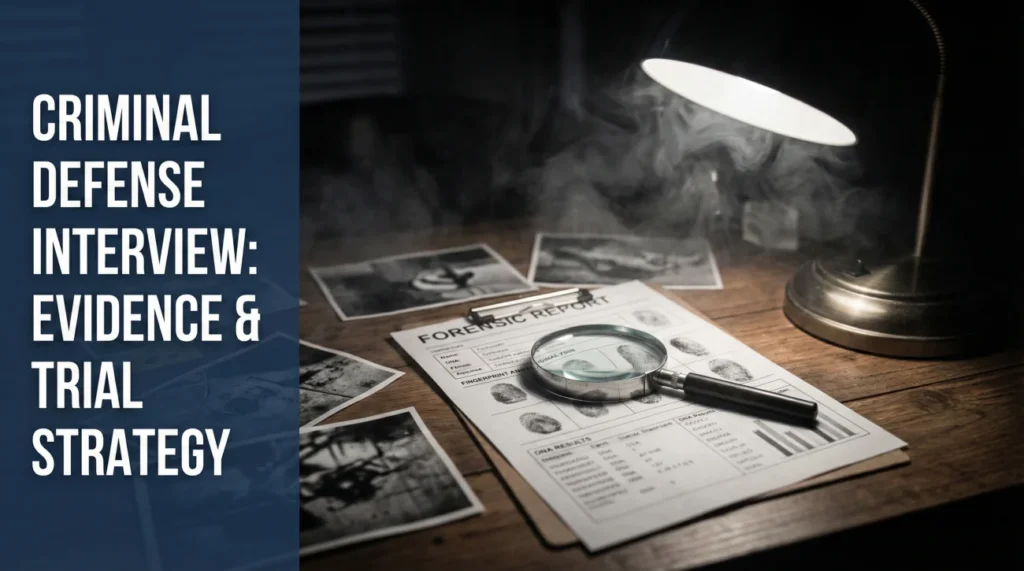
Criminal defense is adversarial by nature. You stand between the government’s power and someone facing loss of liberty. Criminal defense attorney interview questions test whether you can analyze evidence critically, identify constitutional violations, develop winning strategies, and advocate fiercely while maintaining ethical boundaries.
This guide covers evidence analysis and investigation, defense strategy development, constitutional rights and suppression, plea negotiation, and trial preparation.
Evidence Analysis & Investigation
Q: How do you approach reviewing the prosecution’s evidence?
I analyze every piece systematically, starting with charging documents and police reports. I identify what the prosecution must prove for each element. Then I examine whether their evidence establishes those elements or whether gaps create reasonable doubt.
I look beyond what evidence shows to how it was obtained. Chain of custody issues, forensic methodology flaws, and constitutional violations can undermine seemingly strong evidence. What looks damning at first often reveals weaknesses under scrutiny.
Q: Describe your approach to defense investigations.
I never rely solely on prosecution discovery. Police investigations often focus on building their theory rather than exploring alternatives. I identify witnesses police did not interview, questions they did not ask, and scenes worth visiting to understand physical context.
I work with investigators when resources permit. I look for surveillance footage, phone records, and social media that may support defense theories or undermine prosecution claims. Independent investigation frequently uncovers what police missed or ignored.
Q: How do you evaluate witness credibility?
I examine consistency between their statements, physical evidence, and other accounts. I consider relationships to the case: victims, co-defendants with plea deals, or independent witnesses? I look for motives to lie. Memory science shows even honest witnesses can be unreliable.
I prepare to impeach witnesses with questionable credibility. Prior inconsistent statements, criminal history, bias, and perception limitations provide cross examination material. But I also assess which witnesses juries will likely believe regardless of actual reliability.
Defense Strategy Development
Q: How do you develop a defense theory?
I identify where the prosecution’s case is weakest. Then I develop a narrative explaining evidence consistently with innocence or reduced culpability. The best theories account for all evidence, including unfavorable facts.
I consider multiple theories early and refine them as discovery progresses. Sometimes the strongest initial theory becomes less viable. I remain flexible while working toward a coherent story for trial.
Q: What defenses do you consider?
I start with whether prosecution can prove identity and each element beyond reasonable doubt. I examine constitutional violations warranting suppression. I consider affirmative defenses: self-defense, duress, entrapment, depending on charges and facts.
I evaluate lesser included offenses as fallback positions. Sometimes the goal is conviction on less serious charges. I discuss all options with clients so they make informed strategic decisions.
Q: How do you handle cases with overwhelming evidence?
Every case deserves vigorous defense. I scrutinize police procedures, forensic methods, and witness reliability. Constitutional violations can exclude devastating evidence. Procedural errors create grounds for dismissal.
I also focus on sentencing mitigation when conviction seems likely. Building a compelling narrative about the client, identifying mental health issues, and presenting rehabilitative potential significantly affect outcomes.
Q: How do you handle clients wanting unwise strategies?
I explain concerns clearly, including likely consequences. I ensure they understand risks. But fundamental decisions like pleading guilty or going to trial belong to clients. My role is informing that decision.
If clients insist on harmful strategies, I document my advice and their decision. I continue representing them zealously within ethical bounds. The exception is if they direct me to do something unethical.
Constitutional Rights & Suppression
What constitutional issues do you examine?
Fourth Amendment issues arise frequently. Was there probable cause for arrest? Did the search require a warrant? Was consent voluntary? Vehicle exceptions, plain view doctrine, and searches incident to arrest all have specific requirements I examine carefully.
Fifth Amendment concerns include statements during custodial interrogation without Miranda warnings. Sixth Amendment issues arise when law enforcement deliberately elicits statements after formal charges without counsel present.
Describe a successful suppression motion.
I represented a client charged with drug possession where officers claimed to smell marijuana from outside a closed vehicle. Body camera footage contradicted their timeline, showing they searched before the purported observation.
Cross examination exposed inconsistencies between reports and video evidence. The court granted suppression. Without physical evidence, the prosecution dismissed. The key was meticulous video review and timeline documentation.
How do you prepare for suppression hearings?
I analyze every document: police reports, warrant applications, body cameras, dispatch records, consent forms. I create detailed timelines showing what happened when. I research applicable law including recent cases.
I prepare cross examination exposing specific violations. I anticipate prosecution arguments and prepare responses. I ensure my client understands the hearing’s purpose and process.
Plea Negotiation & Trial
Q: How do you approach plea negotiations?
I negotiate from knowledge. I understand evidence, suppression issues, and likely trial outcomes. I know the prosecutor’s tendencies and judge’s sentencing patterns. I demonstrate that trial carries risk for both sides.
I explore creative resolutions: diversion programs, treatment alternatives, charge reductions avoiding collateral consequences. I never pressure clients. I present options with honest assessments and let them decide.
Q: How do you prepare clients to testify?
I explain that testifying is their decision, but ensure they understand implications. Prior convictions may come in. Cross examination can be brutal. Sometimes their testimony is essential. We discuss thoroughly.
When clients choose to testify, I prepare extensively. We rehearse direct examination. I conduct mock cross, often more aggressively than prosecutors will. I teach them to listen carefully and remain calm.
Q: What is your approach to jury selection?
I use voir dire to identify jurors biased against my client or the defense. I look for experiences predisposing jurors toward or against believing police, accepting defenses, or recognizing reasonable doubt.
I also introduce defense themes during voir dire. Questions about reasonable doubt and presumption of innocence start educating jurors. Those who commit to these principles during selection apply them in deliberations.
Criminal Defense Knowledge Check
20 Practice Questions
1. The exclusionary rule:
- Applies only to confessions
- Prevents use of evidence obtained through constitutional violations
- Is discretionary for judges
- Was eliminated recently
2. Miranda warnings are required:
- At the time of arrest
- Before custodial interrogation
- Only for felonies
- After charges are filed
3. Defense investigations should:
- Rely solely on prosecution discovery
- Explore alternatives police may have ignored
- Avoid prosecution witnesses
- Wait until plea negotiations fail
4. The decision to testify belongs to:
- The defense attorney
- The defendant
- The judge
- Both attorney and defendant jointly
5. Chain of custody challenges:
- Apply only to DNA evidence
- Question whether evidence may have been tampered with
- Are rarely successful
- Must be raised before trial
6. Fourth Amendment protections cover:
- Right to counsel
- Unreasonable searches and seizures
- Self-incrimination
- Speedy trial
7. Effective cross examination should:
- Ask open-ended questions
- Use leading questions to control testimony
- Continue until witness breaks down
- Avoid favorable admissions
8. When evidence appears overwhelming:
- Advise immediate guilty plea
- Scrutinize procedures and constitutional issues
- Provide minimal representation
- Focus only on sentencing
9. Plea negotiations should be:
- Avoided whenever possible
- Conducted with full case knowledge
- Accepted if prosecutor recommends
- Handled without client involvement
10. Sixth Amendment right to counsel attaches:
- At arrest
- After formal charges or indictment
- At trial only
- When defendant requests it
11. Defense theory should:
- Ignore unfavorable evidence
- Account for all evidence including unfavorable facts
- Be identical for every case
- Focus only on prosecution weaknesses
12. Voir dire serves to:
- Present evidence to jury
- Identify biased jurors and introduce themes
- Cross examine witnesses
- Request continuances
13. Witness credibility evaluation includes:
- Accepting testimony at face value
- Examining consistency, bias, and motives
- Ignoring prior statements
- Focusing only on demeanor
14. Preparing clients to testify requires:
- Telling them what to say
- Rehearsing direct and mock cross examination
- Minimal preparation
- Reviewing only favorable topics
15. Suppression motion success requires:
- General claims without specifics
- Detailed analysis of timeline and constitutional law
- Client testimony in every case
- Prosecutor agreement
16. Diversion programs:
- Are available for all offenses
- May avoid conviction through treatment
- Guarantee dismissal regardless of compliance
- Are decided by defense attorney alone
17. When clients want unwise strategies:
- Refuse to represent them
- Explain concerns, document, and respect their decision
- Proceed without informing of risks
- Override their wishes
18. Reasonable doubt:
- Must be eliminated by defense
- Is prosecution’s burden to overcome
- Applies only to identification
- Is defined identically everywhere
19. Body camera footage should be:
- Accepted as always accurate
- Compared carefully against written reports
- Viewed only if prosecution offers it
- Ignored if it supports prosecution
20. Collateral consequences include:
- Only the sentence imposed
- Immigration, licensing, and employment effects
- Nothing if probation granted
- Matters outside attorney responsibility
❓ FAQ
⚖️ How do public defenders differ from private defense?
Public defenders handle high caseloads serving indigent clients, developing broad experience quickly. Private attorneys typically have fewer cases with more resources. Both can provide excellent representation; the difference is primarily workload rather than skill.
🎓 What helps new attorneys enter criminal defense?
Prosecution experience provides system understanding. Law school clinics offer hands-on experience. Public defender internships provide courtroom exposure. Trial advocacy courses build skills. Any courtroom experience is valuable for entering this field.
💼 How do you represent clients you believe are guilty?
Every defendant deserves vigorous representation. The defense role ensures prosecution meets its burden, rights are protected, and process functions fairly. Belief about guilt does not change these obligations or the importance of this work.
📋 What are the most challenging aspects?
Emotional toll from difficult cases. Resource constraints, especially in public defense. Systemic biases disadvantaging defendants. Managing expectations when outcomes are unfavorable. Maintaining balance with demanding caseloads.
🏛️ How has criminal defense evolved recently?
Body cameras create new evidence requiring analysis. Digital evidence raises novel issues. Reform movements affect sentencing and diversion. Forensic standards are being reexamined. Wrongful conviction awareness increases evidence scrutiny.
Proving You Can Defend the Accused
Answering criminal defense attorney interview questions well means demonstrating analytical rigor, constitutional knowledge, and fierce advocacy. Prepare examples of evidence you challenged, strategies you developed, and outcomes you achieved. Show that you understand both technical legal work and the human stakes of defending someone’s liberty.
⚠️ Disclaimer: The interview strategies, sample answers, and negotiation tips provided in this guide are for educational purposes only. Hiring decisions are subjective and vary by company and industry. While these strategies are based on professional HR standards, they do not guarantee a specific job offer or result.