Different Medium, Different Rules
When you answer tell me about yourself in a phone interview, you’re operating under constraints that don’t exist in person. The interviewer can’t see your body language, your enthusiasm, or your professional appearance. They’re making judgments based entirely on what they hear. And phone screens are typically shorter than in-person interviews, so every second matters more.
Phone interviews serve a specific purpose: filtering candidates before investing time in longer in-person meetings. The screener is often checking basic qualifications and red flags rather than conducting deep evaluation. Your goal is to pass the screen by demonstrating clear fit without raising concerns.
A recruiter who conducts hundreds of phone screens shared her perspective: “In a phone screen, I’m listening for two things: does this person have the basic qualifications, and do they communicate clearly? I’m not evaluating deeply. I’m deciding whether it’s worth everyone’s time to bring them in. Candidates who ramble or can’t articulate their background clearly don’t make it through.”
Phone Interview Challenges
No Visual Cues
You can’t see the interviewer’s reactions. You don’t know if they’re engaged, confused, or checking email. This uncertainty can throw off your pacing and confidence. Adapt by checking in verbally: “Would it be helpful if I went deeper on that?” or “I’m happy to elaborate if that would be useful.”
Divided Attention
Phone interviewers might be multitasking. Your voice competes with whatever else is happening on their end. Being concise and clear matters even more because attention is fragile.
Building Connection
Without visual rapport, connection happens only through voice. Your tone, energy, and verbal engagement become your primary tools for making a positive impression.
Technical Issues
Phone quality varies. Background noise, poor connections, and audio delays can disrupt communication. Speak clearly and slightly slower than normal to accommodate potential quality issues.
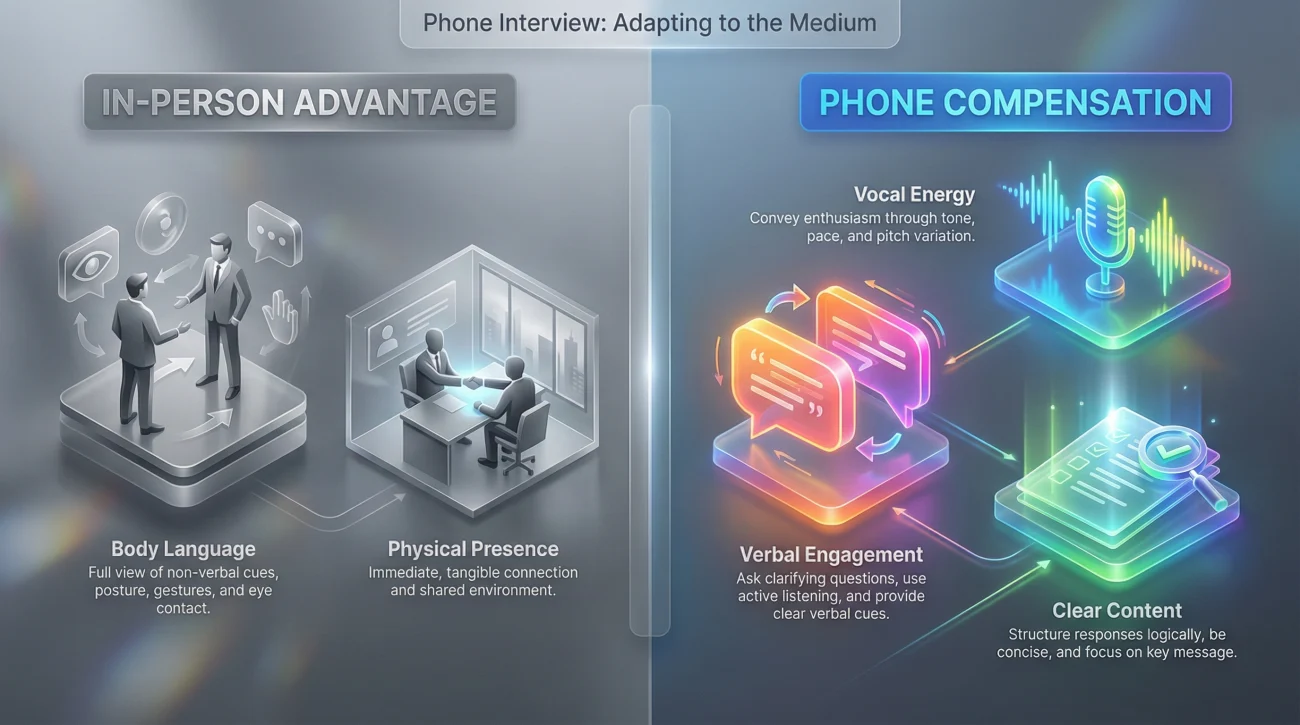
| In-Person Advantage | Phone Compensation |
|---|---|
| Body language | Vocal energy and expressiveness |
| Eye contact | Verbal engagement and acknowledgment |
| Professional appearance | Professional communication and tone |
| Real-time feedback | Periodic check-ins for engagement |
| Physical presence | Clear, memorable content |
The Phone Screen Approach
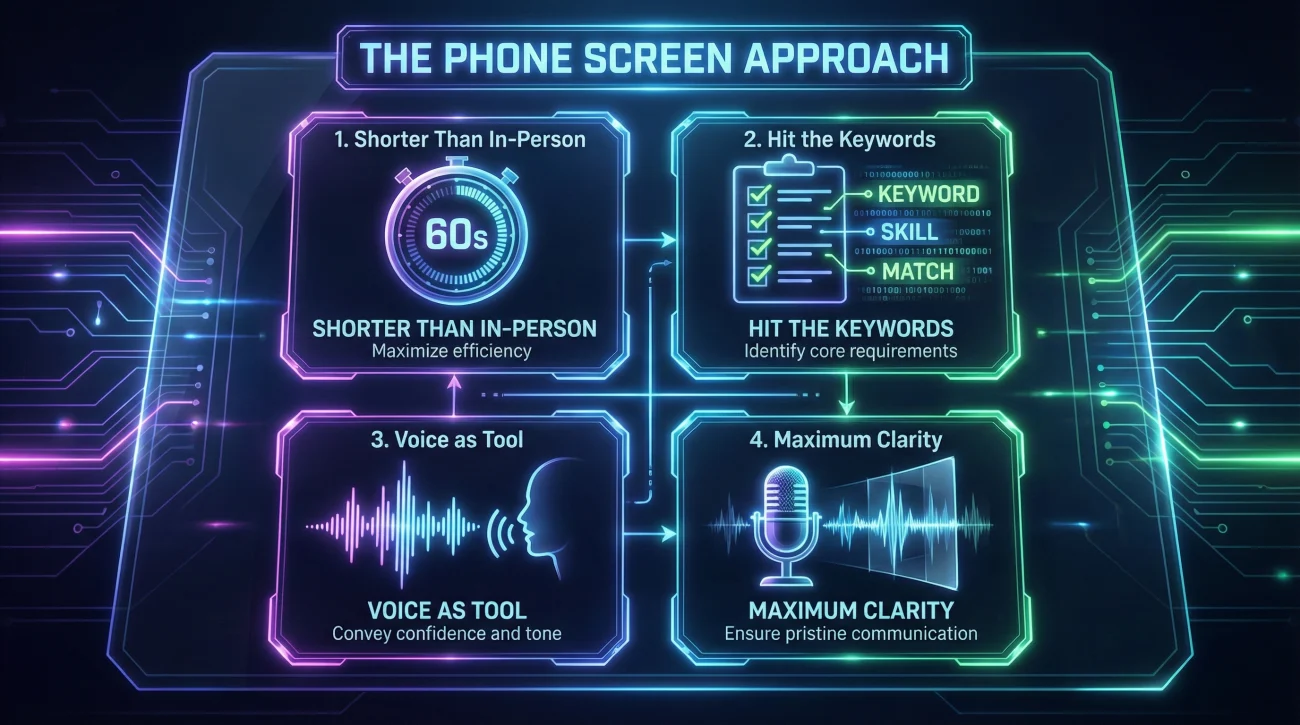
Shorter Than In-Person
Your phone introduction should be more concise than what you’d give in person. Aim for sixty seconds maximum, possibly shorter. Phone screens have less time overall, and attention fades faster without visual engagement.
Hit the Keywords
Screeners often have a checklist of qualifications. Make sure your introduction explicitly mentions the key requirements for the role. If they’re looking for five years of experience in project management, say “five years of experience” and “project management” clearly.
Voice as Tool
Your voice must carry all the energy and engagement that body language would provide in person. Smile while you speak. Stand up if it helps your energy. Vary your tone to maintain interest. A flat, monotone delivery loses attention quickly.
Maximum Clarity
Speak clearly and at a measured pace. Articulate your words fully. Avoid mumbling or trailing off at the end of sentences. The interviewer needs to understand everything you say without visual context to fill gaps.
💡 Pro tip: Keep notes in front of you. Phone interviews allow reference materials that in-person interviews don’t. Have your key points, the job requirements, and company information visible.
Phone Introduction Structure
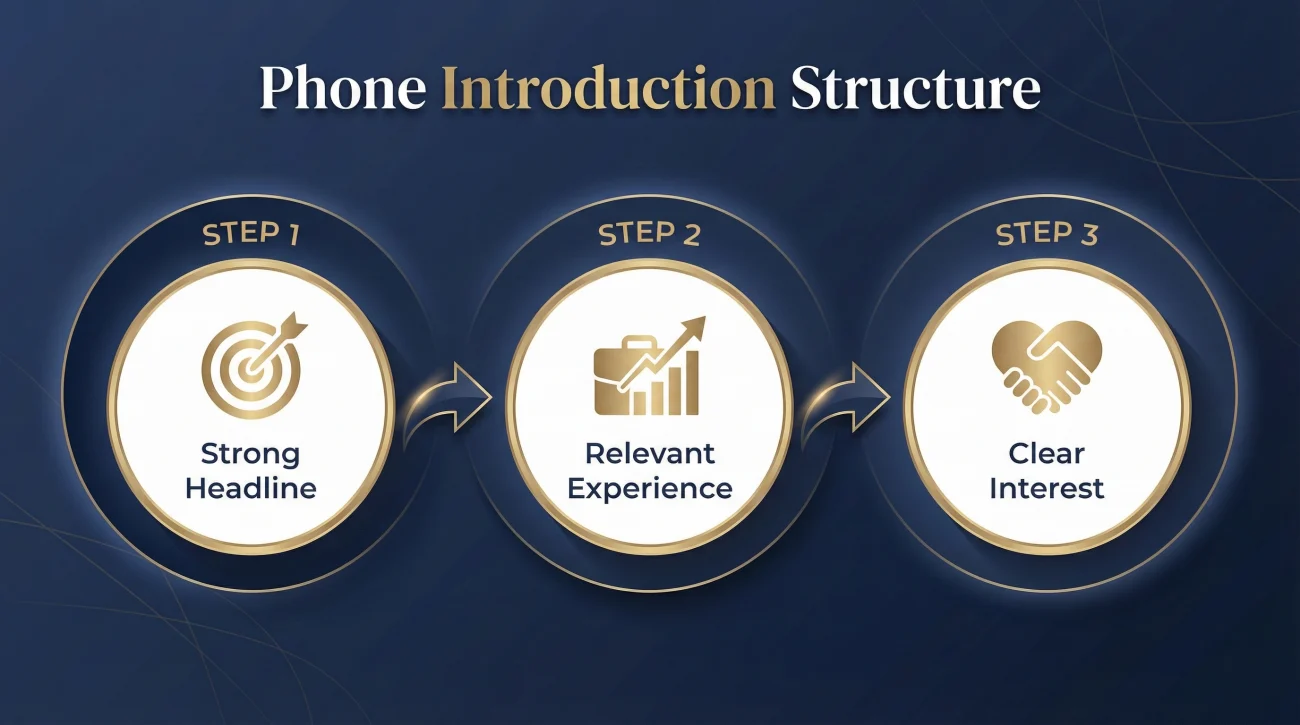
Strong Headline
Open with a clear professional identity that matches what they’re seeking. Make fit obvious in your first sentence.
“I’m a marketing manager with seven years of experience in B2B technology, which I understand is exactly what you’re looking for.”
Relevant Experience
Hit two or three most relevant qualifications quickly. Match your experience to their stated requirements. Be specific enough to be credible but concise enough to maintain attention.
Clear Interest
End with genuine interest in the role. Phone screeners want to know you actually want this job, not that you’re just exploring options.
Sample Phone Introductions
Technical Role
“I’m a software engineer with six years of experience in backend development, the last three focused on distributed systems at scale. Currently at TechCorp, I’ve led the development of our payment processing infrastructure that handles about two million transactions daily.
I saw your role requires experience with microservices and cloud architecture, which has been my focus area. I’m particularly interested because you’re solving similar scalability challenges to what I’ve been working on, and I’d like to continue that work in a new environment.”
Sales Role
“I’m a sales professional with eight years in enterprise software sales, consistently hitting about one hundred twenty percent of quota. I specialize in complex technical sales with six to twelve month cycles, selling to IT and business stakeholders.
I’m interested in your opportunity because you’re expanding into the healthcare vertical, which is where I have deep relationship networks. I’d be excited to bring both my sales track record and my industry connections to the team.”
Operations Role
“I’m an operations manager with ten years of experience in logistics and supply chain, currently overseeing distribution for three regional facilities. My expertise is process optimization, and I’ve led initiatives that reduced operating costs by fifteen percent while improving delivery times.
Your role caught my attention because you’re scaling operations during a growth phase. I have direct experience building operations infrastructure for growing companies, and that’s the kind of challenge I find most engaging.”
For the complete self-introduction framework, see our interview preparation guide.
Technical Preparation
Environment Setup
Find a quiet location with reliable phone signal or connection. Eliminate background noise. Inform others not to interrupt. Technical issues can derail otherwise strong performances.
Reference Materials
Have key information visible: your resume, the job description, company research, and your prepared talking points. Unlike in-person interviews, phone interviews let you reference notes without the interviewer knowing.
Timing and Pacing
Practice your introduction timed. Phone delivery often runs longer than you expect because you can’t pace off visual cues. Rehearse until you can deliver confidently in under sixty seconds.
Phone advantage: You can have a cheat sheet. Use it. Have your key points written where you can glance at them, but know them well enough that you’re speaking naturally, not reading.
❓ FAQ
🎯 How long should my phone introduction be?
Sixty seconds or less. Phone screens are typically shorter than in-person interviews, and attention fades faster without visual engagement. Be concise and leave time for follow-up questions.
💼 Should I use a headset or speakerphone?
Use whatever gives you the clearest audio quality. Test beforehand. Headsets often provide better audio than phone speakers. Avoid speakerphone if possible as it often sounds distant or echoey.
⏰ How do I show enthusiasm without visual cues?
Your voice must carry your energy. Smile while speaking. Stand up if it helps your energy. Vary your vocal tone. Express genuine interest verbally: “I’m really excited about this opportunity because…”
📋 What if there’s a bad connection?
Address it immediately. “I apologize, but the connection seems unclear. Would it be possible to call back?” Most interviewers will accommodate. Don’t struggle through a bad connection hoping it improves.
✨ Should I take notes during the call?
Yes. Jot down key points, questions asked, and information shared. This helps you follow up appropriately and remember details for later interview stages. Just don’t let note-taking distract from listening.
Pass the Screen
Answering tell me about yourself in a phone interview requires adapting your approach for a medium without visual cues. Keep your introduction shorter than in-person versions. Hit key qualifications that match their requirements explicitly. Let your voice carry the energy and engagement that body language would provide otherwise. Set up your environment for clear audio and minimal distractions. Your goal is passing the screen, not winning the job in this call. Demonstrate clear fit, communicate professionally, and move forward to the stages where you can make a fuller impression.
⚠️ Disclaimer: The interview strategies, sample answers, and negotiation tips provided in this guide are for educational purposes only. Hiring decisions are subjective and vary by company and industry. While these strategies are based on professional HR standards, they do not guarantee a specific job offer or result.