- Core Point: Your “tell me about yourself” answer must change with career level because what sounds impressive as a student sounds unfocused as a director or executive.
- Career Stage Shift: Early candidates sell potential with projects and learning agility, mid-career candidates sell track record with metrics, senior leaders sell team and organizational impact, executives sell vision and P&L level outcomes.
- Context Matters Too: Adjust length and framing for phone, video, in-person, panel, and internal promotion interviews, and match your energy and language to startup vs corporate culture.
- Universal Strategy: Filter every sentence for relevance to the role, use the past only as proof, and finish with a clear future-oriented reason this job is your logical next step.
- Prep And Delivery: Build modular story blocks, practice for 45–90 seconds depending on format, cut filler and uptalk, and be ready for variations like resume walkthroughs or “three words” prompts.
Why Your Answer Changes With Experience
The perfect tell me about yourself answer isn’t one-size-fits-all. A student highlighting GPA and extracurriculars sounds tone-deaf in an executive interview. A director reciting their college thesis wastes valuable time. Your introduction must evolve as your career progresses, matching the sophistication your interviewer expects at each level.
Strategic interview introduction examples reveal a pattern: successful answers align content with career context. Fresh graduates emphasize potential and learning agility. Mid-career professionals showcase measurable achievements. Executives articulate vision and strategic impact. The framework remains consistent, but the substance transforms completely.
Understanding these distinctions prevents the common mistake of treating every interview identically. A generic script fails because it ignores what matters most at your specific career stage.
How Content Evolves Across Career Stages
Effective professional self introduction follows predictable evolution. What you emphasize at each stage changes dramatically while the underlying structure stays constant.
| Career Stage | Primary Focus | Evidence Type | Time Split |
|---|---|---|---|
| Student/Entry | Potential & foundation | Projects, internships, GPA | 20% Present | 50% Past | 30% Future |
| Early Professional (1-3 yrs) | Initial contributions | First wins, adaptability | 30% Present | 50% Past | 20% Future |
| Mid-Career (4-7 yrs) | Quantifiable achievements | Metrics, scope expansion | 40% Present | 40% Past | 20% Future |
| Senior/Manager (8-15 yrs) | Team outcomes | Leadership, team scale | 50% Present | 30% Past | 20% Future |
| Executive (15+ yrs) | Strategic vision | P&L, transformation | 60% Present | 20% Past | 20% Future |
Early Career: Building Credibility
Students and recent graduates lack extensive work history, so they emphasize academic achievements, relevant coursework, and internships. Without years of experience, they prove coachability through learning velocity and project outcomes.
- 🎓 Academic foundation: Major, relevant coursework, strong GPA if competitive
- 💼 Practical experience: Internships, co-ops, significant projects
- 🚀 Demonstrated initiative: Leadership roles, competitions, research
- ⚡ Skills evidence: Certifications, technical proficiencies, tools mastered
💡 Pro tip: Entry-level candidates should spend 50% of their answer on past experiences that demonstrate potential rather than claiming expertise they haven’t earned.
Mid-Career: Proving Track Record
Professionals with 4-7 years experience drop educational details entirely unless directly relevant. Their answers center on quantifiable achievements and expanding scope. They demonstrate pattern recognition across projects and show growth beyond executing tasks to solving bigger problems.
This stage requires balancing individual contribution with emerging leadership. The answer showcases both technical depth and ability to guide others. Metrics become more sophisticated, moving from “completed projects” to “improved efficiency by X%” or “drove revenue growth of $Y.”
Expert advice: Mid-career professionals often make the mistake of listing job duties instead of accomplishments. Transform “responsible for managing customer accounts” into “grew key account revenue 40% while improving satisfaction scores from 3.2 to 4.7.”
Senior Leadership: Demonstrating Impact
Managers and directors emphasize team outcomes over personal achievements. Their introductions highlight the scale of responsibility, teams built, and strategic initiatives led. They speak in terms of organizational impact rather than individual tasks.
Executive-level answers focus almost exclusively on vision, strategy, and P&L responsibility. They articulate how they’ve shaped business direction, navigated market challenges, and delivered sustainable growth. The introduction becomes a value proposition about organizational transformation.
Executives who dwell on tactical details from 10 years ago signal they’re stuck at a previous career level.
Adapting to Interview Context
Beyond career stage, effective career level introductions adjust for interview format and company culture. Different contexts demand different approaches while maintaining your core narrative.
Format-Specific Adjustments
Phone and video interviews compress your answer. Without visual cues to gauge engagement, you work with stricter time constraints. Remote settings demand higher vocal energy and clearer articulation. The substance stays consistent, but delivery becomes more disciplined.
| Interview Type | Ideal Length | Key Adjustment |
|---|---|---|
| Phone Screen | 45-60 seconds | Tighter pacing, keyword-rich for ATS |
| Video Interview | 60-75 seconds | Higher vocal energy, camera engagement |
| In-Person | 60-90 seconds | Read the room, adjust based on reactions |
| Panel Interview | 75-90 seconds | Address all stakeholders, structured delivery |
| Internal Promotion | 45-60 seconds | Skip background, focus on expanded contribution |
Cultural Alignment
Startup environments value versatility and scrappiness. Corporate settings expect specialization and process orientation. The same background can be framed differently: “wore multiple hats” for startups becomes “developed deep expertise in X while collaborating cross-functionally” for corporations.
Industry norms also shape expectations. Creative fields appreciate personality and unique perspectives. Traditional industries prefer measured professionalism. Your core qualifications remain constant, but how you present them shifts to match cultural expectations.
Mismatching your energy and framing to company culture creates immediate disconnect, even with perfect qualifications.
Strategic Elements That Work at Every Level
Regardless of experience or context, strong interview answer strategies share common characteristics. They’re concise, relevant, and forward-looking.

The Relevance Filter
Every sentence must connect to why you’re qualified for this specific role. Career changers face this challenge acutely, needing to emphasize transferable skills while acknowledging their pivot. Even linear career paths require selectivity, focusing on experiences that demonstrate relevant capabilities.
- Students filter for potential indicators
- Experienced professionals filter for achievement patterns
- Executives filter for strategic capabilities
- Career changers filter for transferable skills
Future Orientation
Weak answers dwell on the past. Strong answers use the past to frame future contribution. The conclusion always articulates why this opportunity represents a logical next step. This forward focus shows intentionality rather than opportunism.
- 🎯 Students: Emphasize how the role accelerates learning trajectory
- 📈 Mid-career: Show how it expands impact and responsibility
- 🚀 Executives: Position it as the right platform for strategic vision
The past becomes evidence supporting the future claim, not the story itself.
Common Question Variations
Interviewers rarely use identical phrasing. Recognizing these nuances prevents awkward misalignment between question and answer.

Resume Walkthrough Requests
When asked to walk through your resume, the interviewer wants a guided tour, not verbatim reading. You still apply the Present-Past-Future structure but acknowledge the chronological document in front of them. You highlight what matters most rather than covering every line item.
This variation invites more explicit connection between resume bullets and spoken elaboration. You can reference specific items while adding context: “You’ll see I led three major implementations – the most impactful was…” This bridges document and conversation naturally.
Attribute-Based Questions
Questions like “describe yourself in three words” or “how would your boss describe you” test self-awareness and external perception. These require the same underlying strategy – demonstrating relevant strengths – but through a different lens.
Don’t just claim “results-driven” – reference a performance review that praised your metric focus. Don’t simply say “collaborative” – describe feedback from a cross-functional project.
Preparation Strategy
Developing strong answers requires structured preparation, not memorization. You need a flexible framework that adapts to different audiences while maintaining consistent core messaging.
Building Modular Components
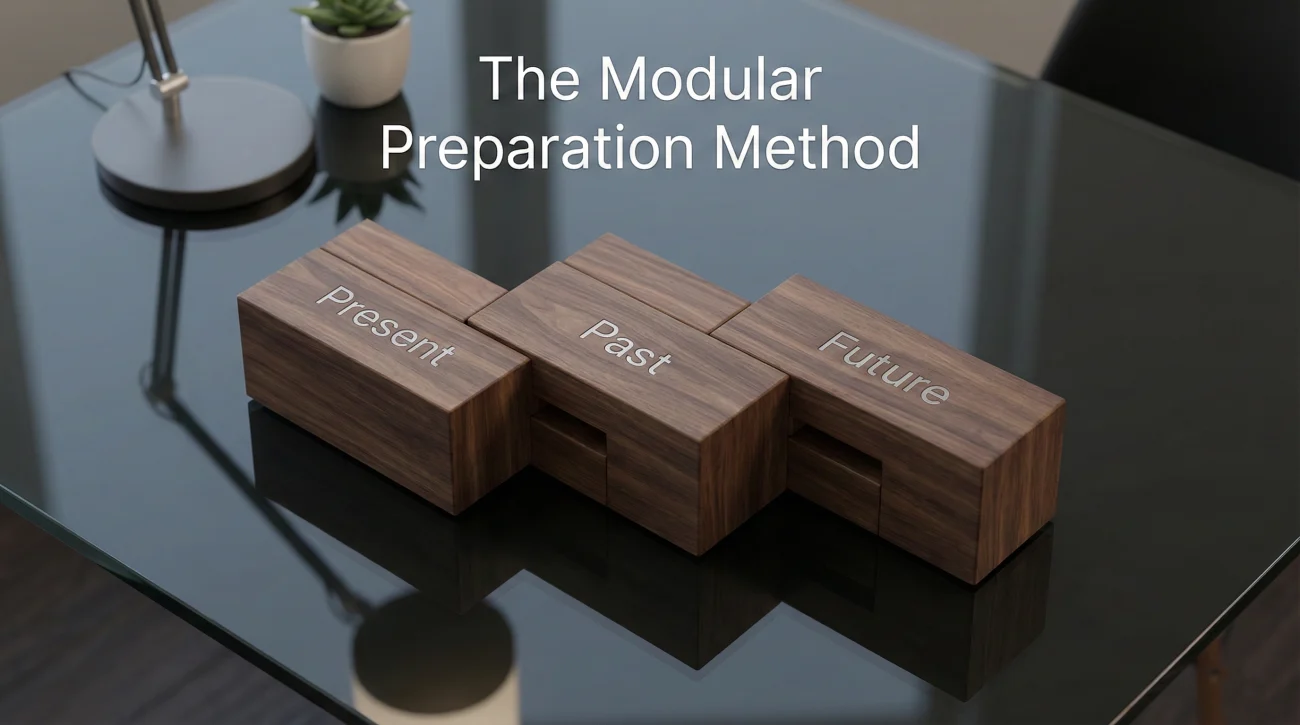
Start by identifying your three to five most relevant experiences for this role. For each, prepare a concise description and clear outcome. These become modular pieces you can arrange based on the specific interview.
Expert advice: Create a “master answer” document with 8-10 key experiences, each with a one-sentence description and specific outcome. Mix and match these based on role requirements rather than memorizing one rigid script.
Your present component should crystallize in one tight sentence describing current role and primary responsibility. Your past should compress into two to three high-impact examples. Your future should connect current trajectory to the opportunity at hand.
Testing and Refinement
Record yourself delivering your introduction. Listen for filler words, awkward phrasing, or unnecessary tangents. Time yourself to ensure you stay within sixty to ninety seconds.
Practice with someone unfamiliar with your background – if they can’t clearly articulate what you do and why you’re qualified afterward, revise for clarity. Test different versions for different contexts. Your phone screen answer might be thirty seconds tighter than your in-person version.
Delivery Mechanics
Content quality means nothing if delivery undermines credibility. Pacing, tone, and energy shape how your message lands. For comprehensive guidance on structuring and delivering your introduction effectively, explore interview answer strategies that work across all career levels.

Pacing and Energy
Nervous candidates rush, cramming ninety seconds of content into forty-five. This signals anxiety rather than confidence. Conversely, meandering delivery suggests lack of preparation. Find the middle ground where you speak naturally but purposefully, pausing briefly between major sections to let key points land.
Energy level should match interview context – phone screens require slightly elevated vocal energy to compensate for lack of visual presence.
Vocal Clarity and Confidence
Avoid uptalk – ending declarative sentences with rising intonation that sounds like questions. This pattern undermines authority regardless of content strength. Similarly, eliminate filler words through practice.
Confident delivery doesn’t mean aggressive. It means clear, steady communication of your value without apology or qualification. Own your achievements without false modesty. State your capabilities directly rather than hedging with “I think” or “I believe.”
Explore Specific Scenarios
Once you understand how answers evolve across career stages, dive into specific frameworks and situations:
Core Frameworks
| Framework | What it’s for |
|---|---|
| Present Past Future Formula | The structural foundation for every introduction |
| Elevator Pitch for Interview | Condensing your story to 30-60 seconds |
| Personal Branding Statement | Defining your unique selling point |
Answers by Career Level
| Guide | Best fit |
|---|---|
| Tell Me About Yourself for Students | Navigating interviews with no prior work history |
| Tell Me About Yourself for Fresh Graduates | Breaking into the workforce post-graduation |
| Tell Me About Yourself for Internships | Positioning yourself for practical training |
| Tell Me About Yourself for Experienced Pros | Leveraging 3+ years of professional track record |
| Tell Me About Yourself for Managers | Focusing on leadership and team oversight |
| Tell Me About Yourself for Executives | High-level strategy for C-suite roles |
| Tell Me About Yourself for Career Changers | Translating past skills to a new industry |
| Tell Me About Yourself for Freelancers | Transitioning from gig work to full-time roles |
Question Variations
| Variation | Focus |
|---|---|
| Walk Me Through Your Resume | Balancing your timeline with key highlights |
| Describe Yourself in 3 Words | Selecting traits that define your personal brand |
| How Would Your Boss Describe You | Validating your skills through a manager’s eyes |
| How Would Your Coworkers Describe You | Highlighting collaboration and culture fit |
| Tell Me Something Not on Your Resume | Showcasing personality beyond the paper |
By Interview Context
| Context | Angle |
|---|---|
| Tell Me About Yourself in Phone Interviews | Delivering a concise, verbal-only pitch |
| Tell Me About Yourself in Video Interviews | Connecting effectively through the screen |
| Internal Interview Introduction | Advancing your case for promotion or transfer |
| Second Interview Introduction | Going deeper than the initial screening |
| Startup vs Corporate Introduction | Adapting your story to the company culture |
| Panel Interview Introduction | Addressing multiple stakeholders at once |
❓ FAQ
🎯 How does my answer change from entry-level to senior roles?
Entry-level focuses on potential and foundational skills, emphasizing learning agility and initial contributions. Senior roles shift to strategic impact, team leadership, and organizational outcomes. The Present-Past-Future framework remains, but evidence evolves from individual tasks to systemic influence.
💼 Should I use the same answer for every interview?
No. While your core framework stays consistent, select different experiences based on what each role values most. Technical roles want different evidence than leadership positions. Startup interviews require different emphasis than corporate ones. Adapt strategically while maintaining authentic consistency.
⏰ How long should my answer be for different interview types?
Phone screens require tighter answers (45-60 seconds) due to limited rapport-building time. In-person interviews allow 60-90 seconds with room for reading engagement cues. Panel interviews benefit from slightly structured delivery to ensure all stakeholders track your points clearly.
📋 What if the interviewer interrupts my introduction?
Don’t fight it. Interruptions signal they’ve heard enough context and want to dive deeper into specific areas. Finish your current sentence gracefully and pivot to their question. You can circle back to omitted points later if relevant. Flexibility demonstrates conversational intelligence.
✨ How do I make my answer memorable without being gimmicky?
Memorability comes from specificity and clarity, not tricks. Use concrete examples rather than generic claims. Quantify impact when possible. Create a clear through-line connecting your experiences. Strong substance delivered with confident energy sticks in interviewers’ minds without artificial tactics.
Final Thoughts
Mastering your tell me about yourself answer means understanding that one framework serves every career level, but the substance filling that framework evolves dramatically. Students emphasize potential. Mid-career professionals showcase achievements. Executives articulate vision. The structure remains constant while content sophistication increases.
Your introduction isn’t a biographical recitation or resume reading. It’s strategic positioning that demonstrates you understand what matters at your career stage and can communicate it clearly. Invest time developing your modular components, practice delivery until it feels natural, and adapt thoughtfully to each interview context.
The interviews you nail start with introductions that immediately establish credibility, demonstrate relevant value, and create momentum for the conversation ahead. Get this right, and everything that follows becomes easier.
⚠️ Disclaimer: The interview strategies, sample answers, and negotiation tips provided in this guide are for educational purposes only. Hiring decisions are subjective and vary by company and industry. While these strategies are based on professional HR standards, they do not guarantee a specific job offer or result.