

- Core framework: Use the Present-Past-Future formula to answer “Tell me about yourself” with a clear narrative, not a chronological resume dump.
- Present first: State your current role, primary focus, and one credibility detail like scale or impact in 1 to 2 tight sentences.
- Past with purpose: Pick 2 to 3 relevant experiences that prove your present claim through achievements and outcomes, not duty lists.
- Future connection: Explain why this role and company now with specific alignment, growth logic, and what you will bring, in 2 to 3 sentences.
- Execution rules: Keep it 60 to 90 seconds, adjust the time split by career stage, avoid rambling and vague interest, and practice transitions so it sounds natural.
The Three-Part Framework That Works
The present past future formula gives your interview introduction a logical flow that matches how interviewers process information. Instead of chronological resume recitation or scattered highlights, this structure creates a narrative arc: where you are now, how you got here, and where you’re headed.
This interview pitch structure works because it mirrors natural storytelling patterns while delivering the specific information hiring managers need. Present establishes your current credibility. Past demonstrates the journey that built your capabilities. Future connects your trajectory to their opportunity. Together, these three components answer the unspoken question behind every interview: why should we hire you?
Understanding this framework transforms a rambling biographical sketch into a strategic positioning statement. The formula provides structure without rigidity, allowing you to adapt content while maintaining clarity.
Present: Establishing Your Current Position
The Present component anchors your introduction in reality. It answers “Who are you right now?” with specificity that immediately establishes credibility.
Core Elements
Your present statement needs three pieces: your current role, your primary responsibility, and a brief context that shows scale or significance. This takes one to two sentences maximum.
- 💼 Role title: What you currently do professionally
- 🎯 Primary function: Your main responsibility or focus area
- 📊 Context/scale: Company type, team size, revenue scope, or impact metric
| Career Level | Present Focus | Example Opening |
|---|---|---|
| Student | Major + relevant activities | “I’m a computer science major at State University, focusing on machine learning and serving as president of the Data Science Club.” |
| Entry-level | Current role + key responsibility | “I’m a junior analyst at TechCorp, where I support the product team by analyzing user behavior data to inform feature decisions.” |
| Mid-career | Role + scope + impact area | “I’m a senior engineer at DataSystems, leading backend development for our enterprise platform that serves 500+ corporate clients.” |
| Manager | Leadership scope + team size | “I’m an engineering manager at CloudTech, leading a team of 12 developers building our core infrastructure services.” |
| Executive | Strategic responsibility + P&L | “I’m VP of Product at FinanceApp, overseeing product strategy and a $50M P&L across three product lines.” |
💡 Pro tip: Quantify your present whenever possible – team size, revenue scope, user base, or projects managed all add concrete credibility.
Common Present Mistakes
Candidates often either undersell by being too vague (“I work in marketing”) or oversell by listing every responsibility. The present component should be punchy and specific without becoming a laundry list.
Starting with “Well, um, I guess I’m currently working as a…” signals uncertainty about your own position.
Past: Demonstrating Your Journey
The Past component builds credibility by showing how you developed the capabilities you claimed in your Present statement. This is where you prove you didn’t just land in your current role by accident.
Selecting Relevant Experience
Don’t recite your entire career chronologically. Choose two to three experiences that directly support why you’re qualified for this specific opportunity. The professional introduction framework demands selectivity – what you leave out matters as much as what you include.
Expert advice: Your past should tell a story of progression, not just a list of jobs. Each experience should show either skill development, increasing responsibility, or relevant domain expertise that builds toward your current position.
- Focus on achievements, not just duties
- Include quantifiable results when possible
- Connect each experience to skills needed for this role
- Show progression or intentional pivots, not random job hopping
Time Allocation by Career Stage
How much past you include depends on where you are professionally. Students might spend 50% of their answer on past (academic projects, internships). Executives might compress 20 years into three sentences, focusing only on inflection points that demonstrate strategic capability.
| Career Stage | Past Focus | Typical Content |
|---|---|---|
| Student/Entry | Academic + early experience | Major projects, internships, relevant coursework, leadership activities |
| Early Professional | First role achievements | Initial wins, skills developed, transition from learning to contributing |
| Mid-Career | Track record of results | 2-3 significant achievements showing scope expansion and impact |
| Senior/Manager | Leadership evolution | Team building, strategic initiatives, organizational impact |
| Executive | Transformation moments | Major pivots, turnarounds, scaling achievements |
Spending too long on past experiences from 10+ years ago signals you’re stuck in previous career phases rather than focused on future contribution.
Future: Connecting to This Opportunity
The Future component answers “Why this role, why now?” It transforms your introduction from biographical information into a strategic case for why you’re the right fit. This is where your three part interview answer becomes clearly purposeful rather than generic.

Essential Future Elements
Strong future statements accomplish three things: they demonstrate you’ve researched the role, they show strategic career thinking, and they make clear you’re not just looking for any job.
- 🎯 Role alignment: Specific aspects of this position that match your goals
- 🚀 Growth trajectory: How this represents logical next step in your progression
- 💡 Value proposition: What you’ll bring based on your past experience
The future component should be concise – two to three sentences that tie everything together. This isn’t the place for extensive elaboration. You’re setting up the rest of the interview conversation, not trying to close the deal in your opening.
Maintaining Authenticity
Generic future statements (“I’m looking for new challenges”) sound hollow. Specific connections to the company’s mission, the role’s scope, or the team’s focus demonstrate genuine interest rather than desperation.
Connect your future to specific elements: “The opportunity to build scalable infrastructure for a platform at this growth stage aligns perfectly with where I want to develop my leadership capabilities.”
“I’m really passionate about this company and would love to work here” says nothing substantive about strategic fit.
Balancing the Three Components
The career narrative structure requires thoughtful time allocation across all three parts. The typical distribution shifts as your career progresses.
Time Allocation Guidelines
A complete introduction should run 60-90 seconds. How you divide that time depends on what you need to establish most urgently based on your background and the role.
| Scenario | Present % | Past % | Future % | Rationale |
|---|---|---|---|---|
| Student/Entry-level | 20% | 50% | 30% | Need to prove potential through past achievements |
| Early professional | 30% | 50% | 20% | Balance current role with track record |
| Mid-career | 40% | 40% | 20% | Equal weight on present capability and past proof |
| Senior/Manager | 50% | 30% | 20% | Emphasize current leadership scope |
| Executive | 60% | 20% | 20% | Current strategic responsibility matters most |
| Career changer | 25% | 45% | 30% | Heavy future focus to justify pivot |
Expert advice: When in doubt, strengthen your present statement. Interviewers care most about who you are now. Your past should support that claim, and your future should be brief but purposeful.
Applying the Formula
Understanding the framework is different from executing it smoothly. Practical application requires building your answer, practicing delivery, and refining based on feedback.
Building Your Answer
Start by writing out each component separately. Draft three versions of your present statement and choose the most concise. List five to seven past experiences, then ruthlessly cut to the two or three most relevant. Write your future statement last, after you know what foundation you’ve laid.
- Write present statement in one sentence, expand if needed to two
- Select 2-3 past experiences with clear outcomes
- Connect future to specific role elements, not generic career goals
- Read the complete answer aloud to check flow and timing
Practicing Delivery
Memorize the structure, not the exact words. You should be able to deliver your answer conversationally while hitting all key points. Practice transitions between components so they feel natural rather than segmented.
💡 Pro tip: Record yourself delivering your introduction, then listen for filler words, pacing issues, or sections that sound awkward. Adjust content, not just delivery, to fix flow problems.
Common Mistakes to Avoid
Even with the formula clear, candidates frequently make predictable errors that undermine their introduction’s effectiveness.
Formula Violations
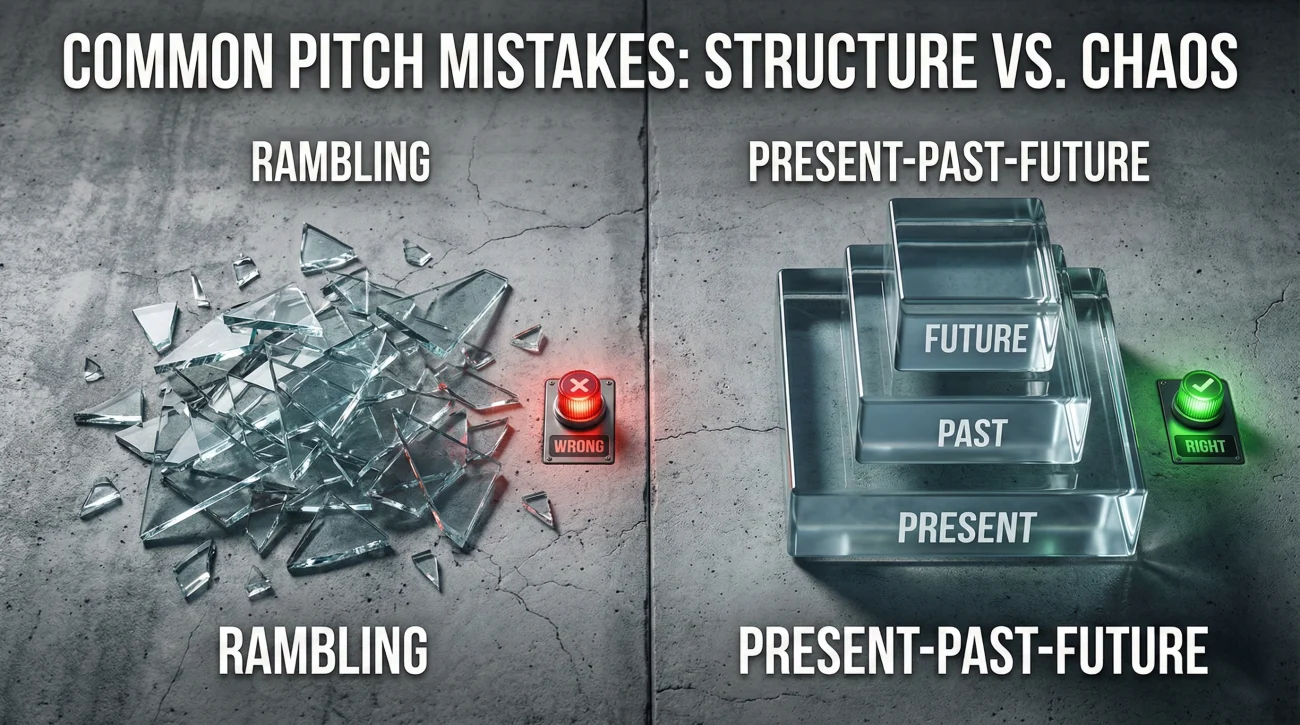
Starting with your education from ten years ago violates the present-first principle. Ending with a vague “so that’s me” instead of connecting to the opportunity wastes the future component. Spending three minutes on detailed job history ignores the 60-90 second target.
- ❌ Chronological recitation: Don’t start with birth or college unless you’re a student
- ❌ Duty lists: “I was responsible for…” describes jobs, not achievements
- ❌ Excessive humility: “I just…” or “I only…” undermines your accomplishments
- ❌ Rambling past: Going beyond 90 seconds total signals poor judgment
If you find yourself saying “let me start from the beginning” and then discussing high school, you’ve already failed the formula.
Advanced Applications
Once you master the basic formula, you can adapt it for specific situations that require nuanced positioning.

Career Change Adaptation
Career changers need to emphasize transferable skills in their past while making a strong case for the pivot in their future. The present might acknowledge the transition: “I’m currently a teacher transitioning to corporate training.” This frames the change as intentional rather than desperate.
Internal Interview Adjustment
Internal candidates can compress or skip present entirely since the interviewer knows your current role. Focus heavily on expanded contribution and strategic fit for the new position. Your future becomes the primary component.
For additional guidance on tailoring your introduction to specific contexts, explore resources on interview introduction strategies across different scenarios.
❓ FAQ
🎯 Can I adjust the time split between Present-Past-Future?
Yes. The interview pitch structure provides guidelines, not rigid rules. Career changers might spend more time on future to justify their pivot. Senior leaders emphasize present to establish current scope. Adjust based on what you need to prove most urgently, but always include all three components.
💼 Should I mention education in the Past component?
Only if you’re within 2-3 years of graduation or if your degree is directly relevant and prestigious (PhD, top-tier MBA). Otherwise, your work experience matters more. Mid-career and senior professionals should skip educational background entirely unless specifically asked.
⏰ What if my Present component is weak because I’m unemployed?
Frame your present around what you’re actively doing: “I’m currently focusing on transitioning to product management, having spent the last three months completing a certification and working on case studies.” This shows intentional activity rather than passive unemployment.
📋 How detailed should my Past achievements be?
Each past point needs one sentence of context and one sentence of outcome. Don’t dive into lengthy explanations in your introduction – you can elaborate later if the interviewer asks follow-up questions. Keep each achievement to 2-3 sentences maximum.
✨ Can I use this formula for written introductions?
Absolutely. The Present-Past-Future structure works for cover letters, LinkedIn summaries, and email introductions to recruiters. Written versions can be slightly longer since readers can skim, but the logical flow remains equally effective.
Final Thoughts
The present past future formula transforms rambling biographical information into strategic positioning. Present establishes immediate credibility. Past proves you’ve earned your current capabilities. Future demonstrates intentional career thinking and genuine interest in this specific opportunity.
This structure works because it matches how decision-makers process information. They need to understand who you are now before they care about how you got here. They evaluate your past to verify your present claims hold up. They assess your future statement to gauge cultural fit and motivation.
Master this three-part framework and you’ll never struggle with interview introductions again. The formula provides enough structure to keep you organized while allowing flexibility to adapt to different roles, industries, and career stages. Practice it until the structure becomes invisible and your content shines through naturally.
⚠️ Disclaimer: The interview strategies, sample answers, and negotiation tips provided in this guide are for educational purposes only. Hiring decisions are subjective and vary by company and industry. While these strategies are based on professional HR standards, they do not guarantee a specific job offer or result.