The Architect of Agreement
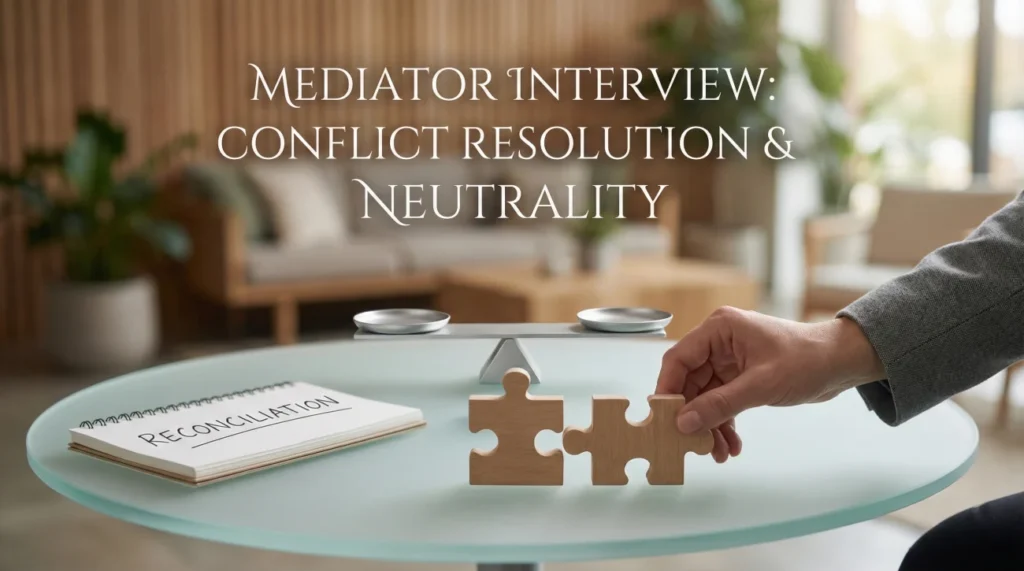
In a legal landscape often defined by adversarial combat, the Mediator stands apart as the architect of peace. You are not a judge who imposes a ruling, nor an advocate who fights for one side. You are the neutral third party whose sole purpose is to guide disputing parties from entrenched hostility to a mutually acceptable resolution. Whether in family law, commercial disputes, or workplace conflicts, the mediator’s toolset is built on psychology, active listening, and creative problem-solving.
Hiring managers for Alternative Dispute Resolution (ADR) firms, court programs, and corporate HR departments are looking for a unique temperament. They need someone who can absorb intense emotional heat without reacting, someone who can reframe toxic language into constructive dialogue, and someone who can see the “zone of possible agreement” (ZOPA) long before the parties do. Prepare to answer mediator interview questions that probe your ability to maintain neutrality in the face of bias, your techniques for breaking impasses, and your ethical boundaries when a deal seems unfair. This guide explores the nuanced skills required to turn conflict into consensus.
Core Mediation Techniques
Q: How do you establish trust and neutrality at the very beginning of a mediation session?
The “Opening Statement” is my foundation. I start by explicitly defining my role: I am there to facilitate their conversation, not to decide who is right or wrong. I explain the concept of confidentiality to create a safe space. I use “mirroring” body language and maintain equal eye contact with all parties to signal impartiality visually. I also normalize the tension by acknowledging that conflict is difficult and commending them for showing up. By setting ground rules collaboratively, rather than imposing them, I give the parties their first shared “yes,” which builds initial trust in the process and in me as the guide.
Q: Describe your approach to “active listening” and “reframing.”
Active listening goes beyond hearing words; it involves decoding the underlying interests. When a party speaks, I do not just nod; I summarize their points back to them to ensure I understood correctly (“So, what I am hearing is…”). Reframing is the art of stripping the toxicity from a statement while keeping the core message. If a party says, “He is a lazy liar who never pays on time,” I might reframe it to, “So, reliability and timely payments are critical values for you in this business relationship.” This transforms a personal attack into a discussable issue, lowering the emotional temperature and allowing the other side to hear the concern without becoming defensive.
Q: What is the “caucus” technique, and when do you use it?
A caucus is a private, confidential meeting with one party away from the other. I use it strategically, not just as a break. I call a caucus when emotions run so high that productive dialogue stops, or when I suspect a party is holding back a key piece of information due to fear or strategy. In the caucus, I can play “devil’s advocate” and reality-test their position more aggressively than I could in the joint session without appearing biased. It allows the party to vent safely. I always clarify exactly what information from the caucus I can share with the other side before returning to the joint room, preserving confidentiality absolutely.
Q: How do you identify the “BATNA” and why is it important?
BATNA stands for “Best Alternative to a Negotiated Agreement.” It is the measuring stick for any deal. I help parties identify their BATNA by asking reality-testing questions: “If we don’t settle today, what does next year look like for you? How much will litigation cost? What is the emotional toll?” Often, parties overestimate their chances in court. By helping them articulate a realistic BATNA (which is often worse than they think), I make the settlement offer on the table look more attractive. It shifts the mindset from “winning” to “managing risk.”
Q: Dealing with power imbalances is critical. How do you handle a session where one party dominates?
Neutrality does not mean passivity. If one party is bullying, interrupting, or intellectually dominating the other, the process fails. I intervene to enforce the ground rules we set. I might use a “talking piece” or strict turn-taking to ensure the quieter party has space. I might use the caucus to coach the quieter party on how to articulate their needs or to privately admonish the dominant party that their aggression is counterproductive. If the imbalance is so severe that the weaker party cannot advocate for themselves (e.g., in cases of domestic violence history), I may terminate the mediation as it is ethically unsafe to proceed.
The Process: From Opening to Agreement
Q: How do you prepare for a complex commercial mediation?
Preparation prevents impasse. I request “mediation briefs” from both sides a week in advance. I read them not just for the legal arguments, but to identify the “hidden” interests – reputation, timing, or future business relationships.
I often conduct pre-mediation calls with the attorneys to discuss logistics and potential sticking points. I ask, “What is the one thing your client needs to hear from the other side to move forward?” This helps me design the process. If it is a multi-party dispute, I map out the alliances and conflicts beforehand to plan the seating arrangement and caucus order.
Q: What do you do when the parties reach an impasse?
Impasse is not the end; it is a pivot point. I change the dynamic. I might switch from a “distributive” (money dividing) discussion to an “integrative” (value creating) one. I ask, “What else can we trade besides money? An apology? A structured payment plan? A press release?”
I might use a “mediator’s proposal” as a last resort, where I confidentially present a settlement number to both sides that I think is fair. They each tell me “yes” or “no” privately. If both say yes, we have a deal. If one says no, the other side never knows the first side accepted, protecting their negotiating position. This often breaks the deadlock.
Q: How do you handle high emotion, such as crying or shouting?
I view emotion as data, not a disruption. It shows what matters most. I do not tell them to “calm down,” which is invalidating. I validate the emotion: “I can see this is incredibly painful for you.”
I allow the vent to happen for a moment, as it releases pressure. Then I try to pivot that energy: “Your anger shows how much you care about fairness. How can we translate that desire for fairness into a proposal?” If it becomes abusive, I call a break. I model calmness; my low heart rate can eventually help lower theirs (co-regulation).
Q: Describe your role in drafting the settlement agreement.
While I am not their attorney, I am the scribe of their consensus. I ensure the terms are specific, measurable, and realistic. Instead of “Father gets reasonable visitation,” I write “Father gets visitation on alternating weekends from Friday 5 PM to Sunday 5 PM.”
I reality-test the clauses: “What happens if Friday is a holiday? Who provides transportation?” I ensure both parties read and understand every word before signing. In court-connected mediation, this document often becomes a court order, so precision is legally required. I make sure they leave with a signed document, even if it is just a “term sheet,” to prevent buyer’s remorse the next day.
Q: How do you manage the attorneys present in the room?
Attorneys can be helpful allies or obstructive combatants. I validate their role as protectors of their client’s rights, but I gently shift the focus from “legal posturing” to “problem solving.” If an attorney is grandstanding, I might say, “Counsel, you have made a strong legal point, but your client has a business problem to solve today.”
I often use the attorneys in caucus to help reality-test their own client. A client might believe they have a 100% chance of winning; the attorney knows it is only 50%. I help the attorney deliver that hard news to the client without the attorney losing face. I treat the attorney as a partner in the resolution process.
Q: What is the difference between “facilitative” and “evaluative” mediation?
In facilitative mediation, I manage the process but do not offer opinions on the outcome. I help them find their own solution. In evaluative mediation, often used in commercial disputes with lawyers, I offer my opinion on the legal merits and the likely court outcome.
I am comfortable with both but prefer facilitative initially. I only switch to evaluative if the parties specifically request it or if they are stuck in an unrealistic fantasy about their legal case. I am careful not to let my evaluation look like bias; I frame it as “based on my experience with similar cases in this jurisdiction.”
Ethics and Dilemmas
One party reveals a serious crime (like money laundering) during a confidential caucus. What do you do?
This is the limit of confidentiality. While general secrets are safe, I cannot facilitate a crime or be a party to fraud. If the mediation is being used to further a crime, I must withdraw.
I would privately tell the party (or their lawyer) that I cannot continue the mediation. I would not necessarily reveal the specific reason to the other side to avoid breaching confidentiality, but I would terminate the session immediately. If it involves child abuse or elder abuse, I am a mandatory reporter in many jurisdictions and would have to report it to the authorities.
The parties reach a settlement that you believe is grossly unfair to one side. Do you intervene?
This is the classic mediator’s dilemma. Generally, I respect self-determination. If the party is competent and informed, they have the right to make a “bad” deal to buy their peace. I am not their guardian.
However, I would use questions to ensure informed consent. “Do you understand that by accepting this $5,000, you are waiving your right to the potential $50,000 claim?” If they understand and still want to proceed to end the stress, I let them. If the unfairness stems from coercion or lack of capacity, I would pause the process and suggest they consult counsel.
You realize you know one of the parties from a social club. Do you proceed?
Disclosure is mandatory. Even a perception of bias can ruin the process. I would stop immediately and disclose the relationship to all parties: “I realized I know Mr. Smith from my golf club.”
I would explain the nature of the relationship (casual, close, past, present). I would ask if they are comfortable proceeding or if they would prefer a different mediator. If either party hesitates or objects, I recuse myself. It is better to lose one fee than to have a settlement overturned later for conflict of interest.
A party demands you testify in court about what was said in mediation. How do you respond?
I refuse. Mediation privilege is sacred. Without it, parties would never be honest. I would cite the relevant evidence code (like California Evidence Code 1119 or the Uniform Mediation Act) that protects mediation communications.
I would contact my own counsel or the ADR program administrator to file a motion to quash the subpoena. I vigorously defend the confidentiality of the process, not just for myself, but to protect the integrity of the mediation profession. I do not testify for or against any party regarding the content of the mediation.
Mediator Knowledge Quiz
20 Practice Questions
1. What is the primary goal of mediation?
- To decide who is legally right
- To facilitate a mutual agreement
- To punish the wrongdoer party
- To provide therapy to parties
2. “ZOPA” stands for:
- Zone of Personal Agreement
- Zone of Possible Agreement
- Zone of Professional Action
- Zone of Partial Authority
3. Which is a core principle of mediation?
- Judicial determination
- Self-determination of parties
- Public record keeping
- Mandatory settlement
4. A “caucus” is:
- A joint meeting with all parties
- A private meeting with one party
- The final signed agreement document
- The mediator’s opening statement
5. “Reframing” involves:
- Repeating insults verbatim
- Restating negatively as neutral
- Ignoring the statement entirely
- Agreeing with the speaker
6. “BATNA” helps parties to:
- Identify their emotional triggers
- Assess their walk-away alternatives
- Select the best mediator available
- Calculate the mediator’s total fee
7. Is mediation confidential?
- No, it is always public record
- Yes, with limited exceptions
- Only if the judge orders it so
- Only for the winning party
8. A “Mediator’s Proposal” is:
- The fee charged by the mediator
- A settlement offer from mediator
- The initial scheduling email
- A request for more documents
9. “Active listening” requires:
- Thinking of your next argument
- Reflecting back what was heard
- Interrupting to correct facts
- Remaining completely silent
10. “Distributive” negotiation focuses on:
- Creating new value for both
- Dividing a fixed pie of resources
- Building long-term relationships
- Ignoring the money aspect
11. “Integrative” negotiation focuses on:
- Winning at all costs
- Creating value / expanding pie
- Compromising quickly
- Avoiding the conflict
12. Who signs the settlement agreement?
- The mediator only signs it
- The disputing parties sign it
- The judge only signs it
- The witnesses only sign it
13. “Reality testing” is used to:
- Check the room temperature
- Challenge unrealistic expectations
- Test the recording equipment
- Verify the mediator’s credentials
14. Can a mediator give legal advice?
- Yes, always freely to everyone
- No, they must remain neutral
- Only to the plaintiff side
- Only to the defendant side
15. “Impartiality” means:
- Helping the weaker party win
- Showing no bias toward either
- Ignoring the law completely
- Making decisions for parties
16. What is “co-mediation”?
- Mediation with a judge present
- Two mediators working together
- Mediation via email only
- Mediation without lawyers
17. “Mandatory mediation” is:
- Voluntary for all parties
- Ordered by a court or statute
- Illegal in most states
- Only for criminal cases
18. The “opening statement” sets:
- The final verdict of the case
- The ground rules and process
- The cost of the settlement
- The lunch break schedule
19. “Empowerment” in mediation means:
- Giving money to the poor party
- Parties making their own choices
- The mediator taking control
- Ignoring the legal constraints
20. Which style is most directive?
- Facilitative mediation style
- Evaluative mediation style
- Transformative mediation style
- Narrative mediation style
❓ Frequently Asked Questions
🎓 Do I need to be a lawyer to be a mediator?
Not necessarily. While many mediators are attorneys (especially in commercial or civil litigation), many successful mediators come from psychology, social work, or HR backgrounds. Family and community mediation often welcome non-lawyers. However, certification requirements vary significantly by state and court program.
🗣️ What is the “Transformative” mediation style?
Transformative mediation focuses less on the settlement and more on changing the relationship between the parties. It aims for “empowerment” (self-confidence) and “recognition” (understanding the other). It is commonly used in workplace or family conflicts where the parties must continue to interact in the future.
💰 How do mediators get paid?
Private mediators charge hourly or daily rates, often split between the parties. Rates vary wildly from $150/hour to $10,000+/day for top commercial mediators. Community mediators often work as volunteers or for a stipend. Court panels often have set fee schedules.
⚖️ Is the settlement agreement legally binding?
Yes, once it is signed by all parties, it becomes an enforceable contract. If it is part of a lawsuit, it can be filed with the court and become a court order. If one party breaches the agreement later, the other party can sue to enforce it.
🚀 Can I specialize in specific types of mediation?
Yes, specialization is key to building a practice. Common niches include Divorce/Family, Construction Defect, Intellectual Property, Employment, and Personal Injury. Special knowledge in the subject matter builds credibility with the attorneys hiring you.
The Peacekeeper’s Mindset
Mediation is more than a process; it is a mindset. It requires the ability to remain calm in the eye of the storm, to see the humanity in angry people, and to believe that a solution exists even when the parties have lost hope. When you interview, tell stories of how you turned “no” into “maybe” and “maybe” into “yes.” Show them your patience, your creativity, and your unwavering commitment to neutrality.
By preparing with these mediator interview questions, you demonstrate that you are ready to guide others through their darkest conflicts and bring them into the light of resolution. You are not just a candidate; you are the bridge over troubled waters.
⚠️ Disclaimer: The interview strategies, sample answers, and negotiation tips provided in this guide are for educational purposes only. Hiring decisions are subjective and vary by company and industry. While these strategies are based on professional HR standards, they do not guarantee a specific job offer or result.