The Pursuit of Truth
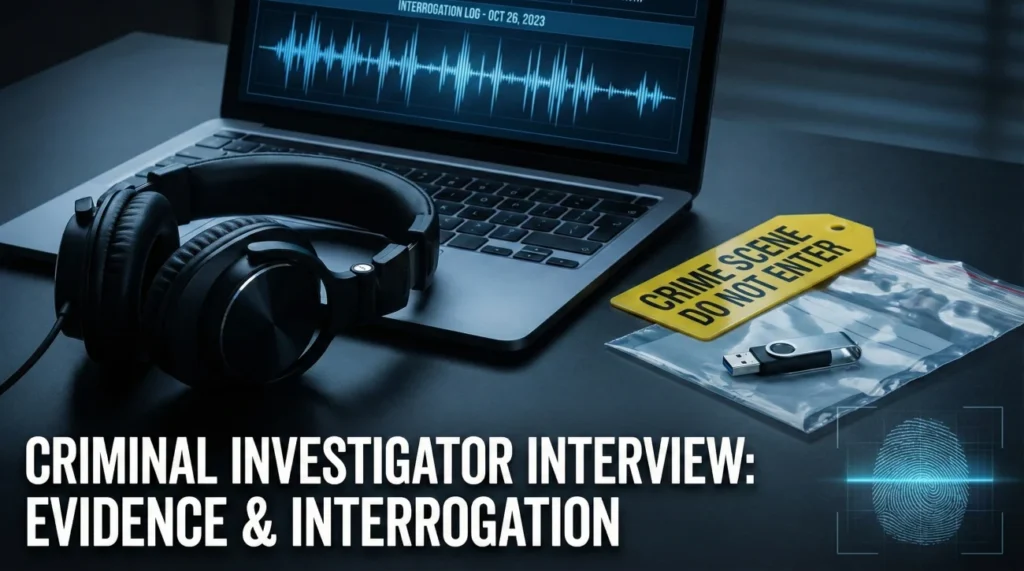
The transition from a uniformed patrol officer to a Criminal Investigator or Detective is a significant leap in responsibility and complexity. You are no longer just responding to the chaos of the moment; you are tasked with reconstructing the past to find the truth. This role demands a meticulous eye for detail, the psychological savvy to elicit confessions, and the patience to build a case that can withstand the scrutiny of a courtroom defense. Hiring managers are looking for candidates who can demonstrate superior analytical skills, a deep understanding of constitutional law, and the ability to manage long-term caseloads without losing focus. To secure this promotion, you must be ready to answer criminal investigator interview questions that test your knowledge of forensic science, your ability to write search warrants that won’t be suppressed, and your strategy for interviewing both traumatized victims and hardened suspects.
Interrogation and Interviewing
Q: What is the difference between an “interview” and an “interrogation”?
This is a critical legal and tactical distinction. An interview is a non-accusatory conversation used to gather information from victims, witnesses, or potential suspects who are not in custody. The goal is fact-finding. An interrogation is an accusatory process designed to elicit a confession from a suspect when I am reasonably certain of their guilt. Interrogations usually require Miranda warnings if the suspect is in custody. Confusing the two can lead to “Miranda” violations or the alienation of a cooperative witness. I always start with an interview to establish a baseline before moving to interrogation if the evidence supports it.
Q: Describe your approach to the Reid Technique versus the PEACE model.
I am familiar with both but prefer a hybrid approach depending on the case. The Reid Technique is the traditional American model involving confrontation and theme development to minimize the moral seriousness of the crime, which can be effective but carries a risk of false confessions. The PEACE model (Planning, Engage, Account, Closure, Evaluation) is an investigative interviewing style focused on gathering a pure version of events without coercion. I find PEACE more effective for modern juries who are skeptical of high-pressure tactics. My goal is to get the suspect talking freely so I can catch them in lies using evidence, rather than forcing a “yes” or “no.”
Q: How do you build rapport with a suspect who hates the police?
Rapport is not about being friends; it is about finding common ground or mutual respect. I start by treating them with basic human dignity. I offer water or a cigarette (if allowed). I acknowledge their perspective: “I know you don’t want to be here, and I respect that.” I look for a hook – a sports team on their hat, a tattoo, or a shared background. I let them vent their frustration without getting defensive. Once they feel heard, they are often more willing to speak. I position myself as a neutral truth-seeker rather than an enemy, which lowers their guard.
Q: How do you handle a suspect who invokes their right to counsel (lawyer up)?
I stop immediately. This is a bright-line constitutional rule (Edwards v. Arizona). I cannot ask any more guilt-seeking questions. I document the exact time and words used to invoke the right. I step out of the room. However, if the suspect re-initiates the conversation voluntarily (e.g., “So what happens to me now?”), I can engage, but I would re-Mirandize them on tape to ensure the waiver is clear. Violating this right guarantees the confession will be thrown out, destroying the case, so I am extremely disciplined here.
Crime Scene and Evidence Management
Q: What is your first priority upon arriving at a major crime scene?
My first priority is always safety (officer and public), followed immediately by securing the scene. Once the scene is safe, I establish a single entry/exit point and start a crime scene log to track everyone who enters.
This prevents contamination (“Locard’s Exchange Principle”). I do not touch anything until the scene has been photographed and documented, unless there is an imminent threat to evidence (like rain washing away blood). I take charge of the patrol officers to ensure the perimeter is large enough; it is easier to shrink a scene later than to expand it once evidence is trampled.
Q: How do you maintain the “Chain of Custody” for evidence?
Chain of Custody is the paper trail that proves who handled the evidence from collection to court. I bag and tag evidence immediately upon collection.
I seal the bag with tamper-evident tape and initial/date across the seal. I log the item into the property system immediately. If I transfer it to the lab, I sign it out and the lab tech signs it in. Any gap in this chain allows a defense attorney to argue the evidence was planted or tampered with. I treat every piece of evidence as if it were the smoking gun.
Q: Describe your experience with writing Search Warrants.
A search warrant must be meticulous. I start with the “Affidavit of Probable Cause.” I detail my training and experience (“Hero Sheet”) to establish expertise.
I lay out the facts chronologically, connecting the crime to the location to be searched (“nexus”). I am specific in the “items to be seized” section; I cannot search for a stolen elephant in a jewelry box. I double-check addresses and descriptions. I often have a prosecutor review it before submitting it to a judge. A bad warrant can lead to the “fruit of the poisonous tree” doctrine, suppressing all evidence found.
Q: How do you handle digital evidence (smartphones/computers)?
Digital evidence is fragile. I do not try to browse the device myself, as that changes timestamps and metadata. If the device is on, I keep it on and place it in a Faraday bag to block remote wiping signals.
If it is off, I leave it off. I apply for a specific search warrant for the data contents. I then turn it over to the Digital Forensics unit for extraction. I know that a phone often contains more evidence (locations, chats, photos) than the physical crime scene itself.
Q: How do you organize a complex case file?
Organization wins cases. I use a standardized binder or digital folder system. Section 1: Reports (Incident, Supps). Section 2: Warrants and Legal. Section 3: Witness Statements.
Section 4: Suspect Info. Section 5: Evidence/Lab Reports. Section 6: Photos/Diagrams. I maintain a “running log” or chronological summary of every investigative step I take. This allows a prosecutor (or another detective) to pick up the file and understand the case status in 10 minutes. It also helps me spot gaps in the investigation.
Q: How do you manage a “Cold Case”?
I start by re-reading the entire file from scratch with fresh eyes, assuming nothing. I look for evidence that can be re-tested with modern DNA technology (like Touch DNA or Genealogy).
I re-interview witnesses; relationships change over time, and a witness who was afraid 10 years ago might talk now. I look for overlooked leads. I maintain contact with the victim’s family to show them the case is not forgotten. Patience and new technology are the keys to solving cold cases.
Investigative Scenarios and Strategy
You have a suspect in interrogation who is clearly lying. Do you confront them immediately?
Not usually. I let them lie. I lock them into their story. I ask them to repeat it, perhaps in reverse order, to increase cognitive load and generate more inconsistencies.
I want them to commit fully to a version of events that I can disprove with hard evidence (video, GPS, DNA). Once they are locked in, I reveal the evidence piece by piece (“You said you were home, but this video shows you at the store”). This destroys their credibility and creates the psychological pressure needed for a confession. Confronting too early allows them to adjust their story to fit the facts.
A victim of a sexual assault is hesitant to pursue charges. How do you handle it?
I use a “victim-centered” approach. I do not pressure them. I explain that the investigation can proceed at their pace (within statute of limitations). I validate their fear.
I connect them with a Victim Advocate immediately. I explain the process clearly so they know what to expect. I gather what evidence I can (like video or medical reports) to preserve it in case they change their mind later. I respect their autonomy; forcing a victim to participate often leads to them recanting later and re-traumatization.
You have two suspects for a robbery. How do you play them against each other?
This is the “Prisoner’s Dilemma.” I separate them immediately. I interview the weaker or less involved suspect first. I might imply (bluffing carefully) that the other suspect is already talking.
“Your buddy is in the other room putting this all on you. He says you held the gun. This is your chance to tell your side.” I offer the first person to talk a chance to be a witness rather than the primary defendant (consulting with the DA first). Creating paranoia about loyalty is a highly effective tactic in multi-suspect cases.
You are investigating a high-profile case and the media is swarming. How do you handle leaks?
Leaks destroy investigations. I keep the “holdback evidence” (details only the killer would know) strictly confidential. I limit the flow of information within the department to a “need to know” basis.
I refer all media inquiries to the Public Information Officer (PIO). I do not speak to reporters “off the record.” If I suspect a leak, I might use a “canary trap” (sharing slightly different versions of info to different people to see which version leaks), but my primary focus is maintaining the integrity of the case file.
Legal and Technical Knowledge
Q: Explain “Exculpatory Evidence” (Brady Material) and your duty regarding it.
Exculpatory evidence is any information that might show the defendant is innocent or impeach the credibility of a prosecution witness. Under Brady v. Maryland, I have an absolute constitutional duty to turn this over to the prosecutor, who must turn it over to the defense. If I find a witness who says “The suspect didn’t do it,” I cannot hide that. Hiding Brady material causes mistrials, gets cases overturned, and can lead to civil rights lawsuits against me personally. My job is to find the truth, not just to convict.
Q: What is a “CI” (Confidential Informant) and how do you manage them?
A CI is a person who provides intel, usually for money or leniency. Managing them is high-risk. I follow department policy strictly: never meet a CI alone, always document payments with a witness, and never promise outcomes I can’t deliver.
I verify their information (“corroboration”) before acting on it. I keep a “CI file” separate from the case file to protect their identity (using a code number). I am always aware that CIs are criminals themselves and may try to manipulate me or entrap others, so I maintain strict professional boundaries.
Q: How do you use cell phone tower dumps and geofence warrants?
These are advanced tools for placing suspects at a scene. A tower dump gives me a list of all phones that pinged a specific tower at a specific time. A geofence warrant (Google) asks for all devices within a specific GPS radius.
I use these when I have no leads. However, they are intrusive, so I must write the warrant carefully to minimize privacy violations for innocent citizens. I analyze the data to find a “pattern of life” or a device that moves from the crime scene to the suspect’s home. This data is powerful circumstantial evidence.
Q: What is the “Fruit of the Poisonous Tree” doctrine?
This legal metaphor means that if the source of evidence (the “tree”) is tainted by an illegal search or seizure, then any evidence gained from it (the “fruit”) is also tainted and inadmissible. For example, if I break into a house without a warrant and find a key to a storage unit, and then find drugs in that unit, the drugs are inadmissible because the original entry was illegal. Understanding this doctrine keeps me disciplined in following the Fourth Amendment.
Detective Knowledge Quiz
20 Practice Questions
1. “Miranda” rights apply when:
- You arrest someone only
- Custody + Interrogation occur
- You talk to a witness
- You pull over a car
2. “Locard’s Exchange Principle” states:
- Criminals always return to the scene
- Every contact leaves a trace
- Evidence must be bagged in paper
- DNA lasts forever
3. “Brady Material” is:
- Evidence against the suspect
- Evidence proving innocence (Exculpatory)
- Photos of the crime scene
- The detective’s notes
4. A “Terry Stop” requires:
- Probable Cause
- Reasonable Suspicion
- A Warrant
- Proof Beyond Reasonable Doubt
5. “Habeas Corpus” prevents:
- Illegal search of a home
- Unlawful indefinite imprisonment
- Cruel punishment
- Double jeopardy
6. “Modus Operandi” (MO) is:
- The suspect’s motive
- The method of operation/habit
- The time of death
- The murder weapon
7. Which item goes in a paper bag, not plastic?
- A dry knife
- Wet/bloody clothing
- A cell phone
- Spent shell casings
8. “Ligor Mortis” is:
- Cooling of the body
- Stiffening of muscles after death
- Pooling of blood (Lividity)
- Decomposition of tissue
9. A “Search Warrant” must be signed by:
- The Chief of Police
- A Judge or Magistrate
- The District Attorney
- The Detective
10. “Chain of Custody” protects against:
- Evidence loss only
- Tampering and contamination claims
- Bad weather at the scene
- Media leaks
11. “AFIS” is a database for:
- DNA profiles
- Fingerprints
- Ballistics (guns)
- Stolen cars
12. “CODIS” is a database for:
- Fingerprints
- DNA profiles
- Criminal histories
- Missing persons
13. “Canvassing” means:
- Painting a picture
- Knocking on doors for witnesses
- Drawing a crime scene sketch
- Searching a car trunk
14. A “Live Lineup” involves:
- Showing photos to a victim
- Real people standing in a row
- A computer facial scan
- Sketching the suspect’s face
15. “GSR” stands for:
- General Service Report
- Gunshot Residue
- Global Security Risk
- Grand Search Requirement
16. The “4th Amendment” covers:
- Free speech
- Search and Seizure
- Right to bear arms
- Right to remain silent
17. “Plain View Doctrine” allows seizure if:
- The officer guesses it’s there
- Item is visible from lawful spot
- The item is hidden in a box
- The suspect admits it
18. “Lividity” helps determine:
- The cause of death
- If the body was moved
- The identity of the victim
- The weapon used
19. A “Cold Case” is:
- A crime in the winter
- An unsolved case with no leads
- A dead body found in a fridge
- A recently opened investigation
20. “Kinesic Interviewing” reads:
- Handwriting analysis
- Body language and non-verbals
- Voice stress levels
- Eye movement tracking
❓ Frequently Asked Questions
👮 How many years of patrol experience do I need?
Most departments require 3 to 5 years of patrol experience before you are eligible to test for detective. This time is crucial for learning the streets, understanding criminal behavior, and mastering report writing. Some specialized units (like Vice or Narcotics) may require less, while Homicide often requires more.
🕵️♀️ Do detectives work 9-to-5?
Rarely. While you may have a “base” shift, detectives are on call. Crime doesn’t watch the clock. If a homicide happens at 2 AM on Christmas, you go. The “First 48” hours are real; you work until the leads dry up or the suspect is in custody. Overtime is common.
💼 Do I have to wear a suit?
It depends on the unit. Homicide and Robbery detectives often wear “business professional” (suits) because they interact with the public, families, and media. Narcotics or Gang units often wear “street clothes” or tactical gear to blend in. Court appearances always require a suit.
🧠 Is the job like CSI or TV shows?
No. TV shows solve crimes in 60 minutes with perfect DNA matches. Real investigations take months. There is mountains of paperwork. You spend more time typing warrants and reviewing hours of CCTV footage than you do in shootouts or dramatic interrogations. Patience is your most important tool.
🚀 What is the career path after Detective?
You can promote to Detective Sergeant (supervising a squad), Lieutenant (running a unit like Homicide), or Captain (commanding a division). Some detectives transition to federal agencies (FBI, DEA) or the District Attorney’s office as investigators. The skills are also valuable in private security and corporate investigations.
The Weight of the Badge
Becoming a detective is the pinnacle of police work for many officers. It is a role that requires you to be a voice for the voiceless and a relentless seeker of facts. When you walk into the interview, show them that you have the intellectual curiosity to solve the puzzle, the empathy to comfort a grieving family, and the integrity to build a case the right way. By mastering these criminal investigator interview questions, you prove that you are ready to carry the case file and the responsibility that comes with it.
⚠️ Disclaimer: The interview strategies, sample answers, and negotiation tips provided in this guide are for educational purposes only. Hiring decisions are subjective and vary by company and industry. While these strategies are based on professional HR standards, they do not guarantee a specific job offer or result.