The Bridge Between Prison and Freedom
The role of a Probation Officer is one of the most complex in the criminal justice system. You are the bridge between the rigidity of incarceration and the autonomy of the community. Unlike police officers who enforce the law on the streets, or prison guards who maintain order behind bars, you operate in the gray zone where public safety meets personal rehabilitation. You are expected to be part law enforcer and part social worker, enforcing strict court orders while simultaneously connecting offenders with the resources they need to change their lives.
Hiring managers for probation departments are looking for a rare psychological profile. They need candidates who possess the skepticism of an investigator and the optimism of a counselor. They want to know if you can spot a lie in a urine test result, if you can de-escalate a hostile situation in a probationer’s living room, and if you can write a Pre-Sentence Investigation (PSI) report that a judge can rely on for sentencing. The interview will aggressively test your judgment, your ethics, and your ability to maintain professional boundaries with manipulative individuals.
To secure this badge, you must be ready to answer probation officer interview questions that delve into your philosophy on recidivism, your knowledge of evidence-based practices like Motivational Interviewing, and your strategies for officer safety in the field. This guide provides the tactical and theoretical answers you need to demonstrate that you are ready for the weight of the caseload.
The Dual Role: Enforcement vs. Support
Q: How do you balance the dual roles of law enforcement and social worker?
I view these roles not as opposites but as complementary tools for behavior change. My primary mandate is public safety, which requires enforcement. If a probationer violates the terms of their release or poses a threat, I must act swiftly to sanction them or revoke their probation. However, long-term public safety is best achieved through rehabilitation. If I only enforce without supporting, the probationer will likely re-offend. Therefore, I use my “social worker” skills to address the root causes of their behavior, such as addiction or lack of employment. I explain to the probationer that I am their ally in success but their adversary in non-compliance. My goal is to use the least restrictive sanction necessary to achieve compliance while keeping the community safe.
Q: What is your philosophy on recidivism and offender change?
I believe that change is a process, not an event. Most offenders have spent a lifetime developing maladaptive behaviors, often rooted in trauma, poverty, or substance abuse. I do not expect overnight transformation. I expect incremental progress. I operate from the “Risk-Need-Responsivity” (RNR) model. I focus my energy on high-risk offenders where I can make the biggest impact. I target their “criminogenic needs,” such as antisocial peers or impulsivity. I understand that relapse is often part of recovery, but I distinguish between a slip-up and a willful disregard for the law. My philosophy is that accountability coupled with opportunity leads to reduced recidivism.
Q: How do you handle a probationer who is manipulative or constantly lying?
Manipulation is a survival skill for many offenders, so I expect it but do not tolerate it. I rely on the principle of “Trust but Verify.” If a probationer tells me they are employed, I do not just take their word; I request pay stubs and call the employer. If they say they are attending AA meetings, I ask for the sign-in sheet. When I catch them in a lie, I confront it immediately but professionally. I say, “The documentation does not match your story. Let’s discuss why you felt the need to lie.” I document every discrepancy. By consistently verifying facts, I train them that lying to me is ineffective and carries consequences, shifting the dynamic toward honesty.
Q: Describe your approach to “Motivational Interviewing” (MI) with a resistant offender.
Motivational Interviewing is crucial for moving an offender from “I have to do this” to “I want to do this.” Instead of arguing or lecturing, which increases resistance, I use the OARS technique (Open-ended questions, Affirmations, Reflections, Summaries). If an offender refuses to get a job, I don’t demand it. I ask, “What are the good things about not working?” and then “What are the not-so-good things?” I help them identify their own discrepancy between their current behavior and their future goals (e.g., getting off probation, buying a car). By rolling with resistance and helping them articulate their own motivation for change, I increase the likelihood of actual compliance.
Case Management and Risk Assessment
Q: How do you prioritize a high-volume caseload?
I prioritize based on risk level and statutory deadlines. I categorize my caseload into High, Medium, and Low risk using validated tools like the LSI-R or COMPAS.
High-risk offenders get the majority of my time and field visits because they pose the greatest threat to public safety. I schedule my field days geographically to minimize driving time. I use a “tickler” system to track court dates and report deadlines weeks in advance. I also batch administrative tasks, such as doing all phone checks in one block of time. I accept that I cannot do everything for everyone, so I focus on the tasks that directly impact safety and compliance.
Q: Explain the concept of “Criminogenic Needs.”
Criminogenic needs are the dynamic risk factors directly linked to criminal behavior. If we treat them, recidivism goes down. The “Big Four” are: history of antisocial behavior, antisocial personality pattern, antisocial cognition (thinking errors), and antisocial associates.
Other needs include substance abuse, employment, family dynamics, and leisure time. My case plan focuses specifically on these areas. For example, helping an offender get a job addresses a criminogenic need; helping them get self-esteem therapy might not. I focus my interventions on the factors that actually drive the crime.
Q: How do you conduct a thorough Pre-Sentence Investigation (PSI)?
A PSI is the judge’s roadmap for sentencing. I start by reviewing the official police report and criminal history (NCIC) to get the objective facts. Then, I interview the defendant to get their version and social history.
I interview victims to include a victim impact statement, which is critical. I verify employment, education, and military service. I assess their risk level. Finally, I synthesize this into a recommendation. I look at the sentencing guidelines but also consider aggravating or mitigating factors. My recommendation must be evidence-based and legally sound, balancing punishment with rehabilitation potential.
Q: What is your strategy for field visits or home checks?
Field visits are about verifying the living situation and checking for contraband. I vary my schedule; I visit at night, on weekends, and early mornings so I am not predictable.
Before I exit my vehicle, I assess the environment for threats (dogs, unknown cars). I stand to the side of the door, not in front of it. Upon entry, I do a visual sweep for weapons or drugs. I check who else is in the home, as association with felons is often a violation. I treat the family with respect, but I am firm in my search. My goal is to see the “real” life of the probationer, not the polished version they show in the office.
Q: How do you handle a “technical violation” versus a new crime?
A technical violation is breaking a rule of probation (e.g., missing a curfews, failing a drug test), while a new crime is breaking the law. For technical violations, I use a graduated sanctions matrix.
For a first minor violation, I might use a verbal warning or tighten a curfew. For repeated violations, I might request a weekend in jail or increased reporting. For a new crime, the response is usually immediate arrest and a revocation hearing. I do not clog the court system with minor technical violations if I can handle them administratively, but I never ignore a new crime.
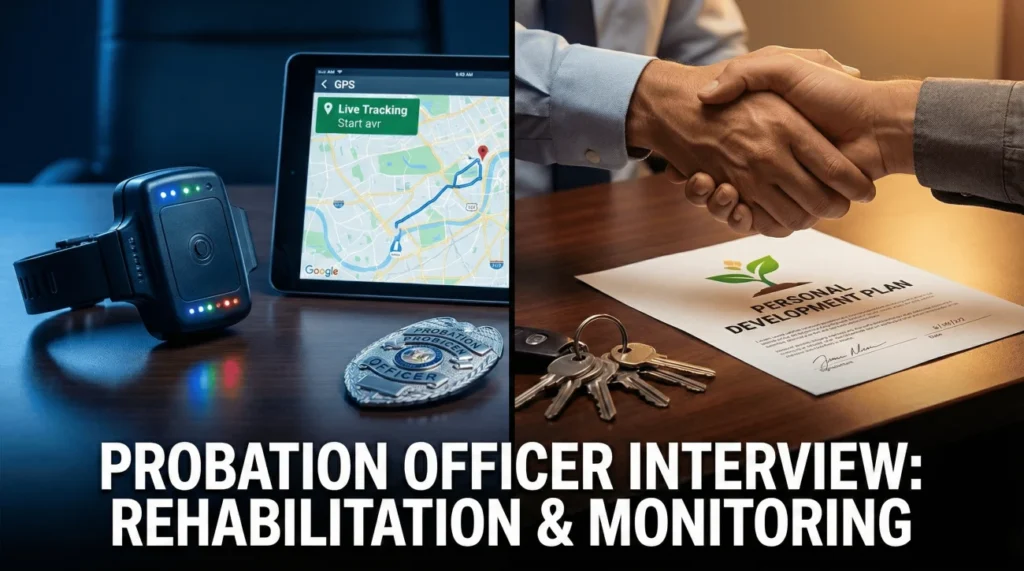
Q: Describe your experience with electronic monitoring (ankle bracelets).
I view electronic monitoring (EM) as a tool, not a replacement for supervision. I understand the difference between RF (Radio Frequency) for curfew monitoring and GPS for active tracking.
I set “inclusion zones” (work, home) and “exclusion zones” (victim’s house, schools). I review the daily tracks for unauthorized stops. If I get a strap tamper alert or a battery low alert, I treat it as an immediate priority. I also verify that the offender is actually charging the device. I remind them that EM is a privilege allowing them to stay out of jail, and any attempt to defeat it will result in custody.
Field Scenarios and Officer Safety
You are conducting a home visit and see drug paraphernalia on the table. The probationer blocks your path. What do you do?
Officer safety is paramount. I do not engage in a physical struggle for evidence alone. I would immediately create distance and de-escalate verbally: “Take a step back. We can talk about this.”
I would retreat to a safe location (my vehicle) and call for law enforcement backup. Once backup arrives, we would re-enter to secure the scene and the contraband. Blocking my path is an assault on an officer and a violation. I would likely arrest the probationer for the violation and the new charge. I document everything, but I never prioritize the seizure of evidence over my life.
A victim calls you terrified because the probationer drove by their house. How do you respond?
I take this very seriously. I ask the victim for details: time, vehicle description, and if they have any video proof. I tell them to call 911 if the probationer returns.
I immediately check the probationer’s GPS data (if applicable) to corroborate the story. I call the probationer in for an unscheduled office visit immediately. If I have evidence of the violation of the “no contact” order, I will file for revocation. Even without hard proof, I will issue a severe warning and potentially modify conditions to include GPS monitoring if not already present. Victim safety is a top priority.
A probationer admits to you they relapsed on heroin. Do you arrest them?
Not necessarily. It depends on their risk level and the department’s matrix. Arresting them might cause them to lose their job and housing, setting them back further. If they are honest and asking for help, I might pivot to treatment.
I would likely mandate an immediate detox or rehab admission. I would increase testing frequency. However, if they admitted it only because they knew they would fail a test I was about to give, or if they are a danger to themselves (overdose risk), I might use a short “shock” incarceration for detox purposes. My goal is to stop the use, not necessarily to punish the addiction if they are compliant with treatment.
You discover a conflict of interest: your new probationer is a former high school classmate. What do you do?
I disclose it to my supervisor immediately. Even if I believe I can be fair, the appearance of bias (either favoritism or vindictiveness) compromises the integrity of the supervision.
I would ask to have the case transferred to another officer. If that is impossible due to staffing, I would establish strict boundaries and have a supervisor sign off on all major decisions (violations, discharge) to ensure transparency. I would explain to the probationer that our relationship is strictly professional and that I have disclosed our history to management.
Court and Administration
Q: Describe your experience writing court reports and recommendations.
I treat every court report as a legal document that will be scrutinized. I write with clarity, objectivity, and brevity. I distinguish between facts (“The defendant tested positive for cocaine”) and opinions (“The defendant appears unremorseful”). I support every opinion with behavioral evidence. When making a recommendation for sentencing or revocation, I tie it back to the sentencing guidelines and the risk assessment score. I proofread meticulously because a typo can undermine my credibility with the judge. I ensure the report is filed by the deadline so the defense attorney and prosecutor have time to review it.
Q: How do you prepare for a revocation hearing where you will be cross-examined?
I prepare by knowing my file inside and out. I review my chronological notes (“chronos”) to refresh my memory on specific dates and conversations. I anticipate the defense attorney’s strategy; they will likely try to paint me as rigid or unfair, or argue that the violation was a misunderstanding. On the stand, I remain calm and neutral. I answer only the question asked. I do not get defensive. If I made a mistake in procedure, I admit it rather than trying to cover it up. My credibility is my most important asset in court.
Q: How do you handle the stress and potential “secondary trauma” of the job?
I recognize that working with violent offenders and victims can lead to burnout. I practice “emotional hygiene.” I have a strong support system outside of law enforcement. I engage in physical exercise to manage stress. I use the Employee Assistance Program (EAP) if a specific case haunts me. I also set strict boundaries; I do not give out my personal number and I leave the job at the office as much as possible. I view my role as a professional function, not a personal crusade, which helps me maintain emotional distance while still caring.
Q: How do you work with other agencies like the police, CPS, or mental health providers?
Collaboration is a force multiplier. I build relationships with local police officers; they are my eyes on the street when I am not there. I share information with Child Protective Services (CPS) if my probationer has children in the home, as we often serve the same dysfunctional families. With mental health providers, I get releases signed so we can coordinate care plans. If a provider tells me a client is non-compliant with meds, I can use my authority to enforce compliance. I view us as a team wrapping services and supervision around the offender.
Probation Officer Knowledge Quiz
20 Practice Questions
1. What is the main difference between Probation and Parole?
- Probation is for felonies only
- Probation is lieu of prison; Parole is after prison
- Parole is decided by a judge
- There is no difference
2. “Recidivism” refers to:
- Rehabilitating successfully
- Relapsing into criminal behavior
- Reducing the prison sentence
- Recording a court session
3. A “Technical Violation” is:
- Committing a new felony crime
- Violating a rule of supervision (e.g., curfew)
- A computer error in the file
- Assaulting a police officer
4. What is a “PSI” report?
- Post-Sentence Incarceration
- Pre-Sentence Investigation
- Probation Supervision Index
- Parole Status Inquiry
5. “RNR” stands for:
- Risk, Needs, Rehabilitation
- Risk, Need, Responsivity
- Review, Note, Report
- Rules, Norms, Regulations
6. Which is a “Criminogenic Need”?
- Low self-esteem
- Antisocial peers/associates
- Anxiety disorder
- Physical health issues
7. “Restitution” is money paid to:
- The probation department
- The victim of the crime
- The court for filing fees
- The defense attorney
8. A “Revocation Hearing” determines if:
- The offender is guilty of the original crime
- Probation should be ended and prison imposed
- The officer should be fired
- The offender can travel abroad
9. “Motivational Interviewing” is used to:
- Interrogate suspects for confessions
- Elicit internal motivation for change
- Threaten offenders with jail
- Interview witnesses for court
10. “Electronic Monitoring” includes:
- Tapping phone calls
- GPS ankle bracelets
- Reviewing email accounts
- Hidden cameras in the home
11. A “slap on the wrist” sanction is:
- Effective for high-risk offenders
- Often ineffective for behavior change
- A literal physical punishment
- Required by federal law
12. “Static” risk factors are:
- Changeable (e.g., employment)
- Unchangeable (e.g., criminal history)
- Related to electricity
- Dependent on the officer’s mood
13. “Dynamic” risk factors are:
- Unchangeable (e.g., age at first arrest)
- Changeable (e.g., substance abuse)
- Genetic traits only
- Determined by the judge only
14. What is “Cognitive Behavioral Therapy” (CBT)?
- Treating physical brain injuries
- Changing thinking patterns to change behavior
- Shock therapy for behavior
- Group therapy for talking only
15. “Interstate Compact” governs:
- Speed limits on highways
- Transferring supervision between states
- Weapons permits for officers
- Prison construction contracts
16. A “Status Offense” applies to:
- Adult felons only
- Juveniles only (e.g., truancy)
- Traffic violations only
- Violent crimes only
17. The “LSI-R” is a tool for:
- Testing drug levels
- Assessing risk and needs
- Lie detection (polygraph)
- Location tracking
18. “Community Service” is a form of:
- Paid employment
- Restorative justice sanction
- Jail time credit
- Educational training
19. A “Warrant” is required to:
- Call an offender on the phone
- Arrest an offender (usually)
- Write a case note
- Drug test an offender
20. “Absconding” means:
- Stealing from a store
- Fleeing supervision/whereabouts unknown
- Completing probation early
- Attending all appointments
❓ Frequently Asked Questions
👮 Do probation officers carry guns?
It depends on the jurisdiction and the specific role. In the federal system and many states, POs are fully sworn peace officers who carry firearms, handcuffs, and pepper spray. In other jurisdictions (especially juvenile probation or county levels), they may be unarmed case managers who rely on police for arrests.
🎓 What degree do I need?
A bachelor’s degree is almost always the minimum requirement. Preferred majors include Criminal Justice, Social Work, Psychology, or Sociology. For federal positions or specialized units, a master’s degree or significant experience is often required.
💸 Is the pay dangerous enough?
Probation officers generally earn a middle-class salary, often with government benefits (pension, health insurance). Federal officers earn significantly more. While the job has risks, it is generally statistically safer than being a police patrol officer, though field work carries inherent unpredictability.
⚖️ What is the hardest part of the job?
The emotional toll of seeing potential wasted and the frustration of the revolving door. You invest time in someone, and they re-offend. Also, the administrative burden is heavy; paperwork, court reports, and data entry consume about 50-60% of the time, which can be tedious for those expecting constant action.
🚀 Can I move from Probation to the FBI or DEA?
Yes. Experience as a probation officer is highly valued by federal law enforcement agencies. It demonstrates you can manage a caseload, investigate, interview suspects, and write legal reports. It is a common stepping stone to becoming a Special Agent.
The Firm but Fair Guardian
Probation work is not for the cynical or the naive. It requires a balanced “firm but fair” approach. You must be the person who holds the offender accountable when no one else will, but also the person who sees their potential when they cannot see it themselves. When you interview, show them your grit and your humanity. Demonstrate that you can handle the danger of the field and the drudgery of the paperwork with equal professionalism.
By preparing with these probation officer interview questions, you position yourself as a candidate who understands the nuances of modern corrections. You are ready to protect the community not just by locking people up, but by helping them change.
⚠️ Disclaimer: The interview strategies, sample answers, and negotiation tips provided in this guide are for educational purposes only. Hiring decisions are subjective and vary by company and industry. While these strategies are based on professional HR standards, they do not guarantee a specific job offer or result.