The Bridge Builder
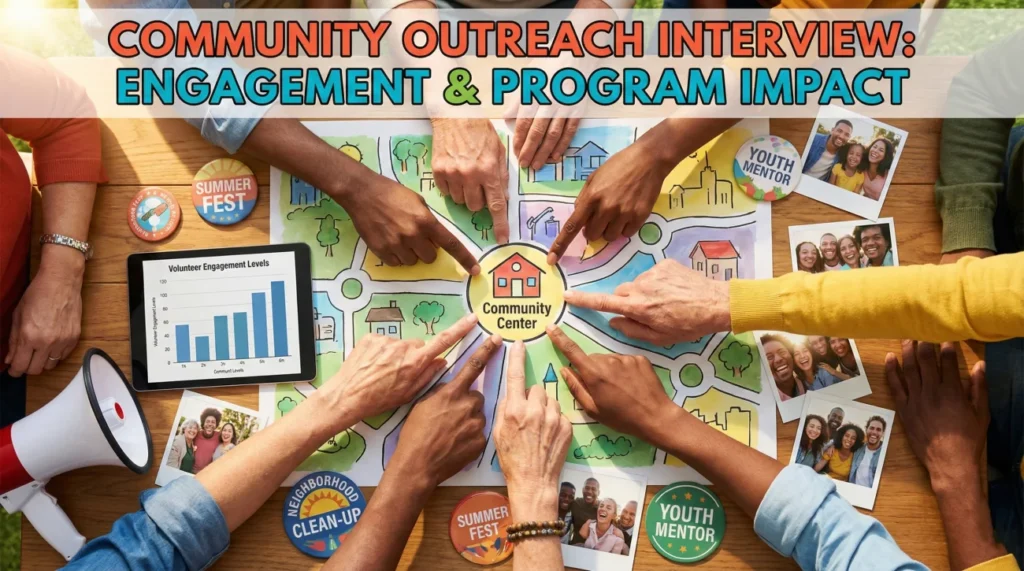
A Community Outreach Coordinator is the face, voice, and heartbeat of an organization within the public sphere. You are the bridge builder who connects a non-profit, government agency, or corporation with the people it aims to serve. This role requires a dynamic blend of skills; you must be a strategic planner, a charismatic public speaker, a meticulous event organizer, and a data-driven analyst all at once.
Hiring managers are looking for candidates who can do more than just hand out flyers at a fair. They need strategists who can conduct community needs assessments, build sustainable partnerships with local leaders, and prove the ROI of outreach efforts through hard data. They want to know if you can mobilize volunteers, secure funding, and navigate the complex political landscape of community organizing without stepping on toes.
To secure this position, you must be prepared to answer community outreach coordinator interview questions that test your ability to turn abstract mission statements into tangible action. This guide provides the detailed, field-tested answers you need to demonstrate that you are the catalyst for connection and change.
Strategic Engagement and Planning
Q: Walk me through your process for conducting a community needs assessment.
A needs assessment is the foundation of effective outreach. I start by gathering existing data from census reports, local health departments, and previous organizational reports to understand the demographic landscape. However, data only tells part of the story. I then move to qualitative research. I conduct focus groups with key demographics, interview community leaders (faith leaders, school principals, local business owners), and attend town hall meetings to listen. I map the community’s assets, not just its deficits. I look for the gap between what the community needs and what services currently exist. Finally, I synthesize this quantitative and qualitative data into a report that identifies the top three priorities for our outreach strategy, ensuring our programs are demand-driven rather than supply-driven.
Q: How do you identify and cultivate strategic partnerships?
I look for alignment in mission and target audience. I start by mapping the ecosystem to see who is already doing the work. I approach potential partners with a “value-add” proposition, not an “ask.” I ask, “How can our resources help you achieve your goals?” For example, if I am from a health clinic, I might partner with a food bank to offer screenings during their distribution times. This benefits the food bank by offering more value to their clients and benefits us by accessing a hard-to-reach population. I formalize these partnerships with MOUs (Memorandums of Understanding) to clarify roles and expectations. I maintain the relationship through regular communication and public recognition of their contributions.
Q: Describe a time you had to pivot an outreach strategy that was not working.
In a previous campaign to increase youth program enrollment, our digital marketing strategy was failing to generate leads. I analyzed the data and realized our target audience (low-income parents) did not rely on the digital channels we were using. I pivoted immediately to a “grassroots” approach. I shifted the budget to print flyers and physically canvassed local laundromats, barbershops, and grocery stores. I also recruited “parent ambassadors” to spread the word via word-of-mouth. Within two weeks, enrollment tripled. This taught me that meeting people where they physically are is often more effective than trying to reach them where we want them to be digitally.
Q: How do you measure the success or impact of your outreach efforts?
I move beyond “vanity metrics” like the number of flyers handed out. I focus on outcome and impact metrics. I use a Logic Model to define success before we start. If the goal is awareness, I measure website traffic spikes or social media engagement during the campaign. If the goal is behavior change, I track conversion rates, such as the number of people who signed up for a screening or attended a workshop. I use pre- and post-surveys to measure changes in knowledge or attitude. I also track the “cost per acquisition” to ensure we are using our budget efficiently. I report these metrics to stakeholders in a dashboard format to prove the ROI of our work.
Q: How do you ensure your outreach is inclusive and culturally competent?
Inclusion is intentional, not accidental. I ensure all materials are translated into the primary languages spoken in the community, using professional translators rather than Google Translate to ensure cultural nuance. I schedule events at varied times (evenings, weekends) to accommodate working families. I choose venues that are physically accessible and trusted by the community, such as libraries or community centers, rather than intimidating government buildings. I also hire or recruit staff and volunteers who reflect the diversity of the population we serve. I actively seek feedback from community members on our approach and am willing to adapt if we miss the mark.
Program Management and Events
Q: How do you manage a limited budget for a large-scale event?
I treat every dollar as critical. I start by creating a detailed line-item budget with a contingency fund. I aggressively seek in-kind donations for the big-ticket items like venue space, food, and printing.
I negotiate with vendors for non-profit rates. I leverage volunteers instead of paid staff for event labor. I prioritize spending on the “client experience” components that drive attendance, cutting costs on administrative fluff. I track expenses in real-time to ensure we never go over budget.
Q: Describe your experience recruiting and managing volunteers.
Volunteers are the lifeblood of outreach. I recruit using a mix of online platforms (VolunteerMatch), corporate CSR programs, and local colleges. I interview potential volunteers to match their skills with our needs, ensuring a good fit.
I provide clear job descriptions and orientation training so they feel confident. I focus heavily on retention through recognition; I send handwritten thank-you notes, host appreciation events, and highlight their work in newsletters. I treat volunteers with the same respect as paid staff, knowing they are donating their most valuable asset: time.
Q: How do you handle an event disaster, like bad weather or a no-show speaker?
I always have a “Plan B” and “Plan C.” For weather, I secure an indoor backup location or a rain date in advance. For speakers, I always have a prepared internal staff member ready to step in or a pre-recorded video option.
Communication is key during a crisis. I use our CRM and social media to blast updates to attendees immediately. I stay calm and solution-oriented on site. If the event is canceled, I follow up with a sincere apology and a concrete plan for rescheduling or refunding, turning a negative into a customer service win.
Q: How do you ensure data collection happens during chaotic community events?
Data collection must be frictionless. I avoid long paper forms. I use QR codes linked to short mobile-friendly surveys. I incentivize completion with a raffle or small giveaway.
I train volunteers to act as “data scribes” with tablets, proactively asking attendees questions so the burden isn’t on the guest. I focus on collecting the minimum viable data (name, email, zip code) to maximize compliance. I ensure all data is entered into our database within 24 hours while the leads are warm.
Q: How do you balance program quality with the pressure to increase quantity/numbers?
This is the classic “depth vs. breadth” tension. I advocate for a balanced portfolio. We might have one large “breadth” event (like a health fair) to generate numbers and awareness.
However, I ensure we also have smaller “depth” programs (like a 6-week workshop) that create lasting impact. I communicate to leadership that while high numbers look good on a grant report, deep engagement creates the testimonials and life changes that actually fulfill our mission. I refuse to dilute program quality just to hit a metric.
Q: Describe your experience with grant writing or fundraising support.
I understand that outreach and fundraising are linked. I support the development team by gathering the data, stories, and photos they need for proposals. I have experience researching grant opportunities that align with our specific programs.
I have written sections of grant narratives, specifically the “program design” and “community need” sections. I also ensure that our grant deliverables are realistic before we accept the money. I track grant compliance rigorously to ensure we can renew the funding next year.
Communication and Public Relations
A community member publicly criticizes your organization at a town hall. How do you respond?
I do not get defensive. I listen actively and validate their frustration. I say, “Thank you for sharing that feedback. I can hear how passionate you are about this issue.”
If they are factually incorrect, I gently correct the record with data, but I focus on their underlying concern. I offer to take the conversation offline to address their specific case personally. This shows the audience that we are responsive and accountable, without letting the meeting derail into an argument. I view critics as potential partners if we can address their concerns.
How do you craft a message that resonates with diverse audiences?
I segment my messaging. The “pitch” I use for a corporate sponsor is different from the one I use for a community elder or a college student. I identify the “WIIFM” (What’s In It For Me) for each group.
I avoid jargon and acronyms. I use storytelling to make the data emotional and memorable. I test my messaging with a small focus group before a wide release. I ensure the visuals used in marketing materials reflect the diversity of the audience so they can see themselves in our mission.
You need to promote an event with zero marketing budget. What is your plan?
I rely on “earned media” and partnerships. I write a compelling press release and pitch it to local newspapers and radio stations, offering them an interesting interview angle. I create a social media toolkit (graphics, sample posts) and ask all our partners, board members, and volunteers to share it.
I post on free community calendars (libraries, coffee shops, neighborhood apps like Nextdoor). I leverage email marketing to our existing list. I use “guerrilla marketing” tactics like chalk art on sidewalks (with permission). Creativity and hustle can often outperform a paid ad buy.
How do you handle internal resistance from staff who don’t want to participate in outreach?
I try to make outreach easy and rewarding for them. I explain how outreach benefits their specific department (e.g., “More outreach means more clients for your program”). I provide them with talking points and materials so they don’t feel unprepared.
I acknowledge their workload and try to schedule their shifts during work hours rather than personal time. I publicly celebrate their participation. If resistance persists, I work with leadership to incorporate outreach participation into job descriptions or performance reviews, framing it as a core organizational value.
Community Outreach Skills Quiz
20 Practice Questions
1. What is a “stakeholder” in outreach?
- Someone who holds the tent stakes
- Anyone affected by the organization’s work
- Only the donors who give money
- The paid staff members only
2. “MOU” stands for:
- Meeting of Understanding
- Memorandum of Understanding
- Method of Utilizing
- Management of Unions
3. A “Needs Assessment” is done to:
- Determine staff salaries
- Identify gaps in community services
- Plan the holiday party
- Create a new logo
4. “Grassroots” outreach focuses on:
- High-level corporate lobbying
- Mobilizing the general public directly
- Buying expensive TV ads
- Mowing the lawn at the office
5. Which is a qualitative metric?
- Number of attendees (500)
- Testimonial about program impact
- Total dollars raised ($10k)
- Number of flyers printed (1000)
6. “Capacity Building” means:
- Building a larger office
- Strengthening ability to deliver mission
- Hiring more security guards
- Buying more computers only
7. “In-kind” donation refers to:
- Cash donations only
- Donation of goods or services
- Kindness shown to staff
- Donations from family members
8. A “Logic Model” maps out:
- The floor plan of the event
- Inputs, Activities, Outputs, Outcomes
- The logic of the computer system
- The schedule for the day
9. “Canvassing” involves:
- Painting on canvas
- Going door-to-door or person-to-person
- Sending mass emails only
- Calling major donors only
10. “Sustainability” in programs means:
- Recycling paper only
- Continuing impact after initial funding ends
- Working shorter hours
- Hiring only local staff
11. A “SWOT” analysis covers:
- Sales, Work, Organization, Time
- Strengths, Weaknesses, Opportunities, Threats
- Staff, Wages, Overtime, Taxes
- Safety, Water, Oxygen, Temperature
12. “Coalition Building” involves:
- Building a new coal plant
- Uniting organizations for a common goal
- Fighting against other groups
- Merging two companies legally
13. “Earned Media” is:
- Paid advertising spots
- Publicity gained through news/editorial
- Media owned by the company
- Social media posts by staff
14. Which is a barrier to access?
- Having too much money
- Lack of transportation to venue
- Too many volunteers helping
- Free food at the event
15. “Cultural Competence” requires:
- Ignoring differences to be equal
- Understanding/respecting diverse values
- Speaking every language fluently
- Only hiring one demographic
16. A “Key Informant” interview is with:
- A police informant
- A community leader with deep insight
- The person who unlocks the door
- A random person on the street
17. “Volunteer Retention” focuses on:
- Firing volunteers quickly
- Keeping volunteers engaged long-term
- Stopping volunteers from leaving
- Retaining their paychecks
18. “Community Asset Mapping” identifies:
- The richest people in town
- Existing resources and strengths
- The location of the bank
- The worst neighborhoods only
19. “Focus Group” is a method of:
- Photography training
- Qualitative research discussion
- Individual therapy
- Staff disciplinary meeting
20. “ROI” stands for:
- Rate of Interest
- Return on Investment
- Risk of Injury
- Range of Impact
❓ Frequently Asked Questions
📆 What are the typical hours for this role?
This is rarely a 9-to-5 job. Community events often happen on evenings and weekends to accommodate working families. You must be flexible and willing to work a non-traditional schedule, though many organizations offer “comp time” to balance the long hours.
🎓 Do I need a specific degree?
While degrees in Communications, Social Work, Public Health, or Non-Profit Management are common, experience often trumps education. Proven success in community organizing, event planning, or volunteer management is highly valued regardless of your major.
🚗 Is a car required?
Almost always. You will be traveling constantly between partner sites, schools, events, and the office. A valid driver’s license and reliable transportation are usually non-negotiable requirements for outreach positions, along with a clean driving record.
💻 How much tech skill is needed?
You need to be proficient in Microsoft Office and Google Suite for basic work. Familiarity with CRM software (Salesforce, Raiser’s Edge), email marketing tools (Mailchimp), and social media platforms/design tools (Canva) is increasingly expected for modern outreach.
🚀 What is the career path?
Successful coordinators often advance to Program Director, Director of Development, or Communications Director. The skills are also transferable to Corporate Social Responsibility (CSR) roles in the private sector or community relations roles in government.
The Catalyst for Connection
Community outreach is the art of turning strangers into allies and ideas into movements. It requires an extroverted energy, an organized mind, and a genuine love for people. When you walk into the interview, bring your portfolio of past successes. Show them the flyers you designed, the data you collected, and the partnerships you forged. Tell the stories of the lives you touched through your programs.
By preparing with these community outreach coordinator interview questions, you demonstrate that you are not just a participant in the community, but a leader within it. You are ready to amplify the organization’s mission and build the lasting connections that drive real change.
⚠️ Disclaimer: The interview strategies, sample answers, and negotiation tips provided in this guide are for educational purposes only. Hiring decisions are subjective and vary by company and industry. While these strategies are based on professional HR standards, they do not guarantee a specific job offer or result.