
- Big picture: “Tell me about yourself” is really a quick check that you can tell a clean, role-relevant story and steer the interview toward your strongest fit.
- Simple flow: Keep it to Present, Past, Future in about 90 to 120 seconds, open with what you do now, pull in 2 to 3 wins that matter here, then land on why this role makes sense.
- Make it believable: Lead with outcomes and concrete details so it sounds like proof, not you reading your résumé out loud.
- What to avoid: Don’t do the full life story, don’t use a generic speech for every job, and don’t overshare personal stuff that creates new questions.
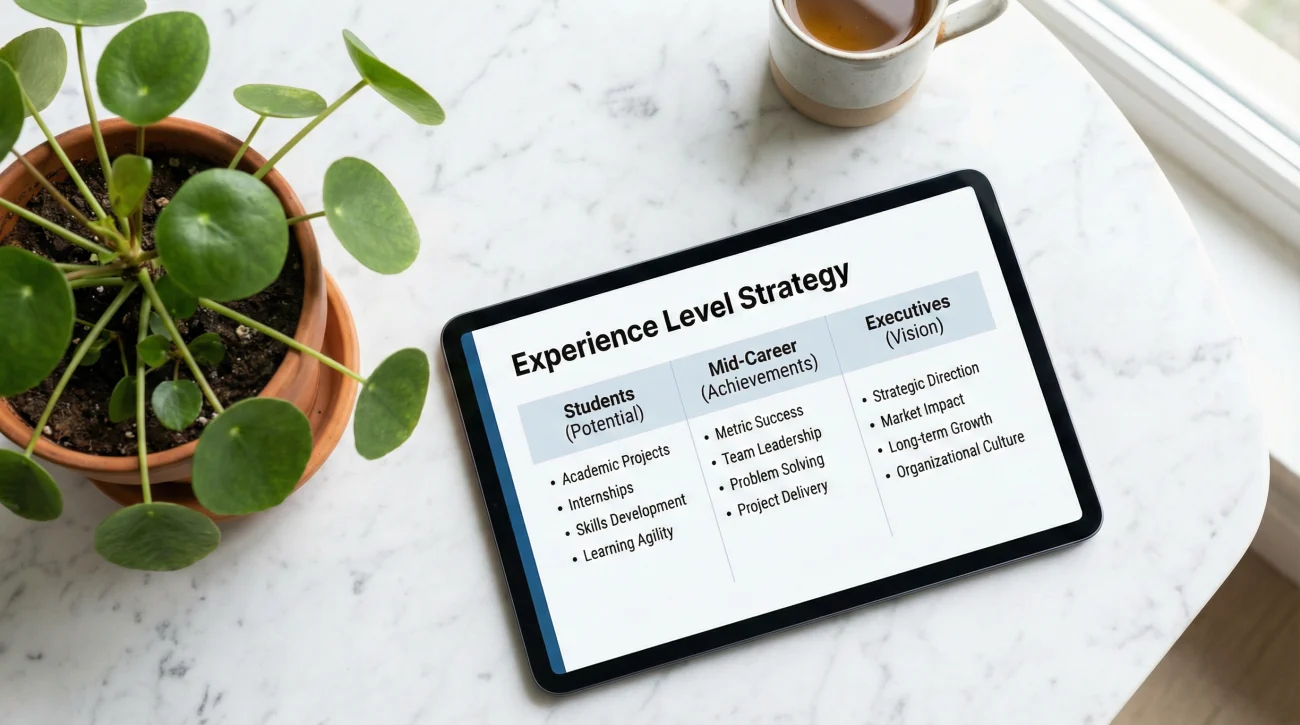
- Tailor fast: Shorten and keyword-match for screens, bring more energy on video, highlight growth for internal moves, and shift emphasis by career stage from potential to results to leadership impact.

The first question in 99% of interviews catches more candidates off guard than any technical challenge that follows.
Tell me about yourself sounds simple. You’ve lived your own life – what could be easier than talking about it? Yet this deceptively open-ended question derails countless qualified candidates who either ramble for five minutes about their childhood or deliver a robotic recitation of their resume.
Hiring managers aren’t asking for your life story. They’re testing whether you can communicate strategically, highlight relevant experience, and connect your background to their specific needs. Your answer sets the tone for everything that follows. Nail this opener, and the rest of the interview flows naturally. Fumble it, and you spend the remaining thirty minutes trying to recover lost ground.
The difference between a forgettable introduction and one that captures attention comes down to structure, relevance, and delivery. This guide breaks down exactly what interviewers want to hear, how to organize your response, and how to adapt your answer across different contexts and career stages.
Why Interviewers Always Start Here
This question serves multiple purposes that extend far beyond breaking the ice. Understanding the psychology behind it helps you craft a strategic response rather than just talking about yourself.
The Communication Skills Test
Interviewers evaluate how clearly you express complex information under pressure. Can you organize your thoughts coherently? Do you stay focused or drift into tangents? Your answer reveals whether you’ll communicate effectively with clients, colleagues, and stakeholders if hired.
Strong communicators provide context without overwhelming detail. They emphasize relevant points and skip unnecessary background. Weak communicators either provide too little information, leaving interviewers confused about their qualifications, or too much, burying key accomplishments under irrelevant details about their high school debate team.
The Relevance Assessment
Smart candidates understand this question isn’t about them – it’s about the role. Interviewers listen for how quickly you connect your experience to their needs. Do you highlight skills that match the job description? Or do you talk about achievements that have nothing to do with the position?
This filters candidates into two groups: those who researched the company and tailored their introduction, and those who deliver a generic speech they’ve memorized for all interviews. The first group demonstrates strategic thinking. The second suggests they’re applying everywhere without genuine interest.
Setting the Interview Direction
Your introduction gives interviewers material for follow-up questions. Mention a specific project, and they’ll ask about it. Reference a skill, and they’ll probe deeper. The details you choose to emphasize guide the conversation toward your strengths rather than your weaknesses.
Experienced interviewers use this response to identify patterns in your career. They’re looking for consistency in your choices, progression in your responsibilities, and alignment between your stated goals and the role you’re pursuing. Your opening answer sets up the rest of the conversation, including how you’ll handle behavioral interview questions that follow.
The Present-Past-Future Framework
The most effective tell me about yourself answer follows a simple three-part structure that keeps you focused and relevant. This framework works across all experience levels and industries.

Present – Where You Are Now
Start with your current situation in one to two sentences. State your role, company, and key responsibility or recent achievement. This immediately establishes your professional identity and sets context for everything else you’ll share.
✅ Strong opening: “I’m a Senior Product Manager at a B2B SaaS startup, where I lead a team building tools that help sales teams automate their outreach.”
Notice the specificity – role, industry, and what the product actually does. Vague openings like “I work in tech” or “I’m in sales” waste the interviewer’s time and suggest you haven’t thought about how to position yourself.
Past – How You Got Here
Spend the bulk of your answer walking through the two to three most relevant experiences that led to your current role. Focus on progression, not chronology. Highlight accomplishments and skills that directly relate to the position you’re interviewing for.
Don’t list every job you’ve held. Cherry-pick experiences that demonstrate the competencies this role requires. If you’re interviewing for a leadership position, emphasize moments where you built teams or drove strategic initiatives. If it’s an individual contributor role, focus on technical achievements and specialized expertise. For structuring your stories effectively, consider using the STAR method to organize your examples.
The present past future formula ensures you spend approximately 60% of your answer on this section. This is where you prove your qualifications through specific examples rather than generic claims about being a “hard worker” or “team player.”
Future – Why This Role
Close by connecting your trajectory to this opportunity. Explain what attracted you to the role and how it aligns with your career goals. This demonstrates intentionality – you’re not randomly applying to jobs, you’ve thought about where you want to go.
💯Effective closing: “I’m excited about this role because it combines my product experience with my interest in enterprise software, and I’m ready to take on the challenge of scaling a product from Series B to Series C.”
Never end with vague statements like “I think I’d be a good fit” or “I’m looking for new challenges.” Be specific about what excites you and why this role makes sense for your next step. This natural transition also prepares you to ask thoughtful questions to ask the employer when they give you the opportunity.
The Seven Deadly Mistakes
Even prepared candidates fall into predictable traps that undermine otherwise strong backgrounds. Recognizing these patterns helps you avoid them.
Resume Recitation
Reading your resume aloud wastes everyone’s time. Interviewers have already seen your resume – that’s why you’re sitting in front of them. They want insight into the person behind the bullet points, not a verbal replay of what they’ve already read. If you need guidance on which experiences to highlight, review common interview questions to understand what interviewers care about most.
The Autobiography
Starting with your childhood, undergraduate major, or hometown buries relevant experience under unnecessary context. Nobody cares where you went to middle school or why you chose your college. Get to professional accomplishments within the first thirty seconds.
The Generic Template
Memorizing one answer for all interviews guarantees irrelevance. Each role requires different skills and experiences. Your introduction for a startup should differ from your pitch to a Fortune 500 company. Tailor your response based on the job description and company culture.
Personal Oversharing
This isn’t therapy or a first date. Interviewers don’t need to know about your divorce, health issues, or family drama. Keep the focus professional. Brief mentions of relevant hobbies are fine – “I love rock climbing” shows you’re active and take on challenges – but don’t let personal details overshadow professional achievements.
| Mistake | Why It Fails | Better Approach |
|---|---|---|
| Too long (5+ minutes) | Loses interviewer attention | Keep it under 2 minutes |
| Too short (30 seconds) | Misses opportunity to sell yourself | Aim for 90-120 seconds |
| Chronological history | Buries relevant experience | Lead with recent, relevant work |
| Listing responsibilities | No proof of impact | Share specific achievements with metrics |
Adapting Across Interview Contexts
Your baseline answer needs modification depending on interview format, round, and company type. The core structure stays the same, but emphasis and length shift based on context.

Phone Screening – Short and Keyword-Rich
Recruiters conducting initial screens often run through multiple candidates per day. They’re checking boxes on required qualifications rather than evaluating nuanced fit. Keep your answer concise – sixty to ninety seconds maximum. Load your response with keywords from the job description to signal you meet their requirements.
This isn’t the time for storytelling or showing personality. Hit the highlights and get to the point. Recruiters want confirmation that you have the baseline qualifications before passing you to the hiring manager.
Video Interview – Energy and Eye Contact
Virtual interviews require adjustments in delivery, not just content. Your energy needs to be 20% higher than in person to compensate for the flat medium. Look directly at the camera when you speak, not at your own image or the interviewer’s face on screen.
Position your camera at eye level and ensure good lighting. Technical issues distract from your message, so test your setup beforehand. The content of your answer remains the same, but your presentation requires extra polish to overcome the virtual barrier.
Internal Promotion – Focus on Growth
When interviewing internally, skip the company research and basic background. Your interviewers already know your work history. Instead, emphasize your contributions to the organization, how you’ve grown, and why you’re ready for increased responsibility.
Frame your answer around value delivered and readiness for the next level. Reference specific projects you’ve led, relationships you’ve built, and strategic thinking you’ve demonstrated. This isn’t about convincing them you can do the job – it’s about proving you deserve the promotion.
Panel Interview – Address Everyone
Multiple interviewers mean multiple perspectives on what matters. Make eye contact with each person as you speak, not just the person who asked the question. Structure your answer to touch on different aspects of the role that appeal to different stakeholders.
If you know their roles beforehand, subtly emphasize different points for each person. Mention technical achievements when looking at the engineering lead, discuss collaboration when addressing the cross-functional partner, and highlight business impact when speaking to the executive.
Tailoring by Experience Level
Career stage dramatically changes what you should emphasize. Students lead with potential and coursework. Executives focus on vision and business impact. Matching your answer to your experience level shows self-awareness.
Students and Entry-Level
Without extensive professional experience, emphasize relevant coursework, academic projects, internships, and extracurricular leadership. Demonstrate learning agility and enthusiasm rather than proven expertise.
Highlight how your education prepared you for the role. Reference specific classes, projects, or research that developed skills the job requires. Showcase your elevator pitch for interview by connecting academic achievements to professional applications. The Muse offers excellent examples of how to structure introductions at different career stages.
Don’t apologize for lack of experience. Frame your newness as an advantage – you’re eager to learn, adaptable, and bring fresh perspectives. Companies hiring entry-level candidates expect to train you. They’re evaluating your potential and coachability, not your track record.
Mid-Career Professionals
With three to seven years of experience, focus on specific achievements that demonstrate mastery of your craft. Skip your education entirely unless you have an advanced degree directly relevant to the role. Lead with your most impressive recent accomplishment.
This is the sweet spot for proving yourself. You’re experienced enough to have delivered measurable results but not so senior that you’re only managing others. Emphasize projects you’ve owned end-to-end, problems you’ve solved independently, and technical or domain expertise you’ve built.
Management and Executive Level
Leadership roles require a fundamentally different approach. Stop talking about what you personally accomplished and start discussing what your teams achieved under your leadership. Focus on strategy, vision, team building, and business outcomes.
Executives should lead with their personal branding statement – a clear articulation of the type of leader they are and the transformation they drive. Reference the size and scope of organizations you’ve run, P&L responsibility you’ve held, and strategic initiatives you’ve championed. For additional guidance on crafting executive-level responses, Big Interview provides comprehensive examples across various seniority levels.
Complete “Tell Me About Yourself” Library
To craft a truly compelling introduction, you need to look beyond a single template. This master guide connects to specialized resources covering every variation of the “tell me about yourself” question, including specific frameworks for all experience levels and strategic contexts:
| Article | Focus |
|---|---|
| Tell Me About Yourself Answer | Answers by Experience Level |
| Career Transition Interview Questions | Employment Gaps & Tough Questions |
| Interview Introduction Scripts | The Copy-Paste Library |
❓ FAQ
🎯 How long should my answer be?
Aim for 90 to 120 seconds – long enough to establish your qualifications without losing the interviewer’s attention. In phone screens, stay closer to 60 seconds. In final-round interviews with senior leaders, you can stretch to two minutes. Practice with a timer until you naturally hit this range.
💼 Should I mention my education?
For students and recent graduates, yes – lead with your degree, major, and relevant coursework. For experienced professionals, skip it entirely unless directly relevant (like an MBA for a strategy role or a PhD for a research position). Your recent work experience matters more than where you went to college a decade ago.
⏰ Can I use the same answer for every interview?
No. While your core framework stays consistent, you need to tailor which experiences you emphasize based on the role requirements. Interviewing for a leadership position? Focus on team management. Individual contributor role? Highlight technical achievements. Same structure, different examples.
📋 What if I have employment gaps?
Don’t hide gaps, but don’t dwell on them either. Briefly acknowledge the break without excessive detail: “After leaving Company X, I took six months to care for a family member before returning to the workforce.” Then immediately transition to your relevant experience. Keep the focus on what you’ve accomplished, not on time away.
✨ How do I make my answer memorable?
Specificity creates memorability. Instead of “I increased sales,” say “I increased enterprise sales by 40% by building a new outbound strategy that prioritized Fortune 500 accounts.” Concrete details and metrics stick in interviewers’ minds far better than generic claims about being passionate or hardworking.
Final Thoughts
Most candidates approach “tell me about yourself” as if it’s actually about them. It’s not. It’s about demonstrating you understand what the interviewer needs and positioning yourself as the solution. Your answer isn’t a biography – it’s a strategic pitch.
The Present-Past-Future framework gives you structure, but the real work happens in selecting which details to emphasize. Every example you choose should reinforce why you’re the right fit for this specific role. Generic answers suggest you haven’t done your homework. Tailored responses prove you understand both the job and your unique value.
Master tell me about yourself and you control the interview from the first moment. You set the agenda, highlight your strengths, and create natural transitions to topics where you shine. The interviewer relaxes because you’ve demonstrated you can communicate effectively – a fundamental requirement for any role.
This isn’t about memorizing a script. It’s about understanding what makes you valuable and articulating it with confidence. Practice your core story until you can deliver it naturally, then adapt it based on the context. That preparation transforms a dreaded question into your strongest opening move.
⚠️ Disclaimer: The interview strategies, sample answers, and negotiation tips provided in this guide are for educational purposes only. Hiring decisions are subjective and vary by company and industry. While these strategies are based on professional HR standards, they do not guarantee a specific job offer or result.