
- Why These Questions Come Up: Non-linear paths (gaps, pivots, short tenures, step-downs) trigger “risk checks,” so interviewers probe commitment, productivity, stability, and patterns.
- Winning Frame: Own the narrative with calm facts, then pivot fast to fit and readiness, spending more time on why this role makes sense now than on why the past happened.
- Bridge The Story: Connect chapters using transferable skills, deliberate choices, and skill-building so your path feels coherent instead of random or reactive.
- Handle Gaps And Pivots Cleanly: Keep explanations brief, show what you did to stay productive or committed, and make your motivation and investment obvious through actions, not claims.
- Avoid Self-Sabotage: Don’t over-explain, blame, or stay negative, replace vague platitudes with specific reasons and outcomes that reassure hiring managers.
Why Transitions Create Interview Anxiety
Non-linear career paths trigger more interview anxiety than straightforward progressions. Gaps in employment history, career pivots, frequent job changes, or stepping down from senior roles all require explanation during interviews. Understanding career transition interview questions helps you address these sensitive topics confidently rather than defensively, transforming potential weaknesses into demonstrations of adaptability, self-awareness, and intentional career management.
The key difference between strong and weak answers lies in framing. Defensive candidates apologize for transitions, make excuses, or dwell on negative circumstances that forced changes. Confident candidates acknowledge transitions matter-of-factly, explain their reasoning clearly, and connect past experiences to current opportunities. When discussing career trajectory, understanding how to structure your narrative through tell me about yourself responses provides the foundation for handling tougher questions about transitions.
Why Interviewers Probe Career Transitions
When asking explaining career change interview questions, interviewers aren’t judging your life choices – they’re assessing whether your transition creates risks for them. Understanding their concerns helps you address them proactively rather than defensively.
Core Interviewer Concerns
Every transition question aims to uncover whether you’ll be committed, productive, and stable if hired. Interviewers worry that gaps signal lack of motivation, frequent changes indicate inability to commit, and career pivots suggest you’ll leave when something better comes along.
- 🎯 Commitment risk: Will you stay long enough to justify hiring costs?
- ⚡ Productivity concerns: Are you up-to-date with skills and industry practices?
- 💼 Stability assessment: Will personal circumstances force another departure?
- 🔄 Pattern evaluation: Does your history suggest chronic dissatisfaction?
💡 Pro tip: Interviewers asking about transitions aren’t being nosy – they’re trying to assess hiring risk. Your job is providing reassurance that hiring you makes business sense despite non-traditional background.
What Triggers Deeper Questioning
Certain resume patterns immediately prompt transition questions. Unexplained gaps longer than a few months, multiple short-tenure roles, dramatic industry changes, or stepping down from senior positions all signal that something happened requiring explanation.
| Resume Pattern | Interviewer Concern |
|---|---|
| Employment gaps (3+ months) | Were you unable to find work or unwilling to work? |
| Multiple short tenures (under 1 year) | Will you leave quickly after we invest in training? |
| Career pivot to unrelated field | Are you serious or just experimenting? |
| Step down in seniority or pay | What happened – burnout, failure, or desperation? |
| Frequent industry changes | Do you understand what you actually want? |
Core Principles for Framing Transitions
Effective job transition interview answers follow consistent principles regardless of specific circumstances. These guidelines help you discuss difficult topics professionally without appearing defensive or making excuses.
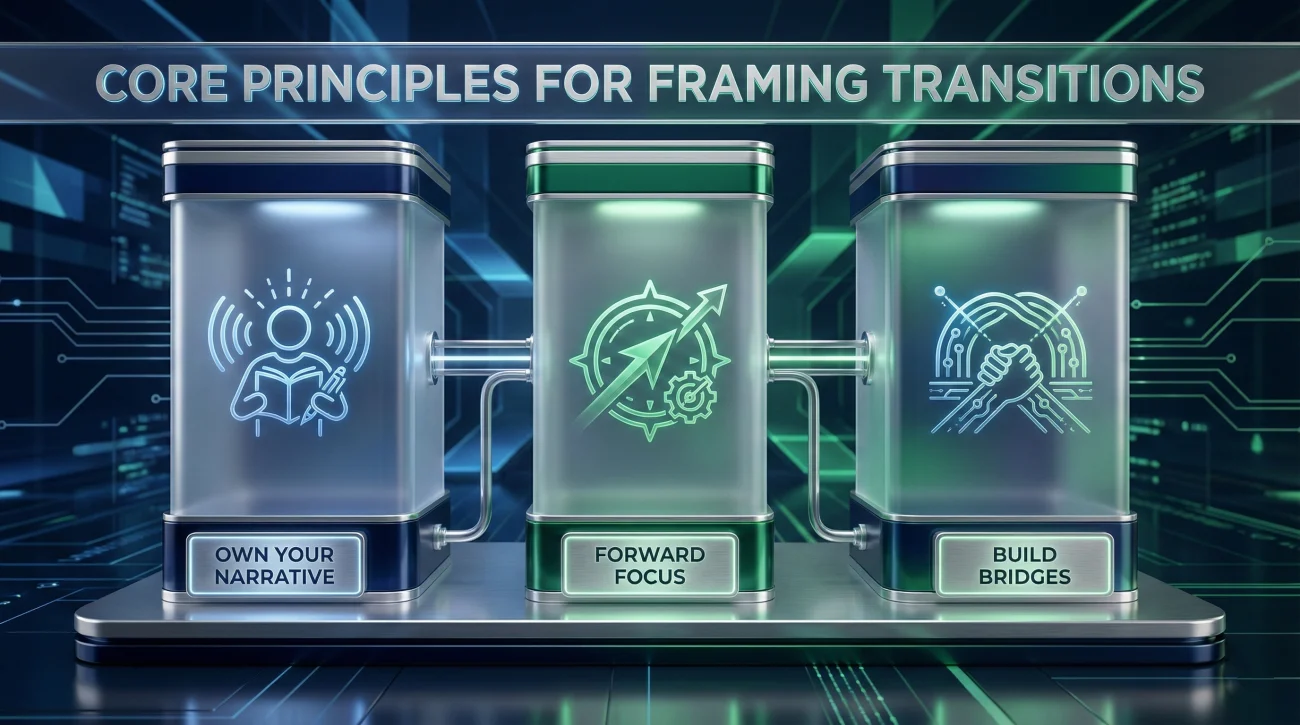
Own Your Narrative
Present transitions as deliberate choices rather than unfortunate circumstances that happened to you. Even when external factors forced changes, frame your response as active decision-making rather than passive victim status. This demonstrates agency and self-direction.
Expert advice: The difference between “I was laid off” and “I was impacted by company restructuring and used that opportunity to refocus my career goals” is framing. Same facts, completely different impression of control and intentionality.
Focus Forward, Not Backward
Spend minimal time explaining why you left previous situations and maximum time explaining why you’re excited about current opportunities. Interviewers care more about your fit for their role than your entire career history. Past transitions matter only as they relate to present readiness.
| Backward Focus (Weak) | Forward Focus (Strong) |
|---|---|
| “My old company had terrible management” | “I’m looking for environments that prioritize collaboration” |
| “I couldn’t find work for six months” | “I used that time to develop skills that make me stronger for this role” |
| “I realized I hated my old career” | “I discovered my passion for this field through specific experiences” |
| “I had to take a lower position” | “I chose this role because it aligns with my long-term goals” |
Build Bridges, Not Walls
Connect past experiences to current opportunities rather than treating your career as disconnected chapters. Even dramatic pivots involve transferable skills, relevant insights, or lessons learned that apply to new contexts. Show continuity in your development even when specific roles differ dramatically.
- Identify skills that transfer across different roles or industries
- Explain how diverse experiences provide unique perspective
- Describe how earlier roles revealed interests leading to current path
- Show intentional skill development bridging old and new careers
Addressing Employment Gaps
Understanding employment gap questions helps you discuss breaks in employment confidently. The goal isn’t elaborate justification – it’s brief explanation followed by evidence that you’re ready and motivated to work now.
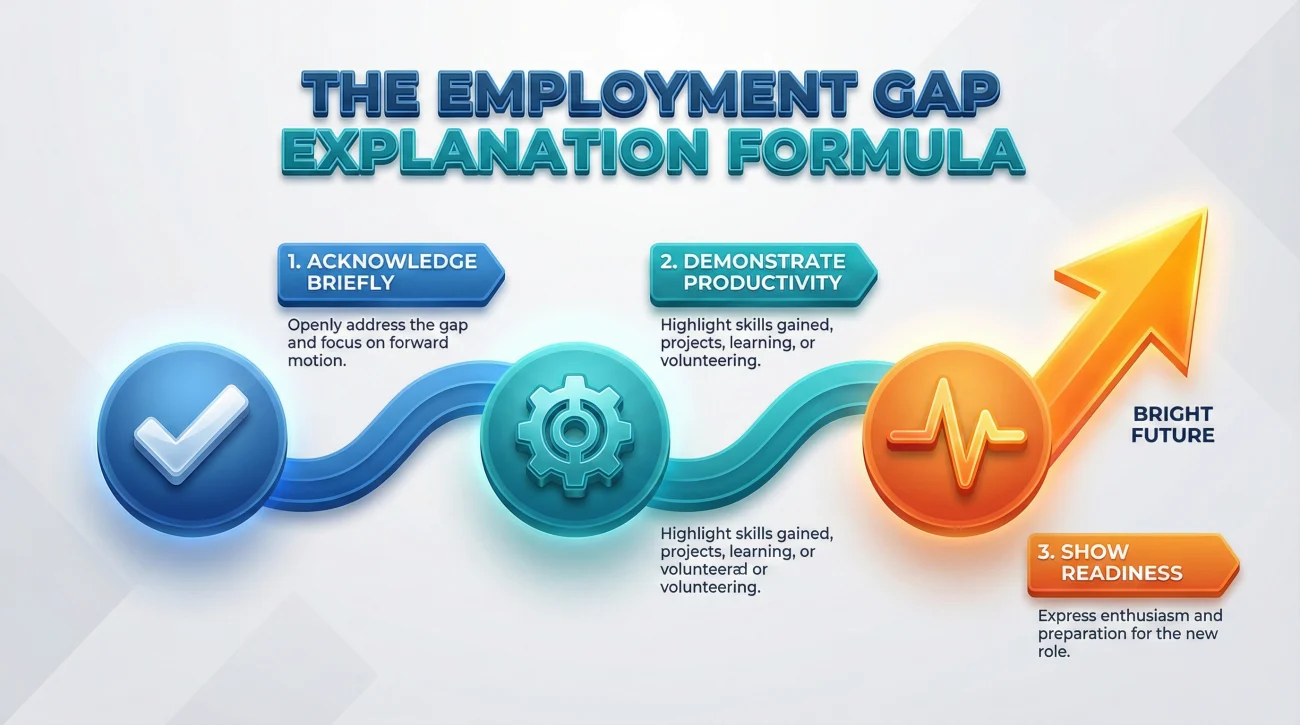
The Gap Explanation Formula
Strong gap explanations follow a three-part structure: brief factual explanation, what you did during the gap to stay productive, and enthusiasm about returning to work. This format acknowledges the gap without dwelling on it.
- 📋 Acknowledge briefly: State the gap reason factually without over-explaining
- 🎯 Demonstrate productivity: Highlight learning, freelancing, volunteering, or skill development
- ⚡ Show readiness: Express enthusiasm about returning to full-time work
Lengthy defensive explanations about why the gap happened make it seem bigger than it is. Brief matter-of-fact acknowledgment followed by what you did productively works better than extensive justification.
Different Gap Types Require Different Approaches
Involuntary gaps (layoffs), voluntary gaps (caregiving, travel), and health-related gaps each require slightly different framing while following the same basic structure of acknowledge, demonstrate productivity, show readiness.
Explaining Career Pivots
Addressing career pivot interview questions requires demonstrating that your change is thoughtful rather than impulsive, strategic rather than desperate, and backed by genuine commitment rather than casual interest.
Crafting Your Pivot Story
Strong pivot narratives connect dots between past experiences and new direction. Show how earlier roles revealed interests, developed transferable skills, or created insights that logically led to your current career path. The change should feel inevitable in retrospect, not random.
Expert advice: The best pivot stories identify specific moments or experiences that sparked the change. “I realized while managing budgets that I loved data analysis” is more credible than “I decided to try something different.”
Demonstrating Genuine Commitment
Career changers face skepticism about whether they’re serious or just experimenting. Counter this by demonstrating investment in your new direction through education, certifications, projects, networking, or taking pay cuts to break into the field. Actions prove commitment more than words.
| Weak Commitment Signal | Strong Commitment Signal |
|---|---|
| “I’ve always been interested in this field” | “I completed a certification and built three projects” |
| “I’m looking for something different” | “I’ve networked with 20 people in this industry” |
| “I think I’d be good at this” | “I took a 20% pay cut to get my first role in this field” |
| “This seems more interesting” | “I volunteered for six months to prove my commitment” |
Common Mistakes That Damage Candidacy
Even candidates with legitimate explanations for transitions sabotage themselves through poor framing, excessive defensiveness, or dwelling on negative circumstances rather than moving forward.
Over-Explaining and Defensiveness
Lengthy justifications make transitions seem more problematic than they are. Brief factual explanations work better than elaborate defenses. When you spend five minutes explaining a three-month gap, interviewers wonder what you’re hiding or whether you lack confidence.
If your explanation for a transition is longer than your answer to “tell me about yourself,” you’re over-explaining. Brief acknowledgment plus forward focus beats lengthy justification.
Negativity and Blame
Criticizing former employers, colleagues, or circumstances – even when criticism is valid – makes you look like the problem. Interviewers wonder if you’ll badmouth their company next. Focus on what you learned and where you’re going, not who wronged you in the past.
- Avoid: “My boss was incompetent and micromanaged everything”
- Better: “I work best with autonomy and clear objectives”
- Avoid: “The company culture was toxic and political”
- Better: “I’m looking for collaborative environments that value direct communication”
Vague or Generic Explanations
Generic answers like “I wanted new challenges” or “I needed a change” provide no real information and suggest you can’t articulate your reasoning. Specific explanations demonstrating self-awareness and intentionality build credibility that vague platitudes destroy.
Explore Specific Scenarios
Once you understand core principles for discussing transitions, dive into specific situations and learn tailored approaches for different types of career changes and employment gaps:
Foundation Skills
| Guide | What it helps with |
|---|---|
| Transferable Skills Examples | Identifying skills that bridge career changes |
| Explaining Reasons for Leaving | Professional departure narratives |
Employment Gap Situations
| Situation | Typical angle |
|---|---|
| Explaining Employment Gap | General unemployment periods |
| Laid Off Interview Question | Involuntary job loss due to restructuring |
| Fired From Job Explanation | Termination for cause with lessons learned |
| Returning to Work After Kids | Parental leave and childcare gaps |
| Job Hopping Interview Questions | Multiple short-tenure roles |
| Sabbatical Leave Explanation | Extended travel or personal development breaks |
| Health Issues Explanation | Medical leave while maintaining privacy |
| Caregiving Gap Explanation | Family care responsibilities |
Career Transition Types
| Transition | Core focus |
|---|---|
| Why Do You Want to Change Careers | The pivot story framework |
| Entrepreneur to Employee | Transitioning from founder to team member |
| Overqualified for the Job | Addressing intentional step-downs |
| Freelance to Fulltime Interview | Moving from independent to employee status |
| Internal Transfer Interview Questions | Navigating internal career moves |
❓ FAQ
🎯 Should I address gaps on my resume or wait for questions?
Address significant gaps (3+ months) proactively in your cover letter or resume with brief explanation. This prevents interviewers from making negative assumptions before meeting you. For shorter gaps or less significant transitions, waiting for questions works fine since you can provide context conversationally.
💼 How detailed should I be about reasons for leaving?
Provide just enough detail to be credible without dwelling on circumstances. One or two sentences acknowledging the situation, followed by what you learned or how you’ve grown, typically suffices. Excessive detail makes transitions seem more problematic than they are.
⏰ Can I be honest about negative reasons for leaving?
Be honest but frame professionally. Instead of “toxic boss,” say “seeking more collaborative leadership.” Instead of “terrible culture,” say “looking for environments that prioritize open communication.” The substance is honest while the framing remains professional and forward-focused.
📋 What if I have multiple gaps or transitions?
Address them as a package showing overall trajectory rather than justifying each individually. Explain the broader pattern or circumstances that led to multiple changes, demonstrate what you learned, and emphasize your current stability and commitment. Patterns need narrative that connects them coherently.
✨ How do I show I won’t leave quickly after a career change?
Demonstrate investment through education, certifications, networking, or financial sacrifice that shows you’re committed long-term. Explain specific aspects of the new field that align with your strengths and interests. Discuss your long-term goals in this career to show this isn’t experimentation.
Final Thoughts
Mastering career transition interview questions requires reframing potentially negative situations as demonstrations of adaptability, intentional career management, and self-awareness. Non-linear paths create interviewer concerns about commitment, productivity, and stability that you must address directly but without defensiveness or excessive justification.
Strong transition narratives own the story rather than making excuses, focus forward on current opportunities rather than dwelling on past circumstances, and build bridges connecting diverse experiences through transferable skills and intentional development. Whether explaining employment gaps, career pivots, or frequent changes, the same principles apply: acknowledge briefly, demonstrate productivity or learning, and show enthusiasm about current direction.
The difference between candidates who overcome transition concerns and those who get rejected often comes down to framing rather than circumstances. Same gap or change presented defensively raises red flags, while the same situation explained confidently as part of intentional career development demonstrates maturity and self-direction. Your transitions don’t define you – how you discuss them does.
Sometimes the hardest part isn’t the transition itself, it’s the silence afterward, so if you’re dealing with that kind of limbo, this piece on employer ghosting helps you keep your follow-ups clean and your story steady without sounding frustrated.
⚠️ Disclaimer: The interview strategies, sample answers, and negotiation tips provided in this guide are for educational purposes only. Hiring decisions are subjective and vary by company and industry. While these strategies are based on professional HR standards, they do not guarantee a specific job offer or result.