
- Core idea: Transferable skills matter more than job titles because they show how you create outcomes across different settings.
- What counts: A skill transfers when the underlying problem, stakeholders, constraints, or decision-making pattern stays the same, even if the industry changes.
- Find yours: Work backward from real accomplishments, break down daily tasks into actions and decisions, then ask others what they consistently rely on you for.
- Make it believable: Use specific transferable skills examples with a clear bridge, not vague claims, so the reader never has to guess how your experience fits.
- Interview use: Weave 1-2 top skills into your intro and behavioral answers, then name any gaps briefly and pair them with visible learning and practice.
Why Skills Matter More Than Job Titles
Career changers often underestimate their value because they focus on what they lack in new fields rather than what they bring from previous experience. Understanding transferable skills examples transforms how you position yourself during transitions. The communication skills developed in teaching apply to client management. Leadership experience from retail management translates to team coordination in tech. Project management abilities from construction work directly to software development. These portable capabilities matter more than industry-specific knowledge for many roles.
The challenge lies in identifying which skills transfer and articulating how they apply to new contexts. Candidates struggle to see past surface differences between roles to recognize underlying skill overlaps. A teacher managing classroom behavior uses conflict resolution. A retail manager handling inventory uses data analysis. An accountant explaining financial reports uses storytelling. When discussing career changes through tell me about yourself answers, highlighting transferable skills bridges old and new careers effectively.
What Makes Skills Transferable
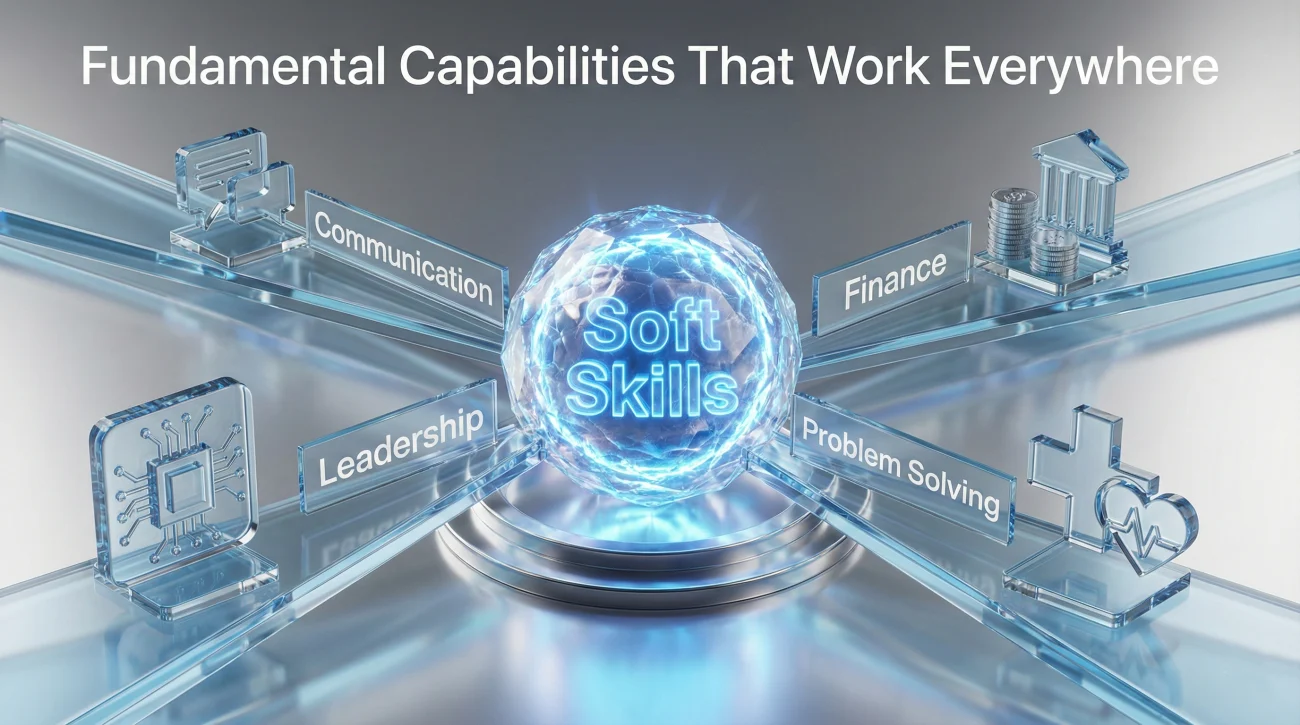
Understanding identifying transferable skills requires distinguishing between job-specific knowledge and fundamental capabilities that apply across contexts. Technical skills tied to specific tools or industries rarely transfer directly. Core competencies in communication, problem-solving, and leadership work everywhere.
Hard Skills vs Soft Skills Transferability
Hard skills – technical abilities requiring specific training – transfer within related domains but rarely across industries. Soft skills – interpersonal and cognitive abilities – transfer broadly across almost any context. Both matter, but soft skills create the foundation for career mobility.
| Limited Transfer (Industry-Specific) | High Transfer (Cross-Industry) |
|---|---|
| Specific software or tool expertise | Communication and presentation skills |
| Industry regulations and compliance knowledge | Leadership and team management |
| Proprietary processes and systems | Problem-solving and critical thinking |
| Domain-specific terminology | Project management and coordination |
| Technical certifications for specific fields | Relationship building and networking |
💡 Pro tip: When career changers say “I don’t have relevant experience,” they usually mean “I don’t have industry-specific knowledge.” The transferable skills they do possess often matter more than domain expertise for many roles.
Core Transferable Skill Categories
Most transferable skills fall into several broad categories that employers value across industries. Recognizing these categories helps you identify your own portable capabilities even when specific job duties differ dramatically.
- 💬 Communication: Writing, presenting, explaining complex ideas clearly
- 🤝 Leadership: Motivating teams, delegating, resolving conflicts
- 📊 Analytical: Data interpretation, pattern recognition, strategic thinking
- ⚡ Organizational: Project management, prioritization, time management
- 🎯 Interpersonal: Building relationships, negotiation, customer service
Identifying Your Transferable Skills
Understanding skills that transfer between jobs starts with systematically analyzing your experience to uncover portable capabilities you may not recognize as valuable skills.
Work Backward From Accomplishments
Review major achievements in previous roles and identify the underlying skills required to accomplish them. The specific achievement matters less than the capabilities it demonstrates. Managing a retail team of 15 people develops the same leadership skills as managing a software team of 15 developers.
Expert advice: Ask yourself “What did I actually do?” rather than focusing on job titles. A “Sales Associate” who trained new hires has teaching and mentoring skills. A “Server” who resolved customer complaints has conflict resolution abilities.
Break Down Daily Tasks
List your regular job responsibilities and identify the skills each requires. Administrative work involves organization and attention to detail. Customer service develops communication and empathy. Team projects require collaboration and compromise. These fundamental skills matter regardless of industry context.
| Job Task | Transferable Skill | Applies To |
|---|---|---|
| Explained products to customers | Communication, simplifying complexity | Client-facing roles, training, consulting |
| Managed team schedules | Coordination, resource allocation | Project management, operations |
| Resolved customer complaints | Conflict resolution, problem-solving | Account management, team leadership |
| Tracked inventory and sales data | Data analysis, attention to detail | Analytics roles, reporting, operations |
| Trained new employees | Teaching, patience, clear communication | Onboarding, documentation, mentoring |
Seek External Perspectives
Ask former colleagues, managers, or mentors what skills they see in you. Outside observers often recognize strengths you take for granted or undervalue. The abilities that come naturally to you might be rare talents others struggle with.
Articulating How Skills Transfer
Understanding cross-industry skills means more than just identifying them – you must articulate clearly how capabilities from one context apply to another. Generic claims about transferable skills fail to convince. Specific examples demonstrating application bridge the gap.
The Skill Translation Formula
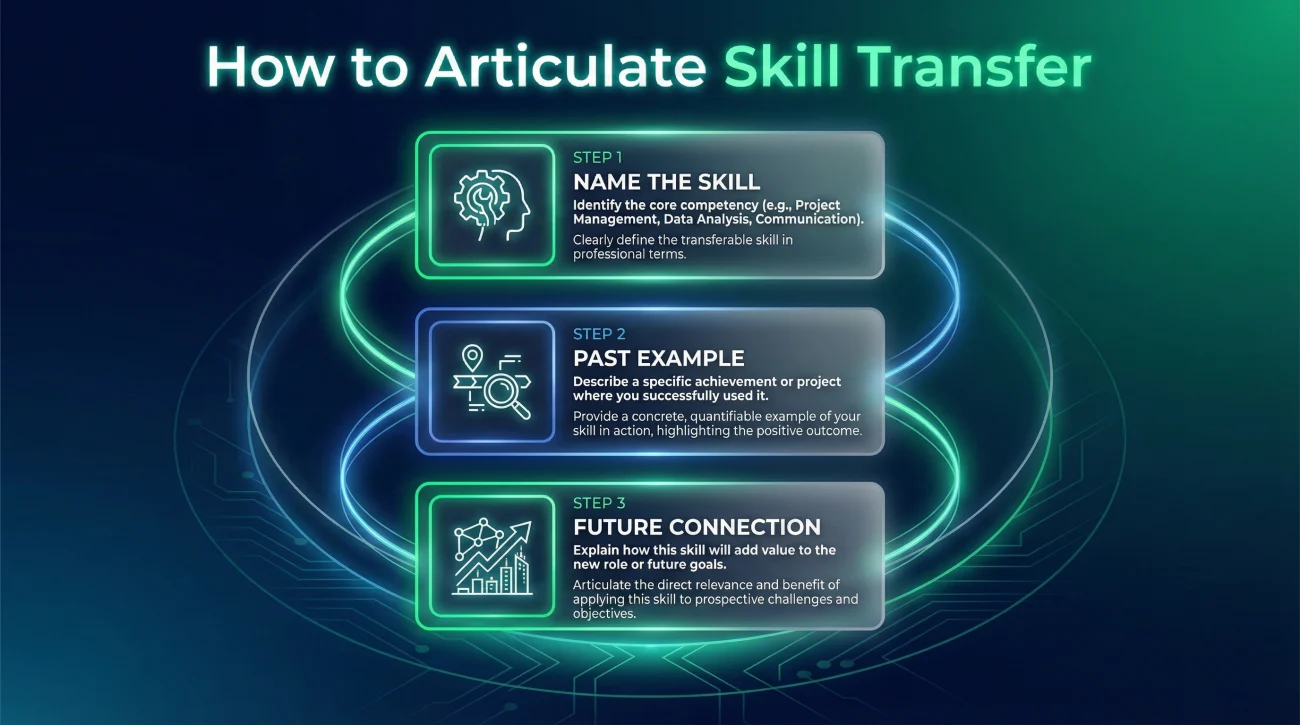
Effective skill translation follows a pattern: name the skill, provide specific example from old context, explain explicit connection to new role. This structure proves transferability rather than just claiming it.
- 🎯 Name the skill: “Project coordination and stakeholder management”
- 📋 Example from past: “In my teaching role, I coordinated with parents, administrators, and support staff”
- 🔄 Connect to new role: “This directly applies to coordinating cross-functional teams here”
Saying “my skills are transferable” without specific examples sounds defensive. Demonstrating exactly how a skill applied in one context translates to another builds credibility.
Using Bridging Language
Certain phrases explicitly connect old experience to new opportunities, helping interviewers see relationships they might miss. These transitions make your narrative coherent rather than forcing interviewers to make logical leaps.
| Weak Connection | Strong Bridge |
|---|---|
| “I managed a store” | “Managing a store taught me the resource allocation and prioritization skills essential for project management” |
| “I was a teacher” | “Teaching developed my ability to explain complex concepts clearly – a skill that translates directly to client communication” |
| “I did sales” | “Sales experience taught me to identify client needs and tailor solutions, which applies to customer success roles” |
| “I ran events” | “Event planning requires the same detailed coordination and timeline management as software project delivery” |
Common Transferable Skills by Category
Recognizing portable career skills across different categories helps you identify which of your abilities matter most for target roles and how to position them effectively.
Communication and Presentation
Any role involving explaining ideas, writing clearly, or presenting information develops communication skills that apply everywhere. Teaching, sales, customer service, and public-facing roles all build these fundamental capabilities.
- Written communication: emails, reports, documentation
- Verbal communication: presentations, meetings, client calls
- Simplifying complexity: making technical ideas accessible
- Active listening: understanding needs before responding
- Storytelling: making data or concepts compelling
Leadership and People Management
Managing people, coordinating teams, or motivating others develops leadership skills regardless of industry. A retail manager handles similar challenges to a tech team lead – delegating effectively, resolving conflicts, and developing team members.
Expert advice: Leadership skills transfer more easily than many career changers realize. Managing a restaurant team during dinner rush requires the same decisiveness, calm under pressure, and rapid problem-solving as managing crisis situations in corporate environments.
Analytical and Problem-Solving
Roles requiring data interpretation, pattern recognition, or systematic problem-solving develop analytical thinking that applies across domains. Accountants, engineers, researchers, and analysts all build similar cognitive capabilities despite different technical applications.
| Role Example | Analytical Skill Developed | Transfers To |
|---|---|---|
| Financial analyst reviewing budgets | Data pattern recognition, variance analysis | Business intelligence, operations analysis |
| Teacher assessing student performance | Tracking metrics, identifying improvement areas | Performance management, talent development |
| Nurse diagnosing symptoms | Information gathering, systematic evaluation | Customer discovery, troubleshooting |
| Engineer solving technical problems | Root cause analysis, testing hypotheses | Process improvement, strategic planning |
Organizational and Project Management
Coordinating multiple priorities, managing timelines, or delivering projects on schedule develops organizational skills that employers value universally. These capabilities matter whether you’re coordinating construction projects or software releases.
Using Transferable Skills in Interview Answers
Knowing your transferable skills means nothing if you can’t articulate them effectively during interviews. Strong candidates weave skill translation throughout their answers rather than awkwardly forcing it.
Integrating Into Self-Introduction
Your opening answer should explicitly connect past experience to current opportunity through transferable skills. This frames the entire interview around what you bring rather than what you lack.
💡 Pro tip: Open with your strongest transferable skill that directly addresses the role’s core need. “My background in teaching developed the communication and patience essential for customer success roles” immediately positions teaching as relevant rather than unrelated.
Incorporating Into Behavioral Answers
When answering behavioral questions, name the transferable skill you’re demonstrating and explain how it applies to the target role. This makes implicit connections explicit so interviewers don’t miss the relevance.
- 🎯 Weak: “In my retail role, I managed a team of 10”
- ✅ Strong: “Managing a retail team developed leadership skills – delegation, conflict resolution, performance coaching – that directly apply to managing cross-functional teams here”
Addressing Skill Gaps Honestly
While transferable skills bridge much of the gap between old and new careers, acknowledging what you need to learn demonstrates self-awareness. The key is framing gaps as opportunities rather than weaknesses.
Demonstrating Learning Commitment
Show how you’re actively developing missing skills through courses, projects, or self-study. This proves you understand the gaps and take initiative to close them rather than expecting the employer to teach you everything.
| Defensive Response | Growth-Oriented Response |
|---|---|
| “I don’t have that specific experience” | “I’m developing that skill through an online course and practice projects” |
| “I can learn on the job” | “I’ve already started learning independently and will continue developing that capability” |
| “My skills from X are just as good” | “My foundation in X accelerates learning Y because both require similar analytical thinking” |
Emphasizing Learning Ability
Your capacity to acquire new skills quickly matters as much as current capabilities. Provide examples of rapidly mastering new domains in previous roles to demonstrate you’ll close skill gaps efficiently.
Expert advice: Career changers who acknowledge skill gaps while demonstrating concrete learning efforts and past examples of quick adaptation often beat candidates with “perfect” experience but limited growth mindset.
❓ FAQ
🎯 How do I know which skills are most transferable?
Study job descriptions for target roles and identify required skills. Compare these to your experience to find overlaps. Skills mentioned across multiple job postings – like communication, project management, or problem-solving – are highly transferable. Industry-specific technical skills rarely transfer; cognitive and interpersonal skills almost always do.
💼 Should I focus on transferable skills or admit what I’m missing?
Do both strategically. Lead with transferable skills to establish relevance, then acknowledge gaps honestly while showing how you’re addressing them. This demonstrates both confidence in what you bring and self-awareness about areas for growth. Balance matters – all strengths sounds defensive, all gaps sounds unprepared.
⏰ How specific should I be when connecting skills to new roles?
Be very specific. Vague claims about transferable skills sound like generic cover-up for lack of qualifications. Specific examples showing exactly how a skill applied in one context maps to requirements in another build credibility. The more explicit your translation, the more convincing your case.
📋 Can I use transferable skills if I lack formal qualifications?
Yes, but combine them with demonstrated learning. Transferable skills prove you can perform, but you still need to show you understand domain basics. Pair “my project management experience from construction” with “I’ve completed online courses in agile methodology” to show both transferable foundation and new learning.
✨ What if interviewer doesn’t see connection between my experience and role?
Make the connection explicit rather than expecting them to figure it out. Use bridging language that directly links past accomplishments to future requirements. If they still don’t get it, provide a specific example showing how you’d apply your skill to a challenge in the new role. Sometimes interviewers need help seeing past surface differences.
Final Thoughts
Mastering transferable skills examples transforms career transitions from explanations of what you lack into demonstrations of what you bring. The communication developed teaching applies to client management. Leadership experience from retail translates to tech team coordination. Analytical thinking from nursing transfers to operations improvement. These portable capabilities often matter more than industry-specific knowledge for many roles.
The key lies in systematically identifying your transferable skills by working backward from accomplishments, breaking down daily tasks, and seeking external perspectives on your strengths. Once identified, articulate clearly how capabilities from one context apply to another using specific examples and explicit bridging language rather than generic claims about skill transferability.
Career changers who succeed don’t apologize for non-traditional backgrounds – they confidently position diverse experience as valuable preparation providing unique perspective and proven capabilities. Combined with honest acknowledgment of skill gaps and demonstrated commitment to learning, strong transferable skills transform potential weaknesses into competitive advantages that set you apart from candidates with conventional but narrow experience.
⚠️ Disclaimer: The interview strategies, sample answers, and negotiation tips provided in this guide are for educational purposes only. Hiring decisions are subjective and vary by company and industry. While these strategies are based on professional HR standards, they do not guarantee a specific job offer or result.