
- Core idea: Interviews follow a predictable pattern, so a few strong answers beat trying to wing it with “authentic” rambling.
- What to master first: Learn the 10 universal questions, because they show up in most interviews and cover the bulk of what you will be asked.
- How to sound strong fast: Keep answers tight and relevant, lead with impact, use specifics, and connect your examples back to what the role actually needs.
- Frameworks that carry you: Use STAR for behavioral questions, plus simple structures like Present Past Future and Problem Solution Benefit to stay clear under pressure.
- Prep that actually works: Build a small story bank, research beyond the job description, practice out loud, and bring smart questions so you look ready to contribute.

The average interview lasts 40 minutes, but your answers to just 3-4 key questions often determine whether you get the job.
Every job interview questions session follows a predictable pattern. Hiring managers ask variations of the same core questions, yet most candidates walk in unprepared, hoping to “wing it” with authentic answers. The truth? Authenticity without preparation leads to rambling responses that miss the mark.
The good news: you don’t need to memorize 100 different answers. Understanding the psychology behind common interview questions and mastering a handful of proven frameworks transforms you from a nervous candidate into a confident professional who consistently lands offers.
This guide breaks down the interview questions you’ll actually face, the strategy behind each one, and the answer frameworks that work across industries and experience levels.
The 10 Universal Interview Questions
Regardless of your industry or role, these questions appear in nearly every interview. Master them, and you’ve covered 80% of what hiring managers will ask.
Tell Me About Yourself
This opener isn’t small talk – it’s your 60-second commercial. Hiring managers use it to assess whether you can communicate clearly and stay focused under pressure. The trap: most candidates either recite their entire resume or share irrelevant personal details.
The winning approach follows a simple structure: present position, relevant background, why you’re here. Start with what you do now, highlight 2-3 key achievements from your career, then explain why this specific role excites you. Keep it under 90 seconds.
Why Do You Want to Work Here?
Generic answers like “great company culture” or “exciting opportunity” signal zero preparation. Interviewers want proof you’ve researched the company and understand how your skills solve their specific challenges.
Strong answers connect three dots: something specific about the company (recent product launch, market position, team structure), how it aligns with your career goals, and what unique value you bring. If you can’t name something specific about the company, you’re not ready for this question.
What Are Your Greatest Strengths?
This question tests self-awareness and relevance. Listing random positive traits wastes everyone’s time. The interviewer wants to know which of your strengths directly impact the role you’re applying for.
Pick one strength that’s critical for the position, then immediately prove it with a specific example. If you’re interviewing for a project manager role, don’t just say “I’m organized” – describe how your organizational system helped deliver a complex project ahead of schedule.
What’s Your Greatest Weakness?
The infamous trap question. Saying “I’m a perfectionist” or “I work too hard” makes interviewers roll their eyes. They’ve heard it a thousand times. Claiming you have no weaknesses suggests you lack self-awareness.
The smart move: choose a real weakness that’s not fatal for the role, then show exactly how you’re addressing it. Be specific about the steps you’re taking and the progress you’ve made. This demonstrates growth mindset and emotional intelligence.
Give Me an Example of a Challenge You’ve Overcome
Behavioral interview questions like this one predict future performance based on past behavior. The interviewer wants to see your problem-solving process and resilience under pressure.
Use the STAR framework: Situation (context in 1-2 sentences), Task (your specific responsibility), Action (what you did, in detail), Result (quantifiable outcome). The Action section should take up 50% of your answer – that’s where you showcase your skills.
Tell Me About a Time You Disagreed with a Coworker
This tests emotional intelligence and collaboration skills. Bad answers trash-talk the coworker or avoid admitting any real conflict. Good answers show you can disagree professionally and find solutions.
Focus on the issue, not the person. Explain how you listened to their perspective, found common ground, and reached a solution that benefited the project. Never blame the other person – take ownership of your part in both the conflict and resolution.
Describe a Time You Failed
Hiring managers ask this to gauge your honesty and learning capacity. The worst response: claiming you’ve never failed or choosing a “failure” that’s actually a humble-brag.
Pick a real failure where you made a genuine mistake, explain what went wrong without making excuses, and spend most of your time on the lessons learned. The best answers show how that failure made you better at your job.
Where Do You See Yourself in Five Years?
They’re not asking for a detailed life plan. They want to know if this role aligns with your career trajectory and whether you’ll stick around long enough to deliver value.
Connect your goals to the company’s growth path. Show ambition, but make it about developing skills and taking on more responsibility within the organization. Avoid mentioning other companies or completely different career paths.
Why Are You Leaving Your Current Job?
Never badmouth your current employer, even if it’s justified. The interviewer can’t verify your story, so they’ll assume you’ll speak the same way about them eventually.
Frame it as moving toward opportunity, not running from problems. Focus on what you’re seeking (growth, new challenges, different industry) rather than what you’re escaping. If you were laid off, state it simply without defensiveness.
Do You Have Any Questions for Us?
Saying “no” signals you’re not genuinely interested. Asking about salary and benefits before they bring it up shows poor timing. This is your chance to demonstrate strategic thinking and cultural fit.
Ask about team dynamics, success metrics for the role, or challenges the department is facing. The best questions show you’re already thinking about how to contribute, not just what you’ll get from the job.
Industry-Specific Question Deep Dives
While the universal questions above appear across all fields, each industry adds its own layer of specialized questions that test domain-specific knowledge and skills. Technical interview questions in software engineering look nothing like the scenario-based questions healthcare professionals face.
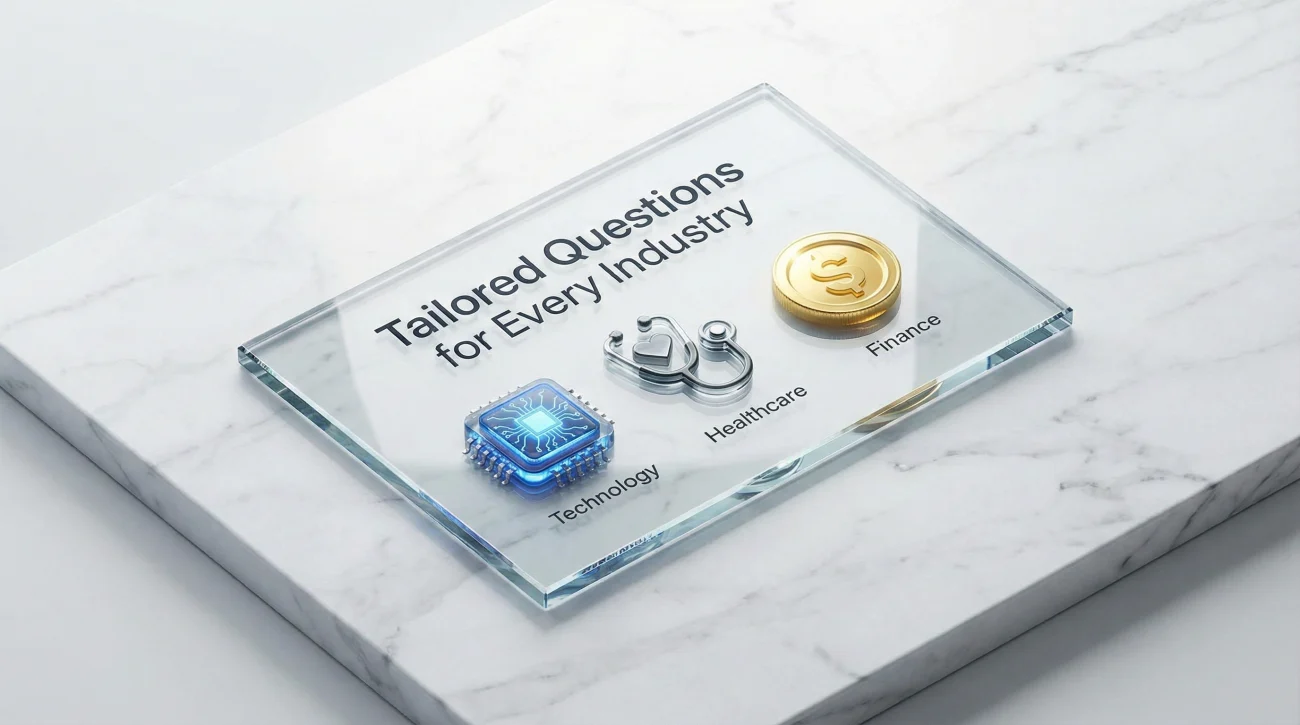
Technology & IT
Tech interviews split into three distinct phases: coding challenges that test algorithmic thinking, system design discussions that reveal architectural knowledge, and behavioral questions that assess team fit. Candidates face whiteboarding exercises, take-home assignments, and pair programming sessions.
Healthcare & Medical
Healthcare interviews emphasize clinical reasoning, patient interaction scenarios, and ethical decision-making. Expect questions about handling difficult patient situations, maintaining confidentiality, and navigating conflicts with colleagues. Nursing and physician roles involve case studies where you walk through your diagnostic process.
Sales, Marketing & Finance
Business roles focus on results and metrics. Sales candidates face role-play scenarios and objection handling. Marketing professionals discuss campaign strategy and ROI. Finance interviews include technical accounting questions, financial modeling discussions, and valuation techniques. Prepare to discuss specific numbers from your past achievements.
Management & Leadership
Leadership interviews probe your management philosophy, conflict resolution approach, and team development methods. Expect questions about difficult personnel decisions, managing underperformers, and navigating organizational change. The interviewer wants to see evidence of emotional intelligence and strategic thinking.
Service & Hospitality
Customer-facing roles test your de-escalation skills and service recovery abilities. Interviewers describe difficult customer scenarios and ask how you’d handle them. They’re evaluating patience, problem-solving under pressure, and your ability to maintain professionalism when customers are upset.
Creative & Design
Portfolio reviews dominate creative interviews, but you’ll also face questions about your design process, handling critical feedback, and working within constraints. Be ready to walk through specific projects, explaining your thought process from concept to final execution.
Operations, Logistics & Manufacturing
These interviews focus on process optimization, safety protocols, and problem-solving under pressure. Expect questions about improving efficiency, reducing costs, and handling supply chain disruptions. Quantify everything – your ability to discuss metrics shows operational thinking.
Answer Frameworks That Actually Work
Knowing how to answer interview questions matters more than memorizing specific responses. These frameworks help you structure clear, compelling answers on the spot.
The STAR Method for Behavioral Questions
Every behavioral question follows the same pattern: “Tell me about a time when…” Your answer needs four components: Situation (brief context), Task (your responsibility), Action (detailed steps you took), Result (quantifiable outcome).
Spend 50% of your answer time on the Action section. That’s where you demonstrate your skills and decision-making process. Keep Situation and Task brief – they’re just setup for your actual contribution. Research from LinkedIn’s survey of 1,300 hiring managers confirms that 75% believe behavioral questions effectively assess a candidate’s potential performance.
For more detailed guidance on behavioral questions, check our behavioral interview strategy guide.
Present-Past-Future for “Tell Me About Yourself”
Structure your self-introduction chronologically backward: start with what you do now (present), briefly explain how you got here (past), then connect it to why you want this job (future). This keeps you focused and gives the interviewer a clear narrative arc.
Want to perfect your introduction? Our complete “Tell Me About Yourself” guide provides templates for every experience level.
What, So What, Now What for Achievements
When discussing accomplishments, follow this three-part structure: What you did (the action), So what (the impact and why it mattered), Now what (how it applies to this new role). This framework prevents you from listing activities without showing value.
Problem-Solution-Benefit for Explaining Decisions
When asked about past decisions or approaches, frame your answer as: Problem (what challenge you faced), Solution (what you chose to do), Benefit (what improved as a result). This structure works for technical decisions, process changes, and strategic choices.
Strategic Interview Preparation
Generic preparation wastes time. Effective interview prep targets the specific questions you’ll actually face and the evidence you’ll need to support your answers.
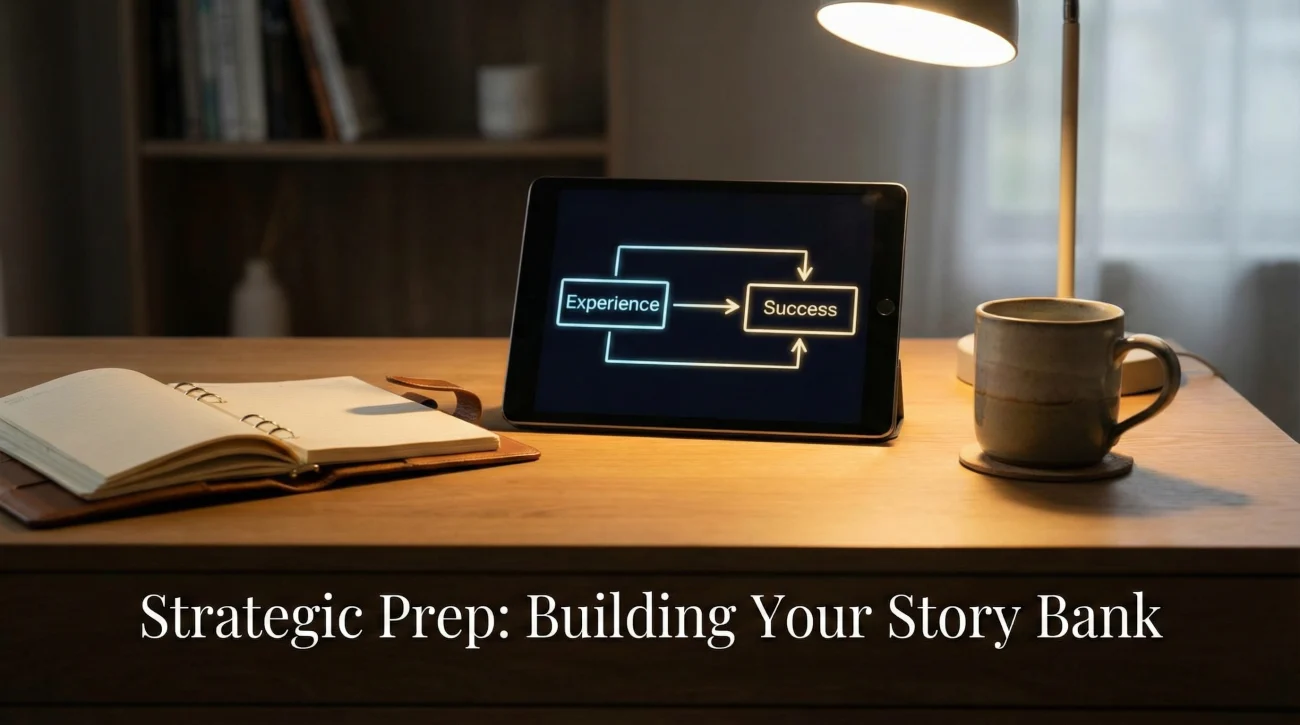
Build Your Story Bank
Identify 5-7 significant projects or situations from your career. For each one, write out the full STAR details. These stories become your raw material – you’ll remix them to answer different questions. One project can demonstrate leadership, problem-solving, and technical skills depending on which angle you emphasize.
Research Beyond the Job Description
Read the company’s recent news, understand their competitors, and identify their current challenges. This research transforms generic answers into specific, relevant responses that show you already understand their business.
Look up your interviewers on LinkedIn. Understanding their background helps you tailor your communication style and choose relevant examples they’ll appreciate.
Practice Out Loud, Not in Your Head
Thinking through answers feels different than speaking them. Practice your responses out loud, timing yourself. Record yourself if possible – you’ll catch verbal tics, pacing issues, and rambling that you’d never notice otherwise. Harvard Business Review research shows that treating interviews like performance rehearsals – where you practice both content and delivery – significantly improves candidate success rates.
The goal isn’t memorization. It’s familiarity with your own stories so you can tell them naturally under pressure.
Prepare Questions to Ask Them
Every interview ends with “Do you have questions for us?” Prepare 5-7 thoughtful questions that show strategic thinking. Ask about team dynamics, success metrics, or challenges the department faces. Save salary and benefits questions for after they make an offer.
Our questions to ask interviewers guide provides 100+ strategic questions organized by interview stage and role.
Strategic Interview Resources & Core Guides
Success in high-stakes interviews requires more than just technical knowledge – it requires a tactical roadmap. Our core library provides the foundational frameworks and industry-specific strategies you need to navigate every stage of the hiring process.
🎖️ Core Guides:
| Article | Focus |
|---|---|
| IT Interview Questions | The Ultimate Cheat Sheet |
| Healthcare Interview Questions | The Medical Hiring Guide |
| Sales and Marketing Interview Questions | The Revenue Growth Guide |
| Accounting and Finance Interview Questions | The Fiscal Hiring Guide |
| Administrative and HR Interview Questions | The Operations Guide |
| Service and Hospitality Interview Questions | The Guest Experience Guide |
| Management Interview Questions | Leadership & Strategy Guide |
| Engineering and Construction Interview Questions | The Build & Design Guide |
| Education and Teaching Interview Questions | The Schools & Universities Hiring Guide |
| Retail and Customer Service Interview Questions | Service Guide |
| Creative and Design Interview Questions | Portfolio & Vision |
| Operations and Logistics Interview Questions | Supply Chain Guide |
| Manufacturing Interview Questions | Production & Plant Guide |
| Legal and Social Services Interview Questions | Justice & Care Guide |
❓ FAQ
🎯 How many questions should I prepare for?
Focus on mastering 10-15 core questions rather than memorizing 100 mediocre answers. The 10 universal questions covered in this guide appear in 90% of interviews. Add 3-5 industry-specific questions based on your field, and you’re thoroughly prepared.
⏰ How long should my answers be?
Most answers should run 60-90 seconds. Behavioral questions using STAR can stretch to 2 minutes. Going longer risks losing the interviewer’s attention. If they want more detail, they’ll ask follow-up questions.
💼 Should I memorize my answers word-for-word?
No. Memorized answers sound robotic and fall apart if the interviewer asks a follow-up you didn’t prepare for. Instead, memorize your key stories and frameworks, then practice adapting them to different questions naturally.
📋 What if they ask a question I haven’t prepared?
Take a breath and use a framework. Most surprise questions are just variations of the core ones. A question about “handling ambiguity” is really asking about problem-solving. “Dealing with a difficult stakeholder” is a conflict question. Listen for the underlying theme and apply the appropriate framework.
✨ How do I stand out when everyone’s giving similar answers?
Specificity wins. While others give vague responses about “working hard” or “being a team player,” you share concrete examples with actual numbers. Instead of “I improved the process,” say “I reduced processing time from 3 days to 4 hours, which saved the team 15 hours per week.” Details make you memorable.
Final Thoughts

Interview success isn’t about having perfect answers – it’s about preparation meeting opportunity. The candidates who land offers aren’t necessarily the most qualified; they’re the ones who can clearly articulate their value under pressure.
Every job interview questions session tests the same core competencies: communication, problem-solving, self-awareness, and cultural fit. Master the frameworks in this guide, prepare your story bank, and practice out loud. That’s the difference between hoping you’ll say the right thing and knowing you will.
The interview isn’t just about convincing them you’re qualified. It’s about demonstrating you’re someone they want to work with every day. Show up prepared, stay authentic, and let your preparation give you the confidence to be yourself.
⚠️ Disclaimer: The interview strategies, sample answers, and negotiation tips provided in this guide are for educational purposes only. Hiring decisions are subjective and vary by company and industry. While these strategies are based on professional HR standards, they do not guarantee a specific job offer or result.