- What finance interviews really test: Accounting and finance interview questions measure technical precision, ethical judgment, and quantitative reasoning under pressure, not just “business fit.”
- Five fundamentals show up everywhere: Technical knowledge, analytical thinking, ethical judgment, communication, and attention to detail, with expectations rising fast as seniority increases.
- Specialization changes everything: Audit and tax focus on standards and compliance, corporate finance leans on forecasting and business partnering, investment roles demand valuation and modeling, banking balances risk with relationships.
- Level matters as much as role: Entry roles check foundations and reliability, mid-level roles test independent judgment, senior roles look for strategy, leadership, and stakeholder management.
- How to prepare without wasting time: Match your prep to the role’s technical vs behavioral mix, expect formats like case studies or panels, and practice explaining your analysis in plain language.
The Financial Profession Interview Landscape
Success in accounting and finance interview questions requires understanding that financial roles assess fundamentally different competencies than most professions. While other fields test general business acumen or soft skills, finance interviews demand technical precision, ethical judgment, and quantitative reasoning under pressure. Interviewers don’t just evaluate whether you understand concepts – they test whether you can apply technical knowledge to real business scenarios while maintaining professional skepticism and regulatory compliance.
The challenge intensifies because finance job interviews vary dramatically by specialization. Public accounting interviews focus on audit methodology and tax code knowledge. Investment banking assessments test valuation techniques and deal structuring. Corporate finance evaluates forecasting abilities and business partnership skills. Risk management explores scenario analysis and mitigation strategies. Each specialization requires distinct preparation approaches, yet all share common foundations in financial statement analysis, accounting principles, and ethical reasoning.
This comprehensive guide breaks down interview preparation strategies across the entire financial profession spectrum – from entry-level bookkeeping to C-suite treasury management, from audit associates to chief audit executives, from banking tellers to portfolio managers. Understanding how questions differ by specialization prevents generic preparation that wastes time on irrelevant topics while missing critical assessment areas.
Universal Financial Competencies
Despite specialization differences, all accounting position preparation should address five core competency categories that appear across financial roles. Mastery of these fundamentals separates candidates who understand isolated concepts from those who think like financial professionals.
| Core Competency | What Interviewers Assess | Common Question Types |
|---|---|---|
| Technical knowledge | Mastery of accounting principles, financial instruments, valuation methods | Explain GAAP vs. IFRS differences; Walk through DCF model; How do you calculate WACC? |
| Analytical thinking | Ability to interpret financial data, identify trends, diagnose problems | Why might inventory turnover decrease? Analyze this variance report; What’s causing margin compression? |
| Ethical judgment | Understanding professional standards, recognizing conflicts, maintaining independence | How would you handle pressure to adjust reserves? What if management disagrees with your assessment? |
| Communication skills | Translating complex financial concepts for non-finance stakeholders | Explain NPV to an executive without finance background; How do you present bad news to clients? |
| Attention to detail | Accuracy under pressure, reconciliation skills, error detection | Walk me through your month-end close checklist; How do you ensure accuracy in high-volume environments? |
Technical Foundation Requirements
Technical knowledge expectations scale with role seniority and specialization. Entry-level positions test fundamental accounting equation understanding and basic financial statement preparation. Mid-level roles require proficiency in complex accounting treatments, consolidation, and specialized industry knowledge. Senior positions assess strategic financial thinking, capital structure optimization, and regulatory expertise.
- 📊 All levels: Financial statement relationships, accounting equation, basic journal entries
- 💼 Staff to senior: Month-end close procedures, reconciliations, variance analysis, technical GAAP/IFRS
- 🎯 Manager to director: Complex transactions (M&A, derivatives, leases), team leadership, process improvement
- ⚡ Executive level: Strategic financing, investor relations, governance, enterprise risk management
Expert advice: Interviewers in finance roles almost always include technical assessments you cannot fake. Unlike behavioral questions where preparation helps craft compelling narratives, technical questions expose knowledge gaps immediately. If you don’t genuinely understand revenue recognition rules or can’t build a three-statement model, no amount of interview coaching will help. Invest time developing actual competence, not just interview performance.
Major Specialization Paths
The financial profession divides into distinct career paths, each with specialized knowledge requirements and interview focus areas. Understanding these differences ensures you prepare for questions actually asked in your target specialization rather than generic finance topics.
Public Accounting Path
Public accounting roles (audit, tax, advisory) emphasize professional standards, client service, and technical accounting judgments. Interviews test audit methodology, tax code knowledge, and ability to handle complex accounting treatments while maintaining independence and professional skepticism.
| Role Focus | Key Interview Topics | Critical Skills Tested |
|---|---|---|
| External auditor | Audit planning, risk assessment, sampling methodology, internal controls (SOX compliance) | Professional skepticism, evidence gathering, client communication |
| Tax specialist | Tax code provisions, return preparation, deduction optimization, tax planning strategies | Tax law interpretation, research skills, deadline management |
| Forensic accountant | Fraud detection, fund tracing, evidence preservation, litigation support | Investigative thinking, attention to anomalies, expert testimony preparation |
Corporate Finance Path
Corporate finance professionals support business operations through budgeting, forecasting, financial analysis, and strategic planning. Interviews emphasize business partnership, modeling capabilities, and ability to translate financial insights into actionable business recommendations.
💡 Pro tip: Corporate finance interviews increasingly test communication skills alongside technical knowledge. You might build a perfect financial model, but if you can’t explain why EBITDA margin contracted or what the forecast assumptions mean for business strategy, you won’t get the offer. Practice translating technical analysis into business language.
Investment Management Path
Investment roles (banking, private equity, hedge funds, equity research) require advanced valuation skills, deal structuring knowledge, and market analysis capabilities. Interviews test technical modeling proficiency through case studies, valuation exercises, and investment thesis development.
- Investment banking: DCF modeling, comparable company analysis, M&A deal structures, pitch book preparation
- Private equity: LBO modeling, return projections, value creation strategies, exit planning
- Hedge funds: Investment thesis development, long/short strategies, alpha generation, risk management
- Equity research: Financial statement analysis, earnings modeling, sector expertise, report writing
Banking and Financial Services Path
Commercial banking, retail banking, and wealth management roles balance financial analysis with client relationship management. Interviews assess credit risk evaluation, lending criteria understanding, and ability to balance risk/return tradeoffs while meeting sales targets.
Expert advice: Banking interviews often include situational questions testing how you balance competing priorities – risk management versus revenue generation, regulatory compliance versus customer satisfaction, process adherence versus relationship flexibility. Demonstrating nuanced thinking about these tensions shows professional maturity.
Interview Focus by Experience Level
Interview emphasis shifts dramatically across career stages. Entry-level interviews test foundational knowledge and coachability. Mid-career assessments evaluate specialized expertise and independent judgment. Senior interviews focus on strategic thinking and leadership capabilities.
Entry-Level and Support Roles
Bookkeepers, payroll specialists, accounts payable/receivable clerks, and bank tellers face interviews testing basic technical competence, attention to detail, and reliability. Questions focus on process adherence, data accuracy, and handling routine transactions correctly.
| Experience Level | Primary Assessment Focus | Typical Question Examples |
|---|---|---|
| Entry-level (0-2 years) | Technical foundations, learning agility, work ethic, basic Excel skills | Explain debits and credits; Walk through AP invoice processing; How do you prioritize tasks? |
| Staff to senior (2-5 years) | Independent execution, complex accounting treatments, client interaction | How do you handle revenue recognition for multi-element arrangements? Describe your audit testing approach |
| Manager (5-10 years) | Team leadership, process improvement, strategic thinking, stakeholder management | How do you develop junior staff? Describe process changes you’ve implemented; Handle scope creep situations |
| Director/VP (10-15 years) | Department leadership, cross-functional collaboration, business impact, risk management | How do you partner with business units? Describe complex technical accounting issue you resolved; Change management approach |
| C-suite (15+ years) | Strategic vision, capital allocation, investor relations, board governance, organizational leadership | How would you optimize capital structure? Approach to M&A integration; Managing board expectations during uncertainty |
Prepare for your actual experience level, not aspirational titles. Claiming controller-level strategic thinking in a staff accountant interview signals unrealistic self-assessment. Conversely, focusing only on technical execution in director interviews misses leadership expectations. Match preparation to role requirements.
Technical vs. Behavioral Question Balance
Finance interviews uniquely combine technical assessments with behavioral questions, but the balance varies significantly by role type. Understanding this balance prevents over-preparing one category while neglecting the other.
Technical-Heavy Roles (70-80% Technical)
Investment banking, private equity, quantitative analysis, and advanced accounting positions dedicate most interview time to technical assessments. You’ll face modeling exercises, valuation case studies, accounting treatment debates, and numerical problem-solving under time pressure.
- 💻 Quant analyst: Probability problems, coding challenges, algorithm design, statistical modeling
- 📊 Investment banking analyst: DCF modeling, comparable company analysis, M&A math, deal structuring
- 🔍 External auditor: Accounting standards application, audit procedures, sampling theory, technical memos
- 📈 Equity research: Financial modeling, sector analysis, earnings forecasting, valuation methodologies
Balanced Roles (50-50 Technical/Behavioral)
Financial analyst, accounting manager, treasury analyst, and credit analyst positions balance technical competence with communication, collaboration, and business judgment. Interviews test both your ability to perform analysis correctly and explain findings to diverse stakeholders.
For comprehensive guidance on structuring behavioral responses in finance contexts, explore interview preparation resources covering communication frameworks and professional scenario handling.
Behavioral-Heavy Roles (60-70% Behavioral)
Relationship management, branch management, financial planning client service, and compliance officer positions emphasize interpersonal skills, ethical judgment, and stakeholder management. Technical questions establish baseline competence, but behavioral assessments determine hiring decisions.
| Question Type | Technical-Heavy Roles | Balanced Roles | Behavioral-Heavy Roles |
|---|---|---|---|
| Technical knowledge | 75% of interview time | 50% of interview time | 30% of interview time |
| Behavioral scenarios | 15% of interview time | 35% of interview time | 50% of interview time |
| Cultural fit/motivation | 10% of interview time | 15% of interview time | 20% of interview time |
Common Assessment Methods
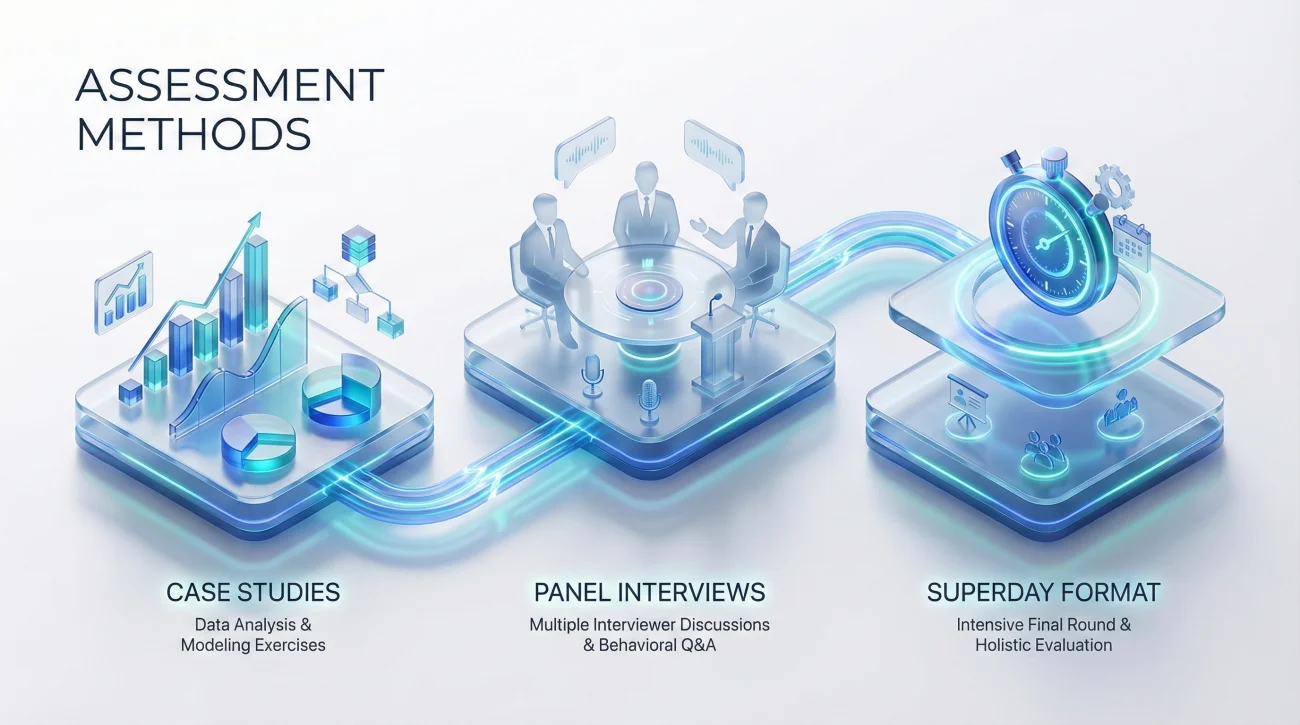
Finance interviews employ diverse assessment formats beyond standard question-and-answer. Anticipating these methods allows proper preparation for each format’s unique demands.
Case Studies and Modeling Exercises
Many finance roles include take-home or live case studies testing your ability to analyze business situations, build financial models, and present recommendations. These exercises reveal technical proficiency, problem-solving approaches, and communication skills simultaneously.
- Take-home financial modeling (investment banking, private equity, corporate finance)
- Live Excel modeling tests with interviewer watching (equity research, FP&A)
- Business case presentations analyzing provided financial data (consulting, strategy roles)
- Technical memo writing on accounting treatment issues (public accounting, SEC reporting)
Panel and Sequential Interviews
Finance organizations frequently use panel interviews or sequential one-on-ones with multiple stakeholders. Each interviewer typically assesses different competency areas – technical skills, cultural fit, leadership potential, or specialized knowledge.
Expert advice: In panel interviews, address your answer to the person who asked the question, but make brief eye contact with other panel members to include them. For technical questions, assume the most knowledgeable interviewer is evaluating your answer’s accuracy while others assess how clearly you explain complex concepts. This dual awareness keeps answers both technically precise and accessible.
Superday Format
Investment banking and consulting often use “superday” marathons with back-to-back interviews across 4-6 hours. Maintaining energy, consistency, and composure throughout tests stamina alongside technical skills. Each interviewer typically shares feedback with the team, so weak performance in early rounds influences later assessors’ perspectives.
Effective Preparation Strategies
Success in financial career interviews requires structured preparation balancing technical review, behavioral rehearsal, and industry research. Generic interview prep fails because finance assessments test actual competence, not just preparation quality.
Technical Knowledge Review
Systematically review core technical concepts relevant to your target role. Don’t just memorize definitions – practice applying concepts to realistic scenarios. Interviewers test application, not recitation.
- 📚 Accounting fundamentals: Review GAAP/IFRS standards, financial statement preparation, consolidation, complex transactions
- 💰 Valuation methods: Practice DCF modeling, comparable analysis, precedent transactions, LBO returns
- 📊 Financial analysis: Ratio analysis, trend interpretation, variance investigation, forecasting techniques
- ⚖️ Regulatory knowledge: SOX requirements, SEC regulations, tax code provisions, industry-specific rules
Behavioral Scenario Preparation
Prepare specific examples demonstrating technical judgment, ethical decision-making, stakeholder management, and problem-solving. Finance behavioral questions often test scenarios involving technical complexity, not just soft skills.
💡 Pro tip: When preparing behavioral examples for finance roles, ensure stories demonstrate both technical competence and professional judgment. “I disagreed with my manager” becomes powerful when you add “because their proposed revenue recognition violated ASC 606 criteria, so I researched the standard, documented my analysis, and presented alternative treatment with supporting citations.” This shows technical knowledge plus ethical courage.
Industry and Company Research
Research target company’s business model, financial performance, competitive position, and recent news. Finance interviewers expect candidates to understand their organization’s financial drivers and strategic challenges.
| Research Area | Key Information to Gather | Where to Find It |
|---|---|---|
| Financial performance | Revenue trends, profitability, cash flow, key metrics | 10-K/10-Q filings, earnings calls, investor presentations |
| Business model | Revenue sources, customer segments, competitive advantages | Company website, industry reports, competitor analysis |
| Strategic priorities | Growth initiatives, M&A activity, digital transformation | CEO letters, earnings transcripts, press releases |
| Industry dynamics | Regulatory changes, competitive landscape, market trends | Industry publications, analyst reports, news coverage |
❓ FAQ
🎯 How technical do finance interviews actually get?
Technical depth varies by role and level. Entry-level positions test fundamental concepts through straightforward questions. Senior roles require demonstrating judgment on complex, ambiguous scenarios without single correct answers. Investment banking and audit typically demand the highest technical proficiency, while relationship management and compliance focus more on regulatory knowledge and ethical reasoning than pure technical depth.
💼 Can I succeed without a finance degree?
Career changers can succeed in finance roles, but must demonstrate technical competence through alternative credentials – CPA certification, CFA charter, MBA with finance concentration, relevant coursework, or proven work experience. Interviewers will scrutinize technical knowledge more carefully when educational background differs from traditional finance paths. Self-study alone rarely suffices for technical roles without formal credentials validating knowledge.
⏰ How long should I prepare for finance interviews?
Preparation time depends on role complexity and current knowledge level. Entry-level candidates might need 2-4 weeks reviewing fundamentals and practicing behavioral responses. Investment banking or private equity roles often require 2-3 months of intensive technical preparation including modeling practice. Career changers need longer timelines to build foundational knowledge before interview-specific preparation.
📋 Should I memorize accounting standards and tax code?
Focus on understanding principles and application rather than memorizing code sections. Interviewers test whether you can interpret and apply standards to scenarios, not recite definitions. Know major standards relevant to your specialization (ASC 606 for revenue recognition, ASC 842 for leases, common tax provisions), but emphasize demonstrating judgment in applying them rather than verbatim recall.
✨ How important are certifications like CPA or CFA?
Certifications matter significantly in finance but requirements vary by role. Public accounting strongly prefers or requires CPA. Investment management values CFA but doesn’t always mandate it. Corporate finance roles care less about certifications than demonstrated analytical skills. Research target role norms – if 80% of job postings mention CPA or CFA, certification becomes practically required regardless of official requirements.
Final Thoughts
Success in accounting and finance interview questions demands more than memorizing technical concepts or crafting compelling behavioral narratives. The financial profession uniquely requires demonstrating technical precision, ethical judgment, and analytical thinking simultaneously – often under significant pressure. Candidates who understand this reality prepare differently than those approaching finance interviews like standard business conversations.
The specialization diversity across financial roles means generic preparation wastes time on irrelevant topics while missing critical assessment areas. Investment banking interviews test completely different competencies than public accounting assessments. Corporate FP&A evaluations differ fundamentally from risk management interviews. Smart preparation starts by understanding exactly which technical knowledge, analytical approaches, and professional behaviors your target role actually requires.
Before your next finance interview, identify your specialization’s core competencies, review relevant technical standards systematically, prepare behavioral examples demonstrating both technical skill and professional judgment, and research your target organization’s financial performance and strategic challenges. This structured approach ensures you demonstrate the complete professional package finance employers seek – technical competence, analytical thinking, ethical reasoning, and business acumen working together to drive sound financial decision-making.
⚠️ Disclaimer: The interview strategies, sample answers, and negotiation tips provided in this guide are for educational purposes only. Hiring decisions are subjective and vary by company and industry. While these strategies are based on professional HR standards, they do not guarantee a specific job offer or result.