What Bookkeeper Interviews Evaluate
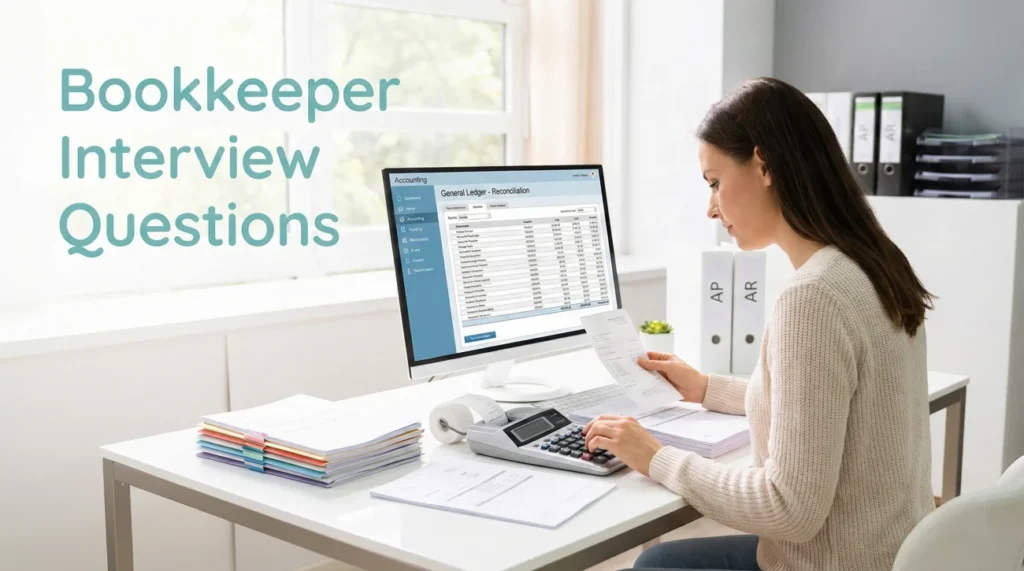
Bookkeeper interview questions assess your ability to maintain accurate financial records, perform reconciliations, manage accounts payable and receivable, and use accounting software effectively. Bookkeepers handle day-to-day transaction recording that forms the foundation for all financial reporting.
This guide covers general ledger maintenance, bank reconciliation, AP/AR management, and software proficiency. Compensation and job demand can vary by location, industry, and experience, but bookkeeping remains a common, practical role across businesses of all sizes. While modern tools automate more routine entry, employers still rely on bookkeepers who can keep records clean, reconcile accounts, spot issues early, and explain discrepancies clearly. Software proficiency in QuickBooks, Xero, or similar platforms is essential for modern bookkeeping roles.
General Ledger and Data Entry
Q: What is a general ledger account?
A general ledger account is a fundamental account used for balance sheet and income statement entries. General ledger accounts are divided into asset accounts such as cash, accounts receivable, inventory, and equipment, and liability accounts including accounts payable, accrued expenses, and notes payable. The general ledger also contains equity accounts like retained earnings, and income and expense accounts that flow into the income statement.
The general ledger is the master record of all financial transactions organized by account. Each transaction affects at least two accounts following double-entry bookkeeping principles. Maintaining accurate general ledger records ensures financial statements reflect the true financial position of the business. I ensure entries are properly classified, dated, and include appropriate supporting documentation.
Q: Explain double-entry bookkeeping.
Double-entry bookkeeping requires every transaction to affect at least two accounts, with debits equaling credits. This system maintains the accounting equation: Assets = Liabilities + Equity. When a company purchases inventory for cash, for example, the inventory account increases (debit) and the cash account decreases (credit) by the same amount.
This method provides built-in error detection because out-of-balance entries indicate mistakes. It also creates a complete audit trail showing both sides of every transaction. Understanding debits and credits for different account types is essential: asset and expense accounts increase with debits, while liability, equity, and revenue accounts increase with credits. Double-entry is the foundation of accurate financial record-keeping that I apply to every transaction I record.
Q: How do you ensure accuracy in data entry?
I maintain accuracy through systematic verification procedures. I double-check entries against source documents including invoices, receipts, and bank statements before posting. I use accounting software features like batch processing and automatic calculations to reduce manual errors. I review entries before finalizing, comparing totals to source document summaries.
I maintain consistent coding practices, using standardized account numbers and descriptions. I perform regular reconciliations catching errors quickly rather than letting them compound. When I identify discrepancies, I trace back to source documents to find the root cause. I implemented a new checklist process for daily entries that reduced errors significantly. Attention to detail isn’t just desirable in bookkeeping; it’s essential for maintaining financial integrity.
Q: If your ledger was off, what would you do?
I follow a systematic approach to identify ledger discrepancies. First, I check my math to ensure totals are calculated correctly. Then, I verify that account balances were input into the ledger accurately from source records. If inputs are correct, I go through the general transaction entries journal and compare each entry to receipts, invoices, or other supporting documents.
Common sources of errors include transposition errors (swapping digits), data entry mistakes, and misclassified transactions. I prioritize finding the source of the discrepancy rather than making arbitrary adjustments. Once identified, I make correcting entries with clear documentation explaining the error and correction. I also consider whether the error type suggests process improvements to prevent recurrence. Thorough investigation protects financial integrity better than quick fixes.
Bank Reconciliation
Q: How do you reconcile a bank statement?
I start by comparing the company’s cash account balance in the general ledger with the ending balance on the bank statement. Then I go through both documents item by item, ticking off matching transactions such as deposits and cleared checks. For any discrepancies, I identify items that appear on one record but not the other.
Common reconciling items include outstanding checks (issued but not yet cleared), deposits in transit (recorded by us but not yet processed by the bank), bank service charges, and interest earned. I make adjusting journal entries for items not yet recorded in our books, such as bank fees or electronic payments. After adjustments, both records should match. I thoroughly investigate any significant or unexplained differences before accepting the reconciliation as complete.
Q: How often should bank reconciliations be performed?
I perform bank reconciliations monthly at minimum, ideally within a few days of receiving the bank statement. More frequent reconciliation, weekly or even daily for high-volume accounts, catches errors faster and reduces investigation time. Quick identification of discrepancies also helps detect potential fraud or unauthorized transactions before they become larger problems.
Timely reconciliation supports accurate financial reporting and cash management. When reconciliations are delayed, errors compound and become harder to trace. I maintain a reconciliation schedule ensuring all accounts are addressed consistently. For businesses with multiple bank accounts, I prioritize accounts by transaction volume and materiality. Regular reconciliation isn’t just good practice; it’s essential for financial control.
Q: Describe a time you found a significant discrepancy during reconciliation.
During a monthly reconciliation, I noticed expenses were understated by approximately $3,000 on our income statement. The figures didn’t match our internal records. I immediately cross-checked entries against bank statements and discovered misclassified transactions where vendor payments had been posted to incorrect expense accounts.
After identifying the misclassifications, I corrected the records and communicated with my supervisor about the adjustments. This not only corrected the financials but also built trust in our reporting accuracy. I implemented a new checklist process for future reconciliations including verification of expense account coding. The experience reinforced the importance of thorough reconciliation procedures for catching errors before they affect financial statements.
Q: What are common causes of bank reconciliation differences?
Timing differences are the most common cause: outstanding checks that haven’t cleared, deposits in transit, and electronic transactions not yet recorded. These are normal reconciling items that explain temporary differences between book and bank balances.
Other causes include data entry errors like transposed numbers or incorrect amounts, bank errors (rare but possible), unauthorized transactions or fraud, duplicate entries, and unrecorded bank fees or interest. I categorize reconciling items to identify patterns. Frequent errors in specific areas suggest process improvements are needed. Bank errors require prompt notification to the bank with supporting documentation. Understanding common difference causes helps me investigate efficiently and maintain accurate records.
Accounts Payable and Receivable
What is the difference between accounts payable and accounts receivable?
Accounts payable represents money a business owes to vendors, suppliers, or creditors for goods or services received. It’s a liability on the balance sheet because it represents an obligation to pay. When we purchase inventory on credit or receive services not yet paid for, those amounts go into accounts payable.
Accounts receivable represents money customers owe the business for products or services provided on credit. It’s an asset on the balance sheet because it represents money we expect to receive. When we sell products or services on account rather than receiving immediate payment, those amounts become accounts receivable. Managing both effectively is crucial: AP management maintains vendor relationships and optimizes cash flow, while AR management ensures we collect what we’re owed promptly.
How do you manage accounts payable effectively?
Effective AP management involves a systematic approach from invoice receipt through payment. I ensure all invoices are received, reviewed for accuracy against purchase orders and receiving reports (the three-way match), and properly authorized before entry. This verification prevents overpayments, duplicate payments, and payments for goods not received.
I prioritize payments based on due dates, payment terms, and cash flow availability. I track early payment discounts to capture savings when beneficial. I use bookkeeping software to schedule payments, track upcoming obligations, and prevent duplicate payments. Regular communication with vendors and internal teams resolves discrepancies promptly and maintains good relationships. I generate aging reports to monitor obligations and ensure nothing falls through the cracks.
How do you handle accounts receivable collection?
Managing accounts receivable begins with accurate invoicing: correct amounts, clear payment terms, and timely delivery to customers. I monitor aging reports regularly, identifying overdue accounts for follow-up. I implement systematic collection procedures: reminder statements, phone calls, and escalation to management for significantly overdue accounts.
I reconcile customer accounts regularly, ensuring our records match what customers believe they owe. I investigate and resolve disputes promptly, as unresolved disputes often delay payment. I track payment patterns by customer, identifying those who consistently pay late and recommending credit term adjustments if needed. Effective AR management directly impacts cash flow; money owed but not collected doesn’t help the business operate.
Software Proficiency and Organization
Q: What accounting software have you used?
I am highly proficient in QuickBooks and have used it extensively for small to mid-sized businesses. I’ve handled full-cycle bookkeeping in QuickBooks including chart of accounts setup, transaction entry, bank reconciliation, and report generation. I’m also familiar with Xero, Sage, and FreshBooks, which are commonly used alternatives.
My software experience includes setting up automated recurring entries, configuring customer and vendor records, generating aging reports, and creating custom reports for management review. I adapt quickly to new software because core accounting principles remain consistent across platforms. When starting with unfamiliar software, I leverage online training resources and practice in test environments to build proficiency quickly without risking live data.
Q: How do you prioritize multiple tasks with varying deadlines?
I maintain a detailed task list organized by deadline and importance. I use calendar reminders for recurring deadlines like payroll processing, bill payments, and monthly reconciliations. I communicate proactively with supervisors and stakeholders to ensure clarity on priorities when multiple urgent items compete for attention.
I tackle high-priority items first while ensuring routine tasks don’t fall behind. I block time for focused work on complex tasks while handling quick items during transitions. I’m realistic about capacity; if deadlines conflict, I raise concerns early rather than missing commitments. During busy periods like month-end close, I plan ahead to manage increased workload. Effective time management ensures accuracy isn’t sacrificed for speed.
Q: How do you handle confidential financial information?
I treat all financial information with strict confidentiality. I follow company policies regarding data access, storage, and sharing. I don’t discuss financial details with unauthorized individuals, whether inside or outside the organization. I secure physical documents and lock my computer when stepping away.
I understand the importance of access controls and only access information necessary for my responsibilities. I’m careful with electronic communications, ensuring sensitive data isn’t sent to unintended recipients. I report any suspected data breaches or security concerns immediately. Trust is essential in bookkeeping roles; employers need confidence that sensitive financial information is protected. I take that responsibility seriously.
Q: What skills do you consider most important for bookkeepers?
Attention to detail is paramount because small errors can have significant financial impact. Accuracy in data entry, reconciliation, and reporting protects the organization from incorrect financial statements and potential compliance issues. I double-check my work and verify entries against source documents consistently.
Organization and time management enable handling multiple accounts and deadlines effectively. Software proficiency increases efficiency and reduces manual errors. Communication skills matter for explaining financial information to non-accountants and resolving discrepancies with vendors or customers. Integrity is fundamental; bookkeepers have access to sensitive information and must be trustworthy. Finally, willingness to learn is essential as technology and processes evolve continuously.
Bookkeeper Knowledge Check
Test Your Bookkeeping Expertise
1. A bookkeeper’s day-to-day work most directly supports:
- Sales outreach
- Financial reporting and decision-making
- Product design
- Customer support
2. In bookkeeping, a bank reconciliation is used to:
- Create customer invoices
- Match the ledger to the bank statement and explain differences
- Calculate payroll taxes
- Approve purchase orders
3. When you find a discrepancy during reconciliation, the best first move is to:
- Delete the transaction
- Trace the difference back to source documents and timing items
- Adjust cash balance without notes
- Ignore it until month-end
4. Modern bookkeeping software typically helps by:
- Replacing the need for controls and reviews
- Automating routine entry while increasing focus on checks and exceptions
- Preventing mistakes entirely
- Eliminating the need to understand debits and credits
5. Accounts payable is classified as:
- Asset
- Liability
- Equity
- Revenue
6. Accounts receivable is classified as:
- Asset
- Liability
- Equity
- Expense
7. Double-entry bookkeeping requires:
- Two separate ledgers
- Debits equal credits
- Two approvals per entry
- Daily reconciliation
8. Asset accounts increase with:
- Debits
- Credits
- Either
- Neither
9. Revenue accounts increase with:
- Debits
- Credits
- Either
- Neither
10. Bank reconciliations should be performed:
- Annually
- Quarterly
- Monthly minimum
- Only when errors suspected
11. Outstanding checks are:
- Issued but not yet cleared
- Lost or stolen
- Voided
- Returned for insufficient funds
12. Three-way match verifies:
- Invoice, payment, bank statement
- PO, receipt, invoice
- Debit, credit, balance
- GL, subledger, trial balance
13. The accounting equation is:
- Assets = Revenue – Expenses
- Assets = Liabilities + Equity
- Assets + Liabilities = Equity
- Revenue = Assets – Liabilities
14. QuickBooks is an example of:
- Spreadsheet software
- Accounting software
- Payroll service
- Banking platform
15. Deposits in transit are:
- Lost deposits
- Recorded by company, not yet by bank
- Bank processing errors
- Unearned revenue
16. Transposition error means:
- Wrong account
- Digits swapped (567 vs 576)
- Missing entry
- Duplicate entry
17. General ledger contains:
- Only asset accounts
- Only liability accounts
- All financial accounts
- Only bank accounts
18. One practical way to increase your value as a bookkeeper is to:
- Avoid learning new software
- Broaden your scope across payroll, AP/AR, reconciliations, and reporting
- Stop reconciling accounts
- Skip documentation to work faster
19. Certified Bookkeeper (CB) credential is offered by:
- AICPA
- AIPB
- IMA
- IIA
20. Primary reason for bookkeeper job decline:
- Outsourcing
- Automation and software
- Economic downturn
- Regulatory changes
❓ FAQ
📜 What qualifications do bookkeepers need?
Many bookkeeper positions accept a high school diploma, and some employers prefer candidates with additional coursework or an associate degree in accounting. Certifications from professional bookkeeping organizations can strengthen credibility and support better opportunities. Software proficiency in QuickBooks or similar platforms is essential.
🔧 How should I demonstrate software skills?
List specific software you’ve used and describe tasks you’ve accomplished: setting up accounts, processing transactions, generating reports, and performing reconciliations. Mention any certifications like QuickBooks ProAdvisor. If you have experience with multiple platforms, highlight your ability to adapt to new software. Provide specific examples of how software improved your efficiency or accuracy.
🎯 What’s the difference between bookkeeper and accountant?
Bookkeepers focus on recording daily financial transactions, maintaining ledgers, and performing reconciliations. Accountants typically require more education, prepare financial statements, analyze financial data, provide tax advice, and make accounting judgments requiring professional expertise. Many accountants supervise bookkeepers and review their work. Bookkeeping often serves as an entry point to accounting careers.
💼 How do I handle errors I’ve made?
Acknowledge errors honestly and demonstrate your corrective approach. Explain how you identified the error, what steps you took to correct it, and what you learned to prevent similar mistakes. Interviewers appreciate candidates who take responsibility rather than making excuses. Show that errors led to improved processes or habits rather than repeated mistakes.
🌟 How can I advance from a bookkeeper role?
Gain experience across different bookkeeping functions including AP, AR, payroll, and reconciliation. Pursue certifications and consider additional education in accounting. Learn advanced software features and explore analytical capabilities. Develop communication skills for explaining financial information. Senior bookkeeper, full-charge bookkeeper, and accounting clerk positions offer increased responsibility and pay as stepping stones toward staff accountant or accounting manager roles.
Advancing Your Bookkeeping Career
Preparing for bookkeeper interview questions requires demonstrating accuracy, organization, and practical software skills. Articulate your experience with general ledger maintenance, reconciliation procedures, and accounts payable and receivable management using specific examples that show attention to detail and problem-solving ability.
Research the prospective employer’s industry and the accounting software they use before interviewing. Be prepared to discuss your approach to maintaining accuracy under deadline pressure. Emphasize your commitment to learning and adapting as technology continues transforming bookkeeping practices. For comprehensive interview preparation, explore accounting career resources to position yourself for success in financial record-keeping roles.
⚠️ Disclaimer: The interview strategies, sample answers, and negotiation tips provided in this guide are for educational purposes only. Hiring decisions are subjective and vary by company and industry. While these strategies are based on professional HR standards, they do not guarantee a specific job offer or result.