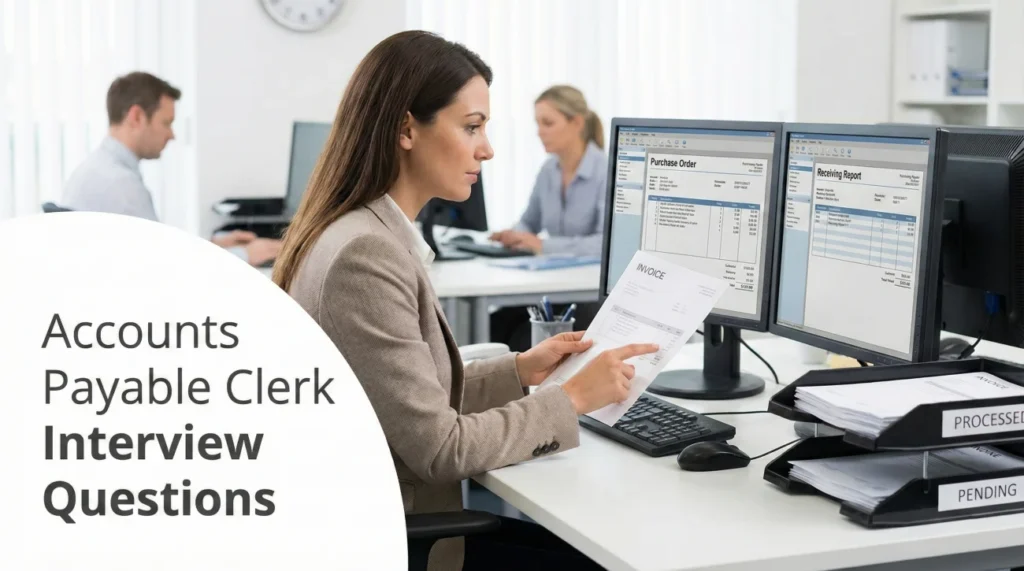
What Accounts Payable Clerk Interviews Evaluate
Accounts payable clerk interview questions are really about control under volume. Interviewers want to know you can move invoices from receipt to payment without losing paperwork, missing approvals, or paying the wrong thing twice.
Great AP work is equal parts detail and communication. You match documents, flag exceptions, and still keep vendors informed so the relationship stays professional even when there is a problem to fix.
To stand out, describe the safeguards you use, three-way matching habits, duplicate checks, approval routing, and how you document decisions so an auditor can follow the trail later.
Invoice Processing and Verification
Q: Describe the accounts payable process from start to finish.
The AP process begins when we receive an invoice from a vendor for goods or services delivered. I verify the invoice against the purchase order and receiving documentation to confirm the order was fulfilled as agreed. This three-way match ensures we only pay for what was actually ordered and received at the correct price.
Once verified, the invoice routes through our approval workflow based on amount thresholds and expense categories. After approval, I enter the invoice into the accounting system with proper coding to the correct general ledger accounts. I schedule payment according to terms and company cash management policies. Finally, I record the payment, update vendor records, and maintain documentation for reconciliation and audit purposes.
Q: Explain three-way matching and why it matters.
Three-way matching compares three documents: the purchase order (what we ordered), the receiving report (what we received), and the vendor invoice (what we’re being charged). The quantity and price on the PO should match the receiving report and the invoice. Any discrepancies are investigated and resolved before payment is authorized.
This process prevents several problems: paying for goods never received, overpaying due to pricing errors, and processing fraudulent invoices. It’s a critical internal control that maintains accuracy in financial records. When discrepancies occur, I document the issue, investigate with relevant departments or vendors, and ensure resolution before processing. Proper three-way matching protects both the company’s cash and its vendor relationships.
Q: What documents do you need to verify an invoice?
To properly verify an invoice, I need the purchase order showing what was originally ordered including quantities, prices, and terms. I need the receiving report or goods receipt note confirming what was actually delivered. I also need any contracts or pricing agreements that govern the vendor relationship.
The invoice itself should include all required components: vendor name and contact information, invoice number and date, itemized list of goods or services with quantities and prices, payment terms, and applicable taxes. I compare these elements across all documents. If anything is missing or doesn’t match, I investigate before processing. Complete documentation also supports audit requirements and provides clear records if questions arise later.
Q: How do you ensure accuracy when processing invoices?
I follow a systematic verification process for every invoice. I double-check all entries against source documents before posting. I use accounting software features like validation rules, auto-fill for recurring vendors, and templates to minimize manual entry errors. I reconcile accounts regularly to catch any discrepancies early.
I maintain organized filing systems so I can quickly verify information when questions arise. I check for common errors like transposed numbers, duplicate invoices, and incorrect vendor assignments. Before batch processing, I review totals and spot-check individual entries. When I find errors, I trace them to the source and correct both the immediate issue and any underlying process problems. Accuracy isn’t just about getting numbers right; it affects vendor relationships, financial reporting, and audit outcomes.
Handling Discrepancies
Q: How do you handle invoice discrepancies?
When I discover a discrepancy between a purchase order and invoice, I first document the exact nature of the issue: is it a pricing difference, quantity mismatch, or something else? I gather all relevant documentation including the PO, receiving report, and any correspondence. This creates a clear picture of what happened.
I then investigate by contacting the appropriate parties. For pricing issues, I check for recent contract changes or price agreements. For quantity differences, I verify with the receiving department what was actually delivered. I communicate with the vendor to understand their perspective. Once I have complete information, I work toward resolution, which might involve requesting a corrected invoice, processing a credit memo, or obtaining approval for the variance. I document everything for audit trail purposes.
Q: Describe a time you found an invoice discrepancy and resolved it.
I once discovered we had been double-paying a vendor because they were submitting invoices under two slightly different company names. The amounts were identical, but our system treated them as separate vendors. I identified the pattern during routine reconciliation when vendor totals seemed unusually high.
I immediately documented the issue and calculated the total overpayment amount. I escalated to my supervisor and then contacted the vendor’s accounting team to arrange resolution. We agreed to apply credits against future invoices rather than requesting a refund, which preserved the relationship. To prevent recurrence, I recommended implementing a vendor naming convention and adding duplicate payment checks to our verification process. The experience reinforced why systematic reconciliation matters.
Q: What would you do if you discovered a vendor under-billed you?
Even when an error benefits us financially, I address it promptly and honestly. I would verify the discrepancy by comparing the invoice to the purchase order and delivery records. Once confirmed, I would notify my supervisor and contact the vendor to inform them of the billing error.
Integrity in these situations protects long-term vendor relationships and the company’s reputation. Vendors who discover unreported errors may lose trust or become more cautious in future dealings. Additionally, depending on the contract terms, we may have legal obligations to report such discrepancies. I document the communication and resolution for our records. Handling under-billing correctly demonstrates the same attention to detail and ethics that prevents overpayment errors.
Q: How do you prevent duplicate payments?
Preventing duplicate payments requires multiple layers of controls. I use invoice matching in our accounting system to check for duplicates before processing, comparing invoice numbers, amounts, and dates. I maintain a centralized vendor database with consistent naming conventions to prevent the same vendor appearing under multiple names.
I review vendor statements regularly to identify any double-posted payments. I implement approval workflows that flag invoices similar to recently processed ones. I also watch for duplicate invoice numbers from vendors or invoices resubmitted with slight variations. When the system flags a potential duplicate, I investigate fully before proceeding. These controls, combined with regular account reconciliation, catch most duplicate payment attempts before money leaves the company.
Vendor Management and Communication
How do you handle vendor inquiries about payment status?
I respond to vendor inquiries promptly and professionally, understanding that their cash flow depends on timely information. I access our AP system to check the invoice status: has it been received, verified, approved, and scheduled for payment? I provide specific, accurate information rather than vague responses.
If there’s a delay, I explain the reason honestly, whether it’s a missing approval, documentation issue, or simply where we are in the payment cycle. I give realistic timelines for resolution. I keep notes of vendor communications for reference. Building good relationships with vendors makes future interactions smoother and can help when we need flexibility on payment terms or expedited orders. Professional, responsive communication reflects well on the entire organization.
Describe a time you negotiated with a vendor.
A key supplier disputed our standard payment terms, expressing frustration with our 45-day cycle. Rather than dismissing their concerns, I scheduled a call to understand their situation. They were experiencing cash flow challenges due to business expansion and needed faster payment on larger orders.
I proposed a compromise: we would pay certain invoices on 30-day terms in exchange for improved pricing on bulk orders. This addressed their cash flow needs while providing cost savings for us. I documented the new arrangement and updated our system accordingly. The negotiation actually strengthened our relationship because both parties felt heard and benefited from the outcome. Sometimes vendor concerns present opportunities for creative solutions.
How do you maintain vendor master data?
I keep vendor records current by verifying information whenever we interact: addresses, contact details, banking information for electronic payments, and tax identification numbers. I use W-9 forms to confirm tax information for new vendors and periodically reverify existing records.
I follow established procedures for adding new vendors, including verification that they’re legitimate businesses. I implement naming conventions that prevent duplicate vendor records. I flag inactive vendors for review rather than allowing outdated records to accumulate. Accurate vendor data prevents payment errors, supports tax compliance, and ensures communications reach the right people. I also maintain records of payment terms and any special arrangements negotiated with each vendor.
Payment Processing and Organization
Q: How do you prioritize vendor payments?
I prioritize payments based on several factors. First, I consider due dates and payment terms to avoid late fees and maintain good vendor relationships. I identify invoices with early payment discounts and prioritize those if capturing the discount benefits our cash position. Critical vendors essential to daily operations receive priority.
I also consider vendor relationships and history. Long-term strategic partners may warrant prioritization during tight cash periods. I communicate proactively with vendors if payments will be delayed, often preventing damage to relationships. I work with finance leadership to understand cash flow constraints and adjust payment scheduling accordingly. The goal is meeting obligations while optimizing cash management and vendor relationships.
Q: What accounting software have you used?
I have experience with several accounting and ERP systems including QuickBooks, SAP, and Oracle. In each platform, I’ve handled invoice processing, approval workflows, payment scheduling, vendor management, and reporting. I’m comfortable navigating different interfaces because core AP principles remain consistent across systems.
I adapt quickly to new software by focusing on understanding the underlying workflow rather than just clicking through screens. I leverage automation features to reduce manual entry and improve accuracy. I generate reports to monitor AP aging, payment status, and vendor activity. If the organization uses a system I haven’t worked with, I’m confident in my ability to learn it efficiently while applying established AP best practices.
Q: How do you organize your work with tight deadlines?
I maintain a detailed schedule tracking all deadlines: payment due dates, discount cutoffs, month-end close requirements, and regular processing cycles. I use calendar reminders and task lists to stay organized. I plan my work to allow buffer time for unexpected issues that inevitably arise.
I prioritize tasks based on deadline urgency and business impact. During high-volume periods like month-end, I focus on critical items first while ensuring routine work doesn’t fall behind. I communicate proactively with stakeholders when multiple urgent requests compete for attention. I’ve found that consistent organization and clear communication prevent most deadline crises. When unexpected volume hits, my organized systems allow me to scale up without losing accuracy.
Q: How do you prepare for month-end close?
Month-end preparation begins before the close period. I ensure all invoices received are processed and properly coded. I follow up on pending approvals to avoid delays. I reconcile vendor statements to our records, identifying and resolving any discrepancies before close.
I prepare accrual entries for goods or services received but not yet invoiced, working with other departments to capture these amounts. I verify that all payments are properly recorded and bank reconciliations are current. I generate AP aging reports and review for unusual items. I ensure all documentation is complete for audit purposes. Thorough preparation makes the actual close smoother and produces more accurate financial statements.
Accounts Payable Knowledge Check
Test Your AP Expertise
1. Three-way matching compares which documents?
- Invoice, check, bank statement
- PO, receiving report, invoice
- Quote, invoice, payment
- Contract, PO, check
2. Accounts payable is classified as:
- Asset
- Liability
- Equity
- Revenue
3. A purchase order is issued by:
- Buyer to vendor
- Vendor to buyer
- Bank to company
- Auditor to company
4. Primary purpose of three-way matching:
- Speed up payments
- Prevent errors and fraud
- Reduce paperwork
- Improve vendor relationships
5. AP aging report shows:
- Vendor contact history
- Outstanding invoices by age
- Payment processing times
- Employee expense reports
6. A credit memo from a vendor indicates:
- Additional charges
- Reduction in amount owed
- Payment received
- New order placed
7. Remittance advice tells vendors:
- What to ship
- What invoices the payment covers
- How to contact us
- Our credit terms
8. W-9 form is used to:
- Request payment
- Collect vendor tax ID
- Report annual payments
- Authorize bank transfers
9. Non-PO invoice means:
- Invalid invoice
- Invoice without purchase order
- International invoice
- Recurring invoice
10. Early payment discount benefits:
- Buyer who pays early
- Vendor only
- Bank
- Auditors
11. Segregation of duties in AP means:
- Working in separate offices
- Different people handle different tasks
- Processing invoices alphabetically
- Separating domestic and international vendors
12. 2/10 net 30 payment terms mean:
- 2% discount if paid in 10 days, otherwise due in 30
- Pay 2% now, rest in 30 days
- Minimum 2 payments over 30 days
- 10% discount if paid in 2 days
13. Vendor statement reconciliation compares:
- Bank statement to GL
- Vendor records to our AP records
- Budget to actual
- PO to invoice only
14. Accrued expenses represent:
- Paid but not received
- Received but not yet invoiced
- Future orders
- Cancelled purchases
15. Common AP software includes:
- Photoshop, Illustrator
- Word, PowerPoint
- SAP, Oracle, QuickBooks
- Slack, Zoom
16. Invoice coding assigns expenses to:
- Vendor accounts
- General ledger accounts
- Bank accounts
- Customer accounts
17. Goods receipt note confirms:
- Payment was made
- Items were delivered
- Invoice was approved
- Order was placed
18. AP automation primarily helps with:
- Vendor negotiations
- Reducing manual errors and processing time
- Increasing payment amounts
- Eliminating approvals
19. Duplicate payment prevention requires:
- Faster processing
- System checks and reconciliation
- Fewer vendors
- Manual processing only
20. Month-end close in AP involves:
- Deleting old records
- Reconciliation and accruals
- Cancelling pending payments
- Adding new vendors
❓ FAQ
🧩 What is the clearest way to explain three-way matching?
Keep it simple: purchase order shows what was authorized, receiving report shows what arrived, and the invoice shows what the vendor is charging. Payment happens only when the three agree or the variance is approved.
Add one example variance, like partial delivery or price change, then explain how you resolve it before releasing payment.
🔁 How do I prevent duplicate payments?
Talk about system controls and human habits. Use vendor invoice number checks, duplicate flags, and careful vendor master hygiene, plus a quick review of batch totals before release.
If you have a story where reconciliation caught a duplicate early, share it. That is the kind of detail that signals reliability.
☎️ What is a strong approach to vendor disputes?
Start with documentation, then empathy. Confirm the facts, explain what you see in the records, and ask what the vendor expects. Most disputes resolve faster when both sides agree on what was delivered and what was approved.
Stay consistent, document every step, and escalate only after you have the full picture.
📥 How do I handle a backlog without sacrificing accuracy?
Explain prioritization, due dates, discount windows, and high-risk invoices first, then batch the rest. Mention checklists, templates, and time blocks that keep you focused.
Interviewers want to hear that speed comes from organization, not from skipping steps.
🕵️ What should I say about fraud prevention in AP?
Call out basic red flags: unusual vendor changes, rush requests, mismatched banking details, and invoices that bypass normal approvals. Mention that you verify changes through a separate channel.
Even an entry-level AP clerk can show good judgment by asking the right questions at the right time.
Advancing Your AP Career
AP interviews are easiest when you can describe your process end to end, what you check, how you route approvals, and how you keep an audit trail clean.
Spend a few minutes practicing the parts you usually do silently, like spotting variances and explaining why you held an invoice. For more drills, use the main question hub and run through a few scenarios from these browse invoice and payment interview questions.
⚠️ Disclaimer: The interview strategies, sample answers, and negotiation tips provided in this guide are for educational purposes only. Hiring decisions are subjective and vary by company and industry. While these strategies are based on professional HR standards, they do not guarantee a specific job offer or result.