What Chief Audit Executive Interviews Evaluate
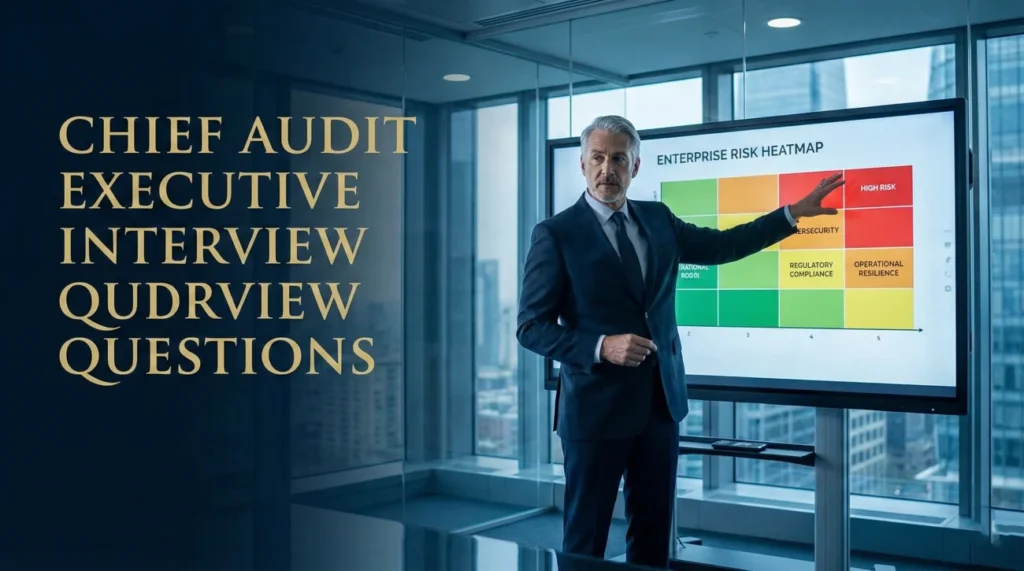
Chief audit executive interview questions assess your ability to lead internal audit functions, provide governance assurance, manage enterprise risk oversight, and serve as a strategic advisor to boards and audit committees. CAEs position internal audit as an independent, objective function delivering value through risk-based assurance and advisory services.
This guide covers governance and board relationships, risk management, audit planning, and internal audit leadership. Compensation and reporting lines vary by industry, organization size, and geography, but hiring teams consistently look for a CAE who can protect independence, deliver risk-based assurance, and communicate clearly with the audit committee. The updated Global Internal Audit Standards, rolling into practice in 2025, also raise expectations around board engagement, essential conditions for effectiveness, and internal audit’s strategic value.
Governance and Board Relationships
Q: How do you maintain independence and objectivity?
Independence and objectivity are foundational to internal audit credibility. I establish clear policies and procedures safeguarding the function’s independence, ensuring audit activities remain impartial and free from undue influence. I maintain functional reporting to the audit committee with administrative reporting to the CEO or other senior executive, creating dual accountability that protects independence.
I do not participate in management decision-making processes or accept operational responsibilities that could compromise objectivity. While I advise management on compliance, risk management, and internal controls, I remain independent of activities I audit. The 2024 Standards require CAEs to discuss “essential conditions” with boards including supporting independent positioning and overseeing internal audit performance. I document and communicate any threats to independence, implementing safeguards or disclosing limitations when complete independence isn’t possible.
Q: Describe your relationship with the audit committee.
The audit committee is internal audit’s primary customer, and I maintain robust two-way communication supporting their oversight responsibilities. I provide regular updates on audit findings, emerging risks, and control environment status. I ensure reports reach the committee with minimal delay, providing actionable insights rather than merely compliance documentation.
I conduct regular executive sessions with the audit committee, creating structured opportunities for candid discussion without management present. I inform the committee of expectations regarding information needed for oversight responsibilities. The committee has sole competence for internal audit charter approval, my appointment and compensation decisions, and budget approval for the function. I present annual holistic opinions on governance, risk management, and control effectiveness. This relationship enables internal audit to serve as the board’s eyes and ears throughout the organization.
Q: How do you ensure the internal audit charter reflects appropriate authority?
The charter defines internal audit’s purpose, authority, and responsibility within the organization. I ensure it grants unrestricted access to all records, databases, workplaces, and employees necessary to fulfill our mandate. It establishes functional reporting to the audit committee and addresses the scope of assurance and advisory services we provide.
I review the charter annually with the audit committee, updating it to reflect changes in organizational structure, regulatory requirements, or professional standards. The 2024 Standards emphasize charter provisions establishing essential conditions for effectiveness. A well-crafted charter promulgated throughout the organization reinforces internal audit’s independent positioning and authority. I address any restrictions on access or scope as potential impairments to our ability to fulfill our responsibilities.
Q: How do you contribute to strategic planning?
I actively participate in strategic planning discussions, providing insights on how internal audit can support broader organizational goals. I align audit activities with strategic objectives, ensuring we focus assurance efforts on areas most critical to organizational success. I advise leadership on risk implications of strategic initiatives before decisions are finalized.
I position internal audit as a proactive partner rather than a reactive compliance function. I identify opportunities where our unique enterprise-wide perspective adds value to strategic decision-making. I benchmark organizational practices against leading standards and competitors. However, I maintain independence by advising rather than deciding, ensuring I can objectively audit areas I’ve provided guidance on. The goal is strategic relevance while preserving the objectivity that makes internal audit valuable.
Risk Management and Oversight
Q: Describe your approach to developing a risk-based audit plan.
I develop audit plans through disciplined, process-oriented risk assessment that identifies the most significant threats to organizational objectives. I gather input from the audit committee, senior management, and business leaders to understand strategic priorities and emerging concerns. I analyze internal and external factors affecting the risk landscape.
I prioritize audit coverage based on risk significance, ensuring we address areas with greatest potential impact on reputation, strategy, and operations. I build flexibility into plans to adapt as business and risk conditions change throughout the year. I coordinate with other assurance providers to optimize coverage and avoid duplication. The audit committee reviews and approves the plan and budget annually, ensuring we have resources to execute on responsibilities. I present the plan showing clear linkage between identified risks and planned audit activities.
Q: How do you address emerging risks?
I establish processes to identify and assess emerging risks for inclusion in audit planning. I monitor trends and technologies that may impact the organization, staying current through professional networks, industry publications, and regulatory updates. I regularly discuss emerging risks with the board, management, and audit committee.
Current priority areas often include cybersecurity, third-party and supply chain exposure, artificial intelligence adoption, ESG reporting expectations, and geopolitical uncertainty. When emerging risks could affect financial reporting quality or regulatory posture, I coordinate with external auditors and compliance partners to ensure coverage is adequate and timely.
Q: How do you coordinate with other assurance providers?
I establish coordination frameworks with external auditors, compliance functions, risk management, and other assurance providers to optimize coverage and leverage expertise. I share risk assessments and audit plans to identify gaps and overlaps. I utilize external audit findings to inform internal audit focus areas and vice versa.
The 2024 Standards require coordination with other assurance providers to enhance coverage efficiency. I participate in combined assurance activities where multiple providers address interconnected risks. When specialized expertise is needed beyond internal audit capabilities, I engage external resources with audit committee approval. Effective coordination maximizes value from total assurance investment while ensuring comprehensive risk coverage without unnecessary duplication.
Q: How do you provide enterprise risk management assurance?
Internal audit’s role in ERM is to provide assurance regarding the adequacy of risk management processes, not to manage risk directly. I assess whether risk identification, assessment, and mitigation activities operate effectively. I evaluate whether the risk management framework aligns with organizational objectives and industry standards.
I review risk appetite statements and assess whether actual risk exposure aligns with stated tolerance. I test whether risk mitigation controls function as designed. I provide independent validation of risk assessments performed by management. Nearly one-third of CAEs now have ERM responsibilities, requiring careful navigation of the line between assurance and management activities. I maintain objectivity by ensuring any advisory role in ERM design doesn’t compromise future audit independence.
Internal Audit Function Leadership
How do you ensure the internal audit function has appropriate resources?
I develop resource requirements based on the approved audit plan and organizational complexity. I assess capability needs including specialized skills for technology, cybersecurity, and emerging risk areas. I present budget requests to the audit committee with clear justification showing how resources align with risk coverage requirements.
The 2024 Standards require boards to ensure adequate resources for internal audit effectiveness. I communicate capacity constraints and their impact on planned coverage to the audit committee. When internal capabilities are insufficient, I utilize co-sourcing or outsourcing for specialized expertise. I invest in team development through training and certification support. High-performing functions invest consistently in training and development, and they treat upskilling as part of the audit plan, not an afterthought. I track utilization metrics to demonstrate efficient resource deployment and justify additional investment when needed.
How do you develop and maintain audit quality?
I develop and maintain a quality assurance and improvement program covering all aspects of the internal audit function. I conduct internal assessments monitoring conformance with Global Internal Audit Standards and progress toward performance objectives. I implement standardized methodologies ensuring consistent audit execution.
I schedule independent external quality assessments on a regular cadence by qualified reviewers, and I communicate results and action plans to the audit committee. I track performance metrics including on-time completion, stakeholder satisfaction, and recommendation implementation rates. I implement continuous improvement based on assessment findings and stakeholder feedback. Quality is built into processes through supervision, review procedures, and ongoing training. Strong quality programs demonstrate professionalism and build credibility with stakeholders.
How do you leverage technology in internal audit?
Technology transforms internal audit from reactive reviewer to proactive partner. I implement data analytics enabling continuous monitoring and anomaly detection. AI-powered tools flag risks in minutes that manual review might miss. I utilize audit management software improving planning, execution, and reporting efficiency.
More CAEs are experimenting with GenAI and advanced analytics to speed up risk sensing, testing, and reporting. I focus on practical use cases with clear governance: data privacy, model risk, access controls, and human review. I build skills across the team through training and targeted hiring when needed, so technology strengthens assurance quality rather than creating new blind spots.
Communication and Stakeholder Management
Q: How do you communicate findings to different audiences?
Effective communication tailors messages to different audiences while maintaining consistent substance. For the audit committee, I focus on strategic implications, risk trends, and control environment health. For management, I provide actionable recommendations with clear ownership and timelines. For operational teams, I explain findings in terms relevant to their daily responsibilities.
I employ clear, concise communication avoiding jargon. I focus on providing actionable insights that facilitate positive changes rather than merely documenting deficiencies. I distinguish between significant issues requiring immediate attention and lower-priority observations. I present findings constructively, positioning internal audit as a partner in improvement rather than an adversary identifying failures. Visual presentations and executive summaries make complex findings accessible to non-technical stakeholders.
Q: How do you handle disagreements with management?
When management disagrees with findings or recommendations, I first ensure I fully understand their perspective and reasoning. I verify facts and reassess conclusions in light of new information. I engage in professional dialogue seeking resolution through evidence and analysis rather than positional debate.
If disagreement persists on significant matters, I have clear escalation paths to the audit committee. I document management’s position and my rationale in reports, allowing the audit committee to make informed decisions. I maintain professional relationships despite disagreement, recognizing that constructive tension can improve outcomes. The audit committee’s role in resolving disputes between internal audit and management reinforces our independence while ensuring appropriate governance oversight.
Q: How do you address ethical dilemmas or conflicts of interest?
I establish clear policies addressing ethical standards and conflicts of interest within the internal audit function. I assess potential conflicts before assigning auditors to engagements, ensuring objectivity isn’t compromised by prior relationships or responsibilities. I require disclosure of any situations that could impair judgment or create appearance of bias.
When ethical dilemmas arise, I apply professional standards and organizational policies to guide decisions. I consult with legal counsel and the audit committee chair on sensitive matters. I maintain confidentiality while ensuring appropriate parties are informed of significant ethical concerns. I model ethical behavior for the team and address any violations promptly. The integrity of internal audit depends on uncompromising ethical standards, even when doing so creates short-term difficulties.
Q: How do you stay current with professional standards and best practices?
I maintain active involvement with the Institute of Internal Auditors and other professional organizations. I ensure compliance with evolving standards including the updated 2024 Global Internal Audit Standards moving into 2025. I attend industry conferences, participate in webinars, and engage with peer networks to learn from leading practices.
I hold monthly training sessions with my team discussing recent changes and case studies, ensuring our advice remains compliant and strategic. I subscribe to professional journals and regulatory updates. I benchmark our function against industry standards and peer organizations. I pursue relevant certifications and encourage team members to do the same. Continuous learning isn’t optional for effective CAE leadership; the profession evolves rapidly, and relevance requires ongoing investment in knowledge and skills.
CAE Knowledge Check
Test Your CAE Expertise
1. The CAE’s primary customer is:
- The payroll team
- Sales leadership
- The audit committee and board
- Vendors and suppliers
2. Functional reporting for internal audit should primarily be to:
- The CFO only
- The controller only
- The audit committee or board
- The head of IT only
3. An effective internal audit charter should explicitly grant:
- Access only to financial statements
- Unrestricted access to records, systems, and people
- Authority to approve budgets across departments
- Permission to sign contracts on behalf of management
4. A risk-based audit plan should be grounded in:
- Last year’s audit schedule with minor edits
- Enterprise risk assessment plus board and management input
- Only external auditor suggestions
- Only regulatory checklists
5. Internal audit’s role in enterprise risk management is to:
- Own and operate the ERM program
- Set risk appetite for management
- Provide assurance on the adequacy of risk processes
- Replace management’s risk owners
6. An executive session with the audit committee is typically:
- A presentation to the entire company
- A private discussion without management present
- A monthly finance close meeting
- A training class for new auditors
7. When a threat to independence arises, the best first response is to:
- Ignore it to avoid conflict
- Switch the audit topic entirely
- Document the threat and apply safeguards or disclose it
- Assign internal audit to run the control being audited
8. If management disputes a significant finding and it cannot be resolved, the CAE should:
- Remove the finding from the report
- Stop auditing that area permanently
- Document both positions and escalate through governance channels
- Publish the report publicly
9. Combined assurance is intended to:
- Eliminate all external audit work
- Reduce gaps and unnecessary duplication across assurance providers
- Move compliance under internal audit management
- Replace risk management teams
10. A strong quality assurance and improvement program (QAIP) includes:
- Only informal feedback from friends
- Ongoing internal assessments and periodic independent review
- Only annual budgeting exercises
- Only audit committee minutes
11. Data analytics strengthens internal audit primarily by:
- Replacing professional judgment entirely
- Spotting anomalies and expanding coverage beyond small samples
- Reducing documentation requirements
- Avoiding interviews with process owners
12. Advisory work is appropriate when internal audit:
- Owns the decision and implementation
- Advises without taking management responsibility
- Approves operational policies for the business
- Runs daily control monitoring for management
13. Essential conditions for internal audit effectiveness are best aligned through discussions with:
- Only external auditors
- Only the HR department
- The board and senior management
- Only vendors
14. For cybersecurity, CAE-level communication should focus on:
- Tool names and product comparisons only
- Business impact, control effectiveness, and risk appetite alignment
- Only password rules
- Only network diagrams
15. A practical way to track emerging risks is to:
- Rely on last year’s risk register unchanged
- Monitor external signals and internal change, then adjust the plan
- Wait for incidents before acting
- Audit only financial reporting risks
16. The audit committee typically approves or oversees:
- Sales compensation plans
- Charter, audit plan, budget, and CAE performance matters
- Day-to-day operational decisions
- Marketing campaign calendars
17. To preserve objectivity, internal audit should avoid:
- Sharing observations with management
- Owning or operating the controls it later audits
- Using standard workpapers
- Attending governance meetings
18. Staying current with standards and best practices depends most on:
- Only reading social media posts
- Structured learning, peer exchange, and method updates in the audit program
- Only vendor newsletters
- Only internal policy manuals
19. Internal audit delivers the most value when it:
- Reports issues without context
- Links findings to enterprise objectives and risk drivers
- Focuses only on minor policy deviations
- Avoids discussing root causes
20. A strong CAE consistently balances:
- Speed over quality
- Independence, relationships, and measurable impact
- Public relations and brand promotion
- Personal preference over standards
❓ FAQ
📜 What credentials are expected for CAE roles?
CIA (Certified Internal Auditor) is the premier credential demonstrating internal audit expertise. CPA provides broad accounting credibility, particularly valuable for financial audit backgrounds. CISA (Certified Information Systems Auditor) demonstrates IT audit capability increasingly important in technology-driven environments. Many CAEs hold multiple credentials reflecting diverse experience across audit disciplines.
🔍 How do I demonstrate board relationship skills?
Describe experience presenting to audit committees and boards. Explain your approach to executive sessions and maintaining appropriate communication cadence. Discuss how you balance providing candid assessments while maintaining productive working relationships. Show understanding of governance structures and director responsibilities. Demonstrate ability to tailor communication for board-level audiences.
🎯 How should I discuss independence challenges?
Describe situations where independence was threatened and how you addressed them. Explain your framework for identifying and managing conflicts. Discuss how dual reporting relationships support independence. Show awareness of situations requiring disclosure or recusal. Demonstrate commitment to principles over expedience even when independence creates tension.
💼 What strategic contributions should I highlight?
Discuss how you’ve positioned internal audit as a strategic partner beyond compliance. Describe contributions to enterprise risk management and strategic planning. Explain initiatives that increased internal audit’s organizational value and visibility. Show how you’ve aligned audit activities with business objectives. Demonstrate understanding of how internal audit supports broader governance goals.
🌟 How do I show knowledge of current standards?
Demonstrate familiarity with the updated Global Internal Audit Standards and how you translate them into day-to-day practice: governance expectations, independence safeguards, risk-based planning, and quality assurance. Discuss how you have prepared your function for implementation in 2025, and connect standards to current priorities like cybersecurity, third-party risk, and responsible AI adoption.
Advancing Your CAE Career
Preparing for chief audit executive interview questions requires demonstrating governance expertise, strategic leadership, and deep understanding of internal audit’s role in organizational assurance. Articulate your experience building board relationships, developing risk-based audit strategies, and leading high-performing teams with specific examples showing measurable impact.
Research the prospective organization’s industry, risk profile, and governance structure before interviewing. Prepare to discuss how you’d approach their specific challenges and opportunities. Demonstrate command of the 2024 Global Internal Audit Standards and current industry trends. For comprehensive interview preparation, explore internal audit leadership resources to position yourself for roles shaping organizational governance and risk oversight.
⚠️ Disclaimer: The interview strategies, sample answers, and negotiation tips provided in this guide are for educational purposes only. Hiring decisions are subjective and vary by company and industry. While these strategies are based on professional HR standards, they do not guarantee a specific job offer or result.