What Accounts Receivable Clerk Interviews Evaluate
Accounts receivable clerk interview questions focus on how you protect cash flow without burning relationships. Employers want someone who can invoice accurately, apply payments correctly, and follow up on past due balances with professionalism.
Good AR is structured. You track aging, keep notes on outreach, handle disputes with evidence, and know when to escalate versus when to negotiate a workable plan.
Bring examples that show firmness with empathy. If you can explain how you reduce DSO or clean up unapplied cash while keeping customers cooperative, you will sound like a safe hire.
Invoicing and Billing
Q: Describe the accounts receivable process from start to finish.
The AR process begins when we deliver goods or services to a customer and generate an invoice. The invoice includes company and customer details, itemized list of products or services with quantities and prices, payment terms, and due date. Upon generating the invoice, I record it as an account receivable, creating an asset on the balance sheet representing money owed to us.
I track invoices through their lifecycle: sent, acknowledged, due, and paid. I send payment reminders before due dates and follow up on overdue accounts according to our collection procedures. When payment arrives, I apply it to the correct customer account and invoices, reconciling against bank deposits. I update the aging report and maintain documentation for audit purposes. The goal is collecting what we’re owed while preserving customer relationships.
Q: What information do you include in an invoice for services rendered?
A complete invoice starts with identifying information: our company name and contact details, customer name and billing address, invoice number for tracking, and invoice date. I include a clear description of each service provided, hours spent if applicable, and the rate or price for each line item. I calculate totals for each service category and the overall invoice amount.
I add payment terms specifying when payment is due and any early payment discounts or late payment penalties. I include acceptable payment methods and where to send payment. If applicable, I itemize taxes separately. I always double-check calculations before sending. Clear, complete invoices reduce customer questions and speed up payment. Missing information often causes delays as customers wait for clarification before processing.
Q: How do you ensure accuracy in billing?
I verify all billing information against source documents before generating invoices. I confirm pricing matches contracts or quotes, quantities match delivery records, and customer information is current. I use pre-billing checklists to ensure nothing is missed: validate pricing and discounts, confirm tax settings, verify purchase order numbers and addresses, and check service periods.
I run exception reports to identify anomalies before invoices go out, such as unusually high amounts or missing information. I review batch totals and spot-check individual invoices. When I find errors, I trace them to the source and correct both the immediate issue and the underlying cause. Accurate billing prevents disputes, speeds collection, and maintains customer trust.
Q: Describe the journal entry process from invoice to payment.
When I generate an invoice, I record a debit to accounts receivable (increasing the asset) and a credit to revenue (recognizing the income). This entry reflects that we’ve earned money but haven’t received cash yet. The accounts receivable balance represents what customers owe us.
When payment is received, I debit cash (increasing the asset) and credit accounts receivable (reducing what’s owed). This entry moves the value from a receivable to actual cash. If there are any discounts, returns, or adjustments, I record appropriate entries to reflect the actual amount collected. Proper journal entries maintain accurate financial records and ensure the balance sheet reflects our true financial position.
Collections Process
Q: How do you handle overdue accounts?
I follow a structured approach to collecting overdue accounts. First, I review the aging report to identify which accounts are past due and by how much. I prioritize based on amount, days overdue, and customer history. I reach out to customers to remind them of their payment obligations and inquire about any issues causing the delay.
I listen to customer concerns and work collaboratively to find solutions. If a customer is experiencing temporary difficulties, I may negotiate a payment plan that works for both parties. I document all communications and agreements. If initial outreach doesn’t resolve the issue, I escalate according to company policy, which might include more formal collection letters, involvement of management, or eventually referral to collections agencies. Throughout the process, I maintain professionalism to preserve the relationship for future business.
Q: How do you prioritize collection efforts?
I segment accounts by risk and value to focus effort where it matters most. High-balance accounts that are significantly overdue get immediate attention because they represent the greatest impact on cash flow. I also prioritize accounts with prior broken payment commitments since they’re higher risk for becoming uncollectible.
I use a systematic cadence: reminder emails before due dates, follow-up calls shortly after accounts become overdue, and escalation for accounts that don’t respond. I track all outreach in our system so I know exactly where each account stands. For strategic customers, I coordinate with sales or account management to ensure collection efforts don’t damage important relationships. The goal is maximizing collections while maintaining customer relationships where possible.
Q: Describe a time you successfully collected on a difficult account.
A long-standing customer had an invoice outstanding for several months despite repeated reminders. Rather than simply sending more notices, I called to understand what was happening. I discovered they were disputing charges they believed were incorrect, but hadn’t communicated this clearly to us.
I pulled the contract and service records to review their concerns. After investigation, I found a legitimate misunderstanding about scope that warranted a partial credit. I worked with my supervisor to approve a credit memo for the disputed portion while collecting the undisputed balance immediately. The customer appreciated that I listened and investigated rather than just demanding payment. We resolved the dispute, collected most of the outstanding amount, and actually strengthened the relationship.
Q: How do you handle bad debt?
When an account becomes uncollectible despite exhausting collection efforts, I follow company procedures for writing off bad debt. First, I document all collection attempts made and the reasons the debt is deemed uncollectible. I obtain appropriate approvals before processing any write-off, as this affects financial statements.
The accounting treatment involves debiting bad debt expense and crediting accounts receivable to remove the uncollectible amount from our books. I maintain records of written-off accounts in case circumstances change or the customer attempts future business with us. I also analyze patterns in bad debt to identify whether certain customer types, credit terms, or other factors contribute to uncollectible accounts, sharing insights that might improve our credit policies.
Aging Reports and Analysis
Explain what an aging report shows and how you use it.
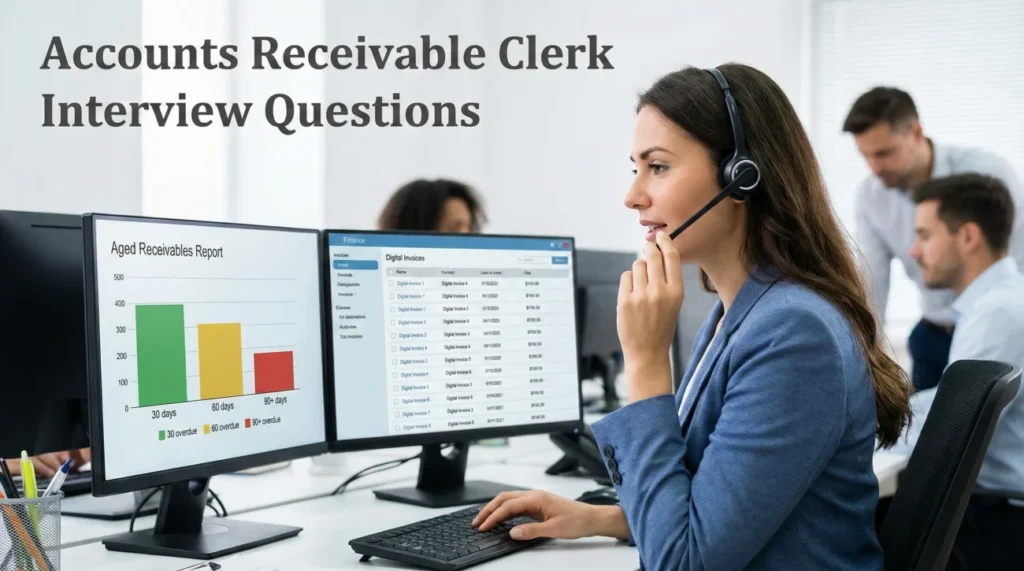
An aging report categorizes outstanding receivables by how long they’ve been unpaid, typically in buckets like current, 1-30 days past due, 31-60 days, 61-90 days, and over 90 days. This visualization shows not just total receivables but the quality of those receivables, since older balances are less likely to be collected.
I use aging reports to prioritize collection efforts, focusing on accounts moving into higher-risk categories. I analyze trends to identify customers with deteriorating payment patterns before they become serious problems. I share aging summaries with management to provide visibility into cash flow expectations. The report also supports estimating bad debt allowances for financial reporting. Regular aging analysis helps catch issues early when they’re easier to resolve.
What is Days Sales Outstanding and why does it matter?
Days Sales Outstanding (DSO) measures the average number of days it takes to collect payment after a sale. It’s calculated by dividing accounts receivable by average daily sales. Lower DSO indicates faster collections and better cash flow management. Higher DSO means money is tied up longer in receivables rather than available for operations.
I monitor DSO as a key performance indicator for the AR function. Rising DSO might indicate collection problems, changes in customer payment behavior, or issues with our billing accuracy. I compare DSO against our payment terms to assess effectiveness. If our terms are net 30 but DSO is 45, we’re not collecting as quickly as we should. Understanding DSO helps identify improvement opportunities and measure the impact of process changes.
How do you prepare aging reports for management?
I generate aging reports from our accounting system, then review for accuracy and completeness. I verify that all payments have been posted and that the report reflects current status. I look for anomalies that might indicate data issues, such as negative balances or accounts that don’t match customer records.
For management presentations, I summarize key metrics: total receivables, breakdown by aging bucket, comparison to prior periods, and significant changes or trends. I highlight accounts requiring attention and provide context on collection efforts in progress. I include DSO calculations and comparisons to targets. Clear, accurate reporting helps management understand cash flow expectations and make informed decisions about credit policies and resource allocation.
Dispute Resolution and Customer Communication
Q: How do you handle invoice disputes?
When a customer disputes an invoice, I first gather all relevant information: the specific items disputed, the customer’s reasoning, and our supporting documentation including contracts, service records, and delivery confirmations. I approach disputes as problems to solve rather than battles to win.
I investigate thoroughly before responding. If the customer is correct, I acknowledge the error, apologize, and issue appropriate corrections promptly. If our billing is accurate, I explain the charges clearly with supporting documentation. For complex disputes, I may need to involve sales, operations, or management to understand the full picture. I document all dispute communications and resolutions. The goal is fair resolution that maintains the customer relationship while ensuring we collect what we’re legitimately owed.
Q: A customer sends payment significantly less than the invoice amount. What do you do?
I first verify our records to ensure the invoice amount is correct and no credits or adjustments should have been applied. I check for any communications from the customer explaining the short payment. Then I contact the customer to understand the discrepancy.
Common reasons include unauthorized deductions, disputed charges, or simple errors. I work with the customer to identify the cause and determine appropriate resolution. If they took an invalid deduction, I explain why and request the remaining balance. If there’s a legitimate dispute, I investigate and resolve it. I document the short payment and follow up until the matter is resolved. Unaddressed short payments accumulate and become harder to collect over time, so prompt attention is important.
Q: How do you maintain positive customer relationships while collecting overdue payments?
I approach collections with professionalism and empathy, recognizing that customers may have valid reasons for payment delays. I communicate respectfully and listen to their concerns before pressing for payment. I seek solutions that work for both parties, such as payment plans for customers experiencing temporary difficulties.
I keep collection communications focused on resolving the specific issue rather than making it personal. I follow through on commitments I make and expect the same from customers. I escalate appropriately when needed but give customers reasonable opportunities to resolve issues first. Maintaining relationships matters because today’s slow-paying customer might become tomorrow’s best customer if treated fairly. That said, I don’t sacrifice the company’s interests; I simply pursue collection professionally.
Q: What accounting software have you used for AR?
I have experience with several accounting systems including QuickBooks, SAP, and NetSuite. In each platform, I’ve handled invoice generation, payment posting, customer account management, aging reports, and reconciliation. I’m comfortable navigating different interfaces because core AR principles remain consistent across systems.
I leverage automation features to improve efficiency, such as automated invoice generation for recurring charges, payment reminders, and exception reporting. I generate and customize reports to track AR metrics and support management decision-making. If the organization uses a system I haven’t worked with, I’m confident in my ability to learn it quickly while applying established AR best practices.
Accounts Receivable Knowledge Check
Test Your AR Expertise
1. Accounts receivable is classified as:
- Asset
- Liability
- Equity
- Expense
2. When an invoice is generated, accounts receivable is:
- Debited (increased)
- Credited (decreased)
- Not affected
- Eliminated
3. When payment is received, accounts receivable is:
- Debited
- Credited (decreased)
- Not affected
- Reversed
4. An aging report categorizes receivables by:
- Customer alphabetically
- Days outstanding
- Invoice amount
- Product type
5. DSO stands for:
- Daily Sales Output
- Days Sales Outstanding
- Deferred Sales Operations
- Direct Sales Orders
6. Lower DSO indicates:
- Faster collections
- Slower collections
- Higher sales
- Lower sales
7. Bad debt expense is recorded when:
- Invoice is generated
- Payment is late
- Account is deemed uncollectible
- Customer disputes charges
8. Net 30 payment terms mean:
- 30% discount
- Payment due in 30 days
- 30 day return policy
- Interest after 30 days
9. 2/10 net 30 means:
- 2% discount if paid in 10 days
- 10% discount if paid in 2 days
- Pay 2% now, rest in 30 days
- Minimum 2 payments over 30 days
10. Cash application refers to:
- Requesting payment
- Posting payments to customer accounts
- Processing refunds
- Calculating interest
11. A credit memo reduces:
- Customer credit limit
- Amount customer owes
- Company expenses
- Revenue permanently
12. Front-end collections typically means:
- Early-stage follow-up on new overdue accounts
- Referring to collection agencies
- Legal action
- Write-offs
13. Accounts receivable turnover measures:
- Staff turnover in AR department
- How often AR is collected during a period
- Number of new customers
- Invoice volume
14. The allowance for doubtful accounts is:
- Cash set aside
- Estimate of uncollectible receivables
- Customer credit limits
- Collection agency fees
15. Remittance advice from customers shows:
- Their outstanding balance
- Which invoices they’re paying
- Their credit limit
- Future order plans
16. Short payment means customer paid:
- Early
- Less than invoice amount
- More than invoice amount
- In installments
17. Dunning refers to:
- Invoice generation
- Collection follow-up communications
- Customer onboarding
- Credit approval
18. AR reconciliation compares:
- Invoices to purchase orders
- Customer accounts to general ledger
- Sales quotes to contracts
- Budget to actual expenses
19. Accounts payable represents money:
- Owed to the company
- The company owes to others
- Collected from customers
- In the bank
20. Primary goal of AR management is:
- Maximizing invoices
- Extending credit to everyone
- Timely collection while maintaining relationships
- Minimizing customer contact
❓ FAQ
📩 What is a good cadence for following up on overdue invoices?
Start before the due date with a gentle reminder, then move to a clear follow-up shortly after it is late. As days past due increase, make the message more specific and include the next step.
Consistency matters more than intensity. A predictable cadence with good notes usually beats random bursts of pressure.
🧾 How do you handle payment application accurately?
Explain how you match remittance information to invoices, confirm customer identifiers, and resolve short pays or overpays. Mention how you document adjustments and keep a clean audit trail.
If your system supports it, talk about lockbox files or bank feeds and how you reconcile them to deposits.
⚖️ What should I do when a customer disputes an invoice?
Pause the collection pressure and move into fact-finding. Pull the contract or PO, delivery evidence, and prior communication, then summarize the dispute in plain language.
Your goal is resolution. Sometimes that means correcting an error, other times it means clarifying scope and collecting the undisputed portion now.
📊 Which AR metrics do interviewers care about?
DSO, aging distribution, and dispute cycle time are common. You do not need perfect numbers, but you should know what improved performance looks like and how your actions influence it.
Talk in drivers, for example cleaner billing reduces disputes, faster outreach reduces slippage, and better cash application reduces confusion.
🧠 How do I balance being firm with being diplomatic?
Use respectful language, focus on facts, and give customers clear options. Firm does not mean rude, it means consistent boundaries and follow-through.
Share a line you would use on a call, then explain how you would document the outcome.
Advancing Your AR Career
AR interviews reward candidates who can explain a clean workflow and also sound comfortable on the phone. Practice describing how you track aging, how you handle disputes, and what you do when a payment promise slips.
If you want extra practice, pick a few scenarios from the broader library and answer them as if you are writing notes into a real AR system. Start here: explore more collections and billing questions.
⚠️ Disclaimer: The interview strategies, sample answers, and negotiation tips provided in this guide are for educational purposes only. Hiring decisions are subjective and vary by company and industry. While these strategies are based on professional HR standards, they do not guarantee a specific job offer or result.