What Risk Manager Interviews Test
Risk manager interview questions evaluate your ability to protect an organization’s capital and reputation without stifling its growth. Today, the role often extends beyond traditional financial metrics to include non-financial threats like cybersecurity, model risk from advanced analytics, and geopolitical uncertainty. Hiring managers want a leader who can translate complex data into actionable business strategies.
This guide covers the core pillars of the profession: Market Risk (VaR, volatility), Credit Risk (counterparty default), and Operational Risk (failed internal processes). You must demonstrate that you possess the quantitative rigor to model worst-case scenarios and the soft skills to challenge senior leadership when risk appetite is breached.
Market & Credit Risk Methodologies
Q: Explain Value at Risk (VaR) to a non-technical board member.
I describe VaR as a “bad day” indicator. It answers the question: “What is the maximum loss we would expect not to exceed over a chosen time horizon at a chosen confidence level?” However, I always add the caveat that VaR does not describe the size of losses in extreme tail events; for that, we need stress testing and scenario analysis.
Q: Why is Stress Testing essential if we already calculate VaR?
VaR relies on historical data and normal market conditions, which means it often fails to predict “Black Swan” events. Stress Testing complements VaR by asking “What if?” We simulate extreme hypothetical scenarios, such as a severe liquidity shock, an abrupt macro regime shift, or a sharp interest-rate move. This reveals hidden vulnerabilities in the portfolio that standard models miss.
Q: How do you assess Counterparty Credit Risk?
I look beyond just credit ratings. I analyze the counterparty’s financial statements for leverage and liquidity ratios. I also evaluate their exposure to specific sectors and their “wrong-way risk” (where their probability of default increases as our exposure to them increases). Mitigants like netting agreements and collateral posting requirements (margin calls) are critical tools I use to limit potential losses.
Q: What is the difference between Liquidity Trading Risk and Funding Liquidity Risk?
Trading Liquidity Risk is the inability to sell an asset quickly without significantly moving its price (e.g., holding a large position in a thinly traded stock). Funding Liquidity Risk is the inability to meet cash obligations as they fall due (e.g., a bank run). Managing the latter is often more critical for survival, as solvency means nothing if you run out of cash today.
Operational & Enterprise Risk (ERM)
Q: How do you distinguish between a KPI and a KRI?
A KPI (Key Performance Indicator) measures how well we are doing against business goals (e.g., “Revenue Growth”). A KRI (Key Risk Indicator) is a leading metric that warns of potential future risks (e.g., “Number of failed login attempts” or “Employee turnover rate in key roles”). I use KRIs as an early warning system to trigger preventative action before a risk event materializes into a loss.
Q: How is Cybersecurity treated in modern Risk Management?
Cybersecurity is no longer just an IT issue; it is a major operational risk. As a Risk Manager, I don’t need to code, but I must quantify the potential financial impact of a data breach. I work with the CISO to assess the “Crown Jewels” (critical data) and ensure we have cyber insurance, incident response plans, and vendor risk management protocols in place.
Q: Explain the “Three Lines of Defense” model.
This is the standard governance framework. The First Line is the business units (Sales/Trading) who own and manage the risk daily. The Second Line is the Risk Management and Compliance function (us), which sets policies and monitors the First Line. The Third Line is Internal Audit, which provides independent assurance to the Board that the first two lines are working effectively.
Q: What is “Model Risk” and why is it growing?
Model Risk is the potential for loss due to using incorrect or misused models. With the rise of advanced analytics and AI in finance, this risk has grown quickly. If an algorithm is trained on biased data or used in market conditions it wasn’t designed for, it can drive large, fast-moving losses. I insist on rigorous model validation and “back-testing” before any model goes live.
Governance & Decision Making
A top trader wants to execute a deal that exceeds our risk limits. They argue it is a “guaranteed profit.” What do you do?
I stand firm on the limits but analyze the request objectively. Limits exist for a reason, to prevent catastrophic concentration risk. I explain that there is no such thing as “guaranteed profit,” only risk-adjusted return. If the trade genuinely has merit, I might explore hedging strategies to bring the net exposure down within limits. However, I will not approve a breach based solely on profit potential. My duty is to the firm’s solvency, not the trader’s bonus.
How do you communicate a complex risk issue to the Board of Directors?
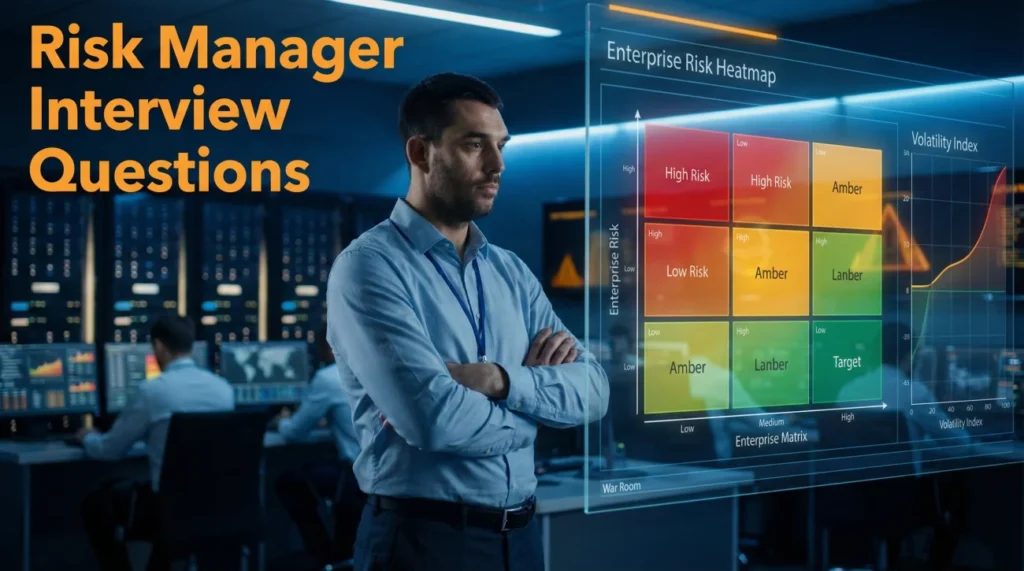
I avoid jargon like “Gaussian copula” or “heteroscedasticity.” Instead, I focus on the practical takeaway. I use clear visualizations (like heat maps) and plain language: “Here is the risk, here is the potential financial impact, and here is our mitigation plan.” I frame risk not just as something to avoid, but as a resource to be allocated efficiently to drive strategic goals.
Risk Management Knowledge Quiz
Test Your Risk IQ
1. “VaR” stands for:
- Variance at Risk
- Value at Risk
- Volume at Risk
- Volatility and Return
2. Operational Risk is defined as the risk of loss from:
- Market price movements
- Inadequate or failed internal processes, people, and systems
- Borrower default
- Currency fluctuations
3. Which Greek letter measures sensitivity to interest rate changes?
- Delta
- Rho
- Theta
- Vega
4. A “CDS” (Credit Default Swap) acts like:
- A stock option
- Insurance against a bond default
- A bank deposit
- A currency exchange
5. “Idiosyncratic Risk” can be reduced by:
- Increasing leverage
- Diversification
- Buying only tech stocks
- Market timing
6. The “Second Line of Defense” refers to:
- Internal Audit
- Business Units
- Risk Management & Compliance Functions
- External Regulators
7. “Basel III” is a global regulatory framework for:
- Bank capital adequacy and liquidity
- Insurance pricing
- Stock exchange rules
- Corporate tax rates
8. A “Black Swan” event is characterized by being:
- Predictable and common
- Rare, unpredictable, and having severe impact
- A slow market decline
- A scheduled announcement
9. “KRI” stands for:
- Key Return Investment
- Key Risk Indicator
- Known Risk Index
- Key Revenue Item
10. “Systemic Risk” refers to:
- Risk of a single company failing
- Risk of the entire financial system collapsing
- Computer system failure
- Operational error
11. “Wrong-Way Risk” occurs when:
- You bet on the wrong stock
- Exposure to a counterparty increases as their credit quality deteriorates
- Interest rates go down
- The market goes up
12. Which certification is most recognized for Risk Managers?
- FRM (Financial Risk Manager)
- CPA (Certified Public Accountant)
- PMP (Project Management Professional)
- HRCI (Human Resources)
13. “Monte Carlo Simulation” is used to:
- Gamble in casinos
- Model the probability of different outcomes using random variables
- Calculate simple interest
- Track employee time
14. “Reputational Risk” is typically considered:
- Easy to quantify
- A qualitative risk with massive potential financial impact
- Irrelevant to finance
- A market risk
15. “LGD” in credit risk stands for:
- Loan Given Default
- Loss Given Default
- Long Gross Debt
- Liquidity Grade Data
16. “Stress Testing” differs from VaR because it:
- Uses historical averages
- Simulates specific extreme hypothetical scenarios
- Is calculated daily
- Is required by law
17. “Duration” measures sensitivity of a bond’s price to:
- Interest rates
- Stock market index
- Credit rating
- Exchange rates
18. “Enterprise Risk Management” (ERM) aims to:
- Eliminate all risk
- Manage risk holistically across the entire organization
- Focus only on insurance
- Focus only on financial risk
19. A “Haircut” in collateral management means:
- A trip to the barber
- A percentage reduction in the value of collateral to account for volatility
- A penalty fee
- A type of bond coupon
20. “Ransomware” is a primary example of:
- Credit Risk
- Market Risk
- Cyber/Operational Risk
- Liquidity Risk
❓ FAQ
🕒 What certifications are required?
The FRM (Financial Risk Manager) by GARP is widely recognized globally. The PRM (Professional Risk Manager) is also respected. For those focusing on operational risk or internal controls, the CIA or CISA (for IT risk) are valuable additions.
📜 What technical skills do I need?
Proficiency in SQL and Python/R is increasingly important for modeling and data analysis. You should also be comfortable with visualization tools like Tableau or PowerBI to communicate risk metrics to the Board effectively.
💼 Market Risk vs. Credit Risk career?
Market Risk is often more quantitative and faster-paced, tied closely to trading desks (Investment Banking). Credit Risk is more analytical and fundamental, tied to lending decisions (Commercial Banking). Both offer strong career trajectories.
🤯 How do you handle high pressure?
Risk managers are often the “brakes” on the car, which can cause friction with revenue-generating teams. Success requires emotional intelligence to maintain relationships while being firm on limits. The pressure is high because a mistake in risk oversight can threaten the firm’s survival.
🚀 What is the future of this role?
The role is becoming less about “reporting yesterday’s news” and more about anticipating emerging threats. Future leaders will need to master non-financial risks like Climate Change (ESG) and AI ethics alongside traditional financial metrics.
Final Thoughts
To succeed in answering risk manager interview questions, you must prove you can see around corners. It is not enough to just calculate the numbers; you must interpret what they mean for the business strategy. Hiring managers want a partner who enables safe growth, not just a “Department of No.”
Demonstrate your holistic view. Show that you understand how a cyber breach impacts liquidity, or how a market crash impacts credit quality. By connecting these dots, you position yourself as a strategic asset.
⚠️ Disclaimer: The interview strategies, sample answers, and negotiation tips provided in this guide are for educational purposes only. Hiring decisions are subjective and vary by company and industry. While these strategies are based on professional HR standards, they do not guarantee a specific job offer or result.