- What makes it different: Finance interviews test real competence plus communication, so you cannot talk your way around technical gaps.
- Start smart: Diagnose your weak spots honestly, then prioritize what the role will actually test instead of reviewing everything at random.
- Technical focus: Refresh statement connections, core accounting rules, and ratio interpretation, then practice spotting trends and red flags quickly under time pressure.
- Behavioral focus: Prepare a small set of STAR stories that show technical judgment in real situations, like ethics, deadlines, variance investigations, and explaining finance to non-finance teams.
- Practice and finish well: Do timed mocks and case reps, research the company’s financial story, then use the final day for light refresh, logistics, and sleep so you show up sharp.
The Strategic Preparation Challenge
Effective finance interview preparation differs fundamentally from standard interview readiness because financial roles test actual competence alongside communication skills. You cannot prepare your way past knowledge gaps – if you don’t understand revenue recognition principles or can’t interpret cash flow statements, no amount of behavioral rehearsal saves you. Yet many candidates waste preparation time reviewing concepts they already know while neglecting the specific technical areas their target role will actually assess.
The challenge intensifies because finance interviews combine technical assessments requiring deep knowledge with behavioral questions testing professional judgment. Pure accounting knowledge review without behavioral practice leaves you unable to articulate how you apply technical skills in workplace situations. Conversely, perfecting STAR method responses without technical competence means you’ll fail case studies and modeling exercises regardless of communication quality.
This guide provides a systematic preparation framework balancing technical review, behavioral rehearsal, and strategic research. You’ll learn how to diagnose knowledge gaps efficiently, prioritize review areas by relevance to your target role, refresh financial statement analysis skills quickly, and prepare behavioral examples demonstrating both technical proficiency and professional judgment.
Diagnosing Your Knowledge Gaps
Smart preparation begins with honest self-assessment of current technical competence. Most candidates either overestimate their knowledge, leading to inadequate preparation, or underestimate it, wasting time reviewing fundamentals they’ve already mastered.
Self-Assessment Framework
Evaluate your proficiency across core technical domains relevant to your target role. Rate yourself honestly on each area, then prioritize preparation time accordingly.
| Knowledge Area | Proficiency Test | If You Struggle |
|---|---|---|
| Financial statements | Can you explain how each statement connects? Trace a transaction through all three statements? | Priority 1 – Fundamental to all finance roles |
| Accounting principles | Can you explain accrual vs. cash accounting? Revenue recognition timing? Asset vs. expense treatment? | Priority 1 – Required for accounting roles, important for finance |
| Financial ratios | Can you calculate and interpret ROE, current ratio, debt/equity, inventory turnover from raw data? | Priority 2 – Expected in most finance interviews |
| Valuation methods | Can you build a DCF model from scratch? Explain when to use different valuation approaches? | Priority varies – Critical for investment roles, less so for accounting |
| Excel proficiency | Can you build three-statement models? Use INDEX/MATCH, VLOOKUP, pivot tables efficiently? | Priority 2 – Increasingly tested through practical exercises |
Identifying Role-Specific Gaps
Different finance specializations require different technical knowledge. Public accounting demands GAAP mastery. Investment banking requires valuation expertise. Corporate FP&A emphasizes forecasting and variance analysis. Focus preparation on gaps that actually matter for your target role.
- 🔍 Audit positions: Audit procedures, internal controls, risk assessment, sampling methodology, SOX compliance
- 💰 Tax roles: Tax code provisions, return preparation, deduction optimization, tax planning strategies
- 📊 Corporate finance: Budgeting processes, variance analysis, forecasting techniques, business partnering
- 📈 Investment roles: DCF modeling, comparable analysis, LBO mechanics, investment thesis development
- 🏦 Banking: Credit analysis, loan structures, underwriting criteria, risk assessment frameworks
Expert advice: Use job descriptions as diagnostic tools. If a posting mentions “consolidations” three times and you struggle with consolidation accounting, that’s a critical gap. If it emphasizes “forecasting accuracy” but never mentions derivatives, skip advanced derivatives review and focus on forecasting methodology. Match preparation effort to stated requirements.
Systematic Technical Review
Once you’ve identified knowledge gaps, review technical concepts systematically rather than randomly. Structured review ensures comprehensive coverage while preventing time waste on already-mastered topics.
Core Accounting Fundamentals Review
Even experienced finance professionals benefit from refreshing foundational concepts before interviews. Interviewers often test whether you can explain complex topics simply, which requires deep understanding of fundamentals.
| Fundamental Concept | Review Focus | Practice Exercise |
|---|---|---|
| Accounting equation | Assets = Liabilities + Equity relationship, how transactions maintain balance | Trace 10 different transactions through the equation |
| Debits and credits | Which accounts increase with debits vs. credits, normal balances | Create journal entries for common transactions without looking up rules |
| Accrual vs. cash | Timing differences, why accrual provides better picture, reconciliation | Convert cash basis statements to accrual and explain differences |
| Revenue recognition | Five-step model (ASC 606), performance obligations, timing recognition | Apply recognition principles to multi-element arrangements |
| Matching principle | Expense timing aligned with revenue, prepaid vs. accrued items | Determine proper expense recognition for various scenarios |
💡 Pro tip: Don’t just read about concepts – practice explaining them aloud as if teaching someone else. This reveals gaps in understanding that silent review misses. If you struggle to explain revenue recognition timing in simple terms without jargon, you don’t understand it deeply enough for interviews.
Financial Statement Mastery
The ability to quickly read and interpret financial statement analysis prep materials separates competent finance professionals from novices. Interviewers may provide actual company financials and expect you to identify trends, diagnose issues, or recommend actions within minutes.
- Income statement: Revenue trends, margin analysis, expense categories, non-operating items, EPS calculation
- Balance sheet: Asset composition, liquidity, leverage, working capital, shareholder equity changes
- Cash flow statement: Operating cash generation, investing activities, financing decisions, free cash flow
- Statement relationships: How net income flows to equity, depreciation’s impact, non-cash charges
Ratio Analysis and Interpretation
Memorizing ratio formulas means nothing if you can’t interpret what ratios reveal about business health. Practice both calculation and analysis – what does decreasing inventory turnover suggest? Why might high ROE concern you despite appearing positive?
| Ratio Category | Key Ratios to Master | Interpretation Focus |
|---|---|---|
| Profitability | Gross margin, operating margin, net margin, ROE, ROA | Margin trends over time, comparison to competitors, drivers of changes |
| Liquidity | Current ratio, quick ratio, cash ratio, working capital | Short-term solvency, ability to meet obligations, seasonal patterns |
| Leverage | Debt/equity, debt/assets, interest coverage, debt service | Financial risk, capital structure sustainability, covenant compliance |
| Efficiency | Asset turnover, inventory turnover, receivables days, payables days | Operational effectiveness, working capital management, cycle time |
| Market valuation | P/E ratio, P/B ratio, EV/EBITDA, dividend yield | Market sentiment, valuation relative to peers, growth expectations |
Expert advice: When practicing ratio analysis, focus on comparative interpretation rather than absolute values. A 15% ROE means nothing in isolation – compared to 20% industry average it signals underperformance, but compared to 8% cost of equity it creates value. Interviewers test whether you can contextualize financial metrics appropriately.
Reading Financial Statements Quickly
Interviews often provide limited time to review financial information before questions. Developing systematic reading approaches allows you to extract critical insights efficiently without getting lost in footnote details.
The 10-Minute Statement Review Framework
When given financial statements in an interview setting, use this systematic approach to identify the most important information quickly.
- 📊 Minutes 1-2 (Income Statement): Revenue trend, gross margin trend, operating margin trend, unusual items
- 💰 Minutes 3-4 (Balance Sheet): Asset composition, debt levels, working capital, equity changes
- 💸 Minutes 5-6 (Cash Flow): Operating cash vs. net income, capex levels, financing activities
- 🔍 Minutes 7-8 (Relationships): Cash flow quality, leverage sustainability, growth sustainability
- 📋 Minutes 9-10 (Synthesis): Overall financial health, major concerns, key strengths
Red Flag Identification
Experienced finance professionals quickly spot warning signs in financial statements. Practice identifying common red flags that suggest financial stress, aggressive accounting, or operational problems.
| Red Flag Category | What to Look For | Why It Matters |
|---|---|---|
| Revenue quality | Revenue growth while receivables grow faster, unusual revenue timing, related party sales | May indicate aggressive recognition or non-sustainable growth |
| Cash flow quality | Positive net income but negative operating cash flow, working capital swings, capitalized expenses | Suggests earnings quality concerns or liquidity stress |
| Asset quality | Growing goodwill, increasing inventory despite flat revenue, old receivables | May require impairment, indicates collection issues or obsolescence |
| Leverage concerns | Declining interest coverage, rising debt/equity, short-term debt refinancing | Signals financial distress risk or covenant violations |
| Accounting changes | Frequent policy changes, extended depreciable lives, reserve releases | May indicate earnings management or deteriorating fundamentals |
Don’t assume all red flags indicate fraud or manipulation. Many reflect legitimate business challenges or industry-specific patterns. The goal is identifying items requiring further investigation or explanation, not jumping to conclusions about accounting quality.
Behavioral Question Preparation
Finance behavioral questions differ from standard interviews because they test both communication skills and technical judgment. Prepare examples demonstrating how you applied technical interview readiness in real workplace scenarios.
Common Finance Behavioral Themes
Certain behavioral question themes appear frequently in finance interviews because they reveal how you handle situations unique to financial roles.
- Ethical dilemmas: Pressure to adjust reserves, management disagreement with accounting treatment, confidentiality conflicts
- Technical judgment: Determining appropriate accounting treatment, explaining complex financial concepts to non-finance stakeholders
- Deadline pressure: Month-end close urgency, audit deadlines, earnings announcements, regulatory filings
- Analytical problem-solving: Diagnosing variance causes, investigating financial anomalies, reconciling conflicting data
- Stakeholder management: Working with difficult clients, managing up to executives, partnering with business units
STAR Method for Finance Contexts
Structure behavioral responses using STAR method (Situation, Task, Action, Result) while ensuring your examples demonstrate both technical competence and professional behavior.
| STAR Component | Finance-Specific Guidance | Example Elements |
|---|---|---|
| Situation | Provide enough technical context to demonstrate complexity without overwhelming with jargon | “During Q3 close, we discovered a $500K inventory discrepancy affecting COGS accuracy…” |
| Task | Clarify your role and technical objectives | “As senior accountant, I needed to trace the error source, determine proper GAAP treatment, and correct before earnings call…” |
| Action | Highlight technical skills used and judgment exercised | “I reconciled physical counts to perpetual records, reviewed receiving logs, consulted ASC 330 guidance, coordinated with operations…” |
| Result | Quantify impact and lessons learned | “Identified timing error in COGS recognition, implemented monthly reconciliation, prevented $500K misstatement…” |
Expert advice: When preparing behavioral examples for finance interviews, collect stories demonstrating technical skills in action rather than pure soft skills. “I built strong stakeholder relationships” matters less than “I explained complex revenue recognition changes to sales leaders in terms of pipeline impact, gaining their support for new contract terms.” The technical context makes the behavioral competency relevant.
For comprehensive guidance on structuring behavioral responses effectively, explore interview preparation frameworks covering STAR methodology and professional scenario handling.
Practical Preparation Exercises
Passive review rarely translates to interview performance. Active practice through realistic exercises builds finance behavioral practice skills while reinforcing technical knowledge.
Mock Interview Practice
Simulate actual interview conditions by practicing responses aloud, ideally with someone who can provide feedback. Written preparation feels different from spoken answers under time pressure.
- 🎯 Technical questions: Record yourself explaining accounting concepts, then listen for unclear language or logical gaps
- 💼 Case studies: Set timers and work through financial analysis exercises without unlimited review time
- 📊 Behavioral scenarios: Practice STAR responses aloud until delivery feels natural, not memorized
- 🔄 Multiple formats: Practice both one-on-one and panel interview scenarios to adjust communication approach
Company-Specific Preparation
Generic technical knowledge isn’t enough – research target companies’ financial performance, business models, and strategic challenges to provide informed responses.
| Research Area | Information Sources | How to Use in Interviews |
|---|---|---|
| Financial performance | 10-K/10-Q filings, earnings transcripts, investor presentations | Reference specific trends or metrics when discussing analytical approaches |
| Accounting policies | Footnote disclosures, MD&A sections, critical accounting estimates | Demonstrate you understand their specific technical challenges |
| Industry context | Competitor filings, industry reports, analyst research | Show awareness of competitive positioning and market dynamics |
| Strategic priorities | CEO letters, earnings call transcripts, press releases | Connect your skills to their stated business objectives |
💡 Pro tip: Don’t just read company financials passively – practice analyzing them as if preparing for investor questions. Calculate key ratios, identify trends, diagnose potential concerns. This active analysis reveals insights you’ll reference naturally in interviews rather than generic platitudes about “strong performance” or “impressive growth.”
Final Day Preparation Strategy
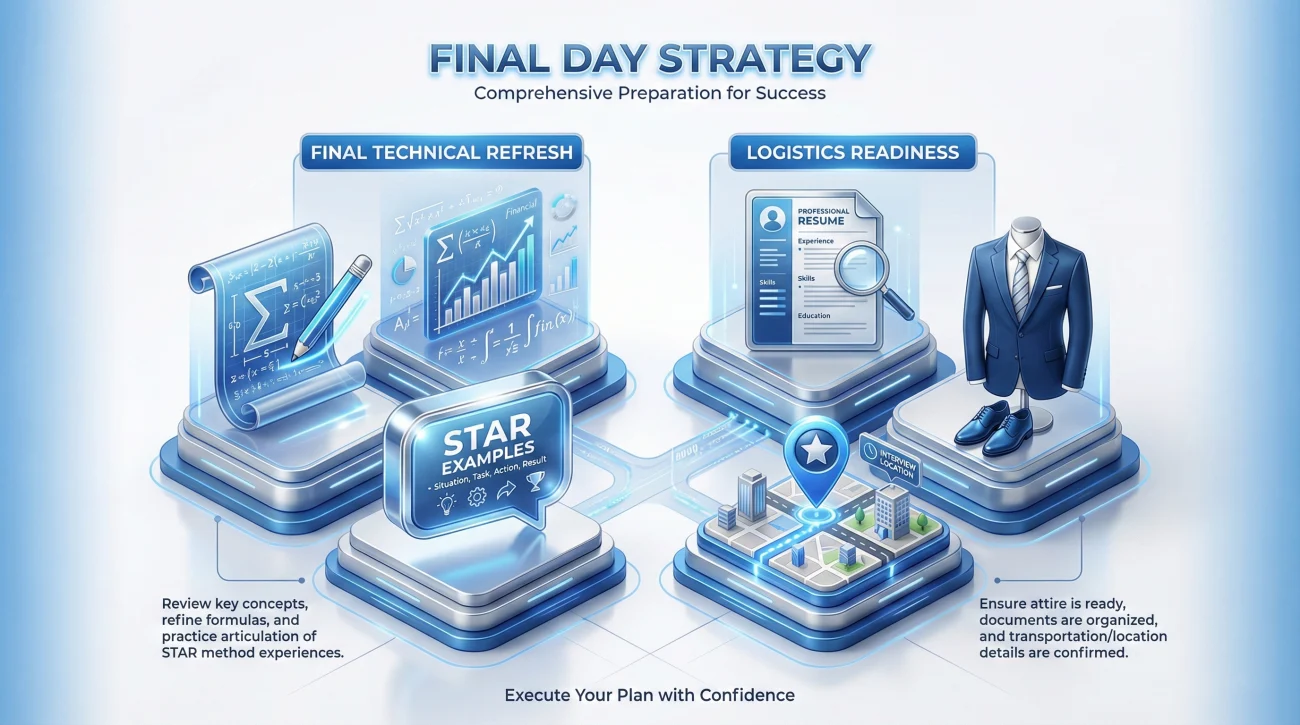
The day before your interview, shift from deep learning to strategic review and mental preparation. Cramming new concepts rarely helps – focus on refreshing knowledge already acquired and ensuring readiness for interview logistics.
Final Technical Refresh
Review your self-created summary notes covering the most likely technical topics for your role. Don’t attempt to learn new material – reinforce existing knowledge.
- Review key formulas and definitions you’ve already studied
- Reread your prepared STAR method examples to refresh story details
- Practice explaining one or two complex concepts aloud to ensure clarity
- Review recent news about the company or industry for conversation starters
Logistics and Materials Preparation
Ensure all practical matters are handled so interview day runs smoothly without unnecessary stress.
- 📋 Documents ready: Extra resume copies, reference list, work samples if applicable, notepad and pen
- 🚗 Route planned: Know exact location, parking options, travel time with buffer for delays
- 👔 Outfit prepared: Professional attire appropriate for finance setting, checked and ready
- 💼 Calculator allowed: If interview includes numerical exercises, confirm if you can bring calculator
Expert advice: The night before an interview, get adequate sleep rather than cramming until midnight. Technical interviews test knowledge you’ve built over weeks, not facts memorized the previous night. Well-rested candidates think more clearly under pressure, explain concepts more coherently, and demonstrate better professional presence than exhausted ones who stayed up studying.
Continuous Professional Development
Interview preparation shouldn’t end when you land a role. The strongest finance professionals maintain continuous learning to stay current with evolving standards, new analytical techniques, and changing business environments.
Maintaining Technical Currency
Accounting standards evolve, new financial instruments emerge, and analytical tools advance. Regular professional development ensures you’re prepared for future interviews while improving current job performance.
| Development Area | Learning Resources | Application Practice |
|---|---|---|
| Accounting standards | FASB updates, webinars, professional publications, CPA continuing education | Analyze how new standards impact your organization or industry |
| Financial modeling | Online courses, Excel training, modeling competitions, finance forums | Build models for public companies, practice various valuation approaches |
| Industry knowledge | Trade publications, conference attendance, analyst reports, competitor analysis | Track industry trends affecting financial performance and reporting |
| Analytical tools | Software training, data analytics courses, visualization tools, automation skills | Apply new tools to routine analysis tasks for efficiency gains |
❓ FAQ
🎯 How far in advance should I start preparing for finance interviews?
Preparation timeline depends on role complexity and current knowledge level. Entry-level candidates with recent finance education might need 2-4 weeks. Career changers or those interviewing for advanced roles often require 2-3 months. Investment banking and private equity positions demanding intensive technical knowledge may warrant even longer preparation. Start early enough to build genuine competence, not just memorize interview answers.
💼 Should I focus more on technical or behavioral preparation?
Balance depends on target role. Technical positions like audit, investment banking, or quantitative analysis require 70-80% technical preparation. Client-facing roles like relationship management need roughly equal emphasis. Research typical interview formats for your specific role – if job descriptions emphasize technical skills heavily, prioritize technical review. If they focus on client service or stakeholder management, weight behavioral preparation higher.
⏰ What if I discover major knowledge gaps close to interview date?
Focus on understanding concepts deeply rather than surface-level cramming. If gaps are fundamental (like not understanding financial statement relationships), consider rescheduling if possible – attempting to fake basic knowledge rarely succeeds. For peripheral gaps in specialized areas, acknowledge them honestly during interviews while emphasizing strengths and learning agility. Interviewers respect intellectual honesty more than attempted deception about competence.
📋 How many behavioral examples should I prepare?
Prepare 5-7 detailed STAR examples covering diverse situations: ethical dilemmas, technical challenges, deadline pressure, stakeholder conflicts, analytical problem-solving, and process improvements. Ensure examples demonstrate both technical skills and professional behaviors. Practice adapting these core stories to different questions rather than memorizing 20 specific responses. Strong candidates flex prepared examples naturally rather than delivering rigid, memorized scripts.
✨ Can I use the same preparation approach for all finance roles?
Core financial statement knowledge applies broadly, but specialization matters significantly. Audit preparation emphasizes different areas than investment banking preparation. Tax roles require tax code knowledge irrelevant to corporate FP&A. Review job descriptions carefully for role-specific requirements, then customize technical review accordingly. Generic preparation wastes time on irrelevant topics while missing critical assessment areas for your specific target role.
Final Thoughts
Success in finance interview preparation requires moving beyond surface-level review toward genuine technical competence and thoughtful behavioral examples. The strongest candidates don’t just memorize accounting principles or rehearse generic STAR responses – they develop deep understanding of financial concepts and prepare authentic examples demonstrating how they apply technical knowledge in workplace scenarios.
Smart preparation balances systematic technical review with behavioral rehearsal, ensuring you can both perform technical analysis correctly and communicate findings effectively. This dual competence separates candidates who understand isolated concepts from those who think like finance professionals – able to diagnose problems, exercise judgment under ambiguity, and explain complex technical matters to diverse stakeholders.
Before your next finance interview, honestly assess knowledge gaps, prioritize review areas by relevance to your target role, practice reading financial statements systematically under time pressure, and prepare behavioral examples showcasing technical skills in action. This structured approach builds genuine readiness rather than superficial interview performance, positioning you for both successful interviews and effective job performance once hired.
⚠️ Disclaimer: The interview strategies, sample answers, and negotiation tips provided in this guide are for educational purposes only. Hiring decisions are subjective and vary by company and industry. While these strategies are based on professional HR standards, they do not guarantee a specific job offer or result.