What Equity Research Teams Hire For
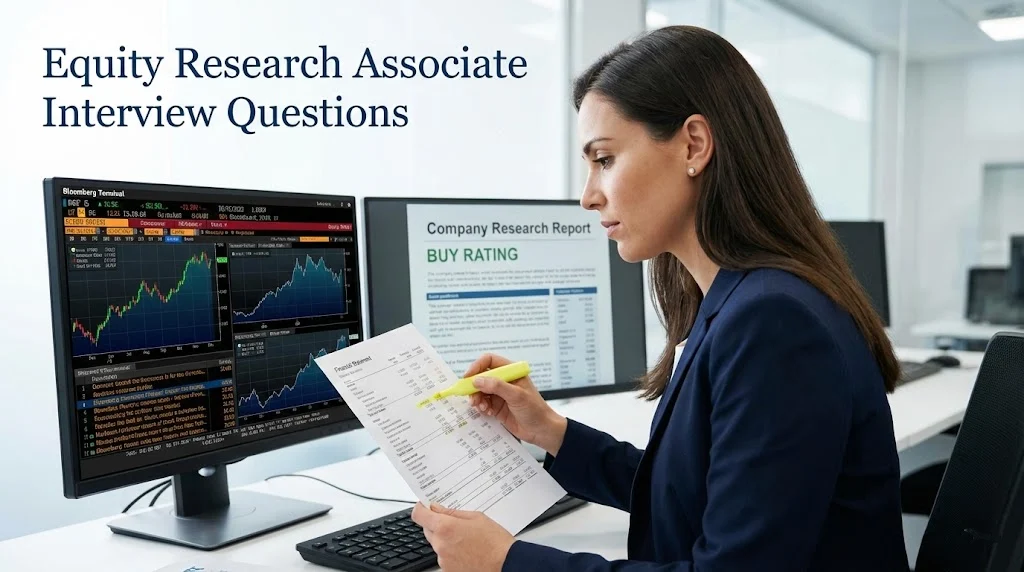
Equity research associate interview questions focus on whether you can turn messy information into a clear recommendation. Strong candidates show structured thinking, clean modeling habits, and writing that sounds confident without pretending risk does not exist.
Prepare to walk through financial statements, defend valuation choices, and summarize a thesis quickly. If you can explain the story of a company in two minutes, your longer answers will land better too.
Equity Research Fundamentals
Q: What is equity research and how does it differ from other finance roles?
Equity research analyzes publicly traded companies to provide investment recommendations. Sell-side research at investment banks and brokerages produces reports distributed to institutional clients like mutual funds and hedge funds. Buy-side research at asset management firms supports internal investment decisions. Both analyze companies but serve different audiences and purposes.
Equity research differs from investment banking, which advises companies on transactions and raises capital. Research analysts focus on ongoing coverage of companies and sectors, while bankers work on discrete deals. Research also differs from hedge fund investing because researchers provide recommendations to others rather than managing capital directly. The role requires deep company and sector expertise, strong writing skills, and the ability to communicate complex analysis clearly to clients who make their own investment decisions.
Q: What is the difference between an analyst and an associate in equity research?
In equity research, the hierarchy differs from investment banking. Analysts are more senior, responsible for coverage recommendations, client relationships, and final report sign-off. Associates support analysts by updating financial models, gathering data, drafting report sections, and conducting preliminary analysis. Associates typically have less client interaction and more execution work.
Associates usually spend two to three years before potentially becoming analysts with their own coverage universe. The path requires demonstrating strong analytical skills, developing sector expertise, and building the judgment needed to make independent recommendations. Some associates transition to buy-side roles at hedge funds or asset managers, leveraging their analytical foundation and sector knowledge.
Q: How do you decide between a buy, hold, or sell recommendation?
My recommendation depends on comparing intrinsic value to current market price, adjusted for risk. If my DCF model and relative valuation indicate meaningful upside relative to risk, I recommend buying. The upside must compensate for execution risk and uncertainty in my assumptions. I also consider catalysts that will drive the stock toward fair value within a reasonable timeframe.
A hold recommendation indicates the stock is fairly valued with limited upside or downside. The company may be performing well, but the market already reflects this in the price. I recommend selling when my valuation shows meaningful downside, when fundamental deterioration is underway, or when better opportunities exist elsewhere. I always consider risk factors: a stock with upside but significant execution risk might warrant a hold rather than buy. My recommendation must be defensible with specific evidence rather than gut feeling.
Q: What is a restricted list and why does it matter?
A restricted list contains securities that research analysts cannot publish opinions on due to conflicts of interest. The most common reason is when the firm’s investment banking division is working on a transaction involving that company, such as an IPO, secondary offering, or M&A advisory. Publishing research during active banking engagements could be seen as promoting the deal rather than providing objective analysis.
Compliance departments maintain restricted lists and notify analysts when coverage must pause. Analysts cannot issue new recommendations, change ratings, or publish reports on restricted names until the engagement concludes. Understanding these restrictions is important because they affect coverage continuity and require planning around potential conflicts. Violations can result in regulatory penalties and reputational damage for both the analyst and firm.
Financial Analysis
Q: Walk me through how you analyze a company’s financials.
I start with the income statement to understand revenue trends, growth drivers, and profitability. I analyze revenue by segment or geography to identify where growth is coming from. I examine gross margin trends to assess pricing power and cost structure, then work down to operating margin and net income. I calculate key ratios like operating margin, net margin, and return on equity to benchmark against peers and historical performance.
On the balance sheet, I assess financial health through liquidity ratios like current ratio and quick ratio, and solvency through debt-to-equity and interest coverage. I examine working capital trends: rising receivables or inventory faster than sales can signal problems. The cash flow statement reveals earnings quality. I compare operating cash flow to net income over time because sustainable businesses convert earnings to cash. I analyze capital expenditure relative to depreciation to understand whether the company is investing adequately. Finally, I synthesize findings into an investment thesis addressing growth prospects, profitability sustainability, and financial risk.
Q: What valuation methods do you use and when?
I use multiple valuation approaches and triangulate results. Discounted cash flow analysis estimates intrinsic value by projecting free cash flows and discounting to present value using WACC. DCF is most appropriate for companies with predictable cash flows and when I have confidence in long-term projections. It’s theoretically rigorous but sensitive to assumptions, particularly terminal value and discount rate.
Relative valuation compares multiples like P/E, EV/EBITDA, or Price/Sales to peers. This approach works well when comparable companies exist and reflects current market sentiment. I select multiples appropriate to the industry: EV/EBITDA for capital-intensive businesses, P/E for mature companies, Price/Sales for high-growth companies not yet profitable. For specific situations, I use sum-of-the-parts for conglomerates or dividend discount models for stable dividend payers. I present a valuation range rather than single point estimate, acknowledging uncertainty in assumptions.
Q: How do you calculate and interpret key financial ratios?
Profitability ratios measure how effectively a company generates returns. Return on equity (net income divided by shareholders’ equity) shows returns to equity holders. Return on assets (net income divided by total assets) measures efficiency regardless of capital structure. Operating margin (operating income divided by revenue) reveals core business profitability before interest and taxes. I compare these ratios to peers and historical trends to assess competitive position.
Liquidity ratios assess short-term financial health. The current ratio (current assets divided by current liabilities) indicates ability to meet near-term obligations. The quick ratio excludes inventory for a more conservative view. Solvency ratios evaluate long-term financial risk. Debt-to-equity shows leverage, while interest coverage (EBIT divided by interest expense) measures ability to service debt. Efficiency ratios like inventory turnover and receivables turnover reveal operational effectiveness. No ratio exists in isolation: I interpret them together and against industry benchmarks to form a complete picture.
Q: How do you value a high-growth company versus a mature company?
High-growth companies require different approaches because current earnings may not reflect future potential. I focus on revenue growth rates, market opportunity, and path to profitability rather than current earnings multiples. Price/Sales or EV/Sales multiples are often more relevant than P/E when earnings are negative or volatile. In DCF analysis, I model an extended high-growth phase before normalizing to terminal growth rates, carefully justifying assumptions about how long elevated growth can persist.
Mature companies with stable cash flows are more amenable to traditional valuation. P/E and EV/EBITDA multiples are meaningful when earnings are consistent. DCF models can use shorter explicit forecast periods since the business is already at steady state. I focus more on dividend yield, payout ratios, and capital return policies. The key difference is uncertainty: high-growth valuations require wider ranges and more sensitivity analysis because small changes in growth assumptions dramatically affect value. Mature company valuations are more precise but may have less upside potential.
Stock Pitch
How do you structure a stock pitch?
I lead with my recommendation and target price so the audience immediately knows my conclusion. Then I provide a brief company overview: what the business does, key segments, and competitive position. This context helps listeners understand the investment thesis that follows.
The investment thesis contains two to three specific reasons why the stock will perform as I expect. Each point should be supported by evidence: financial data, industry trends, or company-specific catalysts. I discuss valuation: what methods I used, how my price target derives from my assumptions, and how it compares to peers. I address key risks honestly and explain why I believe the opportunity outweighs them. I conclude with expected timeline and potential catalysts that will drive the stock toward my target. The entire pitch should take 10-15 minutes, leaving time for questions.
Pitch me a stock you would recommend buying.
I recommend buying a company I have researched at current levels with a price target implying meaningful upside over the next year. The company is a leader in its industry with durable competitive advantages, and recent results show improving fundamentals as the business scales.
My thesis rests on three catalysts. First, upcoming product launches should accelerate growth as the company enters adjacent markets. Second, cost reduction initiatives are ahead of schedule and should expand margins. Third, the valuation looks attractive versus peers despite strong fundamentals. Key risks include competitive pressure and macro sensitivity, but the company’s market position and balance sheet strength provide protection. My DCF supports a fair value above the current price, and relative valuation supports that range.
How would you defend your recommendation if challenged?
I welcome challenges because defending my thesis tests its validity. If questioned on assumptions, I explain my reasoning with specific evidence: historical trends, management guidance, industry data, or comparable transactions. I acknowledge uncertainty where it exists and explain how I’ve accounted for it through sensitivity analysis or conservative assumptions.
If the challenge raises a point I hadn’t considered, I acknowledge it honestly rather than deflecting. I might explain how the new information affects my thesis and whether it changes my conviction. Strong analysts update views when evidence warrants rather than defending positions stubbornly. I also distinguish between disagreements on assumptions, which are legitimate, versus disagreements on facts, which can be resolved with data. The goal is demonstrating thoughtful analysis and intellectual honesty, not winning arguments.
Research Reports
Q: What elements should a research report contain?
A research report begins with an executive summary containing the recommendation, price target, and key thesis points. Busy clients may only read this section, so it must convey the essential message clearly. The company overview provides context on business model, segments, and competitive position for readers unfamiliar with the company.
The investment thesis section presents detailed analysis supporting the recommendation. This includes industry dynamics, competitive advantages, growth drivers, and catalysts. Financial analysis covers historical performance, key metrics, and my forecasts with assumptions clearly stated. The valuation section explains methodology, comparable companies, and how I derive my price target. Risk factors identify what could go wrong and potential impact. Appendices contain detailed financial models, industry data, and management bios. Throughout, writing must be clear, concise, and free of jargon that obscures meaning.
Q: How do you ensure your research is differentiated?
Differentiated research requires going beyond what’s publicly available or consensus. I develop proprietary insights through primary research: speaking with industry contacts, customers, suppliers, and competitors. Channel checks reveal real-time business trends before they appear in financial statements. I analyze alternative data sources that others might overlook.
I also differentiate through analytical depth. Rather than accepting management guidance, I build bottom-up models that test assumptions. I identify key performance indicators that drive results and track them independently. I consider second-order effects and long-term implications that short-term focused analysis might miss. Strong sector expertise enables me to identify patterns and connections others don’t see. The goal is providing clients with insights they cannot generate themselves, justifying why they should read my research rather than competitors’.
Q: How do you handle an earnings report that contradicts your thesis?
When earnings contradict my thesis, I first determine whether the miss reflects temporary factors or fundamental problems. A revenue miss due to deal timing differs from market share loss to competitors. I analyze the details: which segments underperformed, what management said about causes, and whether guidance changed. I update my model with new information and reassess my valuation.
If the thesis is fundamentally broken, I change my recommendation promptly. Holding onto a broken thesis hoping for recovery destroys credibility. If the miss is temporary and my core thesis remains intact, I may maintain my rating while adjusting price target and communicating the changed outlook to clients. Transparency is essential: I explain what changed, why I was wrong, and how my view has evolved. Clients respect analysts who acknowledge mistakes and learn from them more than those who stubbornly defend failed calls.
Sector Knowledge
Q: Why is sector specialization important in equity research?
Deep sector knowledge enables better analysis and differentiated insights. Understanding industry dynamics, competitive forces, and key value drivers allows me to identify what matters most for each company. I can recognize patterns across companies, anticipate how industry trends affect individual stocks, and ask better questions when meeting with management.
Sector expertise also builds credibility with clients and management teams. Clients trust analysts who understand their industry’s nuances rather than generalists applying generic frameworks. Management teams are more forthcoming with analysts who ask informed questions and understand their business context. Over time, sector expertise compounds as relationships deepen and pattern recognition improves. While some skills transfer across sectors, the most valuable research comes from analysts who know their industries intimately.
Q: How do you stay current on your coverage universe and industry?
I maintain a daily routine of monitoring news flow, earnings releases, and regulatory filings for my coverage companies. I track competitor results and industry data points that provide leading indicators. I read trade publications specific to my sector, which often contain insights ahead of mainstream financial media. I maintain a calendar of expected catalysts: earnings dates, product launches, regulatory decisions, and industry conferences.
Beyond routine monitoring, I conduct ongoing primary research through industry contacts, customer conversations, and expert networks. I attend industry conferences to hear management presentations and meet with company executives. I analyze peer research to understand consensus views and identify where I might differ. I also dedicate time to longer-term learning: reading books about the industry’s evolution, understanding new technologies, and studying historical cycles to inform my perspective on current conditions.
Equity Research Knowledge Quiz
Test Your Research Expertise
1. In equity research, analysts are:
- Junior to associates
- Senior to associates with coverage responsibility
- The same level as associates
- Entry-level positions
2. Sell-side research is produced by:
- Hedge funds
- Investment banks and brokerages for clients
- Asset managers for internal use
- Individual investors
3. A buy recommendation typically requires:
- Any positive outlook
- Significant upside with identifiable catalysts
- Analyst gut feeling
- Management approval
4. The restricted list prevents analysts from:
- Attending conferences
- Publishing on stocks with banking conflicts
- Meeting with management
- Building financial models
5. Return on equity is calculated as:
- Revenue divided by equity
- Net income divided by shareholders’ equity
- EBITDA divided by assets
- Operating income divided by debt
6. EV/EBITDA is preferred for capital-intensive businesses because:
- It’s easier to calculate
- It accounts for different capital structures and D&A
- Regulators require it
- Management prefers it
7. For high-growth unprofitable companies, which multiple is most useful?
- P/E ratio
- Price/Sales or EV/Sales
- Dividend yield
- Book value
8. A stock pitch should lead with:
- Company history
- Recommendation and price target
- Risk factors
- Valuation methodology
9. Operating cash flow should be compared to:
- Revenue
- Net income to assess earnings quality
- Total assets
- Market cap
10. Interest coverage ratio measures:
- Liquidity
- Ability to service debt obligations
- Profitability
- Growth potential
11. Channel checks involve:
- Reviewing financial statements
- Primary research with customers, suppliers, competitors
- Reading competitor research
- Attending earnings calls
12. When earnings contradict your thesis, you should:
- Ignore the results
- Analyze causes and update your view if warranted
- Always change your recommendation
- Wait for the next quarter
13. A research report executive summary should:
- Be detailed and lengthy
- Convey recommendation and key thesis concisely
- Include full financial models
- Avoid stating a recommendation
14. The quick ratio excludes:
- Cash
- Inventory
- Receivables
- Short-term debt
15. Differentiated research comes from:
- Copying competitor reports
- Proprietary insights and primary research
- Using consensus estimates
- Accepting management guidance
16. WACC is used in DCF as:
- Growth rate
- Discount rate
- Terminal multiple
- Revenue assumption
17. A hold recommendation indicates:
- Strong buy opportunity
- Stock is fairly valued with limited upside/downside
- Immediate sell recommendation
- Analyst uncertainty
18. Relative valuation compares:
- Historical prices only
- Multiples to peers and historical ranges
- Intrinsic value only
- Dividend yields only
19. Rising receivables faster than revenue may signal:
- Strong sales performance
- Collection problems or aggressive revenue recognition
- Improved efficiency
- Lower risk
20. MiFID II primarily affects:
- Only US markets
- European financial markets and research distribution
- Cryptocurrency only
- Real estate investment
❓ FAQ
📝 What does a strong equity research answer sound like?
Thesis first, support second, risks last. Keep it readable, like a short note you would send to a client.
📊 Which valuation methods should I emphasize?
Use more than one and explain why. Relative multiples for market context, and a DCF when cash flows are predictable enough to justify it.
🔎 How should I handle questions about risks?
Name the risk, show the trigger, then explain how you would update your model. Honest risk work builds credibility.
🧠 Do I need sector expertise to get hired?
It helps, but process matters more early on. Show how you learn a sector quickly and how you build a repeatable research workflow.
✅ What is a practical way to practice?
Pick one company and write a one page recommendation. Then practice summarizing it in two minutes.
How To Sound Like An Equity Research Associate
Strong answers to equity research associate interview questions feel like a short research note: thesis first, evidence next, risks last. If you can keep your logic clean, your model and writing will look cleaner too.
When you need more drills, skim this equity research master question list and practice summarizing each topic in two minutes. Clarity is a skill you can train.
⚠️ Disclaimer: The interview strategies, sample answers, and negotiation tips provided in this guide are for educational purposes only. Hiring decisions are subjective and vary by company and industry. While these strategies are based on professional HR standards, they do not guarantee a specific job offer or result.