The Architects of Manufacturing
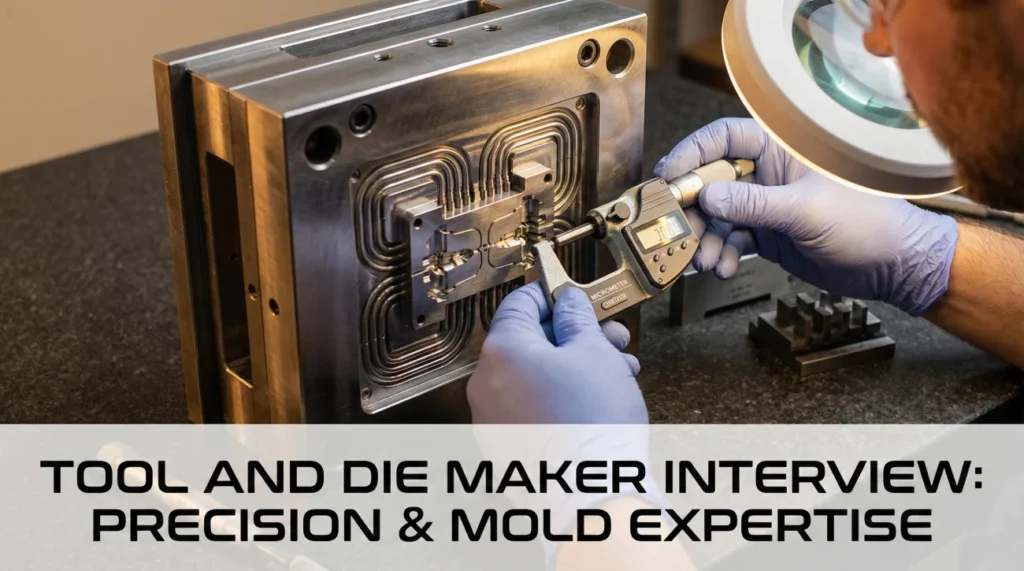
Tool and die maker interview questions target the elite craftsmen of the manufacturing world. In an era of mass production, Tool and Die Makers are the ones who build the machines that build everything else. Hiring managers are looking for a rare combination of old-school craftsmanship and modern technical savvy. They need candidates who can manually grind a part to within a ten-thousandth of an inch, program a CNC wire EDM, and troubleshoot a multi-station progressive die that keeps jamming.
This comprehensive guide machines through the layers of this highly skilled trade. We explore the critical concepts of Precision Measurement (using micrometers and comparators), the specific mechanics of Injection Molds and Stamping Dies, and the essential knowledge of Metallurgy. Whether you are an apprentice looking to break in or a journeyman aiming for a lead role, proving you have the patience and precision to create the tools of industry is your blueprint for success.
Precision Machining & Measurement
You cannot make a tool if you cannot measure it. Interviewers will test your ability to work to tight tolerances.
Q: What is the difference between a Tolerance and an Allowance?
Answer: Tolerance is the permissible limit of variation in a physical dimension (e.g., +/- 0.005 inches). It defines the range in which a part is still considered “good.” Allowance is the intentional difference between the dimensions of mating parts to create a specific fit (e.g., clearance fit or interference fit). Tolerance is about the manufacturing process; Allowance is about the design function.
Q: How do you square a block on a Surface Grinder?
Answer: I start by grinding the largest face flat (Side 1). Then, I place Side 1 against the magnetic chuck rail (which must be true) to grind the adjacent edge (Side 2), creating a 90-degree angle. I proceed to grind Side 3 parallel to Side 2, and Side 4 parallel to Side 1. Finally, I grind the ends square using a precision angle plate or grinding vise. I check squareness constantly with a precision square or cylinder square.
Q: Describe how to use a Sine Bar to set an angle.
Answer: A Sine Bar uses trigonometry to set precise angles. I place the Sine Bar on a surface plate. I calculate the required gage block stack height using the formula: Height = Sine(Angle) x Length of Sine Bar (usually 5 inches). I place the gage blocks under one roller of the Sine Bar to elevate it to the exact angle. This provides a reference surface far more accurate than a protractor.
Q: What is GD&T and give an example of a symbol you use often?
Answer: GD&T (Geometric Dimensioning and Tolerancing) is a system for defining engineering tolerances. It controls geometry, not just size. A symbol I use often is True Position (a circle with a crosshairs). It defines how far a hole’s center can vary from its exact theoretical location. It is crucial for ensuring that pins on a die shoe align perfectly with the bushings on the punch holder.
Dies & Molds (The Core Skills)
This is the “Tool” in Tool and Die. Can you fix a broken mold or a dull die?
Q: What is the difference between a Progressive Die and a Transfer Die?
The Strategy: Stamping Knowledge.
Answer: In a Progressive Die, the metal strip is fed through the die, and the part stays attached to the strip (carrier) as it moves through multiple stations until the final cutoff. In a Transfer Die, the part is cut from the strip early on and is mechanically moved (transferred) from station to station by fingers or rails. Progressive is faster for smaller parts; Transfer is better for larger, complex parts.
Q: How do you troubleshoot “Burrs” on a stamped part?
The Strategy: Die Maintenance.
Answer: Burrs usually indicate that the cutting clearance between the punch and die is too large or the cutting edges are dull. I would inspect the cutting edges under magnification for wear or chipping. If dull, I sharpen (grind) them. If the clearance is excessive due to wear, I might need to shim the die sections or make a new punch/die button to restore the proper gap (usually 10% of material thickness).
Q: What is “Venting” in an injection mold and why is it important?
The Strategy: Molding Physics.
Answer: Venting allows the air trapped inside the mold cavity to escape as the molten plastic fills it. If air cannot escape, it gets compressed and superheated, causing “Diesel Effect” burns on the plastic part or creating “Short Shots” (incomplete fill). I check vents on the parting line or ejector pins to ensure they are open but shallow enough (0.0005″-0.001″) so plastic doesn’t flash into them.
Q: How do you repair a damaged parting line on a mold?
The Strategy: Welding & Fitting.
Answer: If the parting line is crushed (flashing), I usually have to TIG weld (micro-weld) the damaged area to build it back up. Then, I hand-work it back down using stones and files, or put it on the EDM/Grinder to restore the precise shut-off surface. I then blue-in the mold (using spotting blue) to verify that the two halves seal perfectly without gaps.
Q: What is a “Jig” vs. a “Fixture”?
The Strategy: Tooling Definitions.
Answer: A Jig guides the cutting tool (like a drill bushing) and holds the part. A Fixture only holds the part in a specific position/orientation, but does not guide the tool (the machine does that). Jigs are common in manual machining; Fixtures are essential for CNC machining and welding to ensure repeatability.
Q: Describe the EDM (Electrical Discharge Machining) process.
The Strategy: Advanced Machining.
Answer: EDM uses electrical sparks to erode metal. Wire EDM uses a thin brass wire to cut precise contours through a block (like a cheese slicer). Sinker (Ram) EDM uses a graphite or copper electrode shaped like the cavity to burn a shape into the mold. It is essential for cutting hardened steel and creating sharp internal corners that a milling cutter cannot reach.
Materials & Heat Treatment
You work with exotic steels. Interviewers need to know you won’t ruin a $5,000 block of A2 steel.
Q: Explain the difference between A2 and D2 tool steel.
Answer: A2 is an air-hardening steel with good toughness and fair wear resistance; it’s a great all-purpose steel for punches and dies. D2 is a high-carbon, high-chromium steel with excellent wear resistance but is more brittle and harder to machine. I would use D2 for high-volume stamping dies where long life is critical, and A2 where shock resistance is needed.
Q: What happens during the “Tempering” (Drawing) process?
Answer: After hardening (heating and quenching), steel is extremely hard but very brittle (like glass). Tempering involves reheating the steel to a lower critical temperature to relieve internal stresses and trade a little hardness for toughness. If we skip tempering, the tool will likely shatter under impact. The temperature chosen determines the final Rockwell hardness (HRC).
Q: How do you machine hardened steel (HRC 60+)?
Answer: I use specific tools: Carbide end mills, Ceramic inserts, or cubic boron nitride (CBN). I use rigid setups to prevent vibration. Often, it is better to grind it or use EDM for the final dimensions after heat treat. If milling, I use high speeds and light cuts (Hard Milling) to avoid overheating the tool or the part.
Q: What is “Annealing”?
Answer: Annealing is heating metal and cooling it very slowly to soften it. This makes it easier to machine and relieves internal stresses. I might anneal a work-hardened part so I can modify it, and then re-harden it afterwards.
Troubleshooting & Problem Solving
When the press stops, you are the detective. How do you find the root cause?
A punch keeps breaking in a stamping die. What do you check?
The Strategy: Systematic Diagnosis.
Answer: I check alignment first: is the punch hitting the die edge? I check stripping: is the stripper plate sticking and snapping the punch on the return stroke? I check lubrication. I also look at the punch design; maybe the head is too small for the force, or the radius is too sharp causing stress risers. It could also be “slug pulling” where the scrap comes back up and the punch hits it on the next stroke.
An injection mold is producing parts with “Flash.” How do you fix it?
The Strategy: Pressure vs. Tooling.
Answer: Flash means plastic is leaking between the mold halves. First, I check if the clamp pressure on the machine is high enough. If the machine is fine, the mold is the issue. I blue-in the parting line to see if the plates are flat. Often, debris or plastic residue keeps the mold open slightly. Or, the mold support pillars might be crushed, allowing the plates to flex under pressure.
You need to make a complex part but don’t have a blueprint. What do you do?
The Strategy: Reverse Engineering.
Answer: I take the broken or worn part and measure it extensively using calipers, micrometers, and optical comparators. I sketch it out. I have to deduce the original dimensions, compensating for the wear. I also analyze the function to determine tolerances; if it’s a slip fit, I size it accordingly. I essentially create the print myself before machining.
Tool & Die Technical Quiz
Test Your Craftsmanship
1. “EDM” stands for:
- Electronic Die Maker
- Electrical Discharge Machining
- Engine Driven Mill
- External Diameter Measure
2. A “Go/No-Go Gage” is used to:
- Measure the exact size
- Quickly check if a part is within tolerance limits
- Start the machine
- Check surface finish
3. “Heat Treating” changes the metal’s:
- Size only
- Microstructure and physical properties (Hardness/Toughness)
- Color only
- Weight
4. A “Surface Plate” is typically made of:
- Wood
- Granite
- Plastic
- Aluminum
5. “Clearance” in a punch and die set prevents:
- Rust
- Excessive friction and tool breakage during cutting
- Noise
- Oil leaks
6. “TIG Welding” is preferred for mold repair because:
- It is fast
- It provides precise control with minimal heat affected zone
- It is cheap
- It uses flux
7. “Rockwell C” (HRC) measures:
- Length
- Hardness of steel
- Roughness
- Temperature
8. A “Progressive Die” performs:
- One operation only
- Multiple operations in sequence as the strip moves through
- Random operations
- Plastic molding
9. “Shim Stock” is used to:
- Clean parts
- Adjust spacing or clearance precisely
- Wrap lunch
- Cut metal
10. “Blueing” or “Spotting Blue” is used to:
- Paint the tool
- Check for high spots and contact between mating surfaces
- Cool the metal
- Lubricate
11. A “Comparator” (Optical) uses:
- Lasers
- Magnification and light to project a part’s shadow for measurement
- Sound waves
- Water pressure
12. “S7” Tool Steel is known for:
- Rusting easily
- High shock resistance (Impact toughness)
- Being soft
- Being cheap
13. “Knockout Pins” (Ejector Pins) are used to:
- Hold the die together
- Push the finished part out of the mold/die
- Punch holes
- Align the strip
14. “Back taper” or “Relief” in a die allows:
- The punch to stick
- The slug/part to fall through without jamming
- Oil to flow
- Air to enter
15. A “Blind Hole” is:
- A mistake
- A hole that does not go all the way through the material
- A hole you can’t see
- A threaded hole
16. “Surface Grinding” produces:
- Rough surfaces
- Extremely flat and smooth surfaces with tight tolerances
- Round holes
- Threads
17. “Deburring” is the process of:
- Freezing the part
- Removing sharp edges and material tags left after machining
- Painting
- Heating
18. “Draft Angle” in molds helps to:
- Cool the part
- Release the part from the mold (tapered sides)
- Inject plastic
- Lock the mold
19. “Quenching” involves:
- Heating slowly
- Rapidly cooling hot metal (in oil/water/air) to harden it
- Hammering
- Cutting
20. “CNC” stands for:
- Cut New Code
- Computer Numerical Control
- Cast New Component
- Cooling Nitrogen Cycle
❓ FAQ
🛠️ Do I need my own tools?
Yes. Toolmakers take pride in their “Kennedy Box.” You are expected to have your own precision measuring tools (micrometers 0-6″, calipers, indicators, squares) and hand tools. The shop provides consumables and large machinery, but your personal kit proves your seriousness.
📜 Is an apprenticeship required?
Traditionally, yes. A state-certified apprenticeship (8,000 hours) leads to a Journeyman card, which is the gold standard. However, many modern shops hire based on demonstrated skill and technical degrees if you can pass the bench test.
📐 How much math is involved?
A lot. You use Trigonometry (sine, cosine, tangent) daily for angles and bolt circles. You need Geometry for layout. You don’t need calculus, but you must be very comfortable with decimals, fractions, and shop math formulas.
🏭 Is the environment dirty?
Not usually. Tool rooms are distinct from production floors. They are often climate-controlled (for measurement accuracy), clean, and quiet compared to the stamping press area. Precision requires cleanliness.
🚀 Is this a dying trade?
No, it is evolving. While manual machining is less common, the need for high-end prototypes, mold repair, and complex aerospace tooling is booming. Automation cannot replace the problem-solving ability of a master toolmaker.
Final Thoughts
To succeed in answering tool and die maker interview questions, you need to show you are a “Perfectionist with a Purpose.” The hiring manager wants to know that you sweat the details on the tenth of a thousandth, but you also understand the urgency of production.
Highlight your ability to troubleshoot, your respect for expensive materials, and your commitment to the craft. If you can prove you are the person who can turn a block of steel into a high-precision instrument, you will get the job. For insights on the broader manufacturing environment, check out our guide to manufacturing interview questions to understand the full production ecosystem.
⚠️ Disclaimer: The interview strategies, sample answers, and negotiation tips provided in this guide are for educational purposes only. Hiring decisions are subjective and vary by company and industry. While these strategies are based on professional HR standards, they do not guarantee a specific job offer or result.