The Final Gatekeepers of Quality
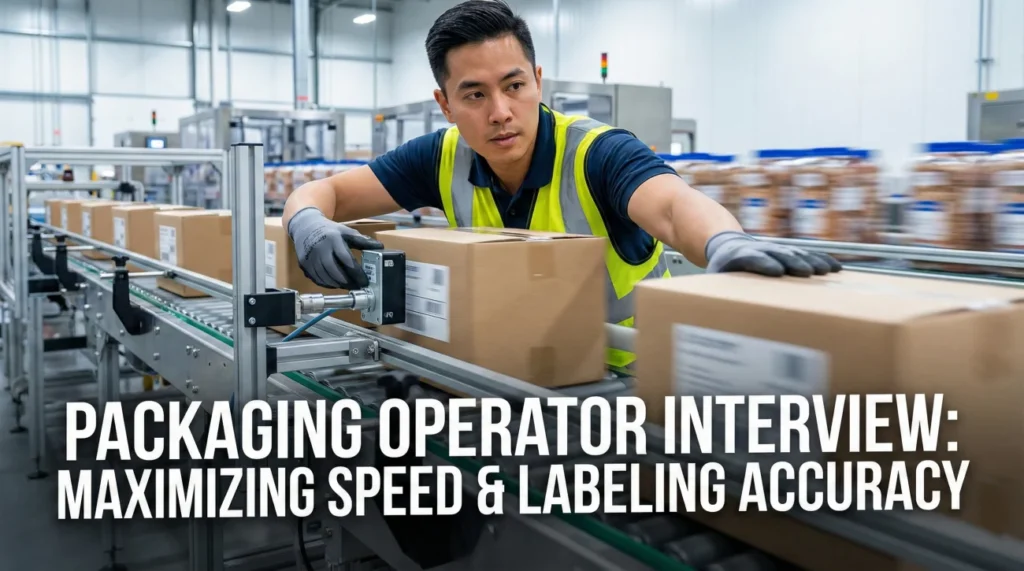
Packaging operator interview questions are designed to find the vigilant guardians at the end of the production line. While the assemblers build the product and the technicians keep the machines running, the Packaging Operator ensures that what the customer receives is safe, sealed, and correctly identified. In a modern facility, this role has evolved from simple manual packing to piloting sophisticated high-speed machinery that can process hundreds of units per minute. Hiring managers are looking for candidates who possess the dexterity to keep up with the conveyor belt and the sharp eye to spot a misaligned label before thousands of units are wasted.
This role demands a unique blend of physical stamina, mechanical aptitude, and obsessive attention to detail. A Packaging Operator is the last line of defense against a costly product recall. If a label is wrong, or a seal is weak, it is the Operator’s responsibility to catch it immediately. In industries like food, pharmaceuticals, and consumer goods, the stakes are incredibly high, and the margin for error is effectively zero.
This comprehensive guide unpacks the essential skills required to succeed in this fast-paced environment. We explore the technicalities of Machine Operation (adjusting flow wrappers and case packers), the critical importance of Label Verification (preventing allergen mix-ups), and the discipline of Good Manufacturing Practices (GMP). Whether you are applying to work on a bottling line, a blister pack machine, or a boxing station, proving you can maintain speed without sacrificing safety is your ticket to the job.
Machine Operation & Troubleshooting
You are a pilot of high-speed equipment. Interviewers want to know if you can run the machine efficiently and fix minor jams without calling maintenance every five minutes.
Q: What types of packaging machinery have you operated?
Answer: I have extensive experience operating Form-Fill-Seal (FFS) machines, specifically Vertical FFS for bagging loose products. I am also proficient with Rotary Labelers and automatic Case Packers. I understand the flow of materials through the web path and how to adjust the tension rollers to prevent film breakage. I am comfortable interacting with the HMI (touchscreen) to load recipes for different SKU changeovers and monitor production counts.
Q: Walk me through your process for clearing a machine jam.
Answer: Safety is the first step. I press the Stop or Pause button immediately to halt the line. If I need to reach into a hazardous area, I perform a localized Lockout/Tagout (LOTO) or engage the safety interlocks to ensure the machine cannot restart. I clear the jammed product and inspect the area for debris or damage to the guides. Once clear, I reset the safety circuit, jog the machine slowly to verify smooth movement, and then restart production, watching closely for the first few cycles to ensure the jam does not recur.
Q: How do you perform a “Changeover” between products?
Answer: Efficiency is key to minimizing downtime. I start by clearing the line of all previous product and packaging materials (Line Clearance) to prevent mixing SKUs. I clean the contact surfaces according to sanitation protocols. Then, I load the new film/labels and adjust the physical guides (rails, funnels) for the new package size using the reference marks. I select the new program on the HMI. Finally, I run a test batch to verify the seal integrity, code placement, and weight before ramping up to full speed.
Q: The machine is running but the bags are not sealing properly. What do you check?
Answer: I check the “Three T’s” of sealing: Time, Temperature, and Pressure. First, I check the temperature controller to ensure the heater bars are reaching the setpoint. If they are, I check the pressure; there might be debris on the seal jaws preventing full contact, or the air pressure to the cylinder might be low. Finally, I check the dwell time (speed); if the machine is running too fast, the film might not have enough time to bond. I troubleshoot these variables one by one to find the root cause.
Quality Control & Labeling Accuracy
A wrong label can kill a company (and a customer). You must demonstrate an obsessive commitment to verification.
Q: Why is “Line Clearance” critical before starting a new batch?
The Strategy: Prevention of Mix-ups.
Answer: Line clearance prevents “rogue” products or labels from the previous run getting mixed into the new batch. If a bottle labeled “Diet” accidentally gets a “Regular” cap, or a peanut-free product gets a peanut-containing label, it could cause a life-threatening allergic reaction for a customer and a massive recall for the company. I physically inspect every chute, conveyor, and bin to ensure zero leftovers before bringing new materials to the line.
Q: How do you verify that the “Date Code” and “Lot Number” are correct?
The Strategy: Verification Loop.
Answer: At the start of the shift and every hour, I perform a code check. I take a sample package and read the printed code against the production order. I verify the legibility (is it smeared?), the position (is it on the seal?), and the content (is the expiration date correct?). I often tape a sample of the correct code to the machine as a “Golden Sample” to compare against throughout the run. If the printer drifts, I stop and adjust it immediately.
Q: What is a “Seal Integrity Test” and how do you perform it?
The Strategy: Destructive Testing.
Answer: A seal test ensures the package is airtight and won’t leak. Depending on the product, I might perform a “Squeeze Test” (manual pressure), a “Water Bath Test” (submerging to look for bubbles), or a “Vacuum Chamber Test” (using negative pressure). I perform these tests at set intervals (e.g., every 15 minutes). If a package fails, I segregate all products made since the last good check and re-inspect them. I assume the whole batch is suspect until proven otherwise.
Q: You notice a pallet of labels has a slight color variation. What do you do?
The Strategy: Stop and Ask.
Answer: I do not use them. I put the pallet on “QA Hold” immediately. Even a slight color change could indicate a printing error or a revision change that implies incorrect ingredient lists. I alert the Quality Assurance technician to inspect the labels against the master standard. It is better to stop the line for 10 minutes to verify than to package 10,000 units with the wrong branding or information.
Q: How do you handle “Metal Detection” kick-outs?
The Strategy: Contamination Protocol.
Answer: If the metal detector rejects a package, I treat it as a critical event. I isolate the rejected package. I run a test wand (ferrous, non-ferrous, stainless steel) through the detector to ensure it is functioning correctly. If the detector works, I carefully open the rejected package to find the contaminant. I inform the supervisor immediately to investigate upstream equipment (like a broken sieve or loose bolt) that might be shedding metal.
Q: What are “Net Weight” checks?
The Strategy: Legal Compliance.
Answer: We must deliver the amount of product stated on the label. I use a calibrated check-weigher or manually weigh samples on a scale. I track the “Giveaway” (overfilling) and “Underweight” (underfilling). If we are consistently overfilling, we lose profit. If we underfill, we violate the law. I adjust the filler heads to keep the weight within the narrowest possible tolerance of the target weight.
Speed, Efficiency & Line Balancing
The line moves fast. You need to show you can keep pace without panicking or creating bottlenecks.
Q: How do you keep up with a high-speed conveyor belt?
Answer: It is about rhythm and ergonomics. I organize my workspace so I minimize reaching. I use both hands symmetrically if possible. I focus on a steady, sustainable pace rather than bursts of speed that lead to fatigue. I also look ahead on the belt to anticipate surges. If the line speed is too high for safe handling, I am not afraid to ask the Line Lead to adjust it slightly or request help to prevent a pile-up.
Q: What is “OEE” and how does a Packaging Operator influence it?
Answer: OEE stands for Overall Equipment Effectiveness. It measures Availability (Machine running), Performance (Running at full speed), and Quality (Good parts). As an operator, I influence all three. I keep the machine running (Availability) by loading materials before they run out (splicing on the fly). I keep it fast (Performance) by clearing jams quickly. I ensure Quality by watching settings. My goal is to keep the “Green Light” on the stack tower lit as much as possible.
Q: The packer downstream is slower than the filler upstream. What happens?
Answer: This creates a bottleneck and potential backup. The product will accumulate and potentially fall off the line or jam the upstream machine. I communicate with the downstream operator to see if they need help or if their machine is having issues. I might temporarily slow down the filler or buffer the product on a accumulation table. Balancing the flow is critical to prevent “Starving” or “Blocking” the machines.
Safety & GMP (Good Manufacturing Practices)
In packaging, hygiene is law. You must prove you understand the rules of a clean environment.
You drop a roll of packaging film on the floor. Can you use it?
The Strategy: GMP Strictness.
Answer: No, not immediately. In a food or pharma environment, anything touching the floor is contaminated. I must inspect the roll. If only the outer layer touched the floor, I might be able to strip off the outer layers until I reach clean material, depending on company policy. However, if the core is damaged or there is any doubt about contamination (e.g., wet floor), I discard the roll. I never risk product safety to save a few dollars of plastic.
Why is jewelry not allowed on the packaging line?
The Strategy: Safety & Contamination.
Answer: Jewelry poses two risks. First, Safety: A ring or necklace can get caught in moving parts (conveyors, rollers), causing severe injury or degloving. Second, Contamination: Stones can fall out of settings and end up in the product as a physical contaminant. Bacteria also hide under rings. I strictly adhere to the “No Jewelry” policy and remove everything before stepping onto the production floor.
You see a coworker bypassing a safety guard to clear a jam faster.
The Strategy: Intervention.
Answer: I stop them immediately. “Hey, don’t put your hand in there while it’s running!” I understand the pressure to keep the line moving, but losing a finger is not worth it. I explain that the safety interlocks are there for a reason. If they persist, I must report it to the supervisor. I want everyone to go home with all their digits. Unsafe speed is not efficient; it is a liability.
Behavioral & Teamwork
Packaging is a team sport. If one person fails, the line stops. How do you fit in?
Describe a time you caught a mistake that others missed.
The Strategy: Attention to Detail.
Answer: “I was loading cartons into the magazine and noticed the ingredient list looked shorter than usual. The front of the box was identical to the previous batch, but the back panel text had changed. I stopped the line and called QA. It turned out the supplier had sent us an old version of the carton that was missing a new allergen warning. By catching it before we packed 5,000 units, I saved the company a massive recall and re-work cost.”
It is the end of a 12-hour shift, and you are exhausted. How do you maintain focus?
The Strategy: Endurance.
Answer: “I know that fatigue leads to errors. I stay hydrated and move around to keep my blood flowing. I rotate tasks with my teammates if possible – switching from palletizing (heavy physical) to inspecting (mental focus) helps refresh the brain. I also double-check my own work. If I feel my focus slipping, I take a moment to reset or splash water on my face. I remind myself that the last package needs to be as perfect as the first.”
How do you handle a coworker who isn’t keeping up with the line speed?
The Strategy: Support, Not Blame.
Answer: “I don’t yell at them. I assume they might be struggling or equipment might be fighting them. I ask, ‘Do you need a hand?’ or ‘Is the machine acting up?’ During a break, I might share a tip on how I hold the boxes to fold them faster. If they are new, I offer encouragement. If they are just lazy and it’s affecting the whole team’s bonus/quota, I might mention it to the Team Lead, but I try to help them succeed first.”
Packaging Operator Skills Quiz
Test Your Packing IQ
1. “FFS” machine stands for:
- Fast Forward System
- Form Fill Seal
- Factory Food Safety
- Final Finish Step
2. A “Lot Number” is used to:
- Count the inventory
- Trace the production history and ingredients of a specific batch
- Tell the price
- Win the lottery
3. “Line Clearance” prevents:
- The line from stopping
- Cross-contamination or mixing of different products/labels
- Workers from leaving
- Machines from breaking
4. “GMP” stands for:
- Get More Product
- Good Manufacturing Practices
- General Machine Parts
- Global Market Price
5. If a Metal Detector rejects a package, you should:
- Put it back on the line
- Isolate it, inspect it, and verify the detector is working correctly
- Throw it away immediately
- Eat the product
6. “Tare Weight” is:
- The total weight
- The weight of the empty packaging material (container) only
- The weight of the product
- The weight of the scale
7. A “Bottleneck” in production is:
- A type of jar
- The slowest point in the line that limits overall output speed
- A break time
- A broken machine
8. “Palletizing” involves:
- Painting the floor
- Stacking finished cases onto a wooden pallet for shipping
- Cleaning the machine
- Mixing the ingredients
9. “LOTO” is required when:
- Going to lunch
- Clearing a jam or performing maintenance where unexpected startup could cause injury
- The shift ends
- Changing a label roll
10. “Blister Pack” is commonly used for:
- Canned soup
- Pharmaceutical tablets or small consumer goods
- Large boxes
- Liquids only
11. “Dwell Time” in sealing refers to:
- Break time
- The duration the heated sealing jaws are in contact with the film
- The machine speed
- Cooling time
12. “FIFO” inventory rotation means:
- Fast In Fast Out
- First In First Out (Use oldest materials first)
- Fit In Fit Out
- Food In Food Out
13. A “HMI” is:
- Heavy Machine Iron
- Human Machine Interface (Touchscreen control panel)
- High Maintenance Item
- Hard Material Input
14. “SKU” stands for:
- Safe Kitchen Unit
- Stock Keeping Unit (Unique product identifier)
- Skip Keep Unit
- Standard Kit Use
15. “Quality Assurance” (QA) checks are done to:
- Slow down the line
- Ensure the product meets all specifications and legal requirements
- Punish operators
- Count inventory
16. If a label is applied “Skewed”, it is:
- Missing
- Crooked or misaligned
- Upside down
- Perfect
17. “Changeover” time is:
- Time to change clothes
- The time taken to switch the line from running one product to another
- Overtime pay
- Lunch break
18. “Primary Packaging” touches:
- The shipping truck
- The product directly (e.g., the bottle or bag)
- The pallet
- The consumer’s hand
19. “Secondary Packaging” helps to:
- Touch the food
- Group primary packages together for handling (e.g., a cardboard box of bottles)
- Look pretty
- Hide defects
20. The “Emergency Stop” (E-Stop) button should be used:
- To pause for lunch
- Only when there is immediate danger to personnel or equipment
- To change settings
- To clean the machine
❓ FAQ
💪 Is this job physically demanding?
Yes. You will be standing for 8-12 hours, lifting boxes (often 25-50 lbs), bending, and performing repetitive motions. It requires stamina and core strength. Good ergonomic shoes are essential to avoid back and foot pain.
👂 Is it noisy?
Very. Packaging lines have constant machine noise, air compressors releasing, and alarms. Hearing protection (earplugs) is mandatory in most facilities. You need to be able to communicate via hand signals or shouting over the noise.
📜 Do I need certification?
Usually not for entry-level. Most companies provide on-the-job training for specific machines. However, having a Forklift license or OSHA safety certification (like OSHA 10) gives you a significant advantage and might start you at a higher pay rate.
⏰ What are the shifts like?
Production often runs 24/7. Expect rotating shifts (switching between days and nights every few weeks) or fixed 2nd/3rd shifts. Weekend work is common. Overtime is frequently available (or mandatory) during peak seasons.
🚀 Is there a career path?
Yes. You can advance to Machine Operator II/III (running more complex equipment), Line Lead (supervising the team), Quality Tech, or move into Maintenance if you show mechanical aptitude.
Final Thoughts
To succeed in answering packaging operator interview questions, you need to present yourself as a “Reliable Guardian.” The hiring manager wants to know that you will show up on time, pay attention for the entire shift, and never let a defective product pass your station.
Highlight your attention to detail, your respect for safety rules, and your mechanical curiosity. If you can prove you are the person who stops the line to fix a labeling error rather than letting it slide, you will secure the job.
⚠️ Disclaimer: The interview strategies, sample answers, and negotiation tips provided in this guide are for educational purposes only. Hiring decisions are subjective and vary by company and industry. While these strategies are based on professional HR standards, they do not guarantee a specific job offer or result.