The Heartbeat of Production
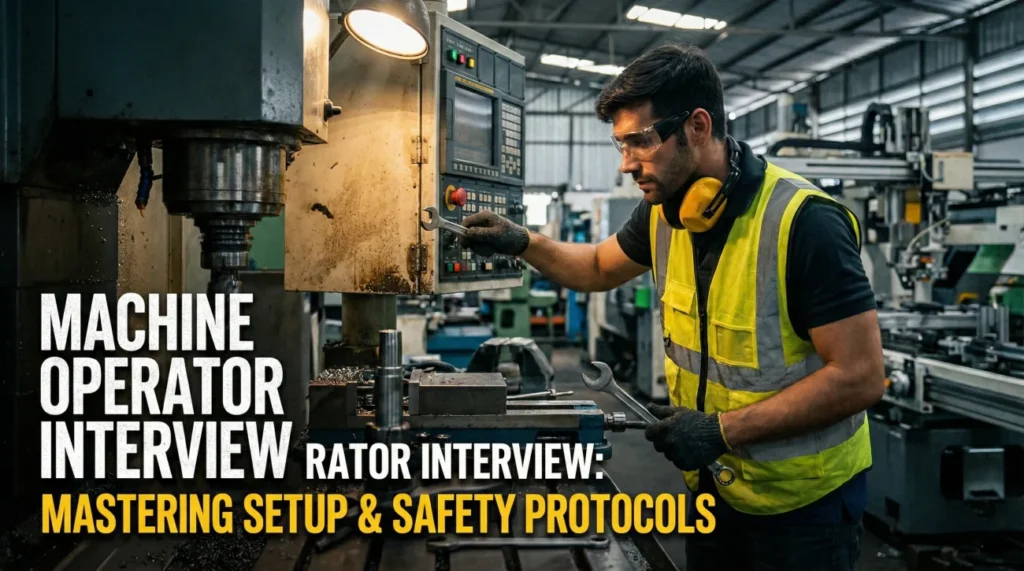
In any manufacturing plant, the Machine Operator is the person who turns raw potential into tangible value. You are the hands and eyes of the production process. While engineers design the equipment and managers plan the schedule, it is the operator who stands at the control panel, ensuring that the machine runs smoothly, safely, and efficiently hour after hour. Employers are looking for reliable individuals who treat their assigned machine with ownership, noticing the slightest change in sound or vibration before it becomes a breakdown.
Hiring managers need to know that you are more than just a “button pusher.” They want candidates who understand the mechanics of their equipment, who respect safety protocols like Lockout/Tagout (LOTO) as if their lives depended on them (because they do), and who can perform precise quality checks on the fly. This guide covers machine operator interview questions designed to test your technical aptitude, your attention to detail, and your ability to keep the line moving under pressure.
Machine Setup & Operation
Q: Walk me through your routine for starting a shift. What is the first thing you do?
My routine begins with safety and communication. Before I touch any controls, I check the machine for any Lockout/Tagout locks or tags left by the previous shift or maintenance. If it is clear, I perform a walk around inspection: checking fluid levels (oil, coolant), ensuring safety guards are in place, and looking for any loose debris or leaks.
Next, I review the “Pass Down” log or speak with the operator from the previous shift. I ask: “How did it run? Any weird noises? Are we running the same part or doing a changeover?” Finally, I verify that I have the correct raw materials and the current Work Order instructions before I start the warm up cycle. I believe that a disciplined start prevents 90 percent of mid shift problems.
Q: How do you perform a “First Article” check after a setup?
After setting up the machine for a new job, I run the very first piece slowly, often in “single block” or manual mode if possible, to watch for tool clearance. Once the part is made, I do not assume it is good. I take it to the inspection bench immediately.
I measure every critical dimension against the blueprint using calibrated tools (calipers, micrometers, or gauges). I compare it to the “Go/No Go” requirements. Only after I verify that this first piece is perfect do I get the Supervisor or QC to sign off on the “First Piece Inspection” sheet. I never run production until that signature is wet ink on the page; running bad parts is a waste of time and money.
Q: What does “Machine Offsets” mean and when do you adjust them?
Machine offsets tell the computer exactly where the tool is relative to the part (Geometry Offsets) or compensate for tool wear (Wear Offsets). Over time, as a cutting tool wears down, the part might get slightly larger (on an OD) or smaller (on an ID).
I monitor the part dimensions regularly. If I see the size drifting towards the tolerance limit, I adjust the Wear Offset by a few thousandths of an inch to bring it back to the nominal (center) target. I make small adjustments; it is better to adjust 0.001 inch twice than to overcompensate by 0.005 inch and scrap the part.
Q: Describe your experience with reading HMI (Human Machine Interface) screens.
I am comfortable navigating touchscreens and control panels to load programs, monitor cycle times, and read error codes. On my last machine, the HMI showed real time pressure and temperature graphs.
I use the HMI not just to start and stop, but to diagnose. If the machine alarms out, I look at the “Alarm History” tab on the screen to see the specific code (e.g., “Servo Overload” or “Door Open”). I treat the HMI as the machine’s way of talking to me.
Troubleshooting & Maintenance
Q: The machine jams in the middle of a cycle. What is your step by step response?
First, I hit the “Stop” or “Feed Hold” button immediately. I do not reach into the machine yet. I assess the situation visually through the window. If I need to reach into a hazardous area to clear the jam, I perform a full Lockout/Tagout (LOTO) to ensure the machine cannot move.
Once safe, I clear the obstructed part using tools (pliers/hooks), not my bare hands if possible. I inspect the tooling for damage – did the jam break the drill bit? After clearing, I reset the machine, remove my lock, and run a “dry cycle” (no part) to ensure everything moves freely before resuming production.
Q: You hear a strange grinding noise coming from the motor. What do you do?
I stop the machine immediately. A grinding noise is never “normal” and usually means a bearing is failing or metal is rubbing on metal. I do not try to “finish the batch.”
I notify the Maintenance Department and my Supervisor. I describe exactly where the sound is coming from (e.g., “the main drive motor on the left side”). I wait for maintenance to inspect it. Running a machine to failure turns a $100 bearing replacement into a $5,000 motor replacement.
Q: What basic preventive maintenance (PM) tasks are you comfortable performing?
I believe operator PM is essential. I am comfortable checking and topping off lube oil and coolant levels daily. I empty the chip bins or scrap hoppers before they overflow.
I also wipe down the sensors and ways (rails) to prevent grime buildup. I inspect hydraulic hoses for signs of rubbing or leaks. I see these tasks as part of “owning” my machine – if I take care of it, it runs better for me.
Q: How do you handle a “Tool Life” alarm?
When the machine signals that a tool has reached its cycle limit, I stop at the next safe opportunity. I do not just reset the counter and keep running.
I remove the old insert or drill bit and inspect it – is it chipped? burned? This tells me if our settings are right. I install the new tool, ensuring it is seated clean and tight. Then, crucially, I reset the tool life counter and run a first piece check to verify the new tool is cutting to the correct size.
Q: The parts are coming out with scratches (cosmetic defects). How do you fix it?
I stop and look at the workflow. Scratches often come from chip buildup or dirty fixtures. I clean the clamping jaws and the locating pads thoroughly with a rag or air gun.
I also check the ejection chute – is the part hitting a sharp metal edge when it falls out? If so, I might add a rubber pad or adjust the chute angle. I also check my own handling – am I stacking parts on top of each other? I treat cosmetic defects as seriously as dimensional ones.
Q: What do you do if you accidentally crash the machine?
I hit the E Stop immediately. Then, I own up to it. I go straight to my Supervisor and say, “I made a mistake and crashed the machine.” I do not try to hide it or blame the machine.
Honesty saves time. If I hide it, the next person might get hurt or make bad parts. We need to check the alignment and the tool holder. I participate in the investigation to explain what happened (e.g., “I typed the wrong offset”) so we can learn from it.
Safety, Quality & Scenarios
Your supervisor asks you to bypass a safety guard to speed up production. What do you say?
I respectfully refuse. I say, “I want to hit the numbers too, but I cannot bypass the guard. It is there to keep me safe, and it is against OSHA regulations and company policy.”
I offer to find a different way to speed up – maybe by organizing the materials better or getting help with loading. But I will not risk losing a finger for a production record. Safety is a non negotiable for me.
You notice the operator next to you is not wearing their safety glasses. What do you do?
I approach them in a friendly, “looking out for you” way. I tap them on the shoulder (safely) and point to my own eyes or say, “Hey, don’t forget your glasses. I don’t want you to get written up or get a chip in your eye.”
Most of the time, they just forgot and will thank me. If they refuse and become hostile, I back off. I am not the police. But if they are doing something that endangers me or others, I would have to mention it to the lead.
You are running behind schedule, but the QC check takes 10 minutes. Do you skip it?
Never. If I skip the check and run bad parts for an hour, I haven’t “saved” time; I have wasted an hour of material and machine time. That puts us even further behind.
I perform the QC check as required. If I am behind, I communicate that to the supervisor early: “I am running 20 pieces behind because of the raw material issue.” Communication solves the scheduling problem; cutting corners creates a quality problem.
General Manufacturing Skills
Q: How do you handle repetitive tasks without losing focus?
I turn it into a personal challenge. I try to beat my own cycle time (safely) or maintain a perfect quality streak. I also keep my mind active by listening to the machine rhythm – often you hear a problem before you see it.
I also take my scheduled micro breaks to stretch and reset my eyes. Staying hydrated helps. I understand that in manufacturing, consistency is key, and losing focus for one second can cause an accident.
Q: Describe how you keep your work area organized (5S).
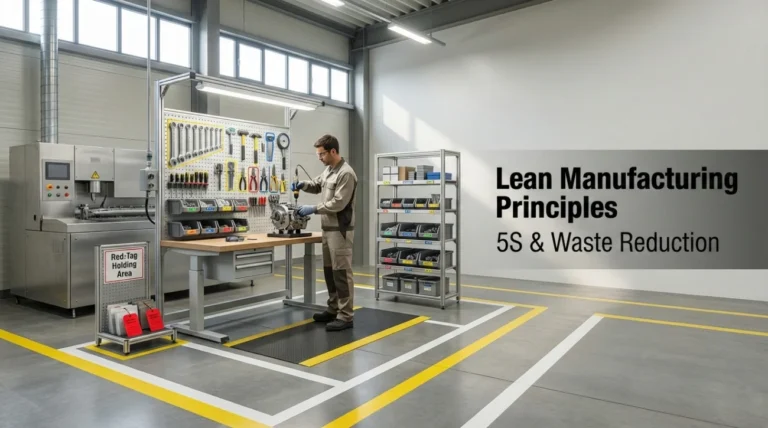
I follow “A place for everything and everything in its place.” I keep my wrenches and gauges on the shadow board when not in use, so I don’t waste time hunting for them. I sweep the floor around my machine regularly to prevent slip hazards from oil or chips.
At the end of the shift, I spend the last 5-10 minutes cleaning down the machine and organizing the raw material for the next guy. It is about professional respect – I wouldn’t want to walk into a mess, so I don’t leave one.
Q: Are you comfortable working rotating shifts or overtime?
Yes, I understand that manufacturing is a demand driven business. I have worked [mention shifts: 2nd, 3rd, or 12-hour shifts] before. I manage my sleep schedule and diet to ensure I am alert.
Regarding overtime, I am a team player. If the orders are piling up and the team needs to stay late or come in on a Saturday to hit the target, I am willing to pitch in. I prefer planned overtime, but I can handle short notice needs too.
Q: How do you ensure you are using the correct raw material?
I verify the “Three-Way Match.” I check the Part Number on the Work Order, the Part Number on the Blueprint, and the Tag/Label on the raw material bin or pallet.
If the label is missing or handwritten and hard to read, I do not guess. I ask the Material Handler or Supervisor to verify it. Using the wrong grade of steel or plastic can destroy the tool or cause the part to fail in the field.
Machine Operator Knowledge Quiz
20 Practice Questions
1. What does the “E-Stop” button do?
- Pauses the program gently
- Cuts power and stops all motion immediately
- Calls the elevator
- Ejects the part
2. LOTO stands for:
- Log On / Time Off
- Lockout / Tagout
- Lights On / Turn Off
- Load Out / Take Out
3. When should you wear safety glasses?
- Only when the boss is looking
- At all times on the production floor
- Only when grinding
- Never
4. What is the first thing you check at the start of a shift?
- Your phone messages
- Safety guards and machine status
- The lunch menu
- The radio station
5. If a machine guard is missing, you should:
- Run the machine carefully
- Do not run the machine; report it immediately
- Use cardboard to cover it
- Ask a friend to watch out
6. A “burr” on a metal part is:
- A cold spot
- A sharp, raised edge left by cutting
- A smooth surface
- A type of paint
7. Which tool measures the outside diameter of a rod?
- Tape measure
- Caliper or Micrometer
- Ruler
- Protractor
8. What is a “Work Order” or “Traveler”?
- A ticket for travel
- A document with instructions for the specific job
- A permission slip to leave early
- A list of tools
9. If you make a bad part, you should:
- Hide it in the trash
- Mark it red and put it in the reject bin
- Ship it anyway
- Give it to the next shift
10. PPE stands for:
- Personal Production Equipment
- Personal Protective Equipment
- People Protection Every day
- Parts Per Employee
11. A “Cycle Time” is:
- The time to ride a bike
- The time it takes to make one part
- The time for lunch break
- The time to setup the machine
12. Why do we use coolant?
- To clean the floor
- To reduce heat and friction during cutting
- To make the machine look shiny
- To make the part heavy
13. If you hear a strange noise from the machine:
- Turn up the radio
- Stop the machine and investigate
- Run faster to finish
- Kick the machine
14. 5S stands for Sort, Set in Order, Shine, Standardize, and:
- Sleep
- Sustain
- Sit down
- Skip
15. What color is usually associated with “Stop” or “Danger”?
- Green
- Red
- Yellow
- Blue
16. Before reaching into a machine to clear a jam, you must:
- Take a deep breath
- Stop the machine and Lockout if necessary
- Ask a friend to hold the button
- Be very fast
17. A “tolerance” on a blueprint is:
- How much the boss tolerates you
- The allowable variation in a dimension
- The weight of the part
- The hardness of the metal
18. If the raw material looks rusty or damaged:
- Use it anyway
- Do not use it; ask the supervisor
- Paint over it
- Wash it with water
19. To lift a heavy box safely, you should:
- Bend your back
- Bend your knees and lift with your legs
- Lift quickly and twist
- Ask someone smaller to do it
20. Who is responsible for quality?
- Only the QC inspector
- Everyone, including the operator
- The customer
- The truck driver
❓ FAQ
🚜 Do I need previous experience?
For entry level roles, attitude and mechanical aptitude (fixing cars, home repairs) often matter more than direct factory experience. Employers are willing to train someone who shows up on time and wants to learn.
📏 What math do I need to know?
Basic arithmetic (add, subtract, multiply, divide) is essential. You need to be comfortable with decimals (e.g., knowing that 0.500 is bigger than 0.050) and fractions (1/4 vs 1/8) to read blueprints and measurement tools.
👂 Is it loud in the factory?
Yes, most machine shops are noisy. That is why hearing protection (earplugs or earmuffs) is mandatory PPE. Protecting your hearing is a priority, and you get used to the environment quickly.
🤖 Will robots replace my job?
Automation is increasing, but robots still need operators to set them up, feed them, and fix them when they error out. The role is shifting from “doing the work” to “managing the machine that does the work,” which actually requires more skill.
👟 What should I wear to the interview?
You don’t need a suit. Wear neat, clean work clothes – like khakis or nice jeans and a polo shirt. If you have steel toe boots, wear them (or bring them) in case they offer you a plant tour. It shows you are ready to work.
Final Thoughts
To land a job as a Machine Operator, you need to project reliability and safety consciousness. The interview is not just about what you know; it is about showing that you can be trusted with expensive equipment and that you will not cut corners when the boss isn’t watching.
Review these machine operator interview questions and be ready to share examples of how you troubleshoot problems or handle repetitive work. Show them that you take pride in making quality parts, and you will be a strong candidate for any manufacturing team.
⚠️ Disclaimer: The interview strategies, sample answers, and negotiation tips provided in this guide are for educational purposes only. Hiring decisions are subjective and vary by company and industry. While these strategies are based on professional HR standards, they do not guarantee a specific job offer or result.