The Doctors of the Factory Floor
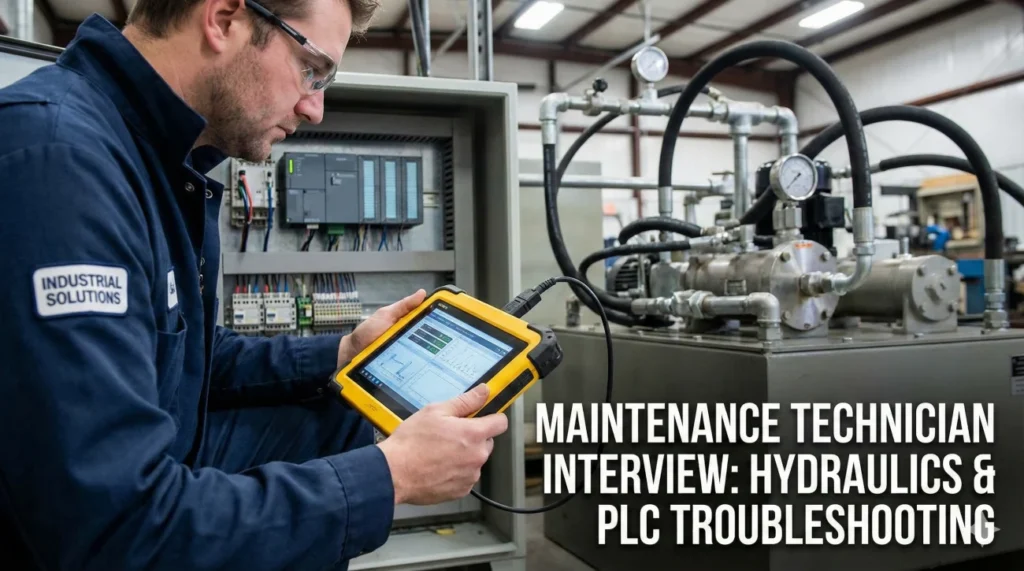
Maintenance technician interview questions are designed to find the problem solvers who keep the modern world moving. In an industrial setting, a machine down for one hour can cost the company thousands of dollars in lost production. Hiring managers are not just looking for someone who can turn a wrench; they are looking for “Industrial Doctors” who can diagnose a complex issue in a PLC code, swap out a hydraulic valve safely, and perform preventive surgery on a motor before it fails.
This comprehensive guide drills deep into the multi-disciplinary skillset required for the role. We dissect the critical knowledge of Fluid Power (Hydraulics & Pneumatics), the invisible logic of PLC (Programmable Logic Controllers), and the strict Safety Protocols (LOTO) that keep you alive. Whether you are applying to a high-speed bottling plant or a heavy steel mill, proving you have the technical range and the troubleshooting logic to minimize downtime is your primary objective.
Electrical Systems & Controls
Modern machines run on electricity. You must prove you can work safely with high voltage and troubleshoot control circuits.
Q: Explain the difference between AC and DC power and where you find them in a factory.
Answer: AC (Alternating Current) is typically used for power distribution and driving large motors (3-phase 480V) because it travels long distances efficiently. DC (Direct Current) is used for control circuits (24V) and sensitive electronics like sensors and PLC cards because it provides a constant, stable voltage. In a cabinet, I expect to see AC coming into the main disconnect and Variable Frequency Drives (VFDs), while the DC power supply converts it for the logic and controls.
Q: How do you troubleshoot a 3-phase motor that is humming but not turning?
Answer: A hum usually indicates “single-phasing,” meaning one of the three legs of power is lost. I would first perform Lockout/Tagout (LOTO). Then, I would use my multimeter to check voltage at the motor terminals (line-to-line). If I have voltage on all three legs, I check the windings for continuity/resistance. If one winding reads open (OL) or shorted to ground, the motor is bad. I also check the mechanical load to ensure the shaft isn’t seized.
Q: Describe how to use a Multimeter to test a fuse.
Answer: I set the meter to “Continuity” (Ohm) mode. With the fuse removed from the circuit (to avoid false readings), I touch the probes to each end of the fuse. If the meter beeps (or reads near zero ohms), the fuse is good (closed circuit). If it is silent (or reads OL/Infinity), the fuse is blown (open circuit). I never trust a visual inspection alone because a fuse can look fine but be internally severed.
Q: What is a VFD and why do we use it?
Answer: A VFD (Variable Frequency Drive) controls the speed and torque of an AC motor by varying the frequency and voltage supplied to it. We use it for process control (ramping speed up/down smoothly) and energy efficiency. When troubleshooting, I check the VFD’s error code display first, which often points directly to issues like “Overcurrent,” “Undervoltage,” or “Overheating.”
PLC & Automation Logic
You don’t need to be a programmer, but you must be able to read the “Ladder” to find the broken switch.
Q: What is a PLC and how do you use it for troubleshooting?
The Strategy: The Brain of the Machine.
Answer: A PLC (Programmable Logic Controller) is the industrial computer running the machine. I use it as a diagnostic tool. If a motor won’t start, I look at the laptop or HMI (Human Machine Interface) to see the PLC logic. I find the output bit for that motor and trace the ladder logic backward to see which input condition (e.g., a safety gate sensor or pressure switch) is missing (false). It tells me exactly which component to check physically.
Q: Explain the difference between “Normally Open” (NO) and “Normally Closed” (NC) contacts.
The Strategy: Fundamental Logic.
Answer: NO (Normally Open) means the circuit is broken (open) in its resting state; it allows current only when actuated (like a doorbell). NC (Normally Closed) means the circuit is complete (closed) in its resting state; it stops current when actuated (like an E-Stop button). In a PLC, safety sensors are almost always NC so that if a wire breaks, the machine stops immediately (Fail-Safe).
Q: What are Inputs and Outputs (I/O)?
The Strategy: Signal Flow.
Answer: Inputs are signals sent to the PLC from field devices (Sensors, Switches, Buttons) telling it the status of the machine. Outputs are commands sent from the PLC to devices (Motors, Valves, Lights) to make something happen. Troubleshooting is often verifying if the Input LED is on; if the PLC sees the input but doesn’t fire the Output, it’s a logic/program issue. If the Input LED is off, it’s a sensor issue.
Q: What is a Photoeye (Photoelectric Sensor) and how do you fix it?
The Strategy: Common Failures.
Answer: A photoeye uses a light beam to detect the presence of an object. Common issues are misalignment (reflector bumped) or dirty lenses (dust/grease blocking the light). My first step is always to clean the lens and check the alignment light. If it’s a “Through-beam” sensor, I ensure both the emitter and receiver are powered and pointing at each other.
Q: How do you handle a machine that has “lost its home position”?
The Strategy: Calibration.
Answer: This usually happens after a power outage or mechanical jam. I check the “Homing Sensor” or encoder. Often, debris is blocking the home sensor, or the servo motor has lost its count. I manually jog the machine to the physical home position and perform the homing sequence on the HMI to reset the encoder to zero.
Q: What is a Proximity Sensor?
The Strategy: Non-Contact Detection.
Answer: A proximity sensor detects metal objects without touching them (Inductive). I check the gap distance; if the machine vibrated, the sensor might have moved too far from the target metal to detect it. I adjust the mounting bracket to get it within the sensing range (usually a few millimeters) and tighten it down.
Hydraulics & Pneumatics
Fluid power drives the heavy lifting. You must understand pressure, flow, and the dangers of high-pressure systems.
Q: What is the difference between Hydraulics and Pneumatics?
Answer: Hydraulics uses incompressible liquid (oil) to create massive force and precise position holding; it is used for heavy lifting (presses, lifts). Pneumatics uses compressible gas (air) for high speed, lower force, and “bouncier” applications; it is used for pick-and-place arms or opening/closing small gates. Hydraulics are messy and slow; Pneumatics are clean and fast.
Q: Describe “Cavitation” in a hydraulic pump.
Answer: Cavitation sounds like marbles rattling in the pump. It happens when the pump is starved of oil (inlet restriction), causing vacuum bubbles to form and then implode violently, pitting the metal. It is caused by clogged inlet filters, low oil level, or oil that is too thick (cold). It destroys pumps rapidly, so if I hear it, I shut the machine down immediately.
Q: How do you troubleshoot a pneumatic cylinder that is moving too slowly?
Answer: I check the air supply pressure first (regulator gauge). If pressure is good, I check the Flow Control Valve on the cylinder exhaust; it might be closed too much. I also check for air leaks in the lines or a worn seal inside the cylinder (air bypassing the piston). If the muffler/silencer is clogged with dirt, backpressure can also slow it down.
Q: What is a Solenoid Valve?
Answer: It is an electromechanical valve used to control the flow of fluid/air. The electrical coil creates a magnetic field that pulls a plunger to open/close the port. To test it, I can check if the coil is magnetized with a screwdriver when energized. If it has power but won’t shift, the mechanical spool might be stuck by debris.
Mechanical Systems & Precision
From gearboxes to bearings, the mechanical side is about alignment, lubrication, and wear.
A bearing keeps failing every month. What do you investigate?
The Strategy: Root Cause (5 Whys).
Answer: I don’t just replace it again. I look for the cause. 1. Lubrication: Are we over-greasing (blowing seals) or under-greasing? 2. Alignment: Is the shaft misaligned, creating vibration and heat? 3. Load: Is the belt too tight (over-tensioned)? 4. Contamination: Is water or dust getting in? Repeated failure is almost always an installation or environment issue, not a bad part.
How do you align a motor and a pump shaft?
The Strategy: Precision Maintenance.
Answer: I use a dial indicator or a laser alignment tool. I check for “Soft Foot” first (one foot not sitting flat) and shim it. Then I check Angular Misalignment (faces of coupling not parallel) and Offset Misalignment (centerlines not concentric). I adjust using shims and jack bolts until they are within tolerance (usually thousandths of an inch). Eyeballing it is not acceptable for high-speed equipment.
Describe the proper way to tension a V-Belt.
The Strategy: Tension & Tracking.
Answer: I don’t just “press it with my thumb.” I use a tension gauge. I calculate the required deflection force based on the span length. If it’s too loose, it slips and burns (glazing). If it’s too tight, it destroys the motor bearings. I also check that the sheaves (pulleys) are perfectly aligned so the belt doesn’t wear on the sidewalls.
Safety & LOTO (Lockout/Tagout)
Safety is the most important skill. One mistake can kill you or a coworker.
Q: Walk me through the LOTO (Lockout/Tagout) procedure.
Answer: 1. Notify operators. 2. Identify all energy sources (Electrical, Pneumatic, Hydraulic, Gravity, Thermal). 3. Shut down the machine. 4. Isolate energy (Breakers off, Valves closed). 5. Lock and Tag individually. 6. Dissipate stored energy (Bleed air, lower gravity loads, discharge capacitors). 7. Verify isolation by trying to start the machine (“Try-Out”). Only then do I start work.
Q: What is “Stored Energy” and how do you handle it?
Answer: Stored energy is power waiting to release even after the power is off. Examples: compressed air in a tank, hydraulic pressure in a hose, a heavy weight held up by a cylinder, or a spring under tension. I must bleed valves to zero pressure, block/pin raised weights so they can’t fall, and discharge capacitors. I treat every “off” machine as a loaded gun until verified.
Q: You see a coworker working on a live machine without LOTO. What do you do?
Answer: I stop them immediately. I don’t care if they get mad. I tap them on the shoulder and say, “Hey, we need to lock this out before you touch that.” If they refuse, I escalate to the Safety Manager immediately. It is not “snitching”; it is saving their life. I have zero tolerance for LOTO violations because there are no second chances with 480 Volts.
Preventive Maintenance & Workflow
Maintenance is shifting from “Fix it when it breaks” to “Don’t let it break.”
Q: What is the difference between Preventive (PM) and Predictive (PdM) Maintenance?
The Strategy: Schedule vs. Condition.
Answer: PM is time-based (e.g., changing oil every 3 months regardless of condition). It prevents failure but can be wasteful. PdM is condition-based (e.g., using vibration analysis or thermography to see if a bearing needs changing). PdM allows us to run parts longer safely and fix them right before failure. I prefer PdM where tools are available.
Q: How do you prioritize work orders when multiple machines are down?
The Strategy: Business Impact.
Answer: I look at the “Bottleneck.” Which machine stops the final product from shipping? If the palletizer is down, nothing ships. If one of three redundant fillers is down, production just slows slightly. I prioritize the equipment that has the highest immediate financial impact on the company. I communicate my plan to the Production Supervisor so they can adjust staffing.
Q: Describe your “Troubleshooting Loop.”
The Strategy: Scientific Method.
Answer: 1. Identify the symptom (What is it doing?). 2. Gather info (Talk to the operator: “What happened right before it stopped?”). 3. Consult manual/schematics. 4. Hypothesize causes. 5. Test theories (Start with the simplest/easiest to check). 6. Repair. 7. Verify operation. 8. Document for future reference. I don’t guess; I trace.
Q: How do you handle an Operator who keeps breaking the machine?
The Strategy: Education.
Answer: I don’t blame them; I train them. Often they don’t know that “slamming” the button breaks the contactor. I explain the “Why”: “When you jam this lever, it bends the sensor bracket inside.” I show them the proper way. If it is malicious, I report it, but usually, it is a lack of training.
Q: What information do you put in a Work Order log?
The Strategy: Data Integrity.
Answer: I record “Problem, Cause, Correction.” Not just “Fixed conveyor.” I write: “Conveyor stopped. Cause: Bad relay CR4. Correction: Replaced relay and verified timing.” This detail helps the next tech if it happens again and helps the reliability engineer track failure trends.
Q: How do you find a part number for a replacement?
The Strategy: Resourcefulness.
Answer: I check the machine manual/BOM (Bill of Materials) first. If that is missing, I look at the tag on the old part. If the tag is worn off, I measure it (shaft size, frame size) and call the vendor or use Google Lens/image search. I always verify the specs (voltage, amp rating) match, not just the physical size.
Maintenance Technical Quiz
Test Your Wrench IQ
1. “LOTO” stands for:
- Lights On Tools Off
- Lockout Tagout
- Low Oil Temperature Output
- Lever Open Tank Open
2. A “Multimeter” measures:
- Temperature only
- Voltage, Current (Amps), and Resistance (Ohms)
- Hydraulic pressure
- Vibration levels
3. In a PLC, “I/O” refers to:
- Inside/Outside
- Inputs and Outputs
- Internet/Offline
- Internal/Operational
4. “Continuity” in an electrical circuit means:
- The power is off
- There is a complete, unbroken path for current to flow
- The fuse is blown
- The wire is hot
5. Which device converts electrical energy into mechanical motion?
- Generator
- Motor
- Transformer
- Capacitor
6. “Pneumatics” use what medium?
- Water
- Compressed Air (or Gas)
- Hydraulic Oil
- Electricity
7. A “Bearing” is used to:
- Stop motion
- Reduce friction between moving parts and support loads
- Heat up oil
- Filter air
8. “PPE” stands for:
- Professional Power Equipment
- Personal Protective Equipment
- Primary Pressure Element
- Plant Production Efficiency
9. A “Check Valve” allows flow in:
- Both directions
- Only one direction
- No directions
- Reverse only
10. “Ladder Logic” is a programming language for:
- Websites
- PLCs (Programmable Logic Controllers)
- Accounting
- Robots only
11. What causes a fuse to blow?
- Low voltage
- Excessive current (Overcurrent/Short Circuit)
- Cold temperature
- Old age
12. “Cavitation” damages pumps by:
- Rusting them
- Imploding bubbles causing pitting on metal surfaces
- Overheating the oil
- Freezing the water
13. A “Limit Switch” detects:
- Heat limits
- The physical presence or position of an object via contact
- Time limits
- Light levels
14. “3-Phase Power” typically has how many hot wires?
- One
- Three (L1, L2, L3)
- Two
- Four
15. “Thermography” uses what to detect faults?
- Sound waves
- Infrared heat patterns (Hot spots)
- X-rays
- Vibration
16. A “Solenoid” converts electrical energy into:
- Light
- Linear mechanical motion (Push/Pull)
- Rotary motion
- Heat
17. “Preventive Maintenance” is based on:
- Breaking things
- Scheduled time intervals or usage hours
- Guessing
- Waiting for failure
18. The “E-Stop” button is usually what color?
- Green
- Red (often on a yellow background)
- Blue
- Black
19. “Lockout” means placing a lock to:
- Secure the toolbox
- Prevent an energy isolating device from being operated
- Lock the door
- Stop theft
20. A “VFD” controls a motor’s:
- Temperature
- Speed (Frequency) and Torque
- Shape
- Oil level
❓ FAQ
🛠️ Do I need to provide my own tools?
It depends. Many companies provide larger specialty tools (pullers, large wrenches, diagnostic laptops) but expect technicians to have their own basic set (wrenches, sockets, meters, screwdrivers). Always clarify this in the interview, as a good toolset is a significant investment.
📜 What certifications are valuable?
Certifications validate your skills. Look for PMMI Mechatronics, NIMS (Industrial Technology Maintenance), or specific PLC certs (Allen Bradley/Siemens). An electrical license or HVAC EPA card is also highly prized depending on the facility.
⏰ What are the typical shifts?
Factories run 24/7. Expect shift work. The most common are rotating 12-hour shifts (e.g., 2-2-3 schedule) or fixed 2nd/3rd shifts. Seniority often dictates who gets the day shift. You must be willing to work nights and weekends initially.
💻 Do I need to know how to code PLCs?
For a Technician role, usually no. You need to know how to read code to troubleshoot (trace inputs/outputs). Writing code from scratch is typically an Automation Engineer’s job. However, the ability to make small edits or force values is a huge plus.
⚠️ Is the job physically demanding?
Yes. You will be climbing ladders, crawling under machines, lifting motors, and working in hot/noisy environments. Physical fitness and flexibility are practical requirements for the job.
Final Thoughts
To succeed in answering maintenance technician interview questions, you need to show you are a “Safety-First Logician.” The hiring manager wants to know that you won’t bypass safety guards to fix a machine faster, and that you solve problems systematically rather than guessing.
Highlight your versatility. If you are strong in mechanical but weak in electrical, admit it but show your eagerness to learn. The best technicians are the ones who are constantly curious about how things work. For more insights on the general interview process, check out our guide to interview questions to polish your soft skills alongside your technical ones.
⚠️ Disclaimer: The interview strategies, sample answers, and negotiation tips provided in this guide are for educational purposes only. Hiring decisions are subjective and vary by company and industry. While these strategies are based on professional HR standards, they do not guarantee a specific job offer or result.