The Asset Guardians
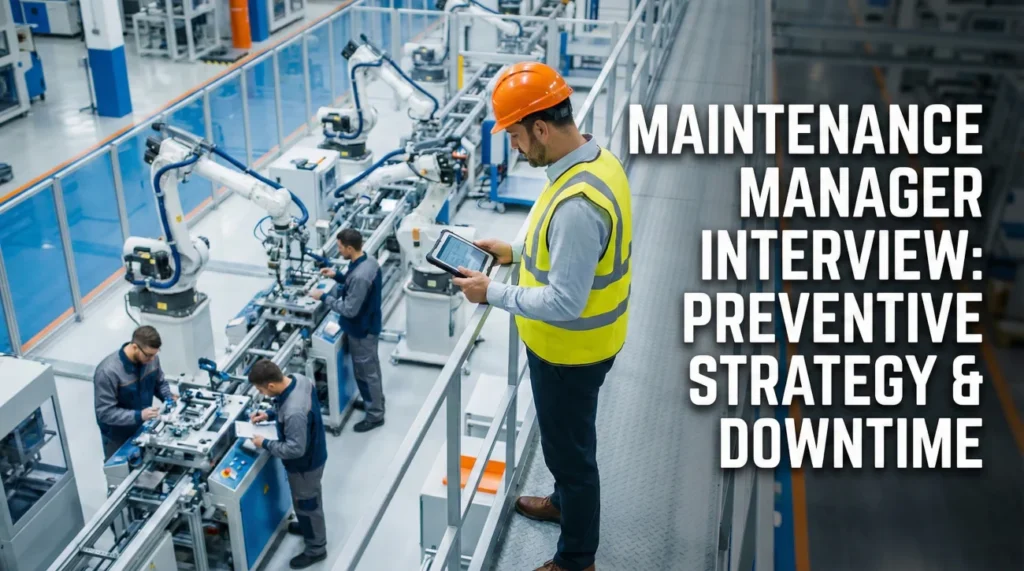
In the high stakes world of manufacturing, the Maintenance Manager is the strategic defender of asset reliability. You are not just the person who calls the mechanic when a machine breaks; you are the architect of a system designed to prevent it from breaking in the first place. Your role bridges the gap between the immediate urgency of production targets and the long term health of the facility’s equipment.
Hiring managers for this leadership role are looking for a candidate who can articulate a vision for moving from a reactive “firefighting” culture to a proactive Reliability Centered Maintenance (RCM) culture. They want to know how you manage a multi million dollar budget, how you decide which spare parts to stock versus which to risk, and how you lead a team of skilled technicians who are often the most experienced and opinionated people in the plant.
This comprehensive guide delves into maintenance manager interview questions that test your strategic thinking, your technical depth in predictive technologies (like vibration analysis), and your ability to justify capital expenditures to the C suite. We will prepare you to prove that maintenance is not a cost center, but a profit protector.
Maintenance Strategy & Reliability
Q: Describe your philosophy on the transition from Reactive to Preventive and Predictive Maintenance.
My philosophy is that “Reactive maintenance is the most expensive way to operate.” It costs 3-4 times more due to overtime, expedited parts shipping, and lost production. However, I also believe you cannot flip a switch overnight. It requires a cultural shift.
I start by stabilizing the chaos using basic Preventive Maintenance (PM) based on OEM recommendations. Once we have stopped the bleeding, I introduce Predictive Maintenance (PdM) technologies like vibration analysis or thermography on critical assets. The goal is not 100% predictive (which is too expensive), but the right mix: Predictive for critical assets, Preventive for standard assets, and Run-to-Failure only for non-critical, easily replaceable items (like light bulbs). It is about applying the right strategy to the right asset class.
Q: How do you calculate and improve MTBF (Mean Time Between Failures)?
MTBF is the total operating time divided by the number of failures. It measures reliability. To improve it, I focus on Root Cause Analysis (RCA). If a pump fails every 3 months, replacing it faster improves MTTR, but figuring out why it fails (e.g., misalignment or wrong seal type) improves MTBF.
I also look at the quality of the PMs. Are we just “checking the box,” or are we actually inspecting the wear components? I audit the PM completion quality and ensure technicians have the training and tools to perform precision maintenance (like laser alignment), which directly extends component life and increases MTBF.
Q: Explain Reliability Centered Maintenance (RCM) and how you would implement it.
RCM is a structured process to determine the maintenance strategy for each asset based on its function and failure consequences. Implementing it involves analyzing the system to ask: “What does this machine do?” “How can it fail?” and “What happens if it fails?”
I would implement it by starting with the bottleneck assets. We would map out the failure modes. If a failure causes a safety risk or stops the whole plant, we invest heavily in monitoring. If a failure has no impact (redundancy), we might choose a less aggressive strategy. RCM moves us away from emotional decisions (maintenance based on fear) to data driven decisions (maintenance based on risk).
Q: What is the “P-F Interval” and why is it important?
The P-F Interval is the time between the point where a potential failure is detectable (P) and the point of functional failure (F). For example, vibration analysis might detect a bearing defect (P) 3 months before the bearing actually seizes (F).
It is important because it dictates the frequency of our inspections. If the P-F interval is 2 weeks, inspecting monthly is useless because the machine could fail between checks. We must inspect at a frequency smaller than the P-F interval (e.g., every week) to catch the failure in time to plan the repair. It is the scientific basis for setting PM schedules.
Budget, Inventory & Team Management
Q: How do you build a maintenance budget and ensure you stick to it?
I build a “zero based” budget rather than just adding 3% to last year. I categorize costs into: Contract Services, Spare Parts, Labor, and Software/Tools. I analyze the PM schedule to forecast the planned parts consumption for the year. I also set aside a contingency fund based on historical emergency spending.
To stick to it, I review the “budget vs. actual” spending weekly, not monthly. If we overspend on a major breakdown in Q1, I immediately look for deferrable expenses in Q2 to balance the books. I also strictly manage the “checkbook” authority of my supervisors, requiring approval for non-critical purchases over a certain threshold.
Q: How do you manage spare parts inventory to balance cost vs. availability?
I use an ABC analysis. “A” items are critical, high value, long lead time parts (like a main drive motor) – we must stock these regardless of cost because downtime is more expensive. “B” items are moderate, and “C” items are consumables like nuts and bolts.
I also work with suppliers on Vendor Managed Inventory (VMI) or consignment stock for expensive items, so we don’t pay until we use them. I regularly review “slow moving” inventory. If a part hasn’t moved in 5 years and the machine it fits is gone, I scrap it to free up cash and shelf space. A store room is for insurance, not hoarding.
Q: Your technicians are resisting using the new CMMS (Computerized Maintenance Management System). How do you handle it?
Resistance usually comes from the system being clunky or the technicians feeling monitored. I address the usability first: I make sure they have tablets or mobile phones so they don’t have to walk back to a desktop to enter data. I simplify the required fields – don’t ask for 50 clicks when 5 will do.
Then I explain the “What’s in it for them.” I show them that good data proves we are understaffed and helps me justify hiring more help. Or that good history records help them troubleshoot faster next time. I turn the CMMS from a “management spy tool” into a “technician support tool.”
Q: How do you prioritize work orders when everything is a “Priority 1”?
This is a common issue with production requests. I implement a strict ranking matrix based on: Safety/Environmental Risk, Quality Impact, and Production Throughput. A safety hazard is always #1. A line down is #2. A flickering light in the office is #5.
I hold a daily morning meeting with Production to align on the day’s priorities. If they say “everything is important,” I force the trade off: “I have 3 electricians. You pick the top 3 jobs, and the rest wait.” By making them choose, we ensure the most critical assets get the attention.
Q: How do you handle a skilled technician who is technically excellent but has a bad attitude?
I separate the skill from the behavior. I acknowledge their expertise but make it clear that toxicity destroys the team. I have a private conversation: “Your work on the compressor was brilliant, but the way you spoke to the operator is unacceptable.”
I focus on the impact. If their attitude prevents apprentices from asking questions, they are actively harming the future of the department. If coaching doesn’t work, I am prepared to let them go. A brilliant jerk can cost more in turnover and morale than they save in repairs.
Q: Describe how you manage outside contractors.
I treat contractors as an extension of my team, but with stricter controls. I ensure they go through the same safety induction (LOTO, permit to work) as my employees. I do not just hand them a key and walk away.
I define the Scope of Work (SOW) very clearly in the contract to prevent “scope creep” and extra charges. I assign a dedicated internal supervisor to monitor their quality and progress. I also evaluate their performance post-job: Did they clean up? Did they finish on time? This data informs who we hire next time.
Downtime Management & KPIs
The Plant Manager asks why maintenance costs are up 10% this month. How do you respond?
I dive into the data before answering. Is the increase due to a one time catastrophic failure (Special Cause) or a general drift (Common Cause)? If we spent $50k on a gearbox, I explain that this expense prevented a $500k loss in production.
I also analyze if the cost is “bad” (emergency overtime/parts) or “good” (planned restoration of an asset). I show the context: “Yes, costs are up 10%, but reliability is up 15%, and we set a production record.” I reframe maintenance as an investment in capacity, not just a drain on the wallet.
You have a major planned shutdown coming up. How do you prepare?
Preparation starts 3-6 months out. I freeze the scope of work 4 weeks prior – no new jobs added unless critical. We kit all parts (verify they are physically in the box) weeks in advance. We pre-qualify contractors and safety plans.
I create a detailed Gantt chart with hourly milestones. During the shutdown, we have “war room” meetings twice a day to track progress against the critical path. If we slip, we have contingency plans (e.g., cutting low priority jobs) to ensure the plant starts up on time. The success of a shutdown is determined before the first wrench is turned.
How do you measure the effectiveness of your PM program?
I track “PM Yield.” If we do 100 PM inspections and find 0 problems, the PM is likely a waste of time or the frequency is too high. If we find 50 problems, the frequency is too low. I aim for a sweet spot where inspections consistently find small, fixable defects.
I also track “Emergency Work vs. Planned Work” ratio. If we are doing all our PMs but emergency work is still 50%, then the PMs are ineffective – they are checking the wrong things. We need to rewrite the checklists to focus on the failure modes that are actually stopping the line.
Advanced Technical Concepts
Q: What is Total Productive Maintenance (TPM)?
TPM is a holistic approach that involves everyone, not just maintenance, in asset care. A key pillar is “Autonomous Maintenance,” where operators perform basic tasks like cleaning, lubrication, and tightening. This frees up skilled technicians to focus on complex troubleshooting and improvements.
Implementing TPM creates shared ownership. Operators stop saying “It broke, you fix it” and start saying “My machine sounds different today.” It is the gold standard for world class manufacturing reliability.
Q: Explain Vibration Analysis and what it can detect.
Vibration analysis is a predictive technology that monitors the vibration signatures of rotating equipment. Every defect creates a specific frequency spike. For example, unbalance shows up at 1x running speed; misalignment at 1x and 2x; bearing defects at high non-synchronous frequencies.
By analyzing the spectrum, we can pinpoint exactly what is wrong (e.g., “inner race defect on the non-drive end bearing”) and how bad it is, allowing us to plan the replacement during a scheduled downtime rather than waiting for a catastrophic seizure.
Q: What is the difference between MTTR and MTTF?
MTTR (Mean Time To Repair) measures maintainability: how long does it take to get the machine running after it fails? It tests our logistics, skill, and organization. MTTF (Mean Time To Failure) measures reliability: how long does the item last before it fails? It applies to non-repairable items (like light bulbs or belts).
For repairable assets, we use MTBF. The formula is: MTBF = MTTF + MTTR. As a manager, I want to maximize MTTF (through better design/operation) and minimize MTTR (through training/kitting/tools).
Q: How do you handle obsolete equipment where parts are no longer available?
This is a strategic risk. I start by trying to find aftermarket suppliers or specialized repair shops. If that fails, I look at re-engineering: can we retrofit a modern motor/drive onto the old frame? Can we 3D print the broken plastic gear?
Ultimately, I build a business case for capital replacement. I calculate the risk cost: “If this $100 board fails, the plant is down for 6 weeks.” I present this to management to get CapEx approval *before* the crisis hits. Managing obsolescence is about proactive risk mitigation.
Maintenance Management Knowledge Quiz
20 Practice Questions
1. MTBF stands for:
- Mean Time Before Fixing
- Mean Time Between Failures
- Maximum Time Between Failures
- Minimum Time Before Failure
2. Which is a Predictive Maintenance technology?
- Changing oil every 3 months
- Vibration Analysis
- Replacing a broken belt
- Cleaning the machine
3. The “Bathtub Curve” describes:
- Water consumption in the plant
- Failure rates over the life of an asset
- The shape of a storage tank
- Employee turnover rates
4. CMMS stands for:
- Computerized Manufacturing Management System
- Computerized Maintenance Management System
- Central Maintenance Monitoring Software
- Certified Maintenance Manager Standard
5. In ABC inventory analysis, “A” items are:
- Low cost, high usage
- High value, critical importance
- Obsolete items
- Office supplies
6. Autonomous Maintenance is a pillar of:
- Six Sigma
- TPM (Total Productive Maintenance)
- Agile Manufacturing
- Reactive Maintenance
7. The “P-F Interval” helps determine:
- The cost of the part
- The frequency of inspections
- The number of operators needed
- The shipping time
8. Which strategy allows a machine to run until it breaks?
- Preventive Maintenance
- Run-to-Failure (Corrective)
- Predictive Maintenance
- Reliability Centered Maintenance
9. OEE is calculated by multiplying:
- Safety x Quality x Cost
- Availability x Performance x Quality
- Time x Speed x Distance
- Input x Output x Waste
10. Root Cause Analysis (RCA) is used to:
- Assign blame to an operator
- Prevent the problem from recurring
- Fix the machine quickly
- Calculate the budget
11. A “Work Order” is:
- A suggestion box item
- Authorization to perform specific maintenance work
- A purchase receipt
- A safety violation notice
12. Which is NOT a leading indicator KPI?
- PM Compliance %
- Total Downtime Hours
- Schedule Compliance
- Training Hours
13. LOTO stands for:
- Lights On / Lights Off
- Lockout / Tagout
- Log Out / Time Out
- Low Oil / Temperature Over
14. Thermography detects faults by sensing:
- Sound waves
- Heat signatures (Infrared)
- Vibration
- Electrical current
15. The primary goal of maintenance is to:
- Fix things when they break
- Ensure asset reliability and availability
- Spend the entire budget
- Supervise contractors
16. “Kitting” work orders means:
- Building first aid kits
- Gathering all parts/tools before the job starts
- Putting tools away
- Ordering random parts
17. A “Backlog” in maintenance refers to:
- Log of wood
- Accumulated work that is approved but not yet completed
- History of past repairs
- Bad parts returned to vendor
18. OEM stands for:
- Old Equipment Manager
- Original Equipment Manufacturer
- Operational Efficiency Method
- Operator Equipment Maintenance
19. Which lubricant property is most critical?
- Color
- Viscosity
- Brand name
- Smell
20. VMI stands for:
- Vehicle Maintenance Inspection
- Vendor Managed Inventory
- Visual Management Indicator
- Vibration Monitoring Instrument
❓ FAQ
🔧 What certifications are valuable for this role?
The most respected certification is the CMRP (Certified Maintenance & Reliability Professional) from SMRP. Others include CPMM (Certified Plant Maintenance Manager) and specific technical certifications like Level 2 Vibration Analyst or Level 1 Thermography.
💻 How technical does a Maintenance Manager need to be?
You don’t need to be the best wrench turner, but you need to understand the principles of mechanics, electricity, and controls well enough to troubleshoot with your team and not get fooled by contractors. Leadership and financial acumen often outweigh pure technical skill at the manager level.
🚧 How do I handle 24/7 on-call stress?
The goal is to build a team and system that doesn’t need you at 2 AM. By training supervisors and creating robust escalation protocols, you reduce the calls that reach your phone. If you are constantly called, it’s a sign of a process failure, not a badge of honor.
📉 What is a good “World Class” downtime percentage?
It depends on the industry, but generally, unplanned downtime below 2-3% is considered world class. Maintenance costs as a percentage of Replacement Asset Value (RAV) should ideally be around 2-3%.
🤝 How do I improve the relationship between Maintenance and Production?
Communication and shared goals. Stop the “Us vs. Them” mentality. Attend their meetings, listen to their frustrations, and explain your constraints. When Production sees Maintenance as a partner helping them hit their numbers, the relationship improves.
Final Thoughts
Securing a role as a Maintenance Manager requires demonstrating that you can think beyond the toolbox. While technical knowledge is the foundation, your ability to manage budgets, lead diverse teams, and implement strategic reliability initiatives is what will set you apart.
Use these maintenance manager interview questions to prepare examples of how you have transformed chaos into order. Show the hiring manager that you are not just looking to fix machines, but to build a robust reliability culture that drives the entire business forward.
⚠️ Disclaimer: The interview strategies, sample answers, and negotiation tips provided in this guide are for educational purposes only. Hiring decisions are subjective and vary by company and industry. While these strategies are based on professional HR standards, they do not guarantee a specific job offer or result.