Where Plans Meet Reality
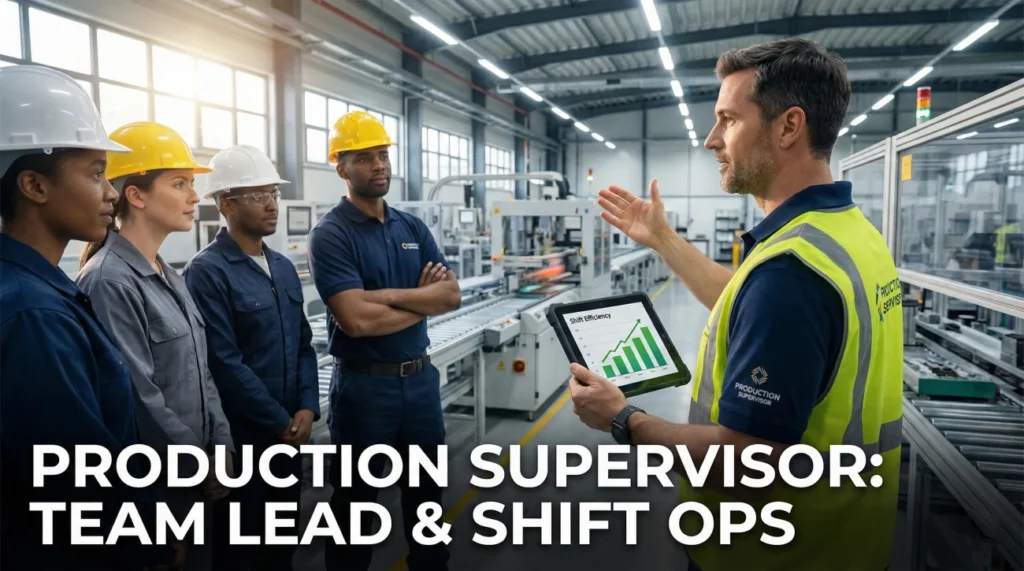
Schedules mean nothing until someone makes them happen. Production supervisor interview questions examine whether you can translate daily targets into completed work by leading frontline teams through each shift. You bridge the gap between management planning and operator execution, handling the human challenges that spreadsheets never capture.
Production supervisors own the shop floor. You assign work, monitor progress, address problems as they arise, coach underperformers, and keep things moving when machines break or people call in sick. Unlike managers who plan across days and weeks, you operate hour by hour, making dozens of decisions that collectively determine whether the shift succeeds.
Interviewers will probe your approach to team leadership, work assignment and monitoring, handling performance issues, maintaining discipline, and responding to the surprises every shift brings.
Team Leadership
Q: Describe your leadership style with production teams.
I lead from the floor, not from an office. I know every operator’s strengths and development areas. I set clear expectations and follow up consistently. I give credit publicly and address problems privately. I work alongside the team when needed while maintaining perspective to see the whole shift.
I adapt my approach to individuals. Some operators need detailed guidance; others perform best with autonomy and occasional check-ins. New employees get more hands-on support until they establish capability. The goal is production results through people development, not just task completion.
Q: How do you motivate operators who do repetitive work?
I help them see how their work matters. Every part they produce goes into something a customer uses. Quality matters because defects affect real people. Efficiency matters because it keeps us competitive and their jobs secure. Connection to purpose helps when the task itself feels monotonous.
I provide variety where possible: cross-training, rotation between stations, involvement in improvement projects. I recognize good performance specifically and promptly. I create team identity and healthy competition between shifts. I address frustrations before they become cynicism. Engagement is not automatic; supervisors build or destroy it daily.
Q: How do you handle conflict between team members?
I address it quickly before it affects production or spreads. I talk to each person separately first, understanding their perspective without taking sides. I identify whether the conflict is personal, work-related, or based on misunderstanding. Most conflicts stem from communication gaps or perceived unfairness.
I bring parties together when appropriate, facilitating discussion focused on work needs rather than personalities. I clarify expectations and boundaries. I follow up to ensure resolution holds. If conflict persists despite intervention, I escalate or separate the individuals. The team cannot function with ongoing warfare.
Q: How do you develop operators’ skills?
I identify each person’s current capability and growth potential. I create opportunities for learning: assigning stretch tasks, pairing less experienced operators with strong performers, explaining the why behind procedures. I give coaching feedback in real-time when I observe performance.
I track skills systematically so I know who can do what. I push for training resources and time from management. I recognize skill advancement publicly. Developing people serves both them and the operation; skilled operators are more productive, more engaged, and provide flexibility when absences occur.
Shift Operations
Q: How do you start a shift effectively?
I arrive early to assess conditions: review handover notes, check equipment status, verify material availability, and understand the day’s priorities. I cannot lead effectively if I discover problems after the shift starts. Preparation prevents chaos.
I conduct a brief team meeting covering safety reminders, production targets, quality focus areas, and any special circumstances. I assign work clearly, confirming each person understands their responsibilities. I walk the floor to verify everyone is positioned and starting. The first hour sets the tone for the entire shift.
Q: How do you allocate work across your team?
I match tasks to capabilities while balancing development opportunities. Critical operations go to proven operators. Newer team members get appropriate challenges with oversight. I consider physical demands, monotony relief, and interpersonal dynamics when making assignments.
I maintain flexibility through cross-training. I rotate assignments to build broader skills and prevent boredom. I track who has been assigned difficult or undesirable tasks to ensure fairness over time. Work allocation that seems random or unfair destroys team trust.
Q: How do you monitor shift progress?
I use visual production boards updated hourly showing planned versus actual output. I walk the floor continuously, observing work pace, equipment behavior, and operator engagement. I check quality at intervals rather than waiting for end-of-shift inspection. Multiple information sources give accurate pictures.
I intervene early when I see problems developing: pace slowing, quality drifting, equipment struggling. Small problems addressed immediately stay small. I document significant issues for shift handover. My manager should never be surprised by shift results if I am doing my job.
Q: Describe how you handle shift handover.
Effective handover ensures continuity across shifts. I document shift results: production numbers, quality issues, equipment problems, personnel matters, and anything incomplete. I write what the incoming supervisor needs to know, not just what happened.
I conduct face-to-face handover with the incoming supervisor, walking through issues verbally and answering questions. I point out anything requiring immediate attention. I stay briefly after handover if complex situations need explanation. Poor handover creates repeated problems shift after shift.
Shop Floor Discipline
How do you address an operator who is not meeting production standards?
I first verify the gap exists and understand why. Is it skill, will, or circumstances? I observe directly rather than relying solely on numbers. If the operator is struggling with capability, I provide additional training or coaching. If materials or equipment are the issue, I address those barriers.
If the gap is effort or attitude, I have a direct conversation explaining expectations, current performance, and required improvement. I document the discussion. I follow up consistently, recognizing improvement and addressing continued shortfall. Progressive discipline applies when coaching fails, but I give people genuine opportunity to succeed first.
How do you enforce safety rules when operators resist?
Safety rules are non-negotiable. I explain the reason behind each requirement, helping operators understand these protect them, not just satisfy regulations. People follow rules they understand and believe in more readily than rules imposed without explanation.
When resistance continues despite explanation, I enforce consistently. I cannot allow PPE violations or procedure shortcuts regardless of production pressure. I document violations and apply consequences per policy. I also listen for legitimate concerns about whether rules are practical; sometimes procedures need improvement rather than just enforcement.
How do you handle an operator who undermines team morale?
Negative attitudes spread quickly on the floor. I address the behavior specifically: complaining, refusing to help others, creating drama. I have a private conversation focusing on observed behavior and its impact, not personality judgments. I explain what acceptable behavior looks like.
I explore whether underlying issues drive the negativity: perceived unfairness, personal problems, legitimate grievances. Sometimes addressing real problems eliminates negative behavior. If attitude problems persist despite intervention, I escalate through progressive discipline. I cannot let one person poison the team while hoping they improve.
Problem Response
Q: An operator calls in sick and you are already short-staffed. What do you do?
I assess the impact: which positions are affected and which are most critical. I check whether any operators can extend shifts or come in early. I contact standby or floater personnel if available. I redistribute work among present operators, prioritizing essential operations.
I communicate with production management about reduced capacity and potential impact on targets. I adjust expectations rather than pushing existing staff into unsafe overtime. I document the situation for future staffing discussions. Short-staffing happens; planning for it reduces the damage.
Q: A machine breaks down mid-shift. How do you respond?
I ensure the equipment is safely stopped and the area secured. I contact maintenance immediately with symptom description. I assess which operations are affected and for how long we can tolerate downtime. I reassign affected operators to other productive work if available.
I communicate with production management about impact on shift targets. I stay informed on repair progress and estimated completion. I prepare to restart production quickly when equipment returns. After the shift, I participate in understanding root cause to prevent recurrence. Equipment failures are inevitable; response determines impact.
Q: You discover a quality problem partway through a production run. What do you do?
I stop production on that line immediately. I segregate suspect product from good product. I assess scope: how far back might the problem extend? I notify quality personnel and production management. Containment comes first; investigation follows.
I work with quality to determine root cause and whether production can safely resume. I ensure any rework or scrap is handled correctly. I document everything for traceability. I participate in corrective action development. Finding problems early limits damage; hiding or ignoring them creates customer escapes.
Production Supervisor Knowledge Quiz
20 Practice Questions
1. Production supervisors primarily manage:
- Weekly production schedules
- Shift operations and frontline operators
- Plant P&L
- Equipment maintenance
2. Arriving early before a shift allows supervisors to:
- Complete paperwork
- Assess conditions and prepare before operators arrive
- Avoid traffic
- Meet with management
3. When addressing underperformance, supervisors should first:
- Issue written warning
- Verify the gap exists and understand why
- Reassign the operator
- Report to HR
4. Cross-training operators provides:
- Higher labor costs only
- Flexibility for work allocation and absence coverage
- Confusion about responsibilities
- Reduced quality
5. Visual production boards should be updated:
- Daily at shift end
- Hourly or more frequently
- Weekly
- Only when problems occur
6. Shift handover should include:
- Production numbers only
- Results, issues, equipment status, and incomplete items
- Written report without discussion
- Whatever the supervisor remembers
7. When team members conflict, supervisors should:
- Let them work it out
- Address it quickly before it affects production
- Immediately separate them permanently
- Report to HR without intervening
8. Safety rules should be enforced:
- Only when observed by management
- Consistently regardless of production pressure
- After first injury
- Flexibly based on circumstances
9. Motivating operators doing repetitive work involves:
- Ignoring their boredom
- Connecting work to purpose and providing variety
- Increasing pay only
- Reducing expectations
10. When short-staffed, supervisors should:
- Push remaining staff into excessive overtime
- Redistribute work and communicate capacity impact
- Lower quality standards
- Cancel the shift
11. Work allocation should consider:
- Seniority only
- Capability, development opportunities, and fairness
- Random rotation
- Operator preferences only
12. Progressive discipline:
- Starts with termination for serious issues
- Gives opportunity to improve before escalating consequences
- Applies only to attendance
- Is HR responsibility only
13. When equipment fails mid-shift:
- Wait for maintenance to notice
- Secure the area, contact maintenance, reassign operators
- Let operators try to fix it
- Continue production if possible
14. Quality problems discovered during production require:
- Finishing the run before investigating
- Stopping production and segregating suspect product
- Hiding from quality department
- Waiting for shift end
15. Face-to-face shift handover:
- Is unnecessary with good documentation
- Allows questions and clarification
- Wastes time
- Is only for emergencies
16. Addressing negative attitudes requires:
- Ignoring until productivity drops
- Direct conversation about specific behaviors and impact
- Public confrontation
- Immediate termination
17. Operator skill development:
- Is training department responsibility only
- Includes stretch assignments and real-time coaching
- Happens automatically with time
- Is not supervisor responsibility
18. Floor walking by supervisors:
- Wastes time better spent in office
- Enables direct observation and early problem detection
- Intimidates operators
- Is only needed for new supervisors
19. Production supervisor differs from production manager by:
- Having less authority
- Managing shifts and operators rather than overall scheduling
- Working fewer hours
- Not attending meetings
20. Start-of-shift meetings should cover:
- Only production targets
- Safety, targets, quality focus, and special circumstances
- Previous shift complaints
- Management announcements only
❓ FAQ
👥 How many operators does a Production Supervisor typically manage?
Team size varies by industry and process complexity, but typically ranges from 10 to 30 operators. Highly automated facilities may have smaller teams. Labor-intensive operations or those with quality-sensitive work often have tighter spans of control. The key is whether the supervisor can effectively observe, coach, and support everyone on their team.
🔀 What is the difference between Production Supervisor and Shift Manager?
Titles vary by company, but shift managers often have broader scope covering entire facility operations during their shift, including coordination across departments. Production supervisors typically focus on specific production areas or lines. Shift managers may supervise multiple production supervisors. Both are frontline leadership roles.
🎓 What experience is needed to become a Production Supervisor?
Most production supervisors advance from operator or team lead roles with demonstrated reliability, technical skill, and leadership potential. Typical requirements include 2-5 years production experience and some leadership exposure. Education requirements vary; many employers value experience over degrees. Formal supervisory training often occurs after promotion.
⏰ What shifts do Production Supervisors work?
Production supervisors work the shifts they supervise: days, evenings, nights, or rotating schedules depending on facility operations. Continuous operations require supervisors on every shift. Supervisors typically work consistent schedules rather than rotating, allowing them to build stable relationships with their teams.
📈 What is the career path from Production Supervisor?
Advancement typically leads to production manager, area manager, or shift manager roles with broader scope. Some move into specialized functions like quality, safety, or continuous improvement. Strong supervisors who develop business acumen can progress to plant management over time. Lateral moves into other departments broaden experience for advancement.
Showing You Can Lead the Floor
Interviewers evaluating production supervisor interview questions want to see that you can handle the real-world complexity of leading frontline teams. Prepare stories about operators you developed, conflicts you resolved, problems you fixed on the spot, and shifts you pulled through despite challenges. Concrete examples prove capability better than management theory.
The production supervisor role tests whether you can earn respect from operators while maintaining accountability, adapt continuously as conditions change, and deliver results through others. Demonstrate that you thrive on the shop floor, that you build teams rather than just manage them, and that you treat every shift as a puzzle to solve. The best supervisors make frontline production look easy, but interviewers know how hard that actually is.
⚠️ Disclaimer: The interview strategies, sample answers, and negotiation tips provided in this guide are for educational purposes only. Hiring decisions are subjective and vary by company and industry. While these strategies are based on professional HR standards, they do not guarantee a specific job offer or result.