Delivering Output Day After Day
When the morning shift starts, you need to know exactly what gets built, who builds it, and what machines they use. Production manager interview questions test whether you can translate customer orders into executable schedules, hit daily targets consistently, and troubleshoot the inevitable disruptions that threaten every production plan.
Production managers live in the space between planning and execution. While plant managers own the P&L and strategic decisions, you own the daily and weekly rhythm that turns plans into shipped products. Your success shows up in schedule adherence, throughput rates, and the ability to absorb surprises without missing commitments.
Expect questions about production planning and scheduling, hitting output targets, staffing and resource coordination, and diagnosing production problems before they cascade into customer failures.
Production Planning & Scheduling
Q: Walk me through how you create a production schedule.
I start with demand: confirmed orders, forecasts, and safety stock requirements. I map this against capacity constraints, considering equipment availability, labor hours, and material supply. I sequence work to minimize changeovers while meeting delivery priorities. The goal is a schedule that is achievable, not just aspirational.
I use planning software to model scenarios and identify conflicts before they happen. I build in buffer for inevitable variability rather than assuming perfect execution. I review the schedule with supervisors before committing, incorporating their knowledge of current floor conditions. A schedule nobody believes in fails before it starts.
Q: How do you handle schedule disruptions?
Disruptions are not exceptions; they are daily reality. When equipment breaks or materials arrive late, I assess impact immediately: which orders are affected and how badly? I prioritize recovery based on customer commitment criticality, not just sequence order.
I have contingency options ready: overtime, shifting work between lines, expediting alternatives. I communicate changes quickly to affected parties, both internal and external. After stabilizing, I analyze what caused the disruption and whether systemic fixes can prevent recurrence. Firefighting is necessary; preventing fires is better.
Q: How do you balance schedule efficiency with flexibility?
Pure efficiency means long runs with minimal changeovers. Pure flexibility means small batches that respond to any demand change. Neither extreme works. I find the balance point appropriate for our business: what changeover time can we afford, what inventory can we hold, what lead time do customers accept?
I use tools like level loading to smooth demand variation and SMED to reduce changeover penalties. I designate some capacity as flex time for urgent orders. I freeze near-term schedules while keeping further-out periods adjustable. The right balance depends on market dynamics, and I revisit it as conditions change.
Q: What production planning systems have you used?
I have worked with ERP systems including SAP and Oracle for master scheduling and MRP. I have used dedicated APS (Advanced Planning and Scheduling) tools for detailed sequencing. I leverage Excel for ad-hoc analysis and scenario modeling when system tools are insufficient.
System proficiency matters, but the tool is not the skill. Understanding production math, constraint management, and trade-off logic matters more than which buttons to push. I have implemented planning system improvements by first understanding the underlying production logic, then configuring systems to support it.
Output Targets & Performance
Q: How do you ensure production targets are met consistently?
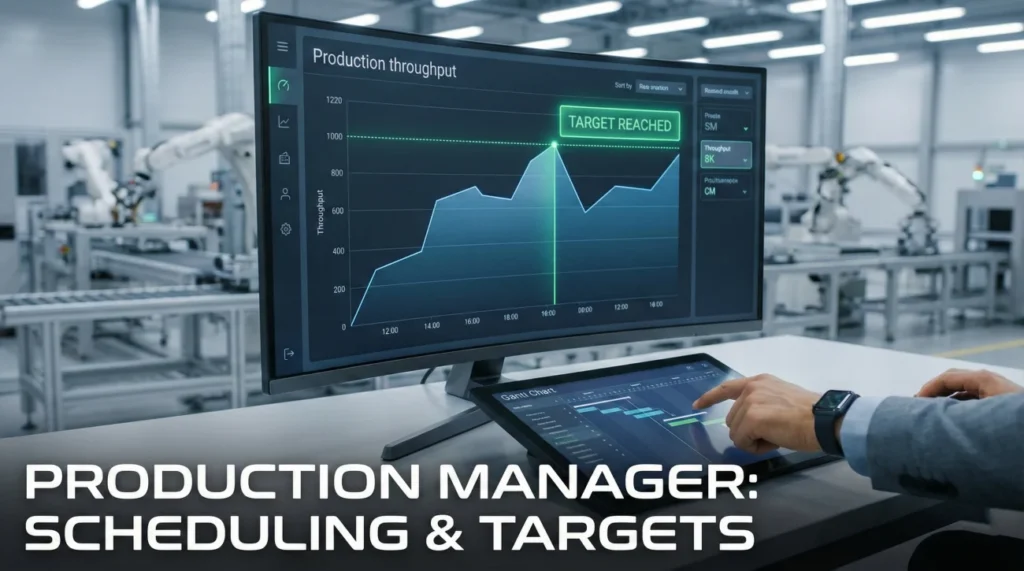
Consistent delivery starts with realistic targets. I establish production rates based on demonstrated capability, not wishful thinking. I break annual targets into monthly, weekly, and daily goals that connect shop floor actions to business results. Everyone knows what “winning today” looks like.
I monitor progress throughout shifts, not just at the end. Visual boards show real-time performance against plan. When we fall behind, I intervene immediately rather than hoping to catch up later. I analyze patterns in misses to address systemic issues. Consistency comes from disciplined execution of good plans, not heroic recovery from bad ones.
Q: What do you do when you are falling behind target?
First I diagnose why: equipment issues, material shortages, quality problems, or labor constraints each require different responses. I assess how far behind and whether the gap is closing or widening. I determine what recovery options exist and their costs: overtime, weekend shifts, temporary labor, outsourcing.
I communicate early with stakeholders about the situation and recovery plan. False optimism destroys credibility when misses occur anyway. I execute recovery actions while simultaneously addressing root causes. After recovery, I conduct retrospective analysis to prevent recurrence. The best response to falling behind is not needing to recover in the first place.
Q: How do you set challenging but achievable production goals?
I use historical data and process capability to establish baselines. I identify improvement opportunities and quantify their potential impact. I set targets that stretch performance but remain physically possible given resources and constraints. Impossible targets demoralize; easy targets underperform potential.
I involve supervisors and operators in target-setting discussions. They know what is achievable and what obstacles exist. I commit to removing barriers when I ask for higher performance. Targets work when people believe hitting them is possible and that someone is helping them succeed.
Staffing & Resource Coordination
How do you determine staffing levels for production?
I calculate labor requirements from production volume, cycle times, and efficiency factors. I account for non-productive time: breaks, meetings, changeovers. I add buffer for absenteeism based on historical patterns. This gives required hours, which I convert to headcount based on shift structure.
I validate calculations against actual results, adjusting when assumptions prove wrong. I maintain cross-trained workers who can flex between areas. I balance permanent staff with temporary or flexible arrangements to handle volume variation. Understaffing creates overtime costs and quality risks; overstaffing wastes labor dollars. Both hurt.
How do you coordinate with other departments?
Production cannot succeed in isolation. I coordinate daily with materials/supply chain on inventory status and incoming shipments. I sync with maintenance on equipment availability and planned downtime. I align with quality on inspection requirements and current issues. I communicate with shipping on outbound priorities.
I participate in cross-functional planning meetings to surface conflicts early. When departments have competing needs, I work to find solutions that satisfy overall business objectives. I build relationships that enable quick informal resolution of daily issues. Silos kill production performance.
How do you handle staffing challenges like absenteeism or turnover?
I track attendance patterns to anticipate problems. I maintain a pool of trained floaters who can cover absences. I have relationships with staffing agencies for rapid backfill when needed. I cross-train broadly so single-person dependencies are rare.
For turnover, I focus on retention through good supervision, fair treatment, and reasonable working conditions. I keep the hiring pipeline active rather than recruiting only when positions open. I onboard new hires systematically so they reach productivity quickly. Prevention is cheaper than reaction, but you need both capabilities.
Process Troubleshooting
Q: Describe your approach to diagnosing production problems.
I start with data: what exactly is happening, when did it start, what changed? I go to the floor to observe directly rather than relying solely on reports. I talk to operators who often have hypotheses about causes. I distinguish between symptoms and root causes.
I use structured problem-solving approaches: 5 Whys for simple issues, fishbone diagrams or 8D for complex ones. I test hypotheses systematically rather than trying random fixes. I document what we learn so knowledge accumulates. The goal is not just fixing this problem but building capability to prevent similar ones.
Q: Tell me about a difficult production issue you solved.
We experienced intermittent quality defects that appeared randomly across shifts and lines. Initial investigation found no pattern. I formed a cross-functional team including quality, maintenance, and operators. We collected detailed data on every defect occurrence, tracking variables we had not monitored before.
Analysis revealed correlation with a specific raw material lot that had passed incoming inspection but behaved differently in our process. We worked with the supplier to understand the variation source and adjusted our process parameters to accommodate it. The experience led to enhanced incoming inspection and tighter supplier specifications. What seemed random had a root cause; finding it required persistence and systematic analysis.
Q: How do you prevent problems from recurring?
I implement countermeasures that address root causes, not just symptoms. I update procedures and training when process knowledge was the gap. I modify equipment or tooling when physical conditions enabled the problem. I add controls or inspections when detection was inadequate.
I verify that fixes actually work by monitoring for recurrence. I share learnings broadly so similar problems are prevented elsewhere. I build problem-solving into daily work through tiered meetings and visual management. Organizations that learn from problems get stronger; organizations that just patch problems repeat them.
Production Management Knowledge Quiz
20 Practice Questions
1. MRP stands for:
- Master Resource Plan
- Material Requirements Planning
- Manufacturing Results Performance
- Monthly Review Process
2. Schedule freeze periods:
- Prevent all changes permanently
- Lock near-term schedules while allowing future adjustments
- Apply only to maintenance
- Are unnecessary with good planning
3. Level loading helps by:
- Maximizing equipment utilization
- Smoothing demand variation across time
- Reducing workforce size
- Eliminating changeovers
4. When falling behind target, the first step is:
- Authorize overtime immediately
- Diagnose why the gap exists
- Inform customers of delays
- Adjust the target
5. Cross-training provides:
- Higher labor costs
- Flexibility to cover absences and balance workload
- Reduced quality
- Longer training time only
6. APS stands for:
- Automatic Production System
- Advanced Planning and Scheduling
- Assembly Process Standard
- Annual Production Schedule
7. Production targets should be based on:
- Maximum theoretical capacity
- Demonstrated capability with stretch improvement
- Last year plus 10%
- Sales forecasts only
8. Real-time production monitoring enables:
- End-of-shift reporting only
- Immediate intervention when falling behind
- Reduced supervision needs
- Automated scheduling
9. Buffer capacity is used for:
- Routine production
- Absorbing variability and urgent orders
- Training new operators
- Maintenance windows
10. 5 Whys analysis:
- Asks exactly five questions
- Digs to root cause by repeatedly asking why
- Is only for safety issues
- Requires special software
11. Changeover time reduction:
- Matters only for high-volume production
- Enables smaller batches and more flexibility
- Increases quality problems
- Is a maintenance responsibility
12. Coordination with maintenance should:
- Happen only when equipment fails
- Include planned downtime scheduling
- Be handled by plant manager only
- Minimize maintenance to maximize output
13. Staffing buffer for absenteeism:
- Is unnecessary with good attendance policies
- Should be based on historical patterns
- Creates overstaffing waste
- Applies only to direct labor
14. Production problem diagnosis should:
- Rely on operator opinions only
- Combine data analysis with floor observation
- Wait until problems recur
- Be delegated to quality department
15. Schedule adherence measures:
- Total output only
- Whether planned work was completed as scheduled
- Equipment availability
- Labor efficiency
16. Early communication about production issues:
- Shows weakness
- Builds credibility and enables stakeholder response
- Should wait until recovery is certain
- Is only for major problems
17. Visual production boards should show:
- End-of-month results
- Real-time performance against plan
- Company announcements
- Safety procedures only
18. Root cause countermeasures:
- Are temporary fixes
- Address underlying causes to prevent recurrence
- Focus on operator retraining only
- Are optional if symptoms stop
19. Involving supervisors in target-setting:
- Weakens management authority
- Improves realism and commitment
- Is only for annual planning
- Creates lower targets
20. The production manager differs from plant manager by:
- Having more authority
- Focusing on daily execution rather than P&L ownership
- Working only day shift
- Not attending management meetings
❓ FAQ
📋 What is the typical scope of a Production Manager role?
Production managers typically own daily and weekly scheduling, output target achievement, direct supervision of production supervisors, troubleshooting production issues, and staffing coordination. They usually report to plant managers or operations directors and focus on execution rather than P&L or strategic decisions.
🔄 How does this role differ from Production Supervisor?
Production supervisors manage specific shifts or areas, directly supervising operators. Production managers oversee multiple supervisors, own the overall production schedule, and handle cross-shift coordination. Supervisors execute plans; production managers create them. The scope is broader with more planning responsibility.
📈 What career progression exists from Production Manager?
Common paths include plant manager, operations manager, or manufacturing director roles with broader scope. Some specialize in supply chain, continuous improvement, or engineering leadership. Demonstrating P&L understanding and cross-functional leadership accelerates advancement to plant-level roles.
💻 What software skills matter for Production Managers?
ERP systems (SAP, Oracle, Microsoft Dynamics) for scheduling and inventory. MES (Manufacturing Execution Systems) for shop floor tracking. Excel for analysis and ad-hoc planning. Increasingly, familiarity with data visualization tools and basic analytics adds value. System skills complement but do not replace production knowledge.
⏰ What are typical working hours for Production Managers?
Production managers typically work regular business hours but must be available for issues across shifts. Many start early to overlap with morning shifts. Weekend or evening presence may be needed during critical periods. The role requires flexibility, but 24/7 presence is not expected like it might be for shift managers.
Demonstrating You Can Deliver
Success with production manager interview questions hinges on proving you can turn plans into products. Come prepared with specific examples: schedules you created that worked, targets you achieved, disruptions you managed, and problems you solved. Numbers matter. Quantify your impact on schedule adherence, output rates, and recovery times.
Show that you understand the daily rhythm of production management. Interviewers want to see that you can start each day with a clear plan, adapt when reality differs, coordinate across functions, and end each day knowing whether you won or lost. The production manager who delivers consistently makes everything downstream possible. Make clear that you are that person.
⚠️ Disclaimer: The interview strategies, sample answers, and negotiation tips provided in this guide are for educational purposes only. Hiring decisions are subjective and vary by company and industry. While these strategies are based on professional HR standards, they do not guarantee a specific job offer or result.