Running the Whole Show
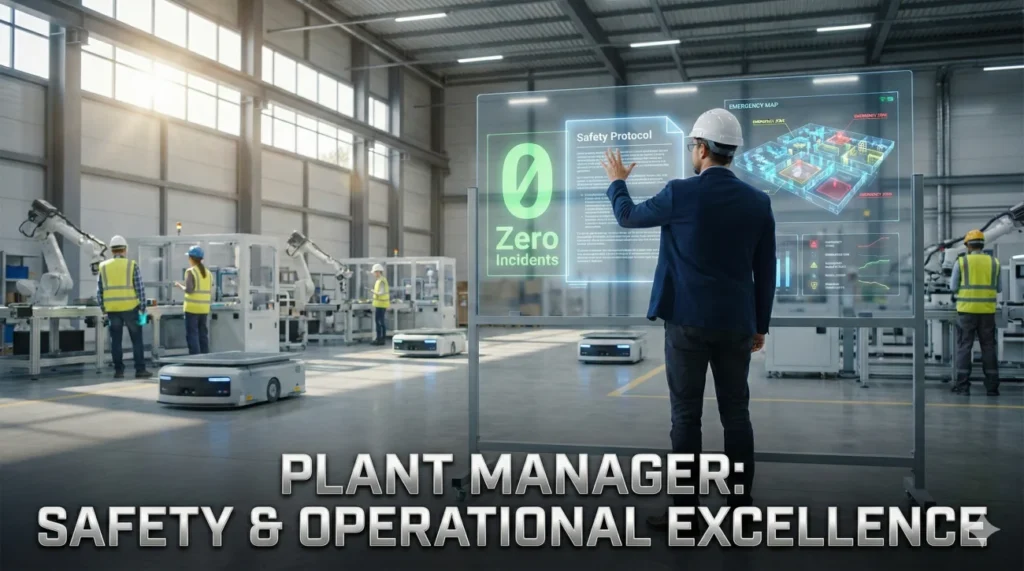
The plant manager owns everything inside those walls. Safety incidents, production shortfalls, quality escapes, cost overruns, regulatory citations: they all land on your desk. Plant manager interview questions probe whether you can handle this weight while keeping hundreds of employees productive, safe, and engaged.
Unlike production managers who focus on daily scheduling or supervisors who manage shifts, plant managers own the facility P&L. You answer for profitability while balancing competing demands: pushing output without sacrificing safety, cutting costs without compromising quality, meeting deadlines without burning out your workforce. Interviewers need evidence you have done this before.
This guide covers safety leadership and compliance, production optimization and output management, quality systems, financial accountability and cost control, plus stakeholder communication and crisis management.
Safety Leadership & Compliance
Q: How do you build a safety culture rather than just enforce safety rules?
Rules alone create compliance; culture creates ownership. I start by demonstrating visible commitment: participating in safety walks, stopping production for hazards, and treating near-misses as seriously as injuries. When leadership shows safety matters more than schedule, the message cascades.
I implement systems that encourage reporting without blame. Near-miss programs, peer observations, and safety suggestion rewards bring hazards to the surface before injuries occur. I involve frontline workers in hazard identification and solution development. People follow rules they helped create. Over time, safety becomes how we work rather than something imposed on work.
Q: Describe your experience with OSHA compliance and regulatory audits.
I maintain continuous compliance rather than scrambling before inspections. I conduct internal audits using OSHA standards, identify gaps, and address them proactively. I ensure required training is current, documentation is accessible, and physical conditions meet standards. When regulators visit, we are ready because we operate that way daily.
During actual inspections, I accompany inspectors personally, answer questions honestly, and take notes for follow-up. If citations occur, I address them promptly and implement systemic corrections to prevent recurrence. I view regulatory relationships as partnerships; inspectors often provide valuable perspective on emerging issues or best practices.
Q: How do you respond when a serious safety incident occurs?
Immediate response prioritizes injured workers and secures the scene. I ensure medical care is provided, notify appropriate parties, and preserve evidence for investigation. I communicate with the workforce promptly, acknowledging what happened without speculation about causes.
Investigation focuses on systemic factors, not individual blame. Using methodologies like 5 Whys or root cause analysis, I identify what failed in our systems that allowed the incident. I implement corrective actions addressing root causes, verify effectiveness, and share learnings broadly. Every incident teaches something; the question is whether we learn before the next one occurs.
Production Output & Optimization
Q: How do you approach improving OEE (Overall Equipment Effectiveness)?
I start with loss analysis, quantifying availability losses (downtime), performance losses (speed), and quality losses (defects). This reveals where the biggest opportunities exist. Attacking the top loss categories delivers the fastest improvement.
For availability, I implement TPM fundamentals and SMED to reduce changeover time. For performance, I address speed losses through standardization and bottleneck management. For quality, I strengthen process controls at root cause. I track OEE daily at the line level, running weekly problem-solving sessions on chronic losses, targeting incremental gains that compound over time.
Q: How do you balance pushing output with maintaining quality and safety?
I reject the premise that these conflict. Sustainable output comes from reliable processes, and reliable processes inherently produce quality safely. When we chase volume by cutting corners, the resulting rework, scrap, and incidents actually reduce net output.
I establish non-negotiables: safety stops production, quality gates cannot be bypassed, and overtime has limits. Within these constraints, I drive efficiency through waste elimination, flow optimization, and capability building. Teams that feel protected from impossible trade-offs ultimately outperform teams that cut corners.
Q: Describe how you handled a significant production shortfall.
We faced a 30% capacity reduction when key equipment failed during peak season. I immediately assessed customer commitments, identifying which orders were most critical and communicating honestly with affected customers about revised timelines.
I coordinated emergency repair while implementing workarounds: overtime on remaining lines, outsourcing selected operations, and prioritizing highest-value orders. I established daily war-room meetings to track progress and adjust tactics. We recovered within three weeks, retained key customers through transparent communication, and subsequently invested in redundancy to prevent recurrence.
Q: How do you establish and monitor production KPIs?
I select KPIs that align with business strategy and are actionable at the floor level. Core metrics include safety (incident rate, near-misses), quality (FPY, DPPM, escapes), delivery (OTIF, schedule adherence), and productivity (OEE, labor efficiency). Too many metrics dilute focus; I keep the primary dashboard tight.
I implement tiered meetings: daily huddles reviewing yesterday’s performance and today’s priorities, weekly reviews analyzing trends and countermeasures, monthly deep-dives on systemic issues. Visual management makes performance visible to everyone. When metrics move, people should already know why before I ask.
Quality Systems & Cost Control
What is your approach to building a quality management system?
I layer quality in stages appropriate to the operation’s maturity. Foundation elements come first: document control, traceability, and inspection at critical control points. These prevent escapes and establish baseline discipline. I tie controls to CTQs (critical to quality) characteristics rather than inspecting everything equally.
As the system matures, I add process capability analysis, statistical process control, and supplier quality management. I implement CAPA processes that actually solve problems rather than just documenting them. For certified environments, I ensure ISO or industry-specific standards are embedded in daily operations, not parallel paper systems.
How do you manage the plant budget and control costs?
I own the P&L completely, understanding every line item and the drivers behind it. I build budgets bottom-up from operational realities, not top-down from financial targets. This creates budgets people believe in and can execute against.
I track actual versus budget weekly, investigating variances before they compound. I distinguish between efficiency variances (our execution) and volume variances (demand changes). I prioritize cost reduction opportunities by impact and implementation difficulty, focusing on sustainable improvements rather than one-time cuts that create future problems.
How have you achieved significant cost reductions while maintaining performance?
I led a cost transformation that reduced manufacturing cost per unit by 18% over two years. The approach combined multiple levers: yield improvements that reduced material waste, OEE gains that increased throughput on existing equipment, supplier negotiations that lowered input costs, and energy management that cut utility expense.
Critically, I maintained quality and safety performance throughout. Cost reduction that damages customer relationships or employee wellbeing is not sustainable. I involved teams in identifying opportunities, which generated better ideas and stronger commitment to execution. The savings funded investments in automation that drove further improvement.
Stakeholder Management & Leadership
Q: How do you communicate plant performance to senior leadership?
I provide regular, structured updates that distinguish signal from noise. Weekly summaries cover key metrics with brief explanations of variances. Monthly reviews analyze trends and progress on improvement initiatives. I present risks proactively with mitigation plans, not surprises requiring rescue.
I adjust communication to audience needs. Executives want business impact and strategic implications; operational leadership wants tactical details and resource needs. I use visual dashboards that make performance immediately comprehensible and support discussion with relevant data. When presenting problems, I always bring options with recommendations.
Q: How do you build and develop your leadership team?
I hire for capability and values, then invest heavily in development. I establish clear expectations for each role and provide regular feedback on performance. I delegate real authority so leaders grow through ownership, not just task execution. I protect my team from organizational noise so they can focus on operational excellence.
I identify high-potential individuals and create development opportunities: stretch assignments, cross-functional projects, external training. I succession-plan every key role, including my own. Strong leadership teams do not happen accidentally; they result from intentional building over time.
Q: Describe managing through a major crisis or disruption.
During a supply chain crisis, we faced potential shutdown due to material shortages. I established a crisis response structure: daily situation assessment, rapid decision-making authority, and clear communication protocols. I personally engaged with critical suppliers and alternative sources.
I was transparent with employees about the situation and what we were doing. I made difficult decisions quickly, including temporary production adjustments and selective overtime, while protecting employment. We emerged with stronger supplier relationships and improved risk management processes. Crisis reveals leadership character; people remember how you behaved when things were hardest.
Plant Management Knowledge Quiz
20 Practice Questions
1. OEE measures:
- Production volume only
- Availability, performance, and quality combined
- Labor efficiency
- Equipment age
2. A safety culture differs from safety compliance because:
- It requires less management involvement
- It creates ownership rather than rule-following
- It eliminates need for procedures
- It costs less to implement
3. SMED is used to:
- Improve quality inspection
- Reduce changeover time
- Train new employees
- Schedule maintenance
4. Near-miss reporting helps by:
- Documenting injuries
- Identifying hazards before injuries occur
- Reducing paperwork
- Satisfying OSHA requirements only
5. TPM stands for:
- Temporary Production Measures
- Total Productive Maintenance
- Team Performance Management
- Technical Process Manual
6. P&L accountability means the plant manager:
- Reviews financial reports
- Owns profitability of the facility
- Approves purchases only
- Reports to finance
7. CTQ stands for:
- Continuous Training Quality
- Critical to Quality
- Cost Time Quantity
- Customer Technical Query
8. Incident investigation should focus on:
- Individual blame assignment
- Systemic factors and root causes
- Regulatory documentation only
- Insurance claims
9. FPY measures:
- Final product yield
- First pass yield (right first time)
- Full production year
- Forecasted production yield
10. Tiered meeting structure includes:
- Monthly meetings only
- Daily, weekly, and monthly reviews at different levels
- Annual planning sessions
- Ad-hoc problem discussions
11. OTIF stands for:
- Overall Time in Factory
- On Time In Full
- Operations Technical Improvement Framework
- Output Target Improvement Focus
12. Visual management helps by:
- Decorating the facility
- Making performance visible to everyone
- Replacing verbal communication
- Impressing visitors
13. When regulatory auditors visit, plant managers should:
- Minimize access and information
- Accompany them personally and answer honestly
- Delegate to subordinates
- Focus on documentation only
14. Budget variance analysis distinguishes:
- Good versus bad results only
- Efficiency variances from volume variances
- Capital from operating expenses
- Fixed from variable costs only
15. CAPA stands for:
- Customer Acceptance Process Audit
- Corrective and Preventive Action
- Capability Assessment Program Analysis
- Cost Allocation and Planning Activity
16. Succession planning should cover:
- The plant manager role only
- Every key role including the plant manager
- HR responsibility only
- Retirement-eligible employees
17. Crisis communication should be:
- Delayed until facts are certain
- Prompt and transparent with appropriate caution
- Minimized to avoid panic
- Handled by corporate only
18. DPPM stands for:
- Daily Production Performance Measure
- Defects Per Parts Million
- Direct Personnel Per Machine
- Delivery Performance Per Month
19. Leadership team development includes:
- Hiring only
- Delegation, feedback, and stretch assignments
- Annual reviews only
- External recruitment preference
20. Sustainable cost reduction:
- Prioritizes one-time savings
- Maintains quality and safety while improving efficiency
- Focuses on headcount reduction
- Cuts training budgets first
❓ FAQ
🏭 What distinguishes a Plant Manager from a Production Manager?
Plant managers own the entire facility including P&L responsibility, all departments (production, quality, maintenance, safety, HR), and external stakeholder relationships. Production managers focus on daily/weekly scheduling and output targets within production operations. Plant managers are accountable for profitability; production managers for execution.
📊 What metrics matter most for plant manager performance?
Core metrics span safety (TRIR, near-miss rate), quality (FPY, customer complaints, DPPM), delivery (OTIF, schedule adherence), cost (cost per unit, margin), and people (turnover, engagement). The specific weighting depends on business strategy and current challenges. Balanced scorecards prevent optimizing one dimension at the expense of others.
💰 How much P&L authority do plant managers typically have?
Authority varies by organization. Many plant managers control operating budgets including labor, materials, maintenance, and utilities. Capital expenditure typically requires corporate approval above certain thresholds. Strategic decisions like major product changes or facility investments involve corporate leadership. Day-to-day operational spending usually has significant autonomy.
🎓 What backgrounds lead to plant manager roles?
Common paths include progression through production management, operations management, or engineering leadership. Technical degrees (engineering, manufacturing) combined with MBA or business experience are typical. Industry-specific experience matters significantly. Most plant managers have 15+ years experience with progressive leadership responsibility.
⚠️ What are the biggest challenges plant managers face?
Balancing competing priorities (output vs. safety vs. cost) is constant. Talent acquisition and retention in competitive labor markets creates ongoing pressure. Supply chain volatility requires adaptive planning. Regulatory compliance adds complexity. Managing upward to corporate while protecting teams from unrealistic demands requires diplomatic skill.
Making Your Case for the Top Job
Answering plant manager interview questions effectively requires more than management theory. You need concrete examples of facilities you have run, problems you have solved, and results you have delivered. Prepare specific stories about safety improvements you led, production challenges you overcame, cost reductions you achieved, and crises you navigated.
Interviewers hire plant managers who can own outcomes completely. Demonstrate that you understand the full scope of facility leadership: the P&L, the people, the processes, the compliance obligations, and the stakeholder relationships. Show that you have done it before and are ready to do it again. The plant manager job is not for everyone, but if you have run a facility successfully, these questions give you the platform to prove it.
⚠️ Disclaimer: The interview strategies, sample answers, and negotiation tips provided in this guide are for educational purposes only. Hiring decisions are subjective and vary by company and industry. While these strategies are based on professional HR standards, they do not guarantee a specific job offer or result.