What Bank Teller Interviews Care About Most
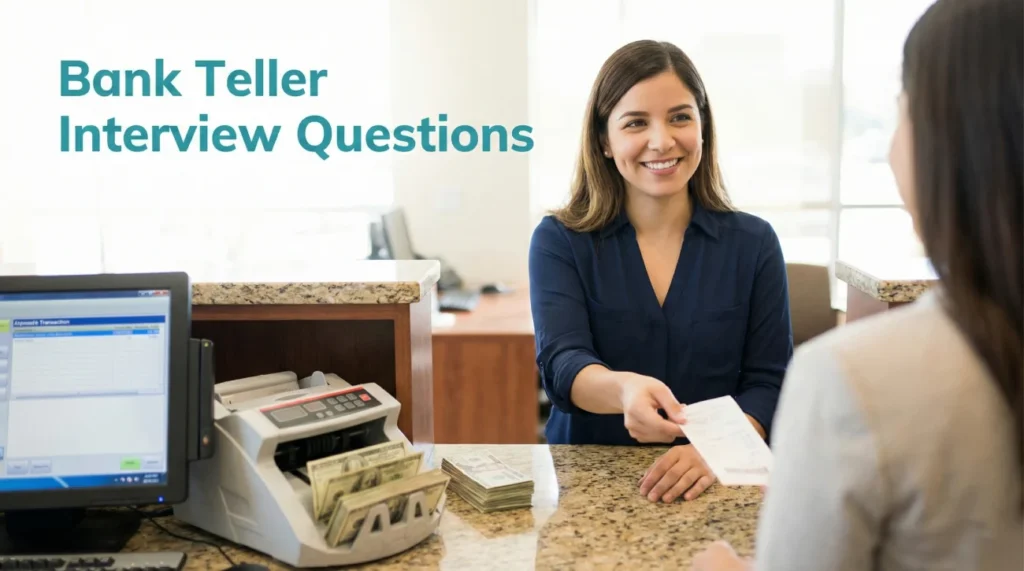
Bank teller interview questions are built around trust. A teller handles cash, protects customers, and represents the bank in short interactions that still need to feel professional and human.
Expect cash handling scenarios, fraud and ID checks, and customer service under pressure. Your goal is to show steady habits: verify, document, stay polite, and escalate the right issues quickly.
Cash Handling & Operations
Q: How do you ensure you balance your drawer at the end of the day?
I focus on “one transaction at a time.” I never keep multiple drawers or piles of cash open simultaneously. I follow a consistent count-and-verify routine, counting carefully when I take cash from the drawer, when I pay it out, and again to confirm the transaction matches the receipt. If a variance occurs at the end of the shift, I systematically re-count my cash and audit my transaction journal to find the error immediately.
Q: What would you do if you spotted a counterfeit bill?
I would follow the bank’s specific security protocol calmly. I would not accuse the customer of a crime, as they may be unaware. I would verify the bill using the bank’s approved counterfeit-detection tools and procedures. If confirmed fake, I would confiscate the bill, explain that I cannot return it per federal regulations, and notify my manager so the bank can file the required report with the appropriate authority.
Q: A customer wants to withdraw a large amount of cash. What do you do?
First, I verify the customer’s identity thoroughly. Then, I check if the drawer has sufficient limits or if I need manager approval. I also look for signs of “elder abuse” or coercion (e.g., is someone standing over them?). If the amount exceeds the applicable cash reporting threshold, I respectfully inform them about any required reporting (such as a Currency Transaction Report) to ensure regulatory compliance.
Q: How do you handle a busy lobby with a long line?
I acknowledge the customers in line with a smile or a nod to let them know they are seen. I work efficiently but do not rush the current transaction, as speed causes errors. If available, I might direct simple transactions to the ATM or mobile app if I see a customer who is comfortable with technology, helping to alleviate the queue for everyone else.
Sales & Referrals (Cross-Selling)
Q: How do you feel about selling products to customers?
I view cross-selling bank products as helping, not pushing. If I notice a customer paying high fees on wire transfers, suggesting a checking account with free wires saves them money. It is about spotting a need during a conversation and offering a solution that improves their financial life. If the product fits, the “sale” happens naturally.
Q: Give an example of a referral opportunity you might spot.
If a customer comes in with a large check from a home sale, I would congratulate them and refer them to a Personal Banker or Financial Advisor to discuss high-yield savings or investment options. Or, if a customer mentions they are planning a vacation, I might mention our credit card that offers no foreign transaction fees and travel rewards.
Q: A customer refuses your offer. How do you handle it?
I respect their decision immediately. I don’t want to be pushy and damage the relationship. I might say, “No problem at all, just wanted to make sure you knew it was an option.” I make a note in their profile (CRM) so we don’t ask them the same thing next week. Preserving trust is more important than a single referral credit.
Q: How do you encourage customers to use the mobile app?
I use the “show, don’t just tell” method. If a client is depositing a small check, I might say, “Did you know you can save a trip next time by snapping a picture of this?” I offer to walk them through the setup right there in the lobby. By empowering them to use digital tools for simple tasks, I free up teller time for more complex interactions.
Behavioral & Security Scenarios
A customer is shouting because you asked for ID. How do you de-escalate?
I stay calm and keep my voice low. I explain that the request is for their protection, not just a bank rule. I might say, “I recognize you, Mr. Smith, but our system requires me to scan an ID for this specific withdrawal amount to protect your account from fraud.” Handling angry banking customers effectively usually involves framing the “inconvenience” as a security benefit for them.
You suspect a co-worker is stealing from their drawer. What do you do?
I would not confront them directly, as that could compromise an investigation or create a hostile environment. I would report my specific observations confidentially to the Branch Manager or use the bank’s anonymous ethics hotline. Integrity is non-negotiable in banking, and ignoring theft makes me complicit.
Bank Teller Skills Quiz
Test Your Teller Knowledge
1. A “CTR” may be required for cash transactions over:
- Any amount, no matter how small
- A defined regulatory threshold
- Only non-cash transactions
- Only after a fraud report is filed
2. “Dual Control” means:
- One person doing two jobs
- Two employees are required to access sensitive areas (like the vault)
- Checking ID twice
- Working a double shift
3. If your drawer is “Out of Balance” (Short or Over), you should:
- Put your own money in to fix it
- Recount, check records, and report it to the manager immediately
- Hide it until tomorrow
- Take the extra money home
4. “Structuring” involves:
- Building a bank
- Breaking large deposits into smaller ones to evade reporting limits
- Organizing files
- Applying for a loan
5. “KYC” stands for:
- Keep Your Cash
- Know Your Customer
- Know Your Counterfeit
- Key Yield Calculation
6. A “Stop Payment” is used to:
- Prevent a specific check from being cashed
- Freeze an entire account
- Close the bank early
- Stop interest from accruing
7. “Cross-selling” is best described as:
- Forcing products on people
- Identifying customer needs and suggesting relevant services
- Selling products from other banks
- Selling across state lines
8. Which denominations are common targets for counterfeiters?
- $1
- Higher denominations like $20 and $100
- $2
- $1,000
9. “Regulation CC” governs:
- Credit Cards
- Funds Availability (hold times on deposits)
- Construction Codes
- Currency Counting
10. If a robber demands cash, you should:
- Fight back
- Comply fully to ensure safety, then activate alarm when safe
- Scream loudly
- Lock the drawer and run
11. A “Cashier’s Check” is guaranteed by:
- The customer’s word
- The bank’s own funds
- The government
- A credit card
12. “Overdraft Protection” helps customers avoid:
- Making deposits
- Declined transactions or non-sufficient funds (NSF) fees
- Paying taxes
- Using ATMs
13. Which is a sign of “Elder Financial Abuse”?
- A senior depositing a pension check
- A caregiver doing all the talking and demanding a withdrawal
- A senior asking for a balance inquiry
- A senior opening a savings account
14. “Bait Money” is:
- Money used to pay for lunch
- Recorded bills used to trace robbers
- Fake money for training
- Money used for fishing
15. “Endorsement” on a check refers to:
- The signature on the back authorizing the deposit
- A compliment from the teller
- The bank’s logo
- The routing number
16. “ChexSystems” is used to verify:
- Credit scores for mortgages
- A customer’s banking history (mishandled accounts)
- Employment history
- Criminal records
17. A “CD” (Certificate of Deposit) typically offers:
- Instant access to funds
- Higher interest rates in exchange for locking funds for a set term
- Unlimited check writing
- No interest
18. “Routing Number” identifies:
- The specific customer account
- The financial institution
- The check number
- The teller ID
19. If a customer leaves their debit card, you should:
- Use it
- Secure it immediately and contact the customer/follow procedure
- Throw it in the trash
- Give it to the next customer
20. “Relationship Banking” focuses on:
- One-time transactions
- Long-term customer loyalty and multiple product usage
- Dating coworkers
- Speed only
❓ FAQ
💵 What do interviewers want to hear about cash handling?
A consistent routine: count, verify, document, and never rush. Mention how you prevent errors before they happen.
🪪 How do I explain ID checks without upsetting customers?
Stay calm and respectful. Frame it as protecting the customer and the bank, then follow policy consistently.
🛡️ What should I say about fraud and counterfeit bills?
Talk about using approved tools, not accusing customers, and escalating to a supervisor. Safety and procedure matter.
⏱️ How do I handle long lines and pressure?
Acknowledge customers, work efficiently, and keep accuracy first. If appropriate, guide simple requests to self service tools.
✅ What is a strong final message for a teller interview?
Trust and consistency. Show you can be friendly, precise, and dependable every day.
How To Finish Teller Prep Strong
For bank teller interview questions, consistency is everything. Describe your routine for verifying identity, counting cash, and documenting exceptions. Hiring managers trust candidates who work the same way on calm days and chaotic days.
When you want more drills, use this bank teller practice questions hub and practice short, calm answers. Accuracy first, speed second.
⚠️ Disclaimer: The interview strategies, sample answers, and negotiation tips provided in this guide are for educational purposes only. Hiring decisions are subjective and vary by company and industry. While these strategies are based on professional HR standards, they do not guarantee a specific job offer or result.