What Compliance Officer Interviews Test
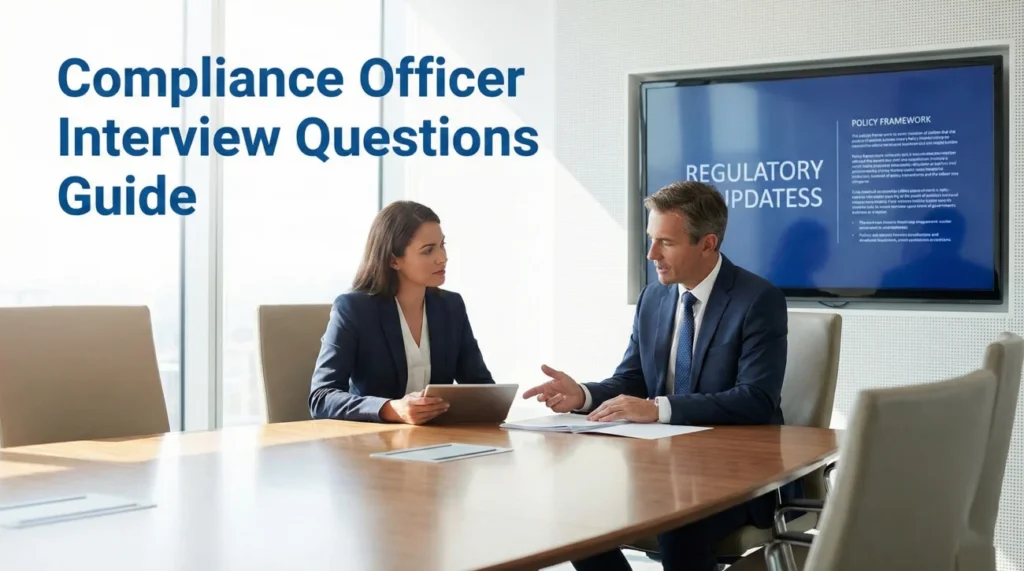
Compliance officer interview questions assess your ability to be the organization’s “moral compass” and regulatory shield. Today, the role goes beyond checking boxes; hiring managers want candidates who can interpret evolving requirements around beneficial ownership, monitoring, and reporting, then implement them without paralyzing the business. The core test is whether you can stand your ground on ethical issues while still being a business partner.
This guide covers the critical pillars of financial compliance: Anti-Money Laundering (AML) protocols, Know Your Customer (KYC) due diligence, managing regulatory examinations, and fostering a culture of compliance. You must demonstrate that you have the attention to detail to catch violations and the communication skills to train staff effectively.
AML, KYC & Regulatory Knowledge
Q: What are the three stages of money laundering?
The three stages are Placement, Layering, and Integration. Placement is introducing illicit cash into the financial system (e.g., breaking large deposits into small ones). Layering involves moving funds through complex transactions to distance them from the source. Integration re-enters the funds into the economy as legitimate assets (e.g., buying real estate). Understanding this cycle is fundamental to detecting suspicious activity.
Q: How has the Corporate Transparency Act changed KYC requirements?
In the U.S., beneficial ownership reporting requirements mean many entities must disclose who ultimately owns or controls them to the appropriate authority. As a compliance officer, this means our KYC process must go deeper than just verifying the legal entity; we must identify and verify the actual human beings who own or control a significant share of the company. This closes loopholes used by shell companies to hide illicit funds.
Q: What triggers a Suspicious Activity Report (SAR)?
A SAR is triggered by transactions that have no apparent lawful purpose, involve funds derived from illegal activity, or are designed to evade reporting requirements (structuring). Examples include a customer making multiple cash deposits just under a reporting threshold, or a sudden surge in wire transfers to high-risk jurisdictions. I ensure staff knows that “willful blindness” to these red flags is not a defense.
Q: Explain the role of the OFAC Sanctions List.
The Office of Foreign Assets Control (OFAC) publishes a list of individuals, entities, and countries that U.S. persons are prohibited from doing business with. My role is to ensure our screening software updates these lists frequently and that any potential match is frozen and investigated immediately. Processing a transaction for a sanctioned entity can result in severe penalties and reputational damage.
Compliance Program Management
Q: How do you prepare for a regulatory examination?
Preparation is a continuous process, not a one-time event. I maintain a “exam-ready” state by keeping all policy manuals updated, organizing meeting minutes, and ensuring all training logs are current. When an exam is announced, I designate a single point of contact to manage document requests. I brief senior management on potential focus areas and ensure we can demonstrate not just that we have policies, but that we follow them.
Q: How do you handle a situation where a top salesperson violates a compliance policy?
I apply the policy consistently, regardless of the employee’s rank or revenue generation. I investigate the violation to determine if it was a training gap or intentional misconduct. If intentional, I recommend disciplinary action in line with our matrix. Making exceptions for high performers creates a toxic culture and is a massive red flag for regulators; it shows that profit is prioritized over compliance.
Q: What is the difference between a “rule-based” and “risk-based” approach?
A rule-based approach is checking boxes: “Do we have ID?” A risk-based approach allocates resources where the risk is highest. For example, we might apply standard due diligence to a local bakery account but Enhanced Due Diligence (EDD) to an international import/export business. Regulators expect a risk-based approach because it is more effective at catching actual financial crime.
Q: How do you stay updated on changing regulations?
I subscribe to alerts from primary regulators (SEC, FINRA, FinCEN) and industry bodies like ACAMS. I also network with peer compliance officers to see how other firms are interpreting new rules. For example, regarding AI in fintech, I am currently following the emerging guidance on model risk management to ensure our automated monitoring tools are compliant.
Ethics & Conflict Resolution
The CEO wants to approve a high-risk client that you flagged. What do you do?
I request a meeting to present the specific risk data, not my opinion, but the facts (e.g., negative news, sanctions nexus, or unclear source of wealth). I explain the potential regulatory impact and fines. If the CEO insists on proceeding, I document my dissent formally in the file and ensure the decision is escalated to the Board’s Risk Committee if necessary. My job is to protect the institution, even from its own leadership.
How do you foster a “Culture of Compliance”?
I move compliance from being the “Department of No” to being a business partner. I involve business units in drafting policies so they understand the “why” behind the rules. I conduct training that uses real-world examples, not just boring slides. When employees see compliance as a tool to protect their own jobs and the company’s reputation, they become the first line of defense.
Compliance Knowledge Quiz
Test Your Regulatory IQ
1. “Placement” in money laundering refers to:
- Introducing illicit cash into the financial system
- Moving funds between accounts
- Buying luxury assets
- Hiring a new employee
2. “Structuring” (or Smurfing) is designed to:
- Organize office files
- Evade a cash reporting threshold
- Build a new bank branch
- Structure a loan
3. Which agency enforces economic and trade sanctions?
- IRS
- OFAC (Office of Foreign Assets Control)
- OSHA
- EPA
4. “KYC” stands for:
- Keep Your Cash
- Know Your Customer
- Know Your Compliance
- Keep Yielding Capital
5. A “SAR” must typically be filed:
- Only after an arrest
- Within the required regulatory timeframe after detection
- Only at year-end
- Only when the customer admits wrongdoing
6. “Beneficial Owner” is someone who:
- Benefits from a charity
- Owns or controls a significant share of a company
- Is a customer service manager
- Receives dividends only
7. “Willful Blindness” means:
- Being unable to see
- Deliberately ignoring obvious red flags to avoid liability
- Trusting your employees
- Working at night
8. The “USA PATRIOT Act” significantly strengthened:
- Tax laws
- AML and terrorist financing prevention laws
- Environmental protection
- Labor unions
9. “EDD” stands for:
- Early Deposit Deadline
- Enhanced Due Diligence
- Electronic Data Delivery
- End of Day Duty
10. A “PEP” (Politically Exposed Person) represents:
- Low risk
- Higher risk due to potential for corruption/bribery
- No risk
- A standard customer
11. “Whistleblower” protection ensures:
- Employees can play sports
- Employees can report violations without fear of retaliation
- Managers can fire anyone
- Salaries are kept secret
12. “Insider Trading” involves:
- Trading inside a building
- Trading securities based on material non-public information
- Trading with friends
- Day trading
13. The “Three Lines of Defense” model places Compliance in the:
- First Line (Business Units)
- Second Line (Risk Management/Compliance)
- Third Line (Internal Audit)
- Fourth Line (External Regulators)
14. A “CTR” (Currency Transaction Report) is filed for cash transactions over:
- Any amount, no matter how small
- Only for non-cash transactions
- A defined regulatory threshold
- Only after a SAR is filed
15. “FinCEN” is a bureau of:
- The FBI
- The U.S. Department of the Treasury
- The SEC
- The Federal Reserve
16. “Conflict of Interest” occurs when:
- Employees argue
- Personal interests interfere with professional duties
- Interest rates rise
- Two customers want the same product
17. “GDPR” regulates:
- Gun control
- Data privacy and protection (EU)
- Gas prices
- General production rates
18. “Sanctions Screening” should occur:
- Once a year
- Before onboarding and periodically/real-time for transactions
- Only for foreign customers
- Never
19. A “Shell Company” is often used for:
- Selling seashells
- Concealing true ownership and facilitating money laundering
- Protecting employees
- Public trading
20. “Risk Assessment” is the process of:
- Taking risks
- Identifying and evaluating potential compliance risks
- Ignoring risks
- Calculating profits
❓ FAQ
🕒 What certifications are best for this role?
The CAMS (Certified Anti-Money Laundering Specialist) is widely considered the gold standard. Other valuable certifications include the CRCM (Certified Regulatory Compliance Manager) for banking and the CFE (Certified Fraud Examiner) for investigations.
📜 How do I keep up with regulatory changes?
Successful officers dedicate time daily to reading updates from regulatory bodies (FinCEN, SEC, OCC) and subscribe to legal newsletters. Joining industry groups like ACAMS provides access to webinars and peer discussions on how to implement new rules practically.
💼 Is this role only in banking?
No. While banking is the largest sector, compliance officers are crucial in fintech, cryptocurrency, healthcare (HIPAA compliance), and multinational corporations (FCPA compliance). The skillset of risk management and rule interpretation is highly transferable.
⚖️ How stressful is the job?
It can be high-pressure, especially during regulatory exams or investigations. You carry the weight of protecting the company from fines and legal action. However, it offers excellent stability and high earning potential for those who can manage the responsibility.
🚀 What is the career path?
Entry-level roles include Compliance Analyst or KYC Analyst. You can progress to Compliance Manager, then Chief Compliance Officer (CCO). Some professionals also move into Risk Management, Legal Counsel (if they have a law degree), or Regulatory Consulting.
Final Thoughts
To succeed in answering compliance officer interview questions, you must show that you are principled yet practical. Hiring managers are afraid of hiring someone who is either too lax (risking fines) or too rigid (killing business). Demonstrate your ability to navigate the gray areas by prioritizing risk.
Highlight your problem-solving skills. Whether it is automating a screening process or investigating a complex shell company structure, show that you use tools and logic to protect the firm.
⚠️ Disclaimer: The interview strategies, sample answers, and negotiation tips provided in this guide are for educational purposes only. Hiring decisions are subjective and vary by company and industry. While these strategies are based on professional HR standards, they do not guarantee a specific job offer or result.