What Forensic Accountant Interviews Evaluate
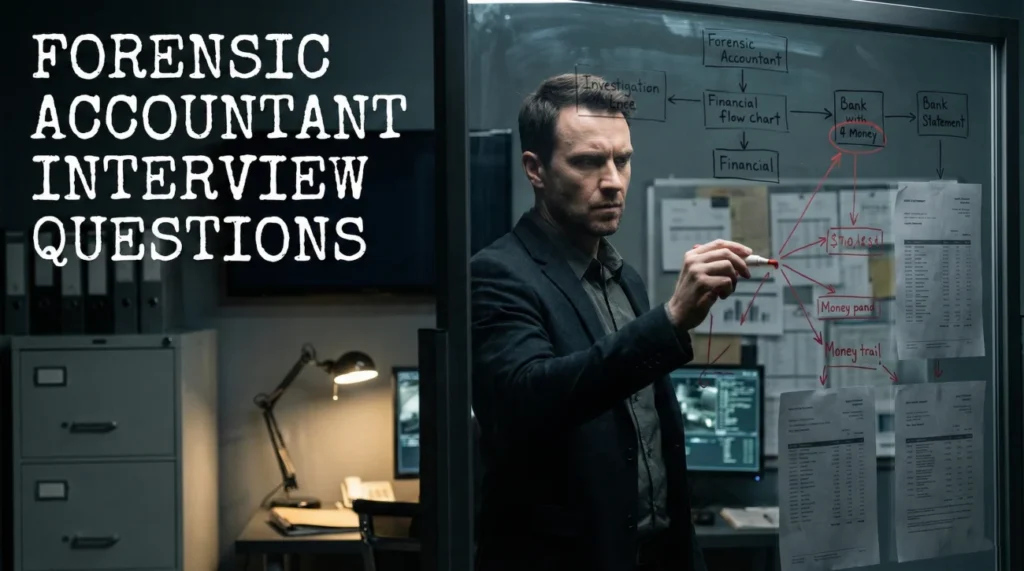
Forensic accountant interview questions assess your investigative skills, fraud detection expertise, evidence handling capabilities, and ability to support legal proceedings. Forensic accountants examine financial records to uncover fraudulent activities, trace funds, and present findings that can withstand legal scrutiny in civil and criminal cases.
This guide covers fraud detection and investigation, evidence handling and documentation, litigation support, and expert testimony. Demand for forensic accounting tends to rise when organizations face heightened fraud risk, tighter regulatory scrutiny, or complex disputes that require evidence-ready analysis. Compensation varies by industry, location, firm type, and seniority, and credentials can help signal specialized capability in investigations and courtroom-ready reporting.
Fraud Detection and Investigation
Q: How do you approach a suspected financial misconduct case?
My first step is understanding the allegations or red flags that triggered the investigation. I review preliminary documents such as financial statements, internal memos, whistleblower complaints, or audit findings to gauge the initial scope. Once I have a clear overview, I map out the individuals, transactions, and processes central to the inquiry and identify potential data sources including bank statements, invoice records, and email communications.
I establish a structured investigation plan prioritizing tasks based on risk level and potential organizational impact. I prioritize immediate threats first, especially those carrying substantial legal, financial, or reputational risks requiring urgent containment. This might involve halting ongoing illicit transactions or removing access from parties central to the fraud. I coordinate with legal counsel, IT security, and internal audit to ensure comprehensive coverage while maintaining confidentiality throughout.
Q: What distinguishes forensic accounting from traditional accounting?
Forensic accounting represents the convergence of financial acuity and investigative diligence. Unlike standard accounting, which focuses primarily on documenting, summarizing, and reporting financial data for compliance and recordkeeping, forensic accounting dives deeper into the evidentiary aspects of financial transactions. We seek to uncover the narrative behind the numbers.
This involves tracing anomalous entries, verifying their authenticity, and connecting findings to legal implications. Forensic accountants examine and interpret data not merely for compliance but to build cases that hold up under legal scrutiny. We might reconstruct records from fragmented sources, analyze suspicious trends, or interview individuals to detect potential fraud. While traditional accounting focuses on historical accuracy in financial statements, forensic accounting emphasizes investigatory depth, ensuring irregularities can be substantiated with robust evidence and clear accountability trails.
Q: Explain the Fraud Triangle and how you apply it.
The Fraud Triangle comprises three elements present when fraud occurs: pressure (or incentive), opportunity, and rationalization. Pressure refers to financial or personal circumstances motivating fraudulent behavior. Opportunity exists when internal controls are weak enough to allow fraud. Rationalization is the mental process allowing perpetrators to justify their actions.
I apply this framework during investigations to understand why fraud occurred and identify contributing factors. When assessing risk, I evaluate whether employees face unusual pressures, whether control gaps create opportunity, and whether organizational culture might enable rationalization. The Fraud Diamond adds a fourth element: capability, recognizing that perpetrators need the skills and position to execute fraud. Understanding these factors helps me identify potential fraudsters, design effective detection procedures, and recommend controls addressing root causes.
Q: How do you detect fraud when strong internal controls exist?
Fraud can occur even with strong controls because collusion allows perpetrators to circumvent segregated duties. For example, in procurement fraud, an internal manager and vendor can conspire to bypass purchase approval mechanisms. Management override is another common method where senior personnel abuse their authority to circumvent controls designed for lower-level employees.
I look for behavioral red flags alongside transactional analysis. Employees living beyond apparent means, reluctance to take vacation, or unusual vendor relationships warrant closer examination. I analyze patterns across transactions that might appear normal individually but reveal anomalies collectively. Data analytics helps identify statistical outliers, duplicate payments, and unusual timing patterns. I also assess whether control testing is robust or merely ceremonial. Strong controls prevent opportunistic fraud but require additional vigilance for organized schemes involving trusted insiders.
Evidence Handling and Documentation
Q: How do you handle and preserve evidence during investigations?
Evidence handling requires meticulous chain of custody documentation from collection through presentation. I document who collected each piece of evidence, when, where, and how it was secured. I use forensic imaging for electronic data to preserve original files while working with copies. Physical documents are secured in controlled environments with access logs.
I maintain detailed contemporaneous notes documenting my analysis process, findings, and conclusions. All working papers are organized systematically so others can follow my logic and verify results. I coordinate with IT security professionals for electronic evidence extraction, ensuring proper forensic protocols are followed. Evidence must remain unaltered and verifiable; any break in chain of custody can compromise its admissibility in legal proceedings. I apply the same rigor whether the matter is headed for litigation or internal resolution.
Q: What is ESI and why is it critical in investigations?
Electronically Stored Information includes emails, digital records, files, and metadata critical in modern financial investigations. ESI often provides the connections between conversations, decisions, and transactions that paper records alone cannot reveal. Email threads can demonstrate knowledge, intent, or coordination among parties.
Metadata reveals when documents were created, modified, and by whom, which can be crucial for establishing timelines and identifying document manipulation. I work with IT forensics specialists to extract, preserve, and analyze ESI properly. Improper handling can alter metadata or corrupt files, undermining evidentiary value. Search protocols must balance thoroughness with relevance to avoid overwhelming volumes of data. ESI has become central to most financial investigations because business communications increasingly occur electronically, leaving digital trails that can be recovered even when perpetrators attempt deletion.
Q: How do you trace funds through complex transactions?
Fund tracing requires reconstructing the flow of money from source to ultimate destination, often through multiple accounts, entities, and jurisdictions. I begin by mapping known accounts and transaction patterns, then identify transfers, conversions, and commingling that obscure the trail. Bank statements, wire records, and accounting entries provide the foundation.
I use visualization tools to diagram complex fund flows, making patterns visible that spreadsheet analysis might miss. I identify nominee accounts, shell companies, and structured transactions designed to avoid reporting thresholds. International transfers require understanding correspondent banking relationships and foreign regulations. Cryptocurrency transactions present unique tracing challenges requiring specialized blockchain analysis. Throughout, I document each step thoroughly so the trail can be presented clearly to legal counsel, regulators, or juries who may not have financial backgrounds.
Q: How do you conduct interviews during fraud investigations?
Investigative interviews progress through distinct phases: introductory questions establish rapport and baseline behavior, informational questions gather facts about processes and transactions, and closing questions address specific allegations or discrepancies. I prepare thoroughly by reviewing relevant documents and identifying key areas requiring clarification before each interview.
I structure interviews to build from general to specific, allowing subjects to provide their version of events before confronting inconsistencies. I observe verbal and non-verbal responses for indicators of deception or discomfort with particular topics. I coordinate with legal counsel regarding interview protocols, particularly for subjects who may become defendants. All interviews are documented contemporaneously, noting not just what was said but demeanor and reactions. Interview evidence can be powerful but requires careful handling to ensure statements are properly obtained and documented.
Litigation Support
How do you support legal teams in financial litigation?
I provide comprehensive support throughout litigation, from case assessment through trial. Initially, I help attorneys understand financial issues, quantify damages, and identify documentary evidence needed. I analyze opponent financial claims and identify weaknesses or inconsistencies. I prepare reports summarizing complex financial matters in terms accessible to judges and juries.
During discovery, I help identify relevant documents and data, draft interrogatories related to financial matters, and analyze opposing party responses. I work with legal teams to develop deposition questions for financial witnesses and may attend depositions to provide real-time analysis. For trial preparation, I create demonstrative exhibits that visualize complex financial transactions and prepare attorneys for cross-examination of opposing experts. I also help rebut opposition expert reports by identifying methodological flaws or unsupported conclusions.
How do you quantify damages in fraud cases?
Damage quantification requires identifying the financial impact of fraudulent conduct with sufficient precision to withstand legal challenge. I analyze actual losses sustained, including direct theft, additional costs incurred, and lost opportunities. I establish causation linking specific fraudulent acts to specific financial harm, which is essential for legal recovery.
I apply appropriate methodologies depending on the case type. For embezzlement, I trace misappropriated funds and reconstruct what should have been. For financial statement fraud, I calculate investor losses using event studies or similar techniques. I consider pre-judgment interest, consequential damages, and mitigation when applicable. All calculations are documented thoroughly with clear assumptions stated. I prepare to defend my methodology against opposing expert challenges, ensuring my approach aligns with accepted forensic accounting standards and legal requirements for the relevant jurisdiction.
What confidentiality considerations apply to forensic investigations?
Confidentiality is critical in forensic investigations because leaks can compromise the entire effort. Premature disclosure can alert suspects, allowing evidence destruction or asset concealment. It can also expose the organization to defamation claims if allegations prove unfounded. Forensic teams often use code names for investigations to maintain discretion internally.
I limit information sharing to those with legitimate need to know and document all disclosures. I use secure communication channels and encrypted storage for sensitive materials. Reports are distributed through controlled channels with clear handling instructions. I coordinate with legal counsel on privilege considerations, ensuring communications remain protected where appropriate. Post-investigation, I advise on appropriate disclosure to regulators, law enforcement, and other parties while maintaining confidentiality of sensitive information not required to be shared.
Expert Testimony and Professional Standards
Q: Describe your experience providing expert testimony.
I’ve testified in both deposition and trial settings on matters including embezzlement quantification, financial statement fraud, and damage calculations in commercial disputes. I prepare thoroughly by reviewing all relevant materials, understanding the legal theories at issue, and anticipating cross-examination approaches. I coordinate closely with retaining counsel on direct examination structure.
On the stand, I present complex financial findings in terms accessible to lay audiences while maintaining technical accuracy. I support conclusions with specific evidence and acknowledge limitations of my analysis where appropriate. Under cross-examination, I remain composed, listen carefully to questions, and provide responsive answers without volunteering unnecessary information. I’ve found that thorough preparation and honest acknowledgment of reasonable uncertainties builds credibility with judges and juries more than overconfident assertions.
Q: How do you explain complex financial findings to non-financial audiences?
I translate financial concepts into language and analogies that resonate with people who don’t have accounting backgrounds. Rather than using technical terminology, I explain what transactions mean in practical terms. Visual aids are essential; I create charts, diagrams, and timelines that illustrate fund flows, relationships, and patterns more effectively than spreadsheets or narrative alone.
I structure presentations to tell a coherent story, building from context through evidence to conclusions. I use concrete examples rather than abstract descriptions. When explaining depreciation to clients, I might compare it to a car losing value over time. For complex fraud schemes, I walk through step-by-step how the perpetrator executed the fraud, showing each transaction’s role. I check for understanding and welcome questions, recognizing that my findings only matter if decision-makers comprehend them.
Q: What certifications are most valuable for forensic accountants?
The Certified Fraud Examiner credential, offered by the Association of Certified Fraud Examiners, is widely recognized in fraud investigation work. It signals focused training in prevention, detection, investigation methods, and the legal context around fraud. The CFE body of knowledge spans common schemes, interviewing and evidence practices, and how to document findings in a way that stands up to scrutiny.
The CPA license provides broad accounting foundation and credibility, especially important when testifying. The Certified in Financial Forensics credential, offered by the AICPA, specifically addresses forensic accounting skills for CPAs. The Certified Forensic Accountant designation focuses on evidence-driven analysis and litigation support. Each credential has different requirements and emphasis, but combinations provide comprehensive coverage of forensic accounting competencies. Continuing education requirements ensure professionals stay current with evolving fraud schemes and investigative techniques.
Q: How do you handle ethical dilemmas in investigations?
Ethical judgment is fundamental to forensic accounting credibility. When facing ambiguous situations, I carefully scrutinize requests to ensure they align with legal and professional standards. I never participate in actions that could indicate obstruction, evidence tampering, or misleading testimony. My obligation is to the truth, not to any particular outcome desired by those who engaged me.
When findings don’t support the client’s position, I communicate that honestly and clearly. I maintain objectivity regardless of who engaged me; my role is to analyze facts, not advocate for parties. I follow professional standards and codes of conduct established by the ACFE, AICPA, and relevant licensing bodies. When ethical conflicts arise between client interests and professional obligations, professional obligations prevail. This stance occasionally creates difficult conversations, but maintaining integrity is essential to long-term credibility and career success in forensic accounting.
Forensic Accounting Knowledge Check
Test Your Forensic Accounting Expertise
1. The primary purpose of forensic accounting is to:
- Prepare routine financial statements for compliance
- Develop evidence-based findings that can support investigations and disputes
- Replace external audits for public companies
- Automate all internal controls
2. Chain of custody documentation helps ensure:
- Evidence is summarized faster
- Evidence remains traceable and defensible from collection through presentation
- Evidence can be edited for clarity
- Only one person handles evidence
3. The Fraud Triangle includes all except:
- Pressure
- Opportunity
- Rationalization
- Capability
4. The Fraud Diamond adds which element to the Triangle?
- Collusion
- Capability
- Concealment
- Corruption
5. ESI stands for:
- Evidence Security Investigation
- Electronically Stored Information
- External Source Integration
- Examination Standard Index
6. Fraud can occur even with strong internal controls because of:
- Inventory valuation rules
- Collusion and management override
- GAAP disclosure requirements
- Bank reconciliation frequency
7. A key benefit of forensic imaging for electronic evidence is that it:
- Deletes irrelevant files automatically
- Preserves the original data while allowing analysis on a working copy
- Removes metadata to protect privacy
- Guarantees a confession in interviews
8. Metadata is most useful for:
- Estimating tax refunds
- Establishing timelines and identifying document handling patterns
- Replacing transaction testing
- Setting payroll rates
9. In investigative interviews, it is generally best to:
- Start with accusations to save time
- Begin broadly, then narrow to specifics as inconsistencies emerge
- Avoid documenting demeanor or reactions
- Skip preparation to prevent bias
10. In litigation support, a demonstrative exhibit is used to:
- Replace sworn testimony
- Help judges and juries understand complex financial patterns or timelines
- Eliminate the need for discovery
- Convert estimates into guarantees
11. Damage quantification must clearly address:
- Only gross profit
- Causation linking actions to specific financial harm
- Only internal control design
- Only management intent
12. Professional skepticism in forensic work means:
- Assuming everyone is guilty
- Testing evidence carefully and not accepting explanations at face value
- Avoiding documentation to stay flexible
- Never using analytics
13. A common red flag that may warrant deeper review is:
- Consistent reconciliation timing
- Unusual vendor relationships or duplicate payment patterns
- Well-documented approvals
- Regular vacations taken by key staff
14. The most common organizational fraud category is typically:
- Asset misappropriation
- Financial statement fraud
- Market risk
- Interest rate risk
15. A major risk of mishandling evidence is that it can:
- Improve admissibility
- Undermine credibility or admissibility if integrity cannot be verified
- Increase data retention automatically
- Reduce the need for legal counsel
16. When communicating findings to non-financial audiences, it helps most to:
- Use only technical terminology
- Use visuals, plain language, and a clear narrative from evidence to conclusion
- Avoid examples to stay abstract
- Share every raw spreadsheet without context
17. Management override refers to:
- Employees skipping lunch breaks
- Senior personnel bypassing controls using authority or access
- Changing depreciation methods annually
- Outsourcing payroll processing
18. A strong working paper file should allow another reviewer to:
- Guess the conclusion quickly
- Recreate your logic and verify results from source to conclusion
- Replace evidence with summaries
- Remove assumptions after the fact
19. When legal privilege may apply, a best practice is to:
- Share findings widely to avoid bias
- Coordinate communication and reporting approach with legal counsel
- Avoid documenting decisions
- Publish drafts publicly
20. In ethical dilemmas, a forensic accountant should prioritize:
- The outcome the client prefers
- Professional standards, objectivity, and the evidence
- Speed over accuracy
- Convenience over documentation
❓ FAQ
📜 What credentials should I pursue?
CFE is a widely recognized credential for fraud investigation, signaling specialized expertise in detection, investigation methods, and professional standards. CPA provides broad accounting credibility, especially valuable for testimony. CFF adds forensic-specific recognition for CPAs. Combining credentials can provide comprehensive coverage. Continuing education helps you stay current with evolving schemes and investigative techniques.
🔍 How do I demonstrate investigative skills?
Describe your systematic approach to case planning and execution. Explain how you identify relevant evidence sources and design analysis procedures. Discuss specific techniques for data analysis, fund tracing, and interview protocols. Provide examples of complex matters you’ve investigated, highlighting your methodology and results achieved while respecting confidentiality.
🎯 How do I prepare for technical scenarios?
Review common fraud schemes including asset misappropriation, financial statement fraud, and corruption. Understand the Fraud Triangle and Diamond frameworks. Be ready to discuss your approach to evidence handling, documentation standards, and chain of custody requirements. Prepare examples demonstrating analytical techniques and problem-solving approaches used in actual investigations.
💼 What distinguishes strong forensic accountants?
Strong forensic accountants combine technical accounting knowledge with investigative mindset and communication skills. They’re naturally curious, detail-oriented, and persistent in following evidence trails. They can translate complex findings for non-financial audiences. They maintain objectivity regardless of who engaged them and demonstrate uncompromising ethical standards throughout their work.
🌟 How do I discuss testimony experience?
Describe your preparation process including material review and cross-examination anticipation. Explain how you present complex findings accessibly while maintaining technical accuracy. Discuss your demeanor under pressure and approach to challenging questions. If you lack testimony experience, discuss relevant presentations to executives, boards, or regulators that required similar communication skills.
Advancing Your Forensic Accounting Career
Preparing for forensic accountant interview questions requires demonstrating both technical expertise and investigative aptitude. Articulate your approach to fraud detection, evidence handling, and litigation support with specific examples showing methodological rigor. Show how you maintain objectivity and ethical standards while pursuing truth through complex financial data.
Research the employer’s practice areas, whether corporate investigations, litigation support, government work, or consulting. Prepare to discuss your experience with relevant fraud types and industry sectors. Demonstrate the combination of analytical precision, communication skills, and professional skepticism that distinguishes effective forensic accountants. For comprehensive interview preparation, explore accounting career resources to position yourself for roles leveraging your investigative expertise.
⚠️ Disclaimer: The interview strategies, sample answers, and negotiation tips provided in this guide are for educational purposes only. Hiring decisions are subjective and vary by company and industry. While these strategies are based on professional HR standards, they do not guarantee a specific job offer or result.