- How education interviews differ: Hiring committees judge learning impact, classroom management, stakeholder communication, and mission fit, not corporate-style efficiency or revenue metrics.
- What they evaluate most: A real teaching philosophy tied to practical methods, differentiation for diverse learners, strong routines and expectations, and clear ways you measure and adjust learning.
- Context changes the questions: Elementary leans on development and parent communication, secondary leans on subject depth and adolescents, special ed leans on IEPs and collaboration, higher ed and admin lean on course design, research, leadership, and operations.
- Prep that wins: Build a concise philosophy, prepare 8 to 10 flexible stories with outcomes and reflection, research the school’s mission and student needs, and rehearse scenario answers that show judgment.
- Pitfalls to avoid: Dropping theory with no classroom example, sounding unrealistically idealistic, or criticizing past schools, instead show balanced optimism with specific strategies for real challenges.
Why Education Interviews Differ From Corporate Settings
Preparing for education and teaching interview questions requires understanding that hiring committees evaluate fundamentally different capabilities than corporate recruiters. While business interviews prioritize revenue generation and efficiency metrics, education interviews assess your ability to facilitate learning, manage diverse classrooms, communicate with multiple stakeholders, and contribute to institutional mission beyond individual performance. The questions probe pedagogical philosophy, classroom management approaches, and commitment to student success in ways that generic preparation doesn’t address.
Educational institutions recognize that credentials alone don’t predict teaching effectiveness. The strongest candidates demonstrate genuine passion for education, specific strategies for engaging struggling learners, nuanced understanding of developmental stages, and realistic approaches to the complex challenges modern classrooms present. Understanding common interview questions provides foundation, but education-specific preparation addresses the unique evaluation priorities that distinguish this field from other professional contexts.
Core Evaluation Priorities Across Education Roles
Understanding what hiring committees prioritize helps candidates prepare responses demonstrating the specific competencies education settings value most.
Pedagogical Philosophy and Practice
Interviewers assess whether your teaching approach aligns with institutional philosophy and produces measurable learning outcomes. They distinguish between candidates who articulate theory without practical application versus those connecting pedagogy to specific classroom strategies. Strong responses demonstrate understanding of learning theories, differentiation techniques, assessment approaches, and how you adapt methods for diverse learners rather than applying one-size-fits-all instruction regardless of student needs or institutional context.
| Evaluation Priority | What Committees Assess | Preparation Focus |
|---|---|---|
| Teaching Philosophy | Pedagogical foundation, student-centered approach, growth mindset | Articulate theory connected to practical classroom examples |
| Classroom Management | Proactive strategies, relationship building, conflict resolution | Specific techniques with real situation applications |
| Student Engagement | Differentiation methods, struggling learner support, motivation | Examples across diverse learning needs and styles |
| Assessment Skills | Formative and summative approaches, data-driven instruction | How you measure learning and adjust teaching |
| Stakeholder Communication | Parent interaction, colleague collaboration, administration updates | Multi-audience communication strategies and examples |
Classroom Management Competency
Effective classroom management separates thriving educators from those who struggle regardless of content expertise. Committees probe your proactive prevention strategies, relationship-building approaches, and specific interventions for common disruptions. They recognize that new teachers often underestimate management complexity, so they assess whether you understand practical realities beyond idealistic theories. Strong candidates describe specific routines, clear expectations, consistent consequences, and how they maintain learning environments where all students feel safe and supported, much like demonstrating conflict resolution skills in professional settings.
Expert advice: The most convincing education interview responses connect pedagogical theory to specific classroom examples showing how you’ve applied concepts with real students in actual teaching contexts.
Question Variations Across Educational Contexts
Different teacher interview preparation strategies apply depending on whether you’re pursuing elementary, secondary, higher education, or administrative positions since each context emphasizes distinct competencies.
K-12 Teaching Positions
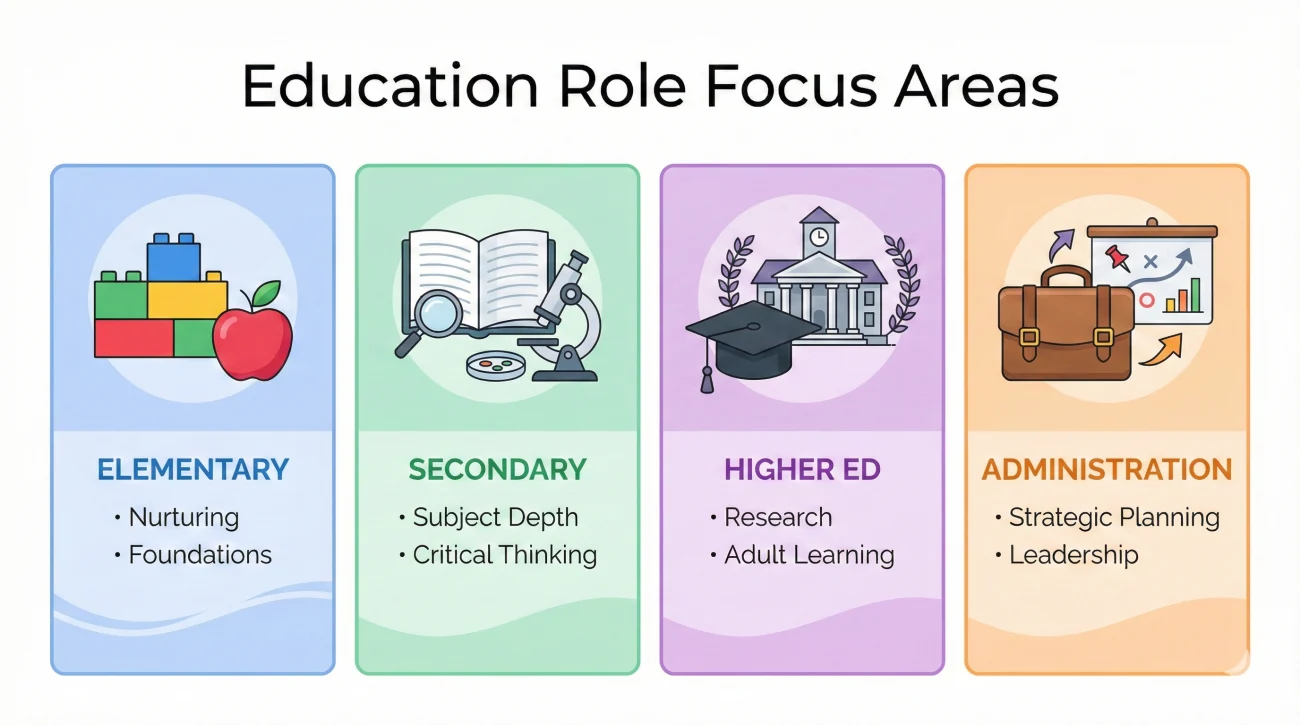
Elementary roles emphasize foundational skill development, developmental appropriateness, and creating nurturing environments where young learners build confidence alongside competence. Secondary positions shift toward subject mastery, critical thinking development, and preparing students for college or career pathways. Special education roles require demonstrating IEP implementation, accommodation strategies, and collaborative approaches with general education teachers. Each level demands specific classroom management approaches matching developmental stages.
Higher Education Roles
University positions emphasize research contributions, course design aligned with learning outcomes, and balancing teaching with scholarship expectations. Committees assess whether you can engage adult learners, facilitate discussion-based learning, integrate current research into curriculum, and navigate departmental politics. Administrative roles like dean or department chair require demonstrating strategic planning, budget management, faculty development, and institutional leadership alongside academic credentials.
- 🎓 Elementary focus: Developmental stages, foundational skills, nurturing environment, parent communication
- 📚 Secondary emphasis: Subject depth, critical thinking, college prep, adolescent engagement
- 🏛️ Higher education: Research integration, adult learning, course design, scholarly contribution
- 👔 Administration: Strategic planning, budget oversight, personnel management, institutional vision
- 🎯 Support roles: Specialized skills (counseling, library, special services) plus collaboration
💡 Pro tip: Research the specific school or institution’s mission, student demographics, and recent initiatives; tailor examples showing how your experience aligns with their particular context and challenges.
Strategic Preparation Framework
Effective education job interview questions preparation requires systematic approaches addressing the comprehensive evaluation education settings employ.
Teaching Philosophy Articulation
Develop concise teaching philosophy connecting theoretical foundation to practical classroom application. Avoid generic statements about loving children or making a difference; instead, articulate specific beliefs about how students learn, your role facilitating that learning, and concrete strategies you employ. Reference educational theorists if genuine influences on your practice, but prioritize authentic philosophy over name-dropping credentials. Strong philosophies acknowledge learning challenges while expressing realistic optimism about student potential.
Building Comprehensive Example Bank
Prepare 8-10 detailed teaching examples covering classroom management successes, differentiation strategies, parent communication challenges, colleague collaboration, data-driven instruction adjustments, and student breakthrough moments. Each example should include context, your specific approach, student outcomes, and reflection on what you learned. This bank allows selecting most relevant examples for each question rather than forcing inappropriate stories into every prompt. Structure these examples using proven behavioral interview frameworks that demonstrate clear situations, actions, and measurable results.
| Preparation Area | Key Actions |
|---|---|
| Philosophy Statement | Draft 2-minute version connecting theory to practice with specific examples |
| Example Stories | Prepare 8-10 diverse teaching situations with outcomes and reflection |
| Institutional Research | Study mission, demographics, recent news, interviewer backgrounds |
| Question Anticipation | Practice responses for common and position-specific questions |
| Scenario Preparation | Think through hypothetical classroom challenges and your responses |
Avoiding Education Interview Pitfalls
Several predictable mistakes undermine otherwise qualified candidates during education interviews, creating doubt about practical teaching readiness or institutional fit.
Theory Without Practice Connection
Citing educational theorists or pedagogical approaches without connecting them to specific classroom application signals academic knowledge without practical teaching ability. Committees want to know how constructivism or differentiated instruction actually manifests in your lesson planning, student interactions, and assessment strategies. Always bridge theoretical concepts to concrete examples showing implementation with real students in actual classrooms.
Unrealistic Idealism
Claiming you’ll reach every student, eliminate all behavioral issues, or achieve universal engagement reveals naivety about teaching realities that concerns experienced educators. Strong candidates express commitment to student success while acknowledging genuine challenges, discussing realistic strategies for difficult situations, and demonstrating awareness of systemic constraints affecting educational outcomes. This balanced perspective signals maturity that overly idealistic promises cannot convey.
Never criticize previous schools, administrators, or colleagues during education interviews; the field values collaboration and this negativity raises concerns about your professionalism and ability to work within institutional structures.
❓ FAQ
🎯 How do education interviews differ from corporate interviews?
Education interviews emphasize pedagogical philosophy, classroom management, student-centered approaches, and multi-stakeholder communication rather than revenue metrics or efficiency. They assess teaching passion and practical strategies for diverse learners alongside credentials.
💼 Should I bring teaching materials to the interview?
Yes, consider bringing a portfolio with lesson plans, student work samples (anonymized), assessment tools, or classroom management documents. These tangible examples demonstrate practical preparation and provide conversation starters about your teaching approach.
⏰ What if I lack extensive teaching experience?
Draw from student teaching, tutoring, volunteer work, or educational contexts outside formal classrooms. Focus on transferable skills like communication, patience, adaptability, and genuine commitment to learning. Acknowledge gaps honestly while demonstrating eagerness to develop through mentorship and professional growth.
📋 How important is research on the specific school?
Critical for demonstrating genuine interest beyond any teaching job. Research mission, student demographics, recent initiatives, test scores, and community context. Reference this knowledge when explaining why you’re excited about this particular position and how your approach aligns with their needs.
✨ Should I discuss challenges with difficult students or parents?
Yes, but frame challenges as learning opportunities showing growth and problem-solving rather than complaints. Describe specific difficult situations, your professional response, outcomes, and what you learned. This demonstrates realistic understanding of teaching complexities with constructive resilience.
Final Thoughts
Education interviews evaluate fundamentally different capabilities than corporate settings, prioritizing pedagogical soundness, classroom management competency, and genuine commitment to student success alongside credentials. The candidates who consistently secure teaching positions demonstrate authentic passion for education through specific examples, articulate clear teaching philosophy connecting theory to practice, and show realistic understanding of classroom challenges with constructive strategies for addressing them.
Mastering education and teaching interview questions requires moving beyond generic interview advice toward preparation addressing education-specific evaluation priorities. Develop comprehensive example bank covering diverse teaching situations, articulate pedagogical beliefs with practical application, research institutional context thoroughly, and prepare responses demonstrating both idealism about student potential and realism about teaching complexities. This balanced preparation signals the professional maturity and teaching readiness that hiring committees seek when selecting educators who will thrive in their specific institutional context while advancing student learning and institutional mission.
⚠️ Disclaimer: The interview strategies, sample answers, and negotiation tips provided in this guide are for educational purposes only. Hiring decisions are subjective and vary by company and industry. While these strategies are based on professional HR standards, they do not guarantee a specific job offer or result.