The Studio Is Not a Storage Closet
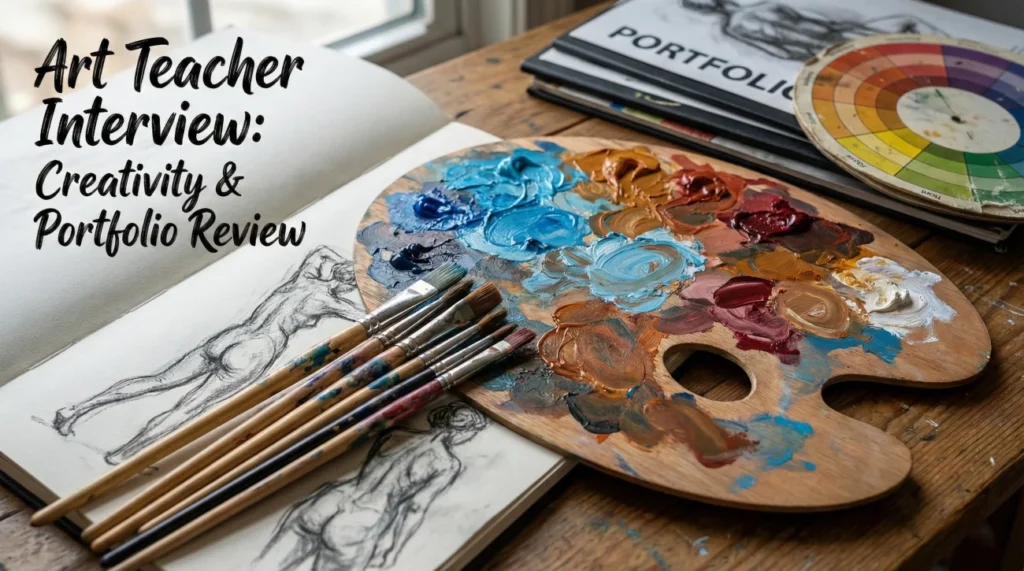
Art teacher interview questions rarely start with paint. They start with a room that never truly resets: drying racks half full, a kiln schedule taped to the wall, and a class that expects freedom but still needs clear limits.
Interviewers are listening for the same thing in every creative answer: safe routines, calm behavior systems, and a plan for teaching skills in small steps. If you can explain how you manage materials, document growth, and protect space for student voice, you sound like a professional, not a hobby supervisor.
This guide focuses on what administrators actually want to hear, from classroom flow and assessment to supply budgeting and studio safety, so you can walk in prepared and walk out confident.
Art Education Philosophy & Pedagogy
Q: Describe your teaching philosophy regarding “Process vs. Product.”
I believe that the learning happens in the making, not just the final result. While I want students to have beautiful artifacts to take home, I prioritize the problem-solving skills they use to get there. If a student’s clay pot explodes in the kiln, the lesson isn’t a failure if they can explain why it happened (air bubbles) and how they would fix it next time.
I use a “Growth Portfolio” approach where students document their sketches, failures, and iterations. This shifts the focus from “Is it pretty?” to “Did I push my skills?” I grade the artistic behavior and the application of techniques, ensuring that students who aren’t naturally “talented” can still succeed through effort and practice.
Q: How do you balance TAB (Teaching for Artistic Behavior) with skills instruction?
I use a hybrid approach. I start the semester with “Boot Camp” lessons where everyone learns the same specific techniques (e.g., how to wash a brush, how to shade a sphere). This ensures a baseline of competency and safety.
Once those skills are established, I open up the studio for “Choice Days” or thematic units where students choose their medium to solve a prompt (e.g., “Create a container for a memory”). This allows for the autonomy of TAB while maintaining the rigor of skills-based instruction. I want them to think like artists, which means making choices, but they need the tools to execute those choices first.
Q: How do you incorporate Art History without it being boring?
I avoid the “slideshow in the dark” method. I use Art History as a “spark” for current projects. If we are studying self-portraits, we look at Frida Kahlo not just to memorize dates, but to analyze how she used symbolism to show pain.
I also prioritize contemporary and diverse artists. I want students to see that art is a living career, not just something dead white men did in the 1600s. We look at street art, digital concept art for video games, and installation art. We play games like “Art Detective” where they have to deduce the story behind a painting using visual evidence.
Q: How do you advocate for the Arts in a school focused on testing?
I speak the language of “Transferable Skills.” I explain to administration and parents that the art room is where students learn divergent thinking, resilience, and fine motor skills – all of which are essential for engineering and coding. I make my curriculum visible by displaying student work not just in the hallway, but in the community library and on the school website.
I also collaborate with other subjects. I might team up with the science teacher for a botanical illustration unit or the math teacher for a lesson on perspective and geometry. This shows that Art is not an island; it is the connective tissue of the curriculum.
Classroom Management & Logistics
Q: The “I can’t draw” student refuses to work. What do you do?
I reframe drawing as a learnable skill, like handwriting, not a magical talent. I start them with low-stakes exercises like “Blind Contour Drawing” where the goal is not to look at the paper. This removes the pressure of perfection.
I also offer entry points that aren’t drawing-heavy, like collage or sculpture. I tell them, “You don’t have to be a master realist to be an artist. You just have to be observant.” I celebrate their unique mark-making to build confidence.
Q: How do you manage cleanup time effectively?
Cleanup is part of the grade. I treat the art room as a “Co-op Studio.” I assign jobs: Table Captains, Sink Monitors, Brush Washers, and Supply Runners. I stop class 5-7 minutes early and play a specific “Cleanup Song.”
I use visual aids – photos of what a clean table looks like – taped to the tables. No one is dismissed until the room passes my inspection. This routine builds respect for the materials and ensures the next class doesn’t start in chaos.
Q: How do you handle a limited budget?
I am the master of “Upcycling.” I ask the community for donations of newspapers, magazines, cardboard, and yarn. I teach students to care for brushes so they last years, not months.
I also prioritize buying high-quality “foundational” supplies (like good paper) and save money on the disposables. I write grants (DonorsChoose) for big-ticket items like kiln shelves or printmaking presses. Creativity thrives under constraints, and I model that resourcefulness.
Q: How do you conduct a student critique that isn’t hurtful?
I teach the “TAG” method: Tell something you like, Ask a question, Give a suggestion. We practice on famous artworks first so they learn the vocabulary without hurting feelings.
I also use “Gallery Walks” where students leave sticky notes with feedback. This allows shy students to participate. I set a strict rule: “Critique the work, not the artist.” The goal is to help the artist see their work through new eyes, not to judge their worth.
Q: How do you manage safety with sharp tools (e.g., lino cutters)?
I do a “Safety License” test. I demonstrate the tool, showing exactly how to cut away from the body (“Always cut away from your belly”). Students must pass a physical demonstration with me watching before they get the tool.
I count the tools out and count them in. If a cutter is missing, no one leaves. I maintain a “Zero Tolerance” policy for horseplay with tools. One strike, and they are back to pencil and paper for the unit.
Q: How do you differentiate for students with fine motor challenges?
I adapt the tools. I put tennis balls on paintbrushes for a better grip. I use larger paper or tape paper to the table so it doesn’t slide. I allow digital art options using tablets which can be more accessible.
I focus on the “Elements of Art” (line, color, shape) rather than precision. If the goal is to show contrast, a student can do that with torn paper collage just as effectively as with a shaded pencil drawing.
Difficult Situations & Ethics
A student accidentally (or purposely) ruins another student’s artwork.
This is a major emotional crisis. I immediately separate the students. If it was an accident, we have a restorative conversation where the offender apologizes and, crucially, helps fix or recreate the work.
If it was on purpose, that is vandalism. I refer it to administration, but I also work with the victim to see if we can “kintsugi” the piece – turning the break into part of the art – or I give them an extension and extra help to redo it. I validate their anger; art is personal.
A parent complains that their child got a ‘C’ in Art because “Art is subjective.”
I pull out the rubric. I explain, “You are right that taste is subjective, but technique and criteria are not.” I show them that the grade was based on specific objectives: Did they use three values of shading? Did they clean up? Did they complete the reflection?
I show them the student’s work alongside the rubric criteria. I frame it as holding the student to a high standard of craftsmanship. Usually, when parents see the objective breakdown, they understand it wasn’t just my opinion.
You suspect a student is tracing or using AI to generate their “original” work.
I require process work. I need to see the thumbnails, the rough sketch, and the work-in-progress photos. If a student produces a masterpiece with no evidence of the process, we have a conversation.
I treat tracing as a tool for learning layout, but not for final work. I ask them to draw live in front of me to demonstrate the skill. If it’s AI, we discuss appropriation and originality. I grade the process as heavily as the product to discourage shortcuts.
Portfolio & Professional Growth
Q: How do you help students build a portfolio for college admission?
I start early, in their junior year. We look at the requirements for top art schools (RISD, MICA, etc.). I teach them to photograph their work professionally – lighting, cropping, and color correction.
I emphasize breadth and depth. They need a few pieces that show they can handle different mediums, but also a sustained investigation (concentration) that shows they can explore a theme deeply. We also work on the “Artist Statement” to ensure they can articulate their intent.
Q: How do you incorporate digital art into a traditional studio?
I view digital as another medium, like charcoal or paint. Even if we don’t have a full Mac lab, I encourage students to use free apps on their phones (like Procreate Pocket or Sketchbook) for drafting.
I teach “Hybrid Art” – scanning a hand-drawn ink drawing and coloring it digitally, or projecting a digital design onto canvas to paint. This prepares them for the real world of commercial art where digital fluency is mandatory.
Q: How do you organize a school-wide Art Show?
I treat the Art Show as a community event. I curate the work throughout the year, saving the best pieces (labeling them on the back immediately!). I recruit student volunteers to help mat and hang the work.
I invite the school board and local press. I try to include an interactive element, like a collaborative mural the guests can add to. It is a massive undertaking, but it is the best advocacy tool we have. It shows the tangible result of our curriculum.
Q: Why do you want to be an art teacher?
I want to teach art because I believe creativity is a muscle that every child has, but many forget how to use. The art room is one of the few places in school where there isn’t always one right answer. I love watching students surprise themselves. I want to provide a safe haven for expression and teach them to see the beauty and complexity in the world around them.
Art Education Competency Quiz
Take the 20-Question Challenge
1. The primary colors in pigment (paint) are:
- Red, Green, Blue
- Red, Yellow, Blue
- Cyan, Magenta, Yellow
- Orange, Green, Purple
2. “Greenware” refers to:
- Pottery painted green
- Unfired clay that is bone dry and very fragile
- Clay that has been fired once
- Moldy clay
3. The “Elements of Art” include:
- Balance, Contrast, Rhythm
- Line, Shape, Color, Value, Form, Texture, Space
- Paper, Pencil, Paint
- Creativity, Talent, Skill
4. “Kiln furniture” consists of:
- Tiny chairs for clay people
- Shelves and posts used to stack ware inside the kiln
- The table the kiln sits on
- Tools used to sculpt clay
5. “TAB” stands for:
- Teaching Art Basics
- Teaching for Artistic Behavior
- Technical Art Background
- Totally Awesome Brushes
6. In a “Blind Contour” drawing, you must:
- Close your eyes
- Look only at the object, never at your paper
- Draw in the dark
- Trace a photo
7. Which is a complementary color pair?
- Red and Orange
- Blue and Orange
- Blue and Green
- Black and White
8. “Bisque” firing is the:
- Final glaze firing
- First firing to harden the clay
- Process of recycling clay
- Type of soup served at art shows
9. A “Maquette” is:
- A type of paintbrush
- A small preliminary model for a sculpture
- A French artist
- A messy palette
10. “Appropriation” in art means:
- Stealing supplies
- Using pre-existing images/objects with little transformation
- Applying for a grant
- Cleaning up properly
11. The safest way to dispose of oily rags (oil paint/solvents) is:
- Throw them in the trash immediately
- Place them in a metal, airtight fire-safety container
- Burn them
- Wash them in the sink
12. “Value” refers to:
- How much the art is worth
- The lightness or darkness of a color
- The emotional meaning
- The size of the paper
13. “Relief” printing involves:
- Printing from a flat surface
- Carving away the negative space so the image stands up
- Scratching into metal
- Digital printing
14. The “Critique Sandwich” involves:
- Eating lunch during critique
- Positive comment, Constructive criticism, Positive comment
- Layering artworks on top of each other
- Criticizing three times in a row
15. “Perspective” was formalized during the:
- Modern Era
- Renaissance
- Middle Ages
- Stone Age
16. When mixing plaster, you always:
- Add water to the plaster
- Add (sift) plaster into the water
- Mix it with your bare hands only
- Pour it down the sink
17. A “Brayer” is used to:
- Donkey noise
- Roll ink onto a printing plate
- Carve clay
- Sharpen pencils
18. “Aesthetics” is the branch of philosophy concerning:
- Math in art
- The nature of beauty and taste
- Safety rules
- Athletic performance
19. To create a “Tint,” you add:
- Black
- White
- Gray
- Water
20. “DBAE” stands for:
- Drawing Based Art Exams
- Discipline-Based Art Education
- Daily Basic Art Exercises
- Digital Business Art Era
❓ FAQ
📜 Do I need a portfolio to get hired?
Yes, a portfolio helps a lot. Keep it simple and organized: a few strong units, photos of student work, short captions that explain the objective and the process, and one or two examples of how you differentiate for different skill levels.
🎨 Do I have to be an expert in every medium?
No. Strong candidates are honest about what they know, then show how they learn fast. Emphasize fundamentals, safety, and a willingness to build new techniques through professional development and collaboration.
🧹 How much time is spent cleaning?
More than people expect, so treat it like part of instruction. Explain how you teach clean up routines, assign rotating jobs, set timers, and keep supplies labeled so transitions stay smooth and the room stays safe.
🖼️ How often should I change displays?
Aim for a predictable rhythm, like monthly highlights with a larger refresh each grading period. Mention student ownership, clear labels, and inclusive representation so the walls show progress and community, not just the top few pieces.
💰 Do I have to buy my own supplies?
You should not be expected to fund the program personally. Ask about the budget, purchasing process, and storage. If you choose to supplement, frame it as optional and sustainable, and highlight how you advocate for resources professionally.
Closing the Door on the Right Kind of Chaos
If you can talk about routines, safety, and student growth with the same confidence you talk about creativity, you will stand out. Use this practice set of art teacher interview questions and coaching prompts to sharpen your stories, then bring that calm leadership into the studio on day one.
⚠️ Disclaimer: The interview strategies, sample answers, and negotiation tips provided in this guide are for educational purposes only. Hiring decisions are subjective and vary by company and industry. While these strategies are based on professional HR standards, they do not guarantee a specific job offer or result.