The Art and Science of Teaching
Teacher interview questions are designed to peel back the layers of your resume and reveal the educator beneath. Administrators are not just looking for someone who knows the subject matter; they are hunting for a practitioner who understands the nuanced interplay between curriculum standards, adolescent psychology, and instructional delivery. The modern classroom is a dynamic ecosystem where a teacher must simultaneously be a content expert, a data analyst, a counselor, and a manager.
Whether you are a fresh graduate or a veteran educator, the interview will probe your pedagogical depth. Can you explain the difference between differentiation and scaffolding? How do you use formative assessment data to adjust your lesson in real-time? Do you have a concrete plan for restorative justice when behavior issues arise? Your answers must demonstrate that your teaching practice is intentional, inclusive, and student-centered.
This guide serves as the foundational resource for all K-12 teaching roles. While specific grade levels have their own quirks, the core competencies covered here – instructional planning, classroom management, assessment literacy, and professional collaboration – are universal. We will explore high-impact strategies like Understanding by Design (UbD), the SAMR model for technology, and Tiered Intervention, providing you with the technical vocabulary and practical examples needed to impress any hiring committee.
Teaching Philosophy & Pedagogy
Q: Describe your teaching philosophy. How does it influence your daily instruction?
This is the classic opener. Avoid clichés like “I love children.” Instead, focus on your core beliefs about how learning happens. A strong answer might center on Constructivism (students build knowledge through experience) or Growth Mindset (intelligence is not fixed). For example: “My philosophy is rooted in the belief that all students can learn when provided with the right scaffolds and a safe environment.”
Then, connect it to practice. “This means my classroom is student-centered. I limit direct lecture to 10-15 minutes and prioritize active learning strategies like Think-Pair-Share or Project-Based Learning (PBL). I view mistakes not as failures, but as data points for growth, which shapes how I give feedback – focusing on the ‘not yet’ rather than the ‘no’.”
Q: How do you differentiate instruction for a diverse class with varying ability levels?
Differentiation is not just giving advanced students more work and struggling students less work. It is about tailoring the Content, Process, Product, or Environment based on student readiness, interest, or learning profile. I use the “Tiered Assignment” approach. For a reading lesson, all students might explore the same theme (e.g., Conflict), but Tier 1 might read a graphic novel, Tier 2 a standard article, and Tier 3 an academic journal.
I also utilize flexible grouping. Sometimes I group by ability for targeted skill remediation (homogenous), and other times I mix abilities (heterogenous) to encourage peer tutoring. The goal is to keep the learning objective constant while making the path to achieving it accessible for everyone, ensuring that an IEP student and a Gifted student both experience growth.
Q: Explain your approach to “Data-Driven Instruction.”
Data-driven instruction means letting student performance dictate the next lesson, not the calendar. I collect data continuously, not just on test day. I use “Exit Tickets” at the end of every class to gauge mastery of that day’s objective. If 80% of the class fails the exit ticket, I do not move on to Chapter 2 the next day; I re-teach the concept using a different modality.
On a macro level, I analyze unit assessment data to identify gaps. If I see that my students consistently miss questions related to critical thinking or inference, I know I need to adjust my questioning techniques. Data removes the guesswork from teaching and ensures that my interventions are targeted where they are needed most.
Q: What is your strategy for integrating technology into the curriculum?
I follow the SAMR Model (Substitution, Augmentation, Modification, Redefinition). I don’t use tech just for the sake of it. Substitution is using a PDF instead of a paper worksheet – low impact. I aim for Modification and Redefinition.
For example, instead of writing a book report (Substitution), students might create a podcast episode analyzing the character’s motives (Modification) or collaborate with a class in another country via video conference to discuss cultural themes (Redefinition). Technology should amplify the student’s voice and allow for creativity that isn’t possible with pen and paper, while also teaching digital citizenship.
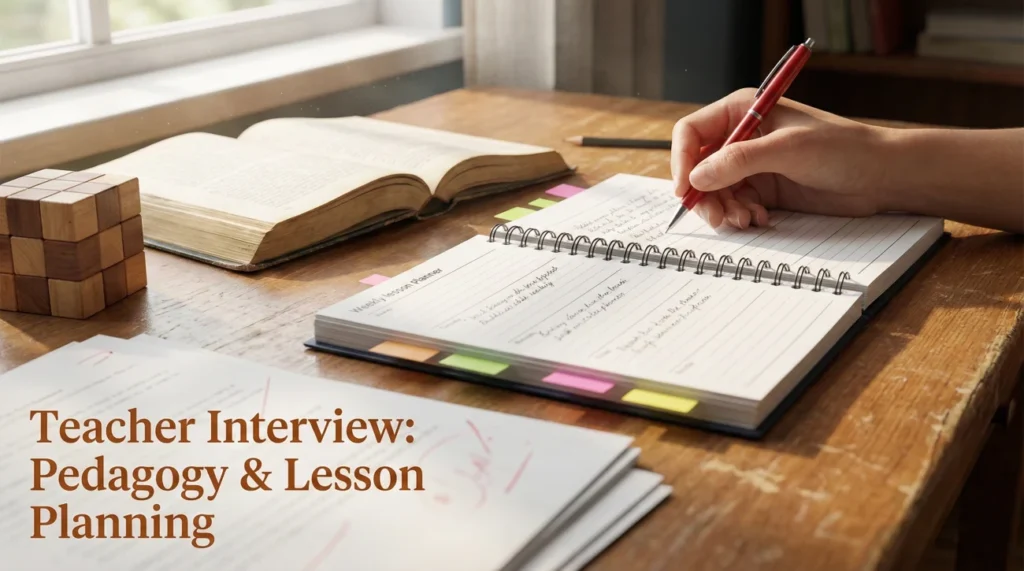
Lesson Planning & Assessment
Q: Understanding by Design (UbD)
UbD, or “Backwards Design,” is my standard for planning. I start with the end goal: “What should students know and be able to do?” (The Standard). Then I determine the evidence: “How will I know they learned it?” (The Assessment). Only then do I plan the activities (The Lesson). This prevents “fun” activities that don’t actually align with the learning objectives.
Q: Formative vs. Summative Assessment
Formative Assessment is “Assessment FOR Learning.” It happens during instruction (e.g., thumbs up/down, whiteboard checks, quizzes) to guide my teaching. It is low-stakes. Summative Assessment is “Assessment OF Learning.” It happens at the end (e.g., final exam, unit project) to evaluate mastery against a benchmark. It is high-stakes. I rely heavily on formative checks to prevent summative surprises.
Q: Scaffolding Techniques
Scaffolding is the temporary support that helps a student reach a higher level of comprehension. It includes graphic organizers, sentence stems (“I agree with… because…”), vocabulary banks, or modeling (I Do, We Do, You Do). As students gain confidence, I gradually remove the scaffolds (the “fading” process) until they can perform the task independently.
Q: Bloom’s Taxonomy
I use Bloom’s to ensure rigor. I don’t stay at the bottom levels (Remember/Understand). I push students to Apply, Analyze, Evaluate, and Create. For example, instead of asking “Who was the first President?” (Remember), I ask “Evaluate how Washington’s military experience influenced his presidency” (Evaluate). Higher-order thinking skills (HOTS) prepare students for the complexities of the real world.
Q: Rubric Design
A good rubric is transparent. It defines clear criteria for success (e.g., “Clarity of Argument,” “Use of Evidence”) and distinct levels of performance (4 – Exceeds, 3 – Meets, 2 – Approaching, 1 – Below). I often co-create rubrics with students so they understand the expectations. Rubrics make grading objective and provide specific feedback for improvement.
Q: Cross-Curricular Connections
Learning shouldn’t happen in silos. I actively look for connections. If I’m teaching the Industrial Revolution in History, I collaborate with the Science teacher to cover steam engines (Thermodynamics) or the English teacher to read Dickens. This reinforces concepts across the day and shows students that knowledge is interconnected.
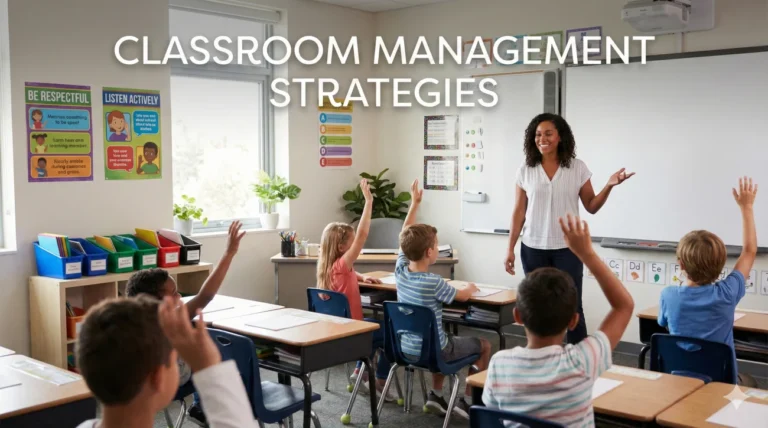
Classroom Management Scenarios
A student is constantly disrupting the class by talking to neighbors. Warnings haven’t worked. What do you do?
I avoid a public power struggle. I would use “proximity control” first – standing near the student while teaching. If that fails, I’d move to a private conversation in the hallway or after class. I seek the root cause: “I notice you’re talking a lot today. Is the work too easy? Too hard? Is something going on?”
Often, behavior is communication. If they are bored, I differentiate. If they seek attention, I give them a positive leadership role (e.g., passing out papers). If the behavior persists, I follow the school’s discipline ladder (parent contact, detention), but I always frame it as a choice the student is making, keeping my tone calm and neutral to preserve the relationship.
You have a “quiet” class that refuses to participate in discussions. It’s like pulling teeth.
Silence usually stems from fear of being wrong. I need to lower the stakes. I would implement “Think-Pair-Share.” Students talk to a partner first before sharing with the whole group. This rehearsal builds confidence. I might also use “Anonymous Polls” (like Kahoot or Plickers) to get everyone engaged without putting individuals on the spot.
I also check my “Wait Time.” Teachers often fear silence and jump in after 1 second. I force myself to wait 5-7 seconds after asking a question. This gives processors time to think. Finally, I validate all answers, even wrong ones (“I see where you’re going with that, can anyone build on it?”), to create a culture where risk-taking is safe.
Two students get into a heated verbal argument that looks like it might turn physical.
Safety is the immediate priority. I would use a loud, firm voice to command “Stop!” and physically position myself between them (without touching, unless necessary for safety and allowed by policy). I would direct the audience (other students) to move away or return to their seats to remove the “theater” aspect.
I would separate the students immediately, sending one to a partner teacher’s room or the office. I do not try to mediate the conflict while tempers are hot. Once everyone is calm, I would document the incident factually (no opinions) and contact administration and parents. Later, a Restorative Justice circle might be appropriate to repair the harm, but only when both parties are ready.
Professionalism & Collaboration
Q: How do you handle a parent who is angry about their child’s grade?
I listen without being defensive. An angry parent is usually an advocate who feels unheard. I start with empathy: “I can see you’re concerned about [Name]’s progress, and I want them to succeed too.” Then, I pivot to data. I pull up the grade book and the specific assignments.
I explain the rubric and where the points were missed objectively. “Here is the standard, and here is the student’s work.” I avoid focusing on the past and pivot to the future: “What can we do now to help them improve for the next unit?” I offer a recovery plan (tutoring, test corrections) if consistent with policy. The goal is to turn the parent from an adversary into a partner.
Q: Describe your experience with PLCs (Professional Learning Communities).
I view PLCs as the engine of school improvement. In a PLC, I don’t just share supplies; I share data. We look at common assessment results together. “Why did Ms. Smith’s class score 90% on this standard while mine scored 70%? What strategy did she use?”
I am open to “deprivatizing” my practice. I believe in sharing lesson plans, observing colleagues, and being observed. I contribute by bringing analyzed data, proposing interventions, and taking ownership of creating common assessments. The focus is always on the collective efficacy of the team to improve student outcomes.
Q: How do you stay current with educational trends?
I am a lifelong learner. I subscribe to reputable journals (like Edutopia or ASCD). I follow thought leaders on social media (Twitter/X EdChat). I attend district PDs with an open mind, looking for one or two actionable takeaways to implement immediately.
Recently, I’ve been researching the “Science of Reading” to better support literacy across the curriculum, or “Trauma-Informed Teaching” to support students post-pandemic. I believe that when a teacher stops learning, they stop teaching effectively.
Q: What is your role in supporting a student with an IEP (Individualized Education Program)?
My role is legal and instructional compliance. I must read the IEP at the start of the year and implement the Accommodations (changes to how they learn, like extended time) and Modifications (changes to what they learn). I view the Special Education teacher as a co-pilot.
I document my implementation. If a student fails, I need to prove I provided the required supports. I also provide data for the IEP meeting – not just grades, but observations on behavior and social skills. I advocate for the student, ensuring they are included in the general education setting to the “maximum extent appropriate” (LRE).
Pedagogy & Policy Knowledge Check
Test Your Teacher IQ
1. Which of the following is an example of “Differentiated Instruction” by Process?
- Giving every student a different book to read based on reading level (Content)
- Offering students the choice to work alone, in pairs, or in a small teacher-led group to complete the same task
- Allowing students to choose between writing an essay or making a video (Product)
- Changing the lighting in the room (Environment)
2. “Formative Assessment” is best described as:
- A final exam at the end of the semester
- Ongoing checks for understanding used to adjust instruction in real-time
- A standardized state test
- An IQ test
3. In Bloom’s Taxonomy, which verb represents the highest level of thinking?
- Identify (Remember)
- Explain (Understand)
- Analyze (Analyze)
- Create (Synthesis/Creation)
4. What does “IEP” stand for?
- Individual Education Plan
- Individualized Education Program
- Independent Evaluation Protocol
- Instructional Engagement Policy
5. Under FERPA (Family Educational Rights and Privacy Act), you cannot:
- Discuss a student’s grades with their parents
- Post a list of student grades by social security number or name on the classroom door
- Share educational records with another teacher who has a legitimate educational interest
- Keep a personal grade book
6. “Scaffolding” in education refers to:
- Building maintenance
- Temporary supports provided to help a student master a task they could not do alone
- Punishing students for bad behavior
- Group work only
7. The “Zone of Proximal Development” (Vygotsky) is:
- What a student can do independently
- What a student cannot do even with help
- The gap between what a learner can do without help and what they can do with guidance
- The seating arrangement in the classroom
8. A “Mandated Reporter” is required by law to report:
- Students who cheat on tests
- Parents who are late for pickup
- Any suspicion of child abuse or neglect to the appropriate authorities
- Colleagues who arrive late
9. “PBIS” stands for:
- Public Board of Instructional Standards
- Positive Behavioral Interventions and Supports
- Parent Based Intervention System
- Problem Based Inquiry Strategy
10. In the “Flipped Classroom” model:
- Students teach the class
- Students review content (lecture/video) at home and do practice/projects in class
- Desks are turned upside down
- Homework is banned
11. “ELL” or “MLL” refers to:
- Early Learning Literacy
- English Language Learners / Multilingual Learners
- Elementary Level Logic
- Educational Law Liability
12. A “Rubric” is primarily used to:
- Punish students
- Provide objective criteria and standards for grading assignments
- Plan the school calendar
- Take attendance
13. “Wait Time” is the strategy of:
- Making students wait in the hall
- Pausing for 3-7 seconds after asking a question to allow thinking time
- Waiting until the end of the year to grade
- Speaking slowly
14. Which is a characteristic of “Project-Based Learning” (PBL)?
- Memorizing facts for a test
- Students actively explore real-world problems and challenges to acquire deeper knowledge
- Doing a poster at the end of a unit
- Teacher lecturing for the whole period
15. “Meta-cognition” means:
- Thinking about the future
- Thinking about one’s own thinking (monitoring understanding)
- Advanced math
- Being confused
16. A “504 Plan” differs from an IEP because:
- It provides specialized instruction
- It provides accommodations for access (Civil Rights) but typically not specialized instruction
- It is only for temporary injuries
- It is optional
17. “Restorative Justice” focuses on:
- Punitive measures and suspension
- Repairing harm and restoring relationships after a conflict
- Ignoring bad behavior
- Courtroom procedures
18. The “Hook” or “Anticipatory Set” of a lesson is designed to:
- End the class
- Grab student attention and connect new learning to prior knowledge
- Test students immediately
- Assign homework
19. “Total Physical Response” (TPR) is often used in:
- Math equations
- Language learning (connecting words to physical actions)
- History lectures
- Science labs
20. “Summative Assessment” data is best used to:
- Adjust the lesson in the moment
- Evaluate student mastery at the end of a unit and assign a grade
- Punish students
- Predict the weather
❓ FAQ
📜 Do I need a portfolio for the interview?
Yes, it is highly recommended. Bring sample lesson plans, student work samples (with names redacted), copies of certifications, and photos of your classroom setup or projects. It changes the conversation from abstract to concrete proof of your skills.
🍎 What if I don’t have experience (New Teacher)?
Lean heavily on your student teaching experience. Discuss your familiarity with the latest educational research (current theory). Show enthusiasm, trainability, and a willingness to be mentored. Principals often hire for potential and attitude over years served.
🤐 How do I answer “What is your greatest weakness”?
Be honest but frame it as a professional goal. “I sometimes struggle with time management because I want to help every student individually, so I have started using a strict timer for transitions.” Avoid fake weaknesses like “I work too hard.”
🏫 How should I prepare for a specific school?
Research the school’s demographics, mission statement, and recent data (test scores). Know their specific programs (e.g., are they an IB school? STEM focused?). Tailor your answers to show you fit their specific culture and needs.
👩🏫 Will I have to teach a demo lesson?
Ideally, yes. Be prepared for a 15-20 minute demo. Focus on a clear objective, student engagement (don’t just lecture), and a check for understanding. If you can’t demo, be ready to walk through a lesson plan in detail.
Shaping the Future
To succeed with this comprehensive teacher interview guide, remember that schools hire people, not robots. While your pedagogical knowledge is crucial, your passion for students is your greatest asset.
Focus on your “Why.” Be ready to tell stories – the student you helped reach a breakthrough, the lesson that flopped and how you fixed it, the parent you won over. Show the interview committee that you are a reflective practitioner who is resilient, collaborative, and deeply committed to the success of every child who walks through your door.
⚠️ Disclaimer: The interview strategies, sample answers, and negotiation tips provided in this guide are for educational purposes only. Hiring decisions are subjective and vary by company and industry. While these strategies are based on professional HR standards, they do not guarantee a specific job offer or result.