Leading a School Means Holding a Thousand Threads
Principal interview questions are less about personal ambition and more about pressure management. A principal is the person everyone looks for when the hallway is loud, the data is flat, and the community is anxious.
In a good interview, you will be asked to show how you improve instruction, build culture, and make hard decisions with fairness. They want to hear systems, not slogans: how you coach teachers, respond to behavior, communicate with families, and keep the work aligned when conflict shows up.
This guide walks through the questions that reveal real leadership, with practical ways to speak about vision, accountability, and daily operations without sounding vague or rehearsed.
Leadership Philosophy & Vision
Q: Describe your leadership style. Are you more of a manager or a leader?
I view myself as a “Servant Leader” with a focus on Distributed Leadership. While management is essential for operations, leadership is about people. My goal is not to hoard power but to empower my Assistant Principals, Department Heads, and Teachers to take ownership of the school’s success.
I prioritize “Instructional Leadership.” This means I am not stuck in my office doing paperwork; I am in the hallways and classrooms. I model the expectations I have for my staff. If I expect them to be lifelong learners, I must share what I am reading and learning. I lead by serving the needs of the teachers so they can serve the needs of the students.
Q: What is your plan for the first 90 days (Entry Plan)?
My first 90 days are dedicated to “Listening and Learning.” I would not come in and make drastic changes immediately, as that alienates the staff and disrespects the school’s history. I would conduct a “Listening Tour,” meeting 1-on-1 with every staff member, key community leaders, and student representatives.
I would ask three questions: What should we keep? What should we change? What do you need from me? I would also do a deep dive into the data (academic, behavioral, attendance) to identify the root causes of our challenges. Only after this period of assessment would I collaborate with the team to draft a strategic plan.
Q: How do you define a “Good School”?
A good school is one where every student, regardless of their background, feels a sense of belonging and achieves at high levels. It is a place where data drives instruction, but relationships drive the culture. In a good school, you can hear the learning in the classrooms and feel the joy in the hallways.
It is also a place where teachers feel supported and safe to take risks. A school cannot be great for students if it is not also a great place for adults to work. Retention of high-quality staff is a key indicator of a good school.
Q: How do you handle the pressure of “High-Stakes Testing”?
I own the data, but I don’t let the data define us. I teach my staff that test scores are a lagging indicator of our success, not the sole purpose of our existence. We use the data diagnostically to adjust instruction, not punitively to shame teachers.
I focus on “Growth” over “Proficiency.” If a student comes to us two years behind grade level and leaves us one year behind, that is a massive success, even if they didn’t pass the state test. I celebrate those growth metrics to keep morale high while we work toward the ultimate goal of proficiency.
Operations, Safety, & Staffing
Q: How do you handle an underperforming teacher?
I follow a strict cycle of observation, feedback, and support. First, I determine if it is a “Skill” issue or a “Will” issue. If it’s skill, I provide coaching, send them to observe master teachers, or assign a mentor.
I document everything explicitly. If the performance does not improve after a formal “Performance Improvement Plan” (PIP) and ample support, I have the difficult conversation about non-renewal. My primary loyalty is to the students; I cannot allow a child to have a subpar education for a year to save an adult’s feelings.
Q: A parent demands a teacher be fired. How do you respond?
I listen to the parent to understand the specific concern, validating their frustration without validating their demand. I explain the due process rights of teachers and the evaluation system.
I investigate the claim thoroughly. If the teacher messed up, I handle it internally and assure the parent that “appropriate personnel action has been taken,” though I cannot share details. I protect my staff from baseless attacks but hold them accountable for legitimate failures. I try to facilitate a restorative meeting between the parent and teacher if possible.
Q: How do you ensure school safety (e.g., active shooter, bullying)?
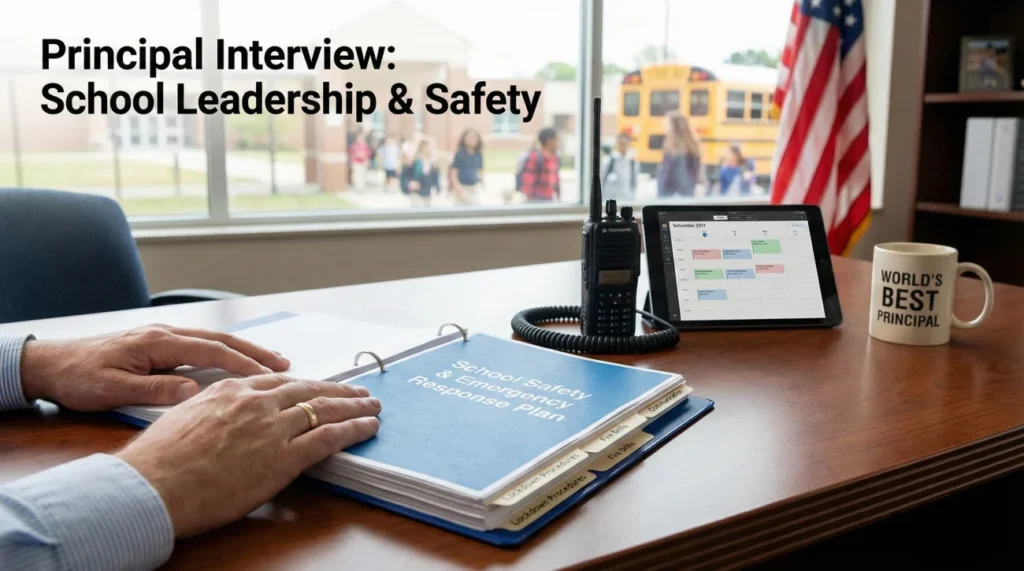
Safety is the baseline; no learning happens without it. I ensure our physical security (single point of entry, cameras, locks) is audited regularly. I take safety drills seriously, debriefing after every drill to find gaps.
However, physical safety starts with emotional safety. I invest in threat assessment teams and mental health support. We need a culture where students feel safe reporting concerns (“See something, say something”). I am visible during arrival and dismissal to monitor the climate.
Q: How do you manage a budget cut?
I prioritize people over programs, and students over adults. I look at every line item through the lens of “Impact on Student Learning.” I cut consumables, travel, and non-essential contracts before I touch classroom positions.
I am transparent with the staff about the reality. I ask for their input on cost-saving measures. Sometimes the staff has creative solutions I hadn’t considered. I advocate fiercely to the district for our needs, but once the number is set, I execute the cuts with integrity and clarity.
Q: How do you handle a “Toxic” staff culture?
I confront it directly but privately. Toxic culture usually stems from a lack of trust or a feeling of being unheard. I identify the “Key Influencers” (often not the official leaders) and work to get them on board.
I stop the “parking lot meetings” by bringing issues into the open during staff meetings. I celebrate the positive loudly. If there are individuals who are perpetually toxic and refuse to align with the school’s mission despite intervention, I encourage them to find a school that is a better fit for them.
Q: How do you implement a new initiative that staff resists?
I start with the “Why.” Resistance usually comes from initiative fatigue (“Here comes another one”). I explain how this specific initiative connects to our vision and solves a problem they have identified.
I build a “Guiding Coalition” of respected teachers to pilot the program first. When the staff sees their peers succeeding with it, buy-in grows. I provide genuine support and training, acknowledging that implementation takes time and there will be a “learning dip” before results appear.
Crisis Management & Stakeholder Relations
A video of a fight at your school goes viral on social media. The media is calling.
I follow the District Communications Protocol strictly. I do not speak to the media without the Superintendent’s permission/PIO guidance. I draft a clear, factual statement for our families first – they should hear from me, not the news.
I focus on safety and privacy. “We are aware of the incident, law enforcement/security intervened immediately, all students are safe, and we are handling discipline according to the code of conduct.” I do not discuss the specific students involved. I use this as a chance to reinforce our school values and review our supervision plan.
You suspect a staff member is coming to work under the influence.
This is a safety and liability emergency. I act immediately. I bring another administrator as a witness. I call the employee into my office and document my observations (smell of alcohol, slurred speech) objectively.
I follow the district’s “Reasonable Suspicion” testing protocol. I do not let them return to class or drive home. I place them on administrative leave pending investigation. My duty is to protect the students, regardless of my personal relationship with the employee.
A group of parents organizes to ban a book or curriculum material.
I adhere to the district’s policy on “Challenged Materials.” I listen to their concerns respectfully but do not immediately remove the material. I explain the educational value and the selection process that was used.
I offer an alternative assignment for their specific children if policy allows (“Opt-Out”), but I defend the right of other students to access the material. I ensure the review committee follows the formal process objectively, rather than reacting to emotional pressure.
School Culture & Equity
Q: How do you ensure equity and inclusion in your school?
I look at the data disaggregated by subgroups. If our suspension rate for minority students is disproportionately high, we have an equity issue. If our AP/Honors classes do not reflect the diversity of our hallway, we have an access issue.
I lead difficult conversations about bias. I ensure our hiring practices aim to recruit a diverse staff. Equity is not a program; it is a lens through which we view every decision, from the master schedule to the budget.
Q: How do you boost Teacher Retention?
Teachers stay where they feel valued, supported, and successful. I protect their time by minimizing useless meetings. I trust them as professionals. I am present to handle discipline so they can teach.
I recognize their work publicly (handwritten notes, shout-outs). I provide meaningful PD that they actually want. Most importantly, I have an open-door policy where they can vent safely. People don’t leave jobs; they leave bad bosses.
Q: How do you engage the community?
I go to them; I don’t wait for them to come to me. I attend community events, church services, or local council meetings. I form a “Principal’s Advisory Council” with diverse parent representation.
I ensure communication is accessible (translated into home languages). I treat parents as partners, acknowledging that they are the experts on their children. Building “Social Capital” with the community pays dividends when the school faces a crisis.
Q: Why do you want to be a Principal?
I want to be a Principal because I believe that a great school can change the trajectory of a child’s life, and a great Principal is the catalyst for that school. I love the challenge of complex problem-solving. I want to scale my impact – as a teacher, I impacted 150 students; as a Principal, I can impact 1,000 students and support the 60 teachers who serve them. I am ready to serve this community.
Principal Leadership Competency Quiz
Take the 20-Question Challenge
1. “Instructional Leadership” primarily involves:
- Managing the building’s HVAC system
- Focusing on teaching quality, curriculum, and student learning outcomes
- Balancing the school bank account
- Scheduling the buses
2. A “SIP” stands for:
- School Internal Protocol
- School Improvement Plan
- Student Intervention Program
- Staff Incentive Package
3. “Distributed Leadership” means:
- The principal does everything alone
- Sharing decision-making and responsibilities with staff and stakeholders
- Distributing textbooks to students
- Rotating the principal position every year
4. When analyzing data, “Disaggregating” means:
- Throwing the data away
- Breaking data down by subgroups (race, gender, SPED) to find gaps
- Looking only at the average score
- Comparing your school to other states
5. “Title I” funding is designated for:
- Schools with high sports achievement
- Schools with high percentages of children from low-income families
- Private schools only
- Teacher salaries exclusively
6. In teacher evaluation, a “Walkthrough” is:
- A fire drill
- A brief, informal classroom visit to gather data on instruction
- Walking through the cafeteria
- A formal hour-long observation
7. “Restorative Justice” focuses on:
- Punishing the offender harshly
- Repairing the harm caused and restoring relationships
- Calling the police for every infraction
- Ignoring the behavior
8. A “PIP” for a teacher stands for:
- Personal Incentive Program
- Performance Improvement Plan
- Principal Intervention Protocol
- Professional Interest Project
9. “FAPE” is a legal requirement ensuring:
- Free Apples for Public Education
- Free Appropriate Public Education for students with disabilities
- Funding All Public Employees
- Fast Assessment of Pupil Education
10. The “Master Schedule” is critical because:
- It tells teachers when to go home
- It dictates how time and resources are aligned with instructional priorities
- It is required by the fire marshal
- It lists the lunch menu
11. “Due Process” for students means:
- They must pay their library fines
- They have a right to notice and a hearing before significant discipline (suspension)
- They can do whatever they want
- Teachers cannot assign homework
12. A “Stakeholder” in education includes:
- Only the students
- Students, parents, staff, community members, and business partners
- Only the school board
- People who hold stakes
13. “PBIS” stands for:
- Principal Based Instruction System
- Positive Behavioral Interventions and Supports
- Public Board of Investigation Standards
- Punishment Based Intervention Strategy
14. When dealing with the media, the Principal should generally:
- Give full interviews immediately
- Follow district protocol and coordinate with the Public Information Officer
- Hide in the office
- Tell the reporter everything off the record
15. “Collective Efficacy” is the belief that:
- The principal is the only one who matters
- The staff together has the capability to positively influence student outcomes
- Budget cuts are inevitable
- Students cannot learn
16. An “IEP” is a legal document for:
- International Exchange Programs
- Special Education services (Individualized Education Program)
- Internal Emergency Protocols
- Integrated Educational Policy
17. “Servant Leadership” emphasizes:
- Making staff serve the principal
- The leader serving the needs of the team to help them perform their best
- Hiring servants for the school
- Strict hierarchy and command
18. To ensure “Sustainability” of a new initiative, a principal should:
- Micromanage every detail forever
- Build capacity in others so the work continues if the principal leaves
- Cancel it after one year
- Do it all themselves
19. A “Climate Survey” measures:
- The temperature in the classrooms
- Perceptions of safety, relationships, and environment among staff and students
- Weather patterns
- The energy bill
20. The “achievement gap” is best defined as:
- The time between classes
- Disparities in academic performance between different groups of students
- The difference between an A and a B
- A hole in the floor
❓ FAQ
📜 Do I need a specific administrative license?
Most districts require an approved principal certification or license, but the exact title varies by state. Be ready to state your credential clearly and explain any steps you are currently completing if you are in transition.
⏱️ What are the hours like?
Long and unpredictable. Mention that you plan your day, but you also stay present for dismissal, evening events, emergencies, and urgent parent concerns. The strongest answer balances commitment with boundaries that prevent burnout.
👔 How is this different from an Assistant Principal (AP)?
An AP often runs key systems. A principal owns the direction and the accountability. Speak to setting priorities, aligning teams, and making final calls on staffing, budget, and community trust.
🤝 Can I still teach?
Sometimes you can model lessons or co teach, but it cannot become your main identity. Emphasize being visible in classrooms, giving feedback, and building teacher capacity, not taking over their work.
💰 Is the pay significantly higher than teaching?
It is usually higher, but it comes with responsibility that is not comparable to a normal teaching load. If asked, keep it professional: you are pursuing impact and leadership, not a paycheck.
Answer Like the Leader They Need Tomorrow
The best interviews make your leadership feel specific, calm, and ready for reality. Work through scenario based principal interview questions practice prompts, tighten your examples, and show that your vision can survive a tough Monday morning.
⚠️ Disclaimer: The interview strategies, sample answers, and negotiation tips provided in this guide are for educational purposes only. Hiring decisions are subjective and vary by company and industry. While these strategies are based on professional HR standards, they do not guarantee a specific job offer or result.