Shaping the First Five Years
Preschool teacher interview questions focus on the unique blend of caregiving and education required for children aged 3 to 5. Unlike K-12 teachers who focus on academic standards, preschool teachers are the architects of a child’s first social experiences outside the home. Hiring managers are looking for educators who understand that “play” is not just a break from learning, but the primary vehicle for learning.
The interview will test your knowledge of developmental milestones, your patience with emotional regulation (tantrums), and your vigilance regarding safety. You must demonstrate that you can design a curriculum that builds fine motor skills through finger painting, social skills through dramatic play, and cognitive skills through block building. It is a role that requires high energy, boundless empathy, and the ability to wipe a nose while teaching the alphabet.
This guide dives deep into the pedagogy of Early Childhood Education (ECE). We explore the nuances of Play-Based Learning vs. Academic Drills, strategies for soothing separation anxiety, and how to partner with parents who are leaving their child for the first time. Whether you follow Montessori, Reggio Emilia, or a traditional model, these answers will help you prove you are ready to nurture the next generation.
Play-Based Learning & Pedagogy
Q: Explain your understanding of “Play-Based Learning” and how you implement it.
Play-based learning is the philosophy that children learn best when they are actively engaged in hands-on, meaningful experiences rather than passive instruction. It is not “free-for-all” chaos; it is Intentional Play. I set up the environment (“The Third Teacher”) to provoke curiosity.
For example, if the theme is “Community Helpers,” I don’t just lecture about doctors. I transform the dramatic play corner into a vet clinic with bandages, clipboards, and stuffed animals. As children “play vet,” they are practicing empathy (Social-Emotional), writing prescriptions (Literacy), and counting heartbeats (Math). My role is to facilitate – asking open-ended questions like “What do you think is wrong with the puppy?” to extend their thinking without hijacking the play.
Q: How do you balance structured activities with free play?
Balance is key to regulation. I typically follow a “sandwich” routine: Active/Free Play -> Structured Circle Time -> Active/Free Play. Young children have an attention span of roughly 1 minute per year of age (so 3-5 minutes for a 3-year-old). Expecting them to sit for a 30-minute lesson is developmentally inappropriate.
I use structured times (Circle Time) for community building, singing, and short read-alouds to build listening skills. I use free choice time (Centers) for deep exploration. I also use “transitions” as learning moments – singing a cleanup song or hopping like bunnies to the line – to maintain structure without rigidity.
Q: Describe your approach to Social-Emotional Learning (SEL).
In preschool, SEL is the curriculum. Before a child can learn to read, they must learn to regulate their emotions and navigate conflict. I use the “Name it to Tame it” strategy. If a child is screaming because their tower fell, I validate them: “You are frustrated. You worked hard on that tower.”
I teach explicit coping strategies like “Turtle Tucker” (going into a shell to breathe) or using a “Calm Down Corner” with sensory bottles. I also coach conflict resolution using “I statements” (“I don’t like it when you push me”). My goal is to give them the vocabulary to express feelings so they don’t have to act them out physically.
Q: How do you support a child who is not meeting developmental milestones?
Early intervention is critical. First, I document. I use a checklist (like CDC’s milestones) to track specific behaviors over weeks – e.g., “Child does not use two-word phrases” or “Child cannot stack 3 blocks.” I look for patterns, not one-off days.
Then, I differentiate. If a child struggles with fine motor skills (cutting), I might give them spring-loaded scissors or have them tear paper first to build strength. I would then schedule a compassionate meeting with the parents to share my observations (data, not judgment) and suggest a screening if necessary, always framing it as “getting them the support they need to soar.”
Classroom Management & Behavior
Q: Handling Separation Anxiety
The “drop-off” is the hardest part of the day. I validate the child’s feeling (“It’s sad to say goodbye”) but project confidence (“Mommy will be back after nap time”). I encourage a quick, consistent goodbye ritual. I immediately distract the child with a high-interest activity or a “special job” (e.g., helping feed the fish). I often send a photo to the parent 10 minutes later showing the child happy, to ease the parent’s anxiety too.
Q: Biting Incidents
Biting is common but visceral. My priority is the victim (First Aid and comfort). I say firmly to the biter, “Biting hurts. We do not bite friends.” I do not shame the biter or force an empty apology immediately. I look for the trigger (Teething? Frustration? Overstimulation?). I shadow the biter to intervene before the next bite. I write incident reports for both families, keeping the other child’s name confidential.
Q: Transitions Management
Transitions are chaos points. I use Auditory and Visual Cues. I give a “5-minute warning” then a “1-minute warning.” I use a cleanup song or a bell, not just my voice. I make the transition a game (“Walk like a giant to the carpet”). I have materials ready before calling them over so they don’t wait. Waiting creates behavior problems.
Q: Nap Time Struggles
Not every child sleeps, but every child rests. I create a calm environment (dim lights, soft music, back rubbing). For non-nappers, I have “Quiet Boxes” with silent activities (puzzles, books) they can do on their mat after a mandatory 20-minute rest period. I respect that sleep needs vary, but I maintain the quiet atmosphere for those who need it.
Q: Potty Training Accidents
Accidents are learning opportunities, not failures. I handle them matter-of-factly to avoid shame. “Uh oh, wet pants. Let’s go get clean ones.” I follow the center’s hygiene protocol (gloves, sanitation). I remind parents to send extra clothes. I also build “potty breaks” into the schedule before transitions (going outside, before nap) to set them up for success.
Q: Sharing vs. Turn-Taking
I don’t force “sharing” (giving up a toy immediately). I teach “turn-taking.” If Child A has the truck and Child B wants it, I coach Child B to say, “Can I have a turn when you are done?” Child A controls the “when.” This reduces hoarding and teaches autonomy. I might use a timer for high-demand items, but generally, I encourage them to negotiate.
Safety & Parent Communication
A parent is upset because their child came home with a scratch and you didn’t write a report. How do you respond?
I apologize for the oversight immediately. In preschool, trust is everything. I would say, “I am so sorry I missed that. Safety is my top priority.” I would listen to their concern fully.
I would investigate – did it happen during outdoor play? I would reassure them that I will be more vigilant. I would retroactively write the report if I can confirm the cause, or note it as an “unwitnessed mark” if not. I might implement a “body check” upon arrival and departure to ensure we are tracking marks accurately. The goal is to reassure the parent that their child is watched and cared for.
You notice a child has a severe allergy (e.g., peanuts) but another parent brings in cupcakes for a birthday. What do you do?
Safety trumps celebration. I cannot serve the cupcakes if I cannot guarantee they are safe (cross-contamination). I would thank the parent but explain the “Nut-Free Policy” firmly. “These look delicious, but because we have a severe allergy in class, I cannot serve them to keep everyone safe.”
I would offer an alternative if available (e.g., stickers, or a safe treat from my emergency stash). I would not single out the allergic child (“We can’t eat these because of Johnny”). I treat it as a community safety rule. I would also send a reminder note to all families about the safe snack policy to prevent recurrence.
A child refuses to participate in Circle Time and sits in the corner facing the wall.
I allow it. Forcing a child to sit in the circle often leads to a disruption that ruins the activity for everyone else. I respect their autonomy to observe from a distance (peripheral participation).
I would continue the lively, engaging circle time. Usually, the “Fear of Missing Out” (FOMO) draws them back in. If they stay away, I might check in privately later (“I missed you at circle”). As long as they are safe and quiet, they don’t have to be criss-cross-applesauce every single time. It might be a sign they are overstimulated and need that space.
Professionalism & Growth
Q: How do you handle the physical demands of the job?
Preschool teaching is an endurance sport. I am constantly bending, lifting, and moving. I prioritize my own health (comfortable shoes, hydration) so I can be present for the kids. I also model self-care. If I am overwhelmed by the noise, I might say, “The room is very loud, I am going to take three deep breaths. Will you do it with me?” This teaches the children regulation while helping me stay calm. Burnout prevention is a professional responsibility.
Q: How do you document learning in a play-based classroom?
I use “Learning Stories” and portfolios. Since we don’t do tests, I take photos of their block towers, transcribe their quotes during dramatic play, and keep samples of their artwork. I caption these with the developmental skill being demonstrated (e.g., “Sorting bears by color – Early Math Standard 2.1”).
I share these with parents via apps (like Seesaw or ClassDojo) or a physical binder. This educates the parents on why play matters (“Look, he isn’t just playing with clay; he’s strengthening his finger muscles for writing”).
Q: Describe your ideal classroom environment.
My ideal room is organized, accessible, and warm. Materials are on low, open shelves with picture labels so children can access and clean up independently (promoting autonomy). The room is zoned: loud areas (blocks, dramatic play) are separated from quiet areas (library, puzzles) by shelves to reduce distraction.
The walls display student work (at their eye level), not store-bought posters. It feels like a “Children’s House,” not a sterile institution. The environment should say “You belong here, and you can do things yourself.”
Q: What is the importance of “Sensory Play”?
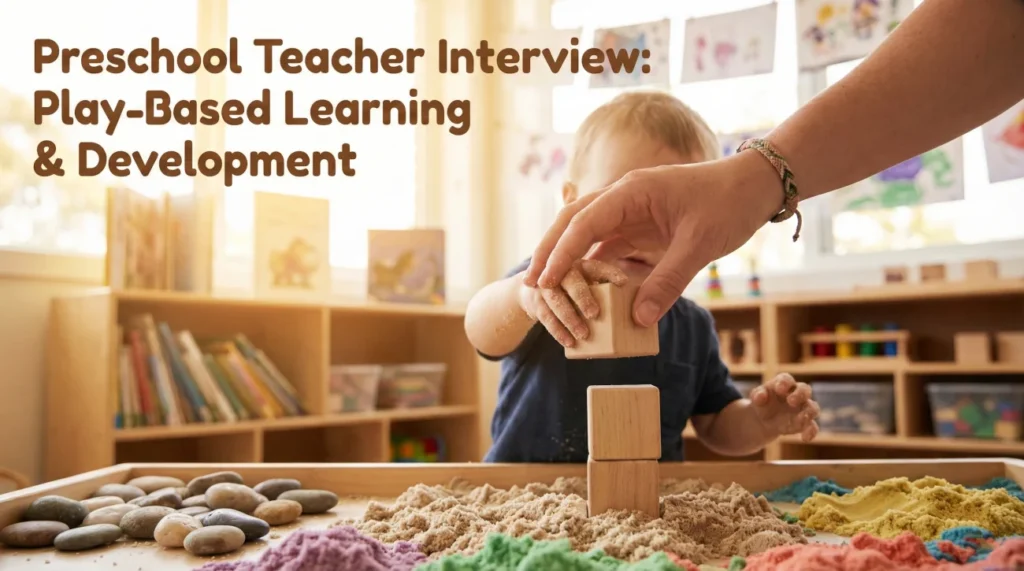
Sensory play (sand, water, playdough, rice) builds neural connections. It is foundational for scientific thinking (cause and effect, volume, texture). It is also the ultimate regulator. An angry child often calms down instantly with their hands in water. I ensure there is a sensory opportunity every day. I manage the mess by setting clear boundaries (“Sand stays in the box”) and teaching cleanup as part of the activity.
Preschool Pedagogy Knowledge Check
Test Your Early Childhood IQ
1. Which activity best supports “Fine Motor Skills”?
- Running on the playground
- Stringing beads or using tweezers to pick up pom-poms
- Listening to a story
- Singing a song
2. “Parallel Play” is defined as:
- Playing a game with rules together
- Playing side-by-side with similar toys but not interacting directly
- Playing alone in a corner
- Watching others play
3. The best way to teach the alphabet to preschoolers is:
- Drilling flashcards for 30 minutes
- Integrating letters into meaningful play (e.g., “M is for Mom” in the house corner, sand writing)
- Worksheets tracing letters
- Watching TV shows
4. Why do we avoid saying “Good Job!” constantly?
- It hurts their feelings
- It creates dependence on external praise; specific praise (“You used so much red paint”) builds internal motivation
- It is too loud
- It confuses them
5. What is the ratio of teachers to 3-year-olds (general guideline)?
- 1:20
- 1:10 (varies by state, but typically 1:8 to 1:10)
- 1:30
- 1:1
6. “Gross Motor Skills” involve:
- Writing with a pencil
- Large muscle movements like jumping, climbing, and balancing
- Thinking skills
- Speaking skills
7. If a child spills milk, the best response is:
- Yelling “Be careful!”
- Cleaning it up yourself quickly
- Saying “Oops, spills happen. Here is a towel, let’s clean it up together.”
- Putting them in time out
8. “Developmentally Appropriate Practice” (DAP) means:
- Teaching college math to toddlers
- Tailoring instruction to the age, individual needs, and cultural background of the child
- Only letting them play
- Using strict discipline
9. What is the purpose of a “Visual Schedule”?
- To decorate the wall
- To help children predict the day’s routine and feel secure (pictures + words)
- To teach reading
- To show parents the plan
10. “Open-Ended Art” (Process Art) focuses on:
- Making a craft that looks exactly like the teacher’s example
- The experience of creating (exploring materials) rather than the final product
- Staying inside the lines
- Not making a mess
11. A “Mandated Reporter” must report suspicion of abuse within:
- 1 week
- Immediately / As soon as practically possible (usually 24 hours for written report)
- Before the school year ends
- Only if they have proof
12. Which theorist is associated with the “Zone of Proximal Development”?
- Piaget
- Vygotsky
- Montessori
- Skinner
13. Why are “Time-Outs” falling out of favor?
- They are too short
- They isolate the child when they need connection/co-regulation (“Time-In”)
- Children like them too much
- They take too much space
14. “Dramatic Play” supports literacy by:
- It doesn’t
- Encouraging storytelling, vocabulary use, and understanding narrative structure
- Teaching spelling
- Teaching silence
15. The “Third Teacher” refers to:
- The parent
- The Environment (Classroom Setup)
- The iPad
- The Assistant
16. What is a “Manipulative”?
- A person who tricks others
- A physical object (block, counter, puzzle) used to teach a concept hands-on
- A type of punishment
- A storybook
17. “Emergent Curriculum” builds lessons based on:
- A textbook
- The children’s interests and questions
- The teacher’s favorite hobby
- What was done last year
18. To encourage language development, a teacher should:
- Use “Baby talk”
- Narrate (“Sportscast”) what the child is doing using rich vocabulary
- Tell them to be quiet
- Correct every grammar mistake
19. Handwashing should last for:
- 5 seconds
- 20 seconds (Happy Birthday song twice)
- 1 minute
- Just water is fine
20. “Risk Assessment” in play means:
- Removing all climbing structures
- Evaluating hazards vs. benefits (e.g., allowing “Risky Play” like climbing trees with supervision to build resilience)
- Wrapping kids in bubble wrap
- Only sitting at desks
❓ FAQ
📜 Do I need a degree?
It varies. Head Start and public school preschools often require a Bachelor’s in ECE and state licensure. Private daycares may only require a CDA (Child Development Associate) credential or an Associate’s degree. Check the specific requirements for your target center.
🤒 What about getting sick?
You will get sick. The first year is known for building your immune system. Practice aggressive hand hygiene, get your flu shot, and don’t touch your face. It gets better after the first year!
🎨 Is it just babysitting?
Absolutely not. You are building the neural architecture of the brain. While “care” (diapers, feeding) is part of it, the intentional interactions you provide are education. Be prepared to explain the science behind your play to anyone who calls it babysitting.
🤯 How do I handle the noise?
A loud classroom is often a happy one, but it can be overstimulating. Use “call and response” (e.g., “1, 2, 3 eyes on me”) to regain control. Structure quiet times into the day. If the noise is chaotic screaming, it usually means the activity is unstructured or too difficult.
🧩 What is the difference between Montessori and Reggio?
Montessori focuses on individual work with specific, self-correcting materials and practical life skills. Reggio Emilia is project-based, led by child interest, and focuses heavily on art and the environment. Knowing the philosophy of the school you apply to is crucial.
Growing Great Humans
To succeed with preschool teacher interview questions, show your heart. Administrators can teach you the curriculum, but they cannot teach you to love a child who is screaming on the floor.
Focus on your ability to see the world through a 3-year-old’s eyes. Share stories about how you turned a rainy day into a puddle-jumping science lesson, or how you helped a shy child make their first friend. Prove that you are patient, playful, and professional.
⚠️ Disclaimer: The interview strategies, sample answers, and negotiation tips provided in this guide are for educational purposes only. Hiring decisions are subjective and vary by company and industry. While these strategies are based on professional HR standards, they do not guarantee a specific job offer or result.