Teaching Students to Argue With Evidence
History teacher interview questions are no longer a trivia contest. Schools want teachers who can turn a textbook chapter into an investigation, where students source documents, compare accounts, and explain why an event mattered.
Panels will listen for your approach to primary sources, DBQs, and civil discourse. They may also ask how you handle sensitive topics and misinformation. The strongest answers show a clear method: norms, sourcing questions, corroboration, and a focus on evidence over opinion.
This guide organizes the biggest interview themes, from inquiry lessons and simulations done carefully to assessments that reward reasoning. If you can show you teach habits of mind, you will look like a teacher who builds citizens, not just students.
Historical Thinking & Philosophy
Q: How do you move students beyond rote memorization of dates and names?
I focus on “Thematic Instruction” and “Enduring Understandings.” Instead of just memorizing a date, we ask, “Why do revolutions happen?” We look for patterns across time – comparing the American Revolution to the French or Haitian Revolutions. Dates are just the signposts; the destination is understanding cause and effect.
I use the “Big History” approach where we connect specific events to larger trends like migration, technology, or human rights. If a student forgets the exact year of the Magna Carta but understands its impact on the limitation of monarchical power and the eventual US Constitution, I consider that a win.
Q: How do you teach students to analyze Primary Sources?
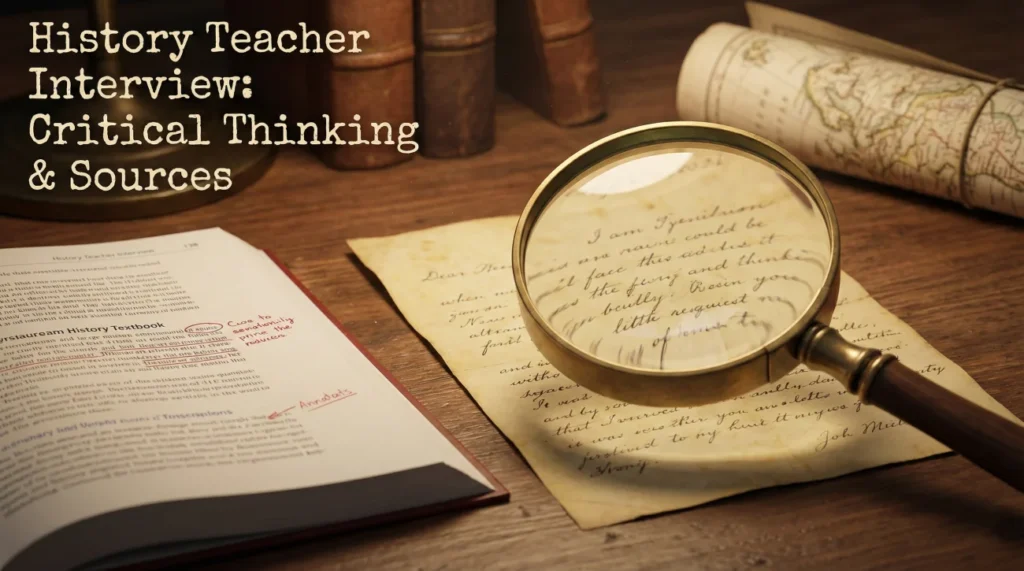
I use the SHEG (Stanford History Education Group) model of historical reading: Sourcing, Contextualization, Corroboration, and Close Reading. Before we even read the text, we “Source” it: Who wrote this? When? Why? For whom?
I model this process explicitly. If we are reading a letter from a Civil War soldier, we ask how his perspective differs from a politician’s speech from the same month. I treat sources as evidence in a crime scene – we never trust just one witness. We look for multiple perspectives to build a complete picture.
Q: What is the role of the textbook in your classroom?
The textbook is a resource, not the curriculum. It provides a helpful overview and a chronological framework, but it is inherently a secondary source with its own narrative choices. I use it for background reading (homework), but class time is spent digging into the primary sources that the textbook summarizes.
I often have students “interrogate” the textbook. We might read a textbook paragraph about an event and then compare it to three primary sources from that day to see what the textbook left out or simplified. This teaches students that history is constructed, not just recorded.
Q: How do you handle “Presentism” (judging the past by modern standards)?
This is a major challenge. Students often want to cancel historical figures for not having 21st-century values. I teach “Contextualization.” We have to understand the world as it was to understand why people made the choices they did.
However, understanding is not excusing. We can acknowledge that Thomas Jefferson wrote “all men are created equal” while enslaving people. We hold that tension. We analyze the complexity of humans rather than categorizing everyone into “Heroes” and “Villains.” History is messy, and my class embraces that messiness.
Instructional Strategies & Methods
Q: How do you scaffold a Document-Based Question (DBQ) essay?
I never assign a full DBQ cold. We start with “The DBQ Project” approach: “Bucketing.” We read the documents together and group them into argument buckets (e.g., Economic reasons, Social reasons).
For struggling readers, I provide modified documents with difficult vocabulary defined. I give sentence starters for citing evidence: “According to Document A,…” and “This shows that…” By breaking the essay into reading, sorting, and drafting phases, it becomes manageable rather than overwhelming.
Q: How do you make history relevant to students today?
I use “Through-lines.” Every unit starts with a modern question. For a unit on the Roman Empire, we might ask, “Are we living in the fall of the American Empire?” and compare the political polarization or military overreach.
I also use “Local History.” We visit local archives or look at the history of our own school or town. When students see that history happened here, on these streets, it becomes tangible and personal.
Q: How do you run a Socratic Seminar or debate?
Preparation is key. Students must have their “Entry Ticket” (annotated text and 3 prepared questions) to enter the circle. I sit outside the circle and track the flow of conversation using a map.
I enforce norms like “Refer to the text, not just your opinion” and “Three before me” (three people must speak before you speak again). The goal is collaborative meaning-making, not winning an argument. Afterward, we reflect on who spoke, who didn’t, and how we can improve the dialogue next time.
Q: How do you address diverse perspectives/marginalized voices?
I audit my curriculum to ensure we aren’t just teaching “Great Man History.” When studying Westward Expansion, we don’t just read the settlers’ diaries; we read the speeches of Native American leaders and the accounts of Mexican citizens who suddenly found themselves in the US.
I ask, “Whose voice is missing from this story?” If the documents only show the elite perspective, we actively search for social history – songs, census data, or court records – that reveal the lives of women, the enslaved, and the working class.
Q: How do you use simulations or role-play effectively?
Simulations must be handled with extreme care. I never simulate trauma (e.g., no “slavery simulations” or “Holocaust boxcars”). That is harmful and trivializes suffering.
Instead, we simulate decision-making. For example, a “Treaty of Versailles” simulation where students represent different countries and try to negotiate a peace deal with conflicting goals. This teaches the difficulty of diplomacy and helps them understand why the real treaty was flawed. The focus is on the cognitive task, not the emotional reenactment of pain.
Q: How do you differentiate for English Language Learners (ELLs)?
History is text-heavy, which is hard. I use visual timelines and plenty of maps. I “chunk” primary sources, giving them just the 2 essential sentences rather than the whole page.
I use “Gallery Walks” where they move around the room to look at images and short captions, allowing for physical engagement. I also allow them to demonstrate understanding through political cartoons or oral explanations instead of always writing essays.
Controversial Topics & Classroom Culture
A student asks your personal political opinion on a current event.
I politely decline to answer. My job is to teach them how to think, not what to think. If I give my opinion, the thinking stops because they just want to agree or disagree with the teacher.
I say, “My opinion isn’t on the test. What matters is the evidence. Let’s look at the different perspectives on this issue.” I play “Devil’s Advocate” against whatever the dominant opinion in the room is to force them to sharpen their arguments, ensuring I remain a neutral moderator.
A parent complains that you are teaching “Revisionist History” or “hating America.”
I listen to hear their fear – usually, they fear their child is being shamed. I clarify that we are teaching inclusive history, not hateful history. I show them the primary sources we are reading.
I explain, “We are reading Frederick Douglass not to hate the Founders, but to understand the full reality of 1850. A patriot loves their country enough to want to understand its whole truth, including its mistakes, so we can do better.” I frame critical history as an act of civic responsibility.
Students encounter “Fake History” or conspiracy theories online.
I treat this as a perfect teachable moment for “Digital Media Literacy.” We bring the claim into class and apply our historical thinking skills: Sourcing and Corroboration.
We ask, “Where did this meme come from? What are their credentials? Can we find two other reliable sources that back this up?” By debunking it together using rigorous methods, I empower them to be skeptical consumers of information on their own feeds.
Curriculum & Professional Growth
Q: How do you assess historical understanding?
I use a mix of traditional and authentic assessments. Multiple choice is useful for checking basic facts, but I prefer “Performance Tasks.” This might be writing a museum plaque for an artifact, creating a podcast interviewing a historical figure, or redesigning a monument.
I look for the ability to use evidence. An essay that has a few grammar errors but uses three primary sources effectively to prove a thesis gets a better grade than a perfectly written summary with no evidence.
Q: How do you integrate Geography into History?
You cannot understand History without Geography. “History is the play; Geography is the stage.” We look at how physical features (rivers, mountains) dictated where civilizations started.
We use GIS (Geographic Information Systems) layers to look at voting patterns or population density. When studying war, we look at the terrain to understand tactical decisions. Geography explains the “Where” and often the “Why” of historical events.
Q: How do you stay current with historical scholarship?
History changes as we find new evidence and new lenses. I subscribe to journals like “The History Teacher” and listen to podcasts by historians. I attend workshops by Gilder Lehrman or the NEH.
I don’t teach the same lecture I wrote 5 years ago. For example, recent scholarship on the Reconstruction era has shifted the narrative significantly, and I ensure my teaching reflects the most up-to-date consensus, not just the myths I learned in high school.
Q: Why do you want to be a history teacher?
I believe that democracy requires an informed citizenry. If students don’t understand where our institutions came from, they won’t know how to protect or improve them. I love the stories of history, but more importantly, I love seeing students realize that they are part of the story – that history is not over, and they are the historical actors of the future.
Historical Pedagogy Competency Quiz
Take the 20-Question Challenge
1. “Primary Source” refers to:
- The most important textbook chapter
- A document or artifact created during the time period being studied
- A scholarly article written by a historian in 2024
- The first source you find on Google
2. “Corroboration” in history means:
- Correcting spelling errors in a document
- Comparing multiple sources to check for consistency and reliability
- Memorizing the timeline of events perfectly
- Collaborating with another teacher
3. “Contextualization” involves:
- Defining vocabulary words
- Placing an event or document within the broader trends of its time
- Reading the text out of order
- Ignoring the date of the document
4. “Sourcing” a document asks students to:
- Find where to buy the book
- Identify the author, their perspective, and the purpose of creation
- Underline the main idea only
- Cite the source in MLA format only
5. “Presentism” is the bias of:
- Giving presents to teachers
- Interpreting past events solely through the lens of modern values
- Focusing only on current events
- Ignoring the future
6. A “DBQ” stands for:
- Daily Bell Question
- Document-Based Question
- Data-Based Quiz
- Direct Biography Quote
7. “Historiography” is the study of:
- Historical maps
- How historical interpretation and writing have changed over time
- The history of fonts
- Biographies of famous people only
8. The “SHEG” (Stanford History Education Group) model emphasizes:
- Memorizing lists of presidents
- Reading like a historian (Sourcing, Contextualizing, Corroborating)
- Using only textbooks
- Watching historical movies
9. Which is a “Secondary Source”?
- A diary from a soldier in WWI
- A biography of Abraham Lincoln written in 2010
- The Declaration of Independence
- A photograph from the 1960s
10. “Inquiry-Based Learning” in history starts with:
- A lecture on dates
- A compelling question to investigate
- A blank map
- Vocabulary definitions
11. “Historical Agency” refers to:
- A government building
- The capacity of individuals or groups to act and influence events
- The spy network in the Cold War
- The job of a historian
12. To teach “Multiple Perspectives,” you should:
- Only read the textbook
- Include sources from diverse groups (gender, class, race) on the same event
- Let students argue without evidence
- Focus only on the winners
13. “Close Reading” requires students to:
- Read with their eyes closed
- Analyze the author’s word choice and argument structure deeply
- Read the text very quickly
- Summarize the plot only
14. A “Seminar” style discussion is best for:
- Lecturing to the class
- Collaborative dialogue and analyzing text together
- Testing factual recall
- Watching a video
15. “Thematic Instruction” organizes history by:
- Strict chronological order only
- Concepts (e.g., Revolution, Migration) across different eras
- Alphabetical order of countries
- The length of the war
16. Which is an appropriate use of a historical film?
- Showing it for a week to fill time
- Analyzing a clip for accuracy and bias compared to primary sources
- Using it as the only source of truth
- Ignoring it completely
17. “Enduring Understandings” are:
- Facts that students memorize forever
- Big ideas and concepts that have lasting value beyond the classroom
- Long tests
- Homework assignments
18. Avoiding “Great Man History” means:
- Never teaching about presidents
- Focusing also on social movements and ordinary people, not just leaders
- Only teaching about women
- Teaching that no one was great
19. “Civic Literacy” includes:
- Knowing how to read a map
- Understanding how government works and how to participate in democracy
- Being polite in class
- Literacy tests for voting
20. When sourcing a document, “Bias” is:
- Something to be completely ignored
- A perspective to be identified and analyzed for how it shapes the narrative
- Always a bad thing that ruins the source
- A type of sewing technique
❓ FAQ
🏟️ Do I need to coach a sport to be hired?
Coaching can help in some districts, but it is not a universal requirement. What matters is showing you contribute to the school community, through clubs, tutoring, debate, student government support, or other activities that fit your strengths.
🎓 What degree or certification do I need for history teaching?
Most roles require a social studies or history certification, and some states bundle multiple disciplines under one license. In interviews, emphasize your content depth and your ability to teach skills, like sourcing, note-taking, and argumentative writing.
🧭 How do I stay neutral when topics get political?
Neutral does not mean silent, it means fair process. Set discussion norms, anchor claims in evidence, and use questions to surface multiple perspectives. If a student asks for your opinion, redirect to, “What does the source show?”
⏳ How do I cover so much content in one school year?
Teach through big questions and case studies. Go deep on a few anchor events that represent larger patterns, then build quick through-lines between them. Students remember frameworks and cause-effect chains more than a rushed list of dates.
🌍 How do I include non-Western history authentically?
Integrate it across units instead of treating it as a single week. Use primary sources from multiple regions, connect global trade and migration, and ask whose voices are missing. This approach strengthens the story of history rather than adding a token chapter.
A Final Reminder for Social Studies
History interviews reward teachers who can keep debates rigorous and humane. Use history teacher interview questions to rehearse answers that show your method: sourcing, corroboration, and clear norms for civil discourse. When you frame the course as evidence-based inquiry, you sound like a teacher who prepares students for citizenship.
⚠️ Disclaimer: The interview strategies, sample answers, and negotiation tips provided in this guide are for educational purposes only. Hiring decisions are subjective and vary by company and industry. While these strategies are based on professional HR standards, they do not guarantee a specific job offer or result.