Running the System, Not One Building
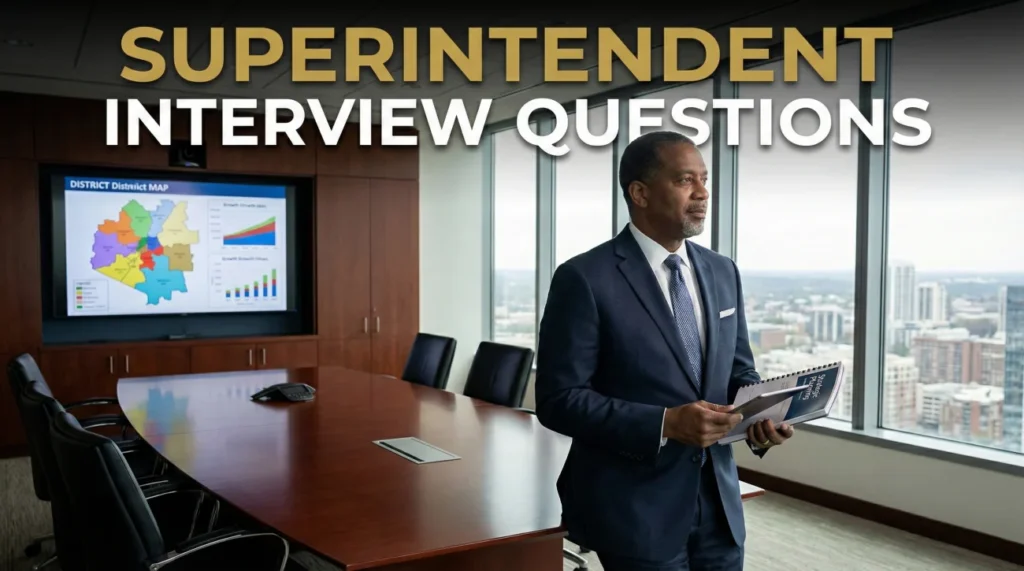
Superintendent interview questions often sound like big-picture leadership talk, but they are really about governance under pressure. One day you are presenting budget projections and staffing plans, the next you are facing a community meeting that is already tense. The role combines strategy, operations, and crisis readiness across an entire district.
Boards listen for clarity, composure, and a decision-making framework that holds up in public. They want a leader who can work productively with elected officials, negotiate fairly, and communicate hard truths without turning every challenge into a political firestorm.
This guide focuses on strategic planning, budget and resource allocation, board relations, equity and accountability, and community engagement so you can show you are prepared to lead the whole system.
Vision & Strategic Leadership
Q: What is your vision for this district?
My vision starts with understanding this community’s values and aspirations, not imposing an agenda from outside. I would spend my first months listening to stakeholders, analyzing data, and learning the district’s strengths and challenges before articulating specific goals. Vision must be co-created with the community it serves.
That said, certain principles guide my leadership everywhere: every student deserves access to excellent education regardless of background, data should drive decisions, and continuous improvement is non-negotiable. I would work with the board to develop a strategic plan with bold but achievable goals, clear metrics, and accountability at every level.
Q: How would you spend your first 90 days in this district?
I would prioritize listening and learning. I would meet individually with every board member, every principal, union leadership, parent groups, and community stakeholders. I would visit every school, sit in classrooms, and talk with teachers and students. I would review financial documents, performance data, and recent board minutes to understand current reality.
I would resist making major changes during this period. New superintendents who arrive with predetermined solutions often fail because they do not understand local context. By day 90, I would have a clear picture of the district’s strengths, challenges, and opportunities. Only then would I begin proposing strategic direction in partnership with the board.
Q: How do you create a culture of continuous improvement district-wide?
Continuous improvement requires clear goals, honest data, and accountability without blame. I establish metrics aligned with strategic priorities and ensure every school and department understands how their work contributes to district goals. I create systems for regular progress monitoring and course correction.
Culture change happens through consistent messaging and modeling. I visit schools regularly and ask about improvement efforts. I celebrate progress publicly. I ensure professional development aligns with improvement priorities. Most importantly, I hold central office accountable first because schools cannot improve if the system does not support them.
Q: Describe a significant change initiative you led. What worked and what did not?
I led a district-wide shift to standards-based grading. What worked: extensive stakeholder engagement before implementation, phased rollout starting with volunteer schools, ongoing professional development, and parent communication that explained the why behind the change. Test scores and student engagement improved measurably.
What did not work initially: we underestimated resistance from veteran teachers comfortable with traditional grading and from parents who wanted familiar letter grades. We adjusted by creating hybrid reporting that showed both standards mastery and traditional grades, then phased out traditional grades over three years. The lesson: pace of change matters as much as direction of change.
Board Relations & Governance
Q: How do you view the relationship between superintendent and school board?
The board governs; the superintendent manages. The board sets policy and strategic direction; I implement it. The board hires one employee: me. I hire and manage everyone else. This distinction sounds simple but requires constant attention because the lines blur easily.
I see my role as providing the board with information and recommendations they need to make good decisions, then executing those decisions faithfully. I keep the board informed so they are never surprised. I respect their authority while offering my professional judgment. When we disagree, we discuss privately and present unity publicly.
Q: How do you handle a board member who wants to micromanage operations?
I address it directly but respectfully. I schedule a private conversation to understand their concerns and clarify roles. Often micromanagement stems from legitimate worries that are not being addressed through normal channels. If a board member is asking about bus routes, they may have constituents complaining about transportation.
I ensure the board receives sufficient information to fulfill their governance role without needing to dig into operations. If role confusion persists, I involve the board chair or suggest governance training. I never publicly embarrass a board member, but I also cannot allow micromanagement to paralyze operations or undermine administrative authority.
Q: How do you communicate with the board between meetings?
I provide regular updates, typically weekly, that cover emerging issues, progress on initiatives, and anything that might generate public attention. No board member should learn about a district issue from the newspaper first. I treat all board members equally with information so no one feels out of the loop.
I am accessible for questions while respecting boundaries. Board members can contact me, but I redirect operational questions to appropriate staff. I document significant communications and share them appropriately. Between meetings, I build relationships through informal conversations that help me understand individual board members’ priorities and concerns.
Q: What happens when you disagree with a board decision?
I voice my concerns clearly during deliberations, providing data and professional judgment to inform the decision. If the board decides differently than I recommend, I implement their decision fully and faithfully. The board has the authority; my job is to execute their decisions, not subvert them.
If a decision violates law, policy, or ethics, that changes the equation. I would document my concerns in writing and potentially seek legal counsel. But normal policy disagreements do not rise to that level. I have left positions when board direction became impossible to support, but that is a last resort after exhausting other options.
Q: How do you prepare for board meetings?
Preparation starts weeks before the meeting. I ensure agenda items have complete backup materials delivered with enough time for board review. I brief board members individually on complex or controversial items so they can ask questions privately and come to meetings informed.
I anticipate questions and prepare staff to address them. I coordinate presentations to be concise and focused on decisions needed, not lengthy information dumps. I identify potential areas of disagreement and develop options. Good preparation means board meetings focus on governance decisions rather than getting up to speed on basic information.
Budget & Resource Allocation
How do you approach developing the annual district budget?
Budget development is a year-round process, not a single event. I start by understanding the district’s financial position: revenue projections, fund balances, long-term obligations, and anticipated changes. I involve principals and department heads early so budget reflects actual needs rather than central office assumptions.
I align budget priorities with strategic plan goals. Every significant expenditure should connect to improving student outcomes. I present options to the board with clear tradeoffs so they can make informed governance decisions. I ensure the budget is transparent and understandable to community members who may not have financial expertise.
How do you make difficult decisions about resource allocation when funds are limited?
I use data to guide difficult decisions. Which programs produce measurable results? Where are we spending money on tradition rather than effectiveness? I protect classroom instruction first because that is where students learn. Administrative costs, facilities, and support services are important but secondary.
I involve stakeholders in understanding tradeoffs. When communities understand that adding a program means cutting something else, they make more realistic requests. I present the board with options and consequences, not single recommendations that box them in. Transparency about constraints builds trust even when decisions are painful.
How do you ensure fiscal accountability and prevent misuse of district funds?
Strong internal controls are essential. I ensure segregation of duties, regular audits, clear procurement policies, and multiple approval levels for significant expenditures. I review financial reports regularly and investigate anomalies immediately. I create a culture where staff understand that misuse will be caught and have consequences.
I also ensure board members can fulfill their oversight role. Financial reports should be clear and timely. The board should understand the district’s financial position without needing forensic accounting skills. An annual independent audit is non-negotiable, and I address any findings promptly.
How do you approach passing a bond measure or tax levy?
Success requires groundwork long before the election. The community must trust district leadership and believe funds will be used wisely. I build that trust through consistent financial stewardship and transparent communication about how current funds are spent.
I engage stakeholders in identifying needs and priorities before proposing specific amounts. I form a citizens committee to review facilities or funding needs independently. I communicate clearly what the measure will fund and what happens if it fails. I respect legal limitations on advocacy while ensuring voters have accurate information. A measure that fails often sets back district priorities for years.
Equity, Accountability & Policy
Q: How do you ensure equity across all schools in the district?
Equity requires intentional action, not just good intentions. I analyze data disaggregated by demographics to identify disparities in outcomes, access to advanced courses, discipline rates, teacher quality, and resource allocation. Patterns reveal where the system is failing certain students.
I allocate resources based on need, not just enrollment. Schools serving more disadvantaged populations may need more funding, more experienced teachers, and more support services. I hold all schools to high expectations while providing differentiated support. Equity does not mean identical treatment; it means ensuring every student has what they need to succeed.
Q: How do you approach closing achievement gaps between student subgroups?
Closing gaps requires acceleration, not remediation. Students who are behind need more time, more support, and higher expectations, not lower ones. I ensure struggling students access grade-level content with scaffolding rather than being tracked into watered-down curricula that guarantee they never catch up.
I address root causes: early literacy intervention, quality early childhood programs, support for English learners, and wraparound services for students facing poverty or trauma. I hold principals accountable for subgroup performance, not just overall averages that can hide disparities. Progress takes years of consistent effort; there are no quick fixes.
Q: How do you balance state and federal accountability requirements with local priorities?
Compliance is baseline, not ceiling. I ensure the district meets all legal requirements for testing, reporting, and accountability. But I also ensure that chasing test scores does not narrow curriculum or reduce education to what is measured. State tests assess minimum proficiency; we should aim higher.
I communicate with the board and community about what accountability measures do and do not tell us. I advocate at the state level for accountability systems that reflect student growth and multiple measures of success. Within constraints, I focus on preparing students for success in life, which includes but extends beyond standardized test performance.
Q: How do you handle a principal who is not meeting expectations?
I address performance issues directly with documentation, clear expectations, and support. I work with the principal to identify obstacles and develop an improvement plan with specific goals and timelines. I provide coaching, professional development, and regular feedback.
If performance does not improve despite support, I make the difficult decision to remove the principal. Students cannot wait years for a struggling leader to turn around. I follow proper procedures, document thoroughly, and involve HR and legal counsel as appropriate. Protecting ineffective leaders harms students and damages district credibility.
Community & Stakeholder Relations
Q: How do you engage parents and community members in district decision-making?
I create multiple channels for input: town halls, advisory committees, surveys, and regular communication through newsletters and social media. I ensure input opportunities reach all segments of the community, not just those who typically engage. I go to where people are, not just expect them to come to district meetings.
Engagement must be genuine, not performative. If I ask for input, I must show how it influenced decisions. If community input cannot change a decision, I say so upfront rather than creating false expectations. Building trust requires follow-through over time.
Q: How do you handle contentious community issues that divide the district?
I create structured forums for civil dialogue rather than allowing social media or board meetings to become battlegrounds. I present factual information to counter misinformation. I acknowledge different perspectives without endorsing positions that harm students or violate policy.
I focus on what we can agree on: all want students to succeed. I recommend board positions based on student welfare and legal requirements, not political pressure. I prepare the board for potential backlash and present a united front publicly. Some issues will not achieve consensus; leadership means making decisions anyway.
Q: How do you work with unions and navigate collective bargaining?
I respect unions as legitimate representatives of employees while maintaining management authority over operations. I build relationships with union leadership through regular communication outside of bargaining. Many issues can be resolved informally before becoming grievances.
In bargaining, I prepare thoroughly with data on district finances, comparable districts, and strategic priorities. I seek agreements that attract and retain quality staff while maintaining fiscal sustainability. I bargain in good faith, keep commitments, and avoid public battles that damage relationships. Both sides should feel the agreement is fair.
Q: How do you handle media relations and crisis communication?
I build relationships with local media before crises occur. I am accessible, honest, and responsive. When I cannot share information, I explain why rather than stonewalling. Journalists who trust me are more likely to report fairly.
In crisis, I communicate quickly with facts, even if incomplete. Silence creates vacuum filled by speculation. I coordinate messaging so the district speaks with one voice. I brief the board before they see news coverage. After crisis passes, I conduct after-action review to improve future response.
District Leadership Quiz
20 Practice Questions
1. The primary role of the school board is:
- Managing daily operations
- Setting policy and strategic direction
- Hiring teachers and principals
- Developing curriculum
2. The superintendent’s relationship with board members should be:
- Distant and formal only
- Professional with equal treatment of all members
- Closer with some members than others
- Adversarial to maintain independence
3. Budget development should:
- Be completed by the finance department alone
- Align with strategic plan goals and involve stakeholders
- Maintain previous year allocations
- Prioritize central office needs
4. When a board member micromanages, the superintendent should:
- Comply to maintain peace
- Publicly confront them at meetings
- Address it privately while clarifying roles
- Ignore it
5. Equity in education means:
- Identical resources for every school
- Providing differentiated support based on student needs
- Lowering standards for disadvantaged students
- Focusing only on underperforming schools
6. In the first 90 days, a new superintendent should primarily:
- Implement their agenda immediately
- Listen, learn, and build relationships
- Replace underperforming staff
- Announce major changes
7. When the board makes a decision the superintendent disagrees with:
- Refuse to implement it
- Publicly criticize the decision
- Implement it faithfully while documenting concerns
- Resign immediately
8. Achievement gaps should be addressed through:
- Lower expectations for struggling groups
- Acceleration with additional support
- Remedial tracks separate from peers
- Focusing only on overall averages
9. Community engagement should:
- Be limited to formal meetings
- Reach all segments and show how input influenced decisions
- Focus on parents who already engage
- Avoid controversial topics
10. A struggling principal should be:
- Immediately terminated
- Given clear expectations, support, and improvement timeline
- Transferred to another school
- Left alone to improve
11. Board meetings should:
- Include detailed operational reports
- Focus on governance decisions with adequate preparation
- Surprise board members with new information
- Be as brief as possible
12. Union relations are best maintained by:
- Avoiding all contact outside bargaining
- Building relationships and communicating regularly
- Granting all union requests
- Public confrontation
13. Crisis communication should be:
- Delayed until all facts are known
- Quick with available facts, honest about unknowns
- Handled only by communications staff
- Avoided to prevent escalation
14. Fiscal accountability requires:
- Board review of every expenditure
- Strong internal controls, audits, and transparent reporting
- Minimal spending
- Finance department autonomy
15. Strategic plans should:
- Be developed by the superintendent alone
- Be co-created with stakeholders and include measurable goals
- Remain unchanged for ten years
- Focus only on test scores
16. Contentious community issues require:
- Avoiding the topic
- Structured dialogue, facts, and decisions based on student welfare
- Taking political sides
- Letting the board handle alone
17. Bond measures succeed when:
- The district waits until crisis
- Community trusts district leadership and understands needs
- Campaign promises are vague
- Opposition is silenced
18. State accountability requirements should be:
- Ignored if they conflict with local priorities
- Met as baseline while pursuing broader educational goals
- The sole focus of district efforts
- Fought publicly
19. The superintendent should communicate with board members:
- Only at formal meetings
- Regularly with equal information to all members
- Through the board chair only
- As rarely as possible
20. Continuous improvement culture requires:
- Constant criticism of staff
- Clear goals, honest data, and accountability without blame
- Changing initiatives annually
- Focusing only on struggling schools
❓ FAQ
🎓 What qualifications are commonly required for superintendents?
Many districts require a graduate degree in educational leadership and a superintendent credential, plus experience at the building and central office level. Requirements vary by state, and some boards are open to nontraditional candidates if they bring strong management and community leadership experience.
⏰ How long do superintendents usually stay in a role?
Tenure often falls in the three to five year range, though it varies by district stability, board dynamics, and community expectations. Leadership changes can be driven by politics as much as performance, so a superintendent must build trust early and maintain it consistently.
💰 How is superintendent compensation decided?
Pay is typically set through an employment contract and reflects district size, regional market rates, and the scope of responsibilities. Contracts may include benefits, relocation support, and performance-based incentives. Boards also consider the complexity of the district, not just enrollment numbers.
📊 How are superintendents evaluated by the board?
Evaluation usually ties to agreed goals, such as academic outcomes, financial stewardship, staff retention, and progress on strategic initiatives. Strong boards define metrics and timelines in advance and review progress regularly, rather than waiting for an annual meeting to surface concerns.
🏫 What is the difference between a superintendent and a principal?
A principal leads one school building, managing daily instruction and school culture. A superintendent leads the entire district, aligning schools under one strategy, managing budgets and contracts, and working directly with the board and community. One role runs a site; the other runs the system.
Final Thoughts
When you answer superintendent interview questions, tie every story to outcomes and trust. Explain how you set priorities, communicate early, and keep the board informed so surprises are rare and decisions stay anchored in student needs.
District leadership is a long game. The strongest candidates show they can make tough calls, protect students and staff, and keep a diverse community moving in the same direction even when the conversation gets noisy.
⚠️ Disclaimer: The interview strategies, sample answers, and negotiation tips provided in this guide are for educational purposes only. Hiring decisions are subjective and vary by company and industry. While these strategies are based on professional HR standards, they do not guarantee a specific job offer or result.