Precision With a Human Voice
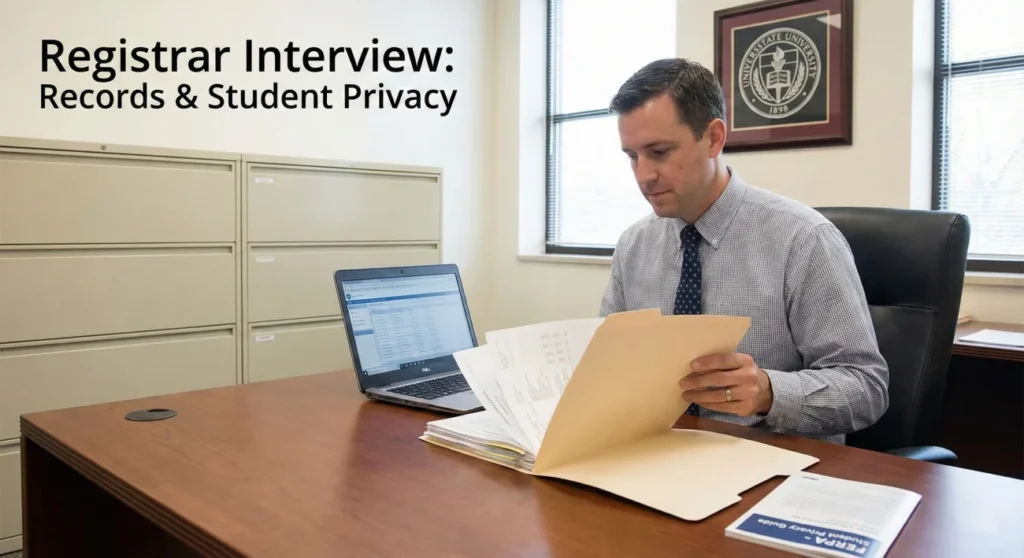
Registrar interview questions look for a rare blend: you have to protect policy and data, and still serve people who are stressed, confused, or angry. The Registrar’s office is where the university proves it can be fair, accurate, and consistent.
Interviewers will probe your judgment. Can you enforce FERPA without escalating conflict? Can you run clean processes for grade changes, audits, and commencement? Can you partner with IT on systems without losing control of data quality?
This guide helps you answer like a steward, not a gatekeeper. You will learn how to speak about compliance, operations, and service as one connected mission.
FERPA & Policy Compliance
Q: How do you ensure FERPA compliance across the university?
I view FERPA education as an ongoing process, not a one-time orientation video. I implement annual mandatory training for all staff and faculty who access student records. I also conduct “spot checks” or audits of access logs to ensure staff are only viewing records they have a legitimate educational interest in.
I create clear, accessible “FERPA Cheat Sheets” for faculty, specifically addressing common pitfalls like posting grades publicly or talking to parents without a waiver. My goal is to create a culture of privacy where protecting data is everyone’s responsibility.
Q: A parent calls demanding their child’s grades, claiming they pay the tuition. How do you handle it?
I stand firm on the law but soften the delivery. I explain, “I understand you are supporting your student, but under federal law (FERPA), once a student turns 18 or enters post-secondary education, the rights transfer to them.”
I check the system for a signed waiver. If none exists, I cannot release the info. I advise the parent to have a conversation with their student and ask the student to show them the grades via the portal. I protect the institution from liability while treating the parent with respect.
Q: How do you handle a request to change a grade?
I treat grades as the purview of the faculty, but the process is mine to police. I never change a grade based on a student’s plea or a parent’s threat. I only change a grade if there is a documented clerical error or the result of a formal grade appeal process.
I require a “Change of Grade Form” signed by the instructor and the Department Chair. I maintain an audit trail of every change. If a faculty member tries to change a grade arbitrarily (e.g., to help a student athlete play), I refer the matter to the Provost, as that is an academic integrity violation.
Q: How do you stay current with changing federal and state regulations?
I am an active member of AACRAO (American Association of Collegiate Registrars and Admissions Officers). I subscribe to their legislative updates and attend the annual conference.
I also maintain a network of peer Registrars at similar institutions. When a new regulation (like GDPR or a change in Veteran’s benefits) is proposed, we collaborate on best practices for implementation. I don’t wait for the lawsuit to tell me I’m non-compliant; I proactively audit our policies.
Operations & Systems Management
Q: What is your experience with Student Information Systems (SIS)?
I have extensive experience with [Banner/PeopleSoft/Workday]. I am not just a user; I am a “Super User.” I understand the backend architecture well enough to troubleshoot errors before calling IT.
I have led/participated in a system migration or upgrade. I know that the key to a successful system is clean data. I run regular integrity reports (e.g., checking for duplicate IDs or missing birthdates) to ensure our database is pristine.
Q: How do you manage the stress of Registration Week?
Preparation is key. I work with IT weeks in advance to load-test the servers. I publish the course schedule early so students can plan. I use “staggered registration” based on credits earned to prevent system crashes.
During the week, I set up a “War Room” or triage center (virtual or physical) to handle immediate issues like prerequisite errors. I communicate constantly with students via text/email updates. I expect chaos, so I plan for it.
Q: How do you ensure the accuracy of the Degree Audit?
The Degree Audit (e.g., DegreeWorks) is the contract between the student and the university. I adhere to the catalog strictly (“Catalog Rights”).
I work closely with Department Chairs to ensure that curricular changes are encoded correctly. If a substitution is made, it must be documented. I run “batch audits” for graduating seniors months in advance to catch missing requirements early, so no student is surprised on graduation day.
Q: How do you handle transfer credit evaluation?
I balance efficiency with academic integrity. I maintain a robust “Transfer Equivalency Database” so common courses from feeder schools are processed automatically.
For new or weird courses, I send the syllabus to the faculty subject matter expert for review. I don’t make academic judgments on content I don’t know. My goal is to give students as much credit as possible without watering down our degree.
Q: How do you manage the graduation/commencement process?
Commencement is the Registrar’s Super Bowl. It is a massive logistical operation. I focus on the data: ensuring the list of names is accurate, honors are calculated correctly, and diplomas are ordered.
I coordinate with Event Planning on the ceremony, but my role is the certification of the degree. I have a triple-check process for diplomas because misspelling a graduate’s name is a failure of our service.
Q: How do you create the Class Schedule (Master Schedule)?
I balance faculty preferences with student needs and room availability. I analyze “Heat Maps” of room usage to prevent bottlenecks. I enforce standard meeting times to minimize conflicts.
I use historical enrollment data to predict how many sections of English 101 we need. I am willing to have tough conversations with Deans about canceling low-enrolled sections to be efficient with resources.
Leadership & Crisis Management
You discover a data breach or a transcript fraud.
I act immediately to contain it. I notify the CIO (Chief Information Officer) and Legal Counsel. If it is external fraud (fake transcript), I revoke the admission/credit and document the evidence.
If it is an internal breach, I follow the incident response protocol. Transparency is vital; we must notify affected students as per law. I then conduct a “Root Cause Analysis” to patch the vulnerability, whether it was a software flaw or a human error in password security.
Faculty are complaining about a new policy you implemented.
I listen to their concerns. Often, resistance comes from not understanding the “Why.” I explain the regulatory or system reason for the change (e.g., “We have to do this to keep our financial aid eligibility”).
I ask for their input on the “How.” If the policy is non-negotiable, maybe the implementation timeline can be adjusted. I view faculty as partners, but I hold the line on compliance. I attend Faculty Senate meetings to answer questions directly.
A student needs a transcript urgently but has a financial hold.
I follow the institution’s policy, but I am aware of the changing legal landscape (some states are banning transcript withholding for debt). If our policy allows withholding, I explain it clearly and refer them to the Bursar to set up a payment plan.
If they need it for employment which would help them pay the debt, I might advocate for a temporary release if I have that discretion. I try to be a bridge, not a wall, while still respecting the university’s need to collect revenue.
Data Governance & Future Vision
Q: How do you use data to support student retention?
I use the SIS to identify “risk factors” early. I can pull reports on students who withdrew from multiple classes or whose GPA dropped significantly. I share this data with Advising and Student Success teams.
I also analyze “DFW rates” (D, Fail, Withdraw) for courses to help Deans identify curricular bottlenecks. The Registrar holds the data; my job is to turn that data into actionable intelligence for the university.
Q: What is your vision for the Registrar’s Office of the future?
I see the office moving from a “Gatekeeper” to a “Concierge.” We should automate the routine transactions (transcript ordering, enrollment verification) so my staff can focus on complex problem-solving.
I want to move toward “Comprehensive Learner Records” (CLR) that capture skills and co-curricular experiences, not just grades. I want to use technology to make the student experience seamless, removing administrative barriers to graduation.
Q: How do you manage your team?
I manage by “Cross-Training.” I don’t want a single point of failure where only one person knows how to build the schedule. Everyone should know the basics of everyone else’s job.
I encourage professional development. I set clear metrics for customer service (e.g., email response time). I celebrate accuracy and efficiency. I protect my team from abuse by angry parents, backing them up when they enforce policy correctly.
Q: Why do you want to be a Registrar?
I love the puzzle of it. I find satisfaction in the order and logic of academic policy. But more than that, I know that the Registrar is the backbone of the university. When we do our job well, students graduate, accreditation is secure, and the university runs smoothly. I want to be the steward of that trust and integrity.
Registrar Competency Quiz
Take the 20-Question Challenge
1. FERPA stands for:
- Federal Education Rights and Public Access
- Family Educational Rights and Privacy Act
- Free Education Rules and Protection Act
- Financial Emergency Response Plan Act
2. “Directory Information” under FERPA usually includes:
- Grades and GPA
- Name, dates of attendance, and degree awarded
- Social Security Number
- Race and Ethnicity
3. An “Articulation Agreement” is:
- A speech class requirement
- A formal agreement between institutions to accept transfer credits
- A faculty contract
- A student conduct rule
4. A “Hold” on a student account prevents:
- The student from entering the library
- Registration, transcript release, or graduation processing
- The student from eating lunch
- The student from using the Wi-Fi
5. AACRAO is the professional association for:
- Athletic Coaches
- Admissions and Registrar Officers
- Academic Advisors only
- Alumni Relations
6. “Census Date” is vital because:
- It is the day we count chairs
- It is the deadline for reporting enrollment for financial aid and state funding
- It is the last day of class
- It is graduation day
7. A “Degree Audit” system (like DegreeWorks) checks:
- The student’s bank account
- Progress toward graduation requirements against the catalog
- The quality of the professor
- The student’s attendance only
8. “Catalog Rights” means:
- Students can buy the catalog
- Students graduate under the requirements in effect when they entered, not when they leave
- The catalog is always right
- Students can change the catalog
9. The “National Student Clearinghouse” is used for:
- Cleaning dorms
- Verifying enrollment and degrees for employers and lenders
- Clearing snow
- Student loans only
10. “SIS” stands for:
- Student Inspection Service
- Student Information System (e.g., Banner, PeopleSoft)
- School Internal Security
- Staff Incentive Scheme
11. A “Solomon Amendment” request requires the university to:
- Teach the Bible
- Release student recruiting information to the military
- Lower tuition
- Close on Sundays
12. “IPEDS” reporting is mandatory for:
- Private schools only
- All institutions receiving federal financial aid
- High schools
- International schools only
13. “Cross-Listing” a course means:
- Teaching it angrily
- Offering the same course under two different prefixes (e.g., HIST 300 / POLS 300)
- Canceling the course
- Listing it in two semesters
14. If a student invokes their “Right to Non-Disclosure” of directory info:
- You can still tell their parents
- You must treat them as if they do not exist at the university (complete confidentiality)
- You can publish their name in the commencement program
- It expires after one year
15. “Credit Hour” definition is essential for:
- Scheduling lunch
- Federal compliance and accreditation (Carnegie Unit)
- Paying professors
- Buying books
16. A “Transcript” is:
- A summary of a meeting
- The official permanent academic record of a student
- A diploma
- A bill
17. “Prerequisite” checking prevents:
- Students from graduating
- Students from taking advanced courses without the foundational knowledge
- Professors from teaching
- Registration entirely
18. The “Common App” is primarily for:
- Graduation
- Undergraduate Admissions
- Registrars only
- Faculty hiring
19. “Reverse Transfer” involves:
- Taking away credits
- Transferring university credits back to a community college to award an Associate’s degree
- Moving backward in grades
- Refunding tuition
20. The Registrar reports typically to the:
- Athletic Director
- Provost or Vice President of Enrollment Management
- Head of Security
- Librarian
❓ FAQ
🔐 What are the most common FERPA mistakes to watch for?
Casual disclosure is the big one: talking to parents without consent, sharing screens, or leaving records visible. Explain how you train staff and build habits that prevent mistakes.
🧾 How should I talk about grade-change requests?
Emphasize process and audit trail. Grades belong to faculty, but changes require documentation, appropriate approvals, and clear records so integrity is never questioned.
🧠 What matters most in an SIS migration?
Data cleanliness and change management. You need validated rules, tested reports, and user training. A migration succeeds when the data is right and people trust the system.
🏁 How do you prevent graduation-day surprises?
Run proactive audits early. Batch checks for seniors, clear catalog-rights rules, and documented substitutions keep students from discovering missing requirements at the finish line.
🧑💼 How do you lead a Registrar team during peak seasons?
Cross-train, set triage priorities, and protect accuracy. During registration and commencement, clear roles and calm communication matter as much as staffing levels.
Final Thoughts
The strongest candidates sound methodical, calm, and service-minded. Practice explaining your processes in plain language, then show how you handle edge cases with fairness. Use this interview resource to rehearse scenarios and tighten your phrasing, and you will be ready for high-stakes Registrar interview questions without sounding robotic.
⚠️ Disclaimer: The interview strategies, sample answers, and negotiation tips provided in this guide are for educational purposes only. Hiring decisions are subjective and vary by company and industry. While these strategies are based on professional HR standards, they do not guarantee a specific job offer or result.