Turning Confusion Into Clarity
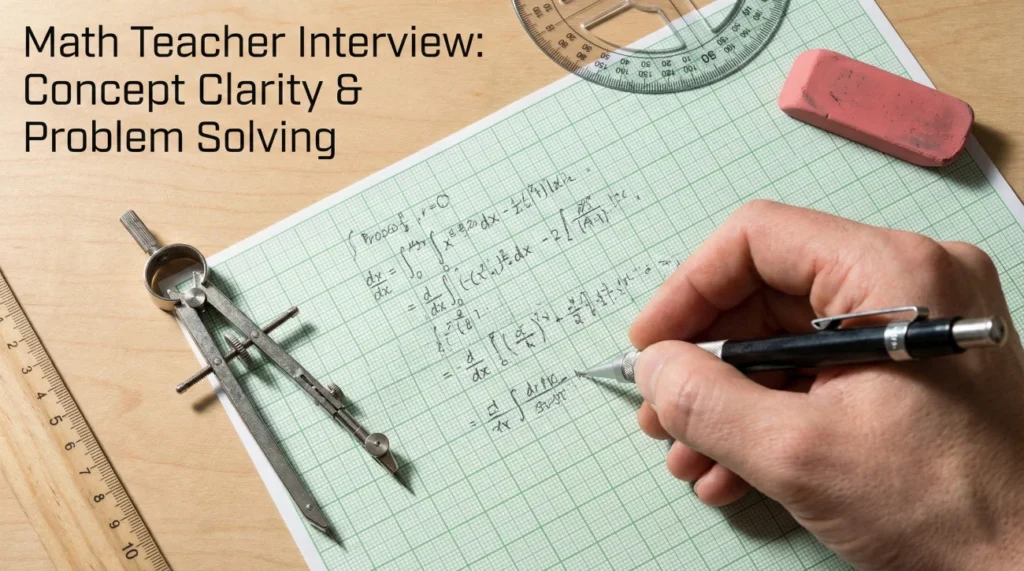
Math teacher interview questions go beyond solving problems at the board. They test whether you can translate math into ideas students can hold in their hands, then move them back toward symbols with confidence.
Modern classrooms reward reasoning, not speed. Hiring committees want to hear how you balance conceptual understanding with procedural fluency, how you surface misconceptions without embarrassing students, and how you make “show your work” mean thinking, not just writing extra lines.
You will see strategies that interview panels love, including low-floor high-ceiling tasks, quick formative checks, purposeful practice, and tech tools that visualize patterns. The thread running through it all is this: you teach students to think, not just to calculate.
Pedagogy & The “Math Mindset”
Q: How do you address the “I’m not a math person” mindset in your students?
I address this head-on by establishing a “Growth Mindset” culture on Day 1. I explicitly teach the neuroplasticity of the brain – explaining that struggling with a problem is actually when the brain grows the most. I ban phrases like “I can’t do this” and replace them with “I can’t do this yet.”
I also normalize mistakes. I do “My Favorite No” warm-ups where we analyze an incorrect answer anonymously to find the logic in the error. By showing that mistakes are valuable data points, not failures, I lower the anxiety barrier. I share stories of famous mathematicians who struggled, emphasizing that math is about persistence, not speed.
Q: Describe your lesson planning structure. How do you introduce a new concept?
I follow the “I Do, We Do, You Do” gradual release model, often wrapped in an Inquiry-Based launch. I start with a “Hook” or a “3-Act Task” – a real-world scenario that requires math to solve (e.g., “Which pizza deal is actually cheaper?”). This creates a need for the math before I introduce the procedure.
Then, I use the CRA framework (Concrete-Representational-Abstract). We might start with physical algebra tiles (Concrete), move to drawing diagrams (Representational), and finally introduce the variable notation (Abstract). This ensures students understand the concept before they just memorize the rule. The lesson ends with an Exit Ticket to gauge mastery immediately.
Q: What is the difference between “Procedural Fluency” and “Conceptual Understanding”?
Procedural Fluency is knowing how to get the answer (e.g., “invert and multiply” for dividing fractions). Conceptual Understanding is knowing why that works (e.g., understanding that dividing by 1/2 means finding how many halves fit into the whole).
My goal is to balance both. Without fluency, students get bogged down in calculation and lose the thread of the problem. Without conceptual understanding, they cannot apply the math to novel situations or word problems. I teach the concept first to build the foundation, then practice the procedure to build efficiency.
Q: How do you incorporate “Math Talks” or verbal reasoning into your class?
I believe that “if you can’t explain it, you don’t understand it.” I use Number Talks where students solve a problem mentally and share their strategies aloud. I ask probing questions like, “Did anyone solve it a different way?” or “Why did that step work?” instead of just “That’s correct.”
I also require students to write justifications for their answers. In geometry proofs or algebra word problems, simply having “x=5” isn’t full credit; they must explain the steps that led them there. This builds literacy skills within the math classroom.
Instructional Strategies & Differentiation
Q: How do you differentiate for students with vastly different skill levels?
I use “Low Floor, High Ceiling” tasks. These are problems that everyone can start (Low Floor) but that can be extended to high levels of complexity (High Ceiling). For example, “Create a shape with an area of 24.”
A struggling student might draw a 4×6 rectangle. An advanced student might draw a composite shape or use decimals. I also use station rotations where I can pull a small group for remediation on basics (like integer operations) while other students work on enrichment projects or complex applications.
Q: How do you use technology in the math classroom?
I use technology to visualize the invisible. Tools like Desmos or Geogebra allow students to manipulate graphs in real-time – sliding a variable to see how it shifts a parabola. This provides instant feedback that a textbook cannot.
I also use gamified platforms like Kahoot or Blooket for fluency reviews, but I am careful not to rely on them for deep learning. For assessment, I might use Google Forms which allows for immediate data analysis so I can adjust tomorrow’s lesson based on today’s misconceptions.
Q: What is your approach to homework?
Homework should be for practice, not for learning new material. I keep it short (15-20 minutes) and focused on content we have already practiced in class (“We Do”). I avoid sending home stumpers that require parental help, as this exacerbates equity issues.
I also use “Spiraling” in homework. Instead of 10 problems on today’s topic, I might give 4 on today’s topic and 2 reviewing last week’s topic to prevent the “learn it and forget it” cycle. I grade for completion and effort, checking for understanding in class.
Q: How do you handle common misconceptions (e.g., “multiplication makes things bigger”)?
I anticipate them during lesson planning. I explicitly introduce “Counter-Examples.” If students think multiplication always increases the value, I ask, “What happens if we multiply by 0.5?”
I use “Error Analysis” activities where I present a solved problem that contains a common mistake and ask the students to be the “detective” and find the error. This forces them to analyze the logic rather than just following steps. Confronting misconceptions directly prevents them from taking root.
Q: How do you make math relevant to students’ lives?
I avoid the generic “train A leaves the station” problems. I build projects around student interests: financial literacy (budgeting for a dream car), sports statistics (analyzing player efficiency), or art (using geometry in design).
I also bring in guest speakers or show videos of how math is used in coding, architecture, and even video game design. When students ask, “When will I ever use this?” I want to have a concrete, exciting answer that connects to their future career aspirations.
Q: How do you assess student learning beyond tests?
I rely heavily on Formative Assessment. I use whiteboards for “Show Me” moments during the lesson, allowing me to scan the room and see who has it instantly. I use exit tickets to group students for the next day.
I also use performance tasks where students must apply math to a scenario. For example, instead of a test on surface area, they might have to design packaging for a product that minimizes waste. This assesses their ability to transfer knowledge, which is the ultimate goal.
Handling Difficult Situations & Parents
A parent complains: “Why can’t you just teach the standard way? This ‘New Math’ is confusing.”
I validate their frustration first – change is hard. Then I explain the why. I might say, “The standard algorithm is great for getting an answer quickly, and we will get there. But these new strategies help Johnny understand what the numbers mean so he can do mental math and algebra later.”
I invite them to a “Math Night” or send home a video tutorial explaining the strategy. I position us as partners: “I want Johnny to be a flexible thinker, not just a human calculator. Let me show you how this area model connects to the way we multiply polynomials in high school.”
You suspect a student is cheating or using an app (like PhotoMath) to do their homework.
I address this by changing the assessment. If a machine can solve the homework, the homework might need to change. I focus more on in-class assessments where I can monitor their work.
Privately, I talk to the student: “I noticed your homework is perfect, but the quiz showed some struggles. The homework is practice for the game; if you cheat at practice, you won’t be ready for the game.” I frame it as a learning loss for them, not a moral failing, and offer help during lunch if they are cheating because the work is too hard.
A student asks a question you don’t know the answer to.
I model lifelong learning. I say, “That is a fascinating question, and I honestly don’t know the answer right now. Let’s write it on the ‘Parking Lot’ board.”
I then either research it for the next day or, better yet, assign it as a bonus challenge for the class to investigate. Teachers shouldn’t be the keeper of all knowledge; admitting I don’t know builds trust and shows students that learning is a continuous process for everyone.
Classroom Management & Logistics
Q: How do you organize your classroom for effective math learning?
I arrange desks in pods or groups to facilitate collaboration. Math is a social activity in my room. I ensure that manipulatives (rulers, calculators, blocks) are accessible in “self-serve” stations to minimize disruption.
I also have “Vertical Non-Permanent Surfaces” (whiteboards on the walls). Research shows students are more willing to take risks standing up at a whiteboard than hunched over paper. It also allows me to see everyone’s thinking from anywhere in the room.
Q: How do you handle a student who is constantly disrupted by their own anxiety?
I provide “scaffolds for anxiety.” This might be a reference sheet or a “cheat sheet” with formulas that they can keep on their desk. This removes the panic of memorization and allows them to focus on the process.
I also use discrete check-ins. A thumbs-up/thumbs-down close to their chest allows them to communicate their status without embarrassment. I celebrate their partial successes loudly and correct their errors quietly.
Q: What is your policy on calculator use?
It depends on the learning target. If the goal is number sense or fact fluency, we put the calculators away. If the goal is analyzing a complex function or modeling real-world data, the calculator is a necessary tool.
I teach students that the calculator is only as smart as the person using it. They need to estimate the answer first to know if the calculator’s result is reasonable. This prevents the “syntax error” helplessness.
Q: Why do you want to be a math teacher?
I want to be a math teacher because I want to give students the power of logic. Math is the language of the universe, and understanding it opens doors to the most exciting careers of the future. I love the moment when a concept clicks, but more than that, I love helping students rewrite their internal narrative from “I can’t” to “I can.” I want to be the teacher who makes math accessible, relevant, and yes, even fun.
Math Education Competency Quiz
Take the 20-Question Challenge
1. CRA stands for:
- Calculation, Repetition, Assessment
- Concrete, Representational, Abstract
- Counting, Reading, Arithmetic
- Complex Reasoning Application
2. “Low Floor, High Ceiling” tasks are designed to:
- Keep students seated on the floor
- Be accessible to all while offering depth for advanced learners
- Be extremely easy for everyone to get an A
- Focus solely on geometry and spatial reasoning
3. Formative Assessment is best described as:
- A final exam at the end of the year
- Ongoing checks for understanding during instruction (like exit tickets)
- Standardized state testing (SAT/ACT)
- Grading homework for accuracy only
4. Which is an example of a “Concrete” manipulative?
- Writing the equation x + 2 = 5
- Using algebra tiles or blocks to model the equation
- Drawing a picture of a balance scale
- Using a digital graphing calculator
5. “Productive Struggle” means:
- Leaving students alone until they cry
- Allowing students to grapple with a problem to build perseverance
- Giving the answer immediately to prevent frustration
- Assigning work that is far above their grade level
6. The primary goal of “Number Talks” is to:
- See who can answer the fastest
- Build mental math strategies and communicate reasoning
- Practice writing numbers neatly
- Prepare for a spelling test
7. “Scaffolding” in math might look like:
- Doing the problem for the student
- Providing a sentence starter or a multiplication chart
- Removing all difficult problems from the test
- Letting students skip the lesson
8. A common misconception about the equals sign (=) is:
- It means “is greater than”
- Thinking it means “the answer is coming” instead of “balance”
- It is just a decoration
- It is used for subtraction
9. “Inquiry-Based Learning” starts with:
- Memorizing a formula
- A question or a scenario to investigate
- A worksheet of 50 problems
- A lecture from the teacher
10. “Procedural Fluency” refers to:
- Understanding the history of math
- Skill in carrying out procedures flexibly, accurately, and efficiently
- Writing essays about math
- Knowing only one way to solve a problem
11. A “Growth Mindset” in math class emphasizes:
- That math ability is fixed at birth
- That effort and practice grow the brain’s ability
- That only boys are good at math
- That speed is the most important factor
12. “Spiral Review” means:
- Drawing circles on the paper
- Revisiting past concepts periodically to ensure retention
- Only teaching new material every day
- Getting dizzy during the lesson
13. Which tool is best for visualizing geometric transformations?
- A four-function calculator
- Dynamic geometry software (like GeoGebra)
- An Excel spreadsheet
- A dictionary
14. When a student asks “Why do we need to learn this?”, you should:
- Say “Because it’s on the test”
- Connect the concept to a real-world application or career
- Send them to the principal’s office
- Ignore the question
15. “Think-Pair-Share” is effective because:
- It gives the teacher a break
- It allows students to process ideas safely with a peer before sharing
- It increases the noise level unnecessarily
- It is required by law
16. Differentiation by “Product” means:
- Buying different supplies
- Allowing students to demonstrate learning in different ways (video, poster, test)
- Teaching different subjects
- Giving everyone the same worksheet
17. The “Flipped Classroom” model involves:
- Turning desks upside down
- Students learning content at home (video) and practicing in class
- Students teaching the teacher
- Class starting at the end of the day
18. To help a student with dyscalculia, you might:
- Tell them to try harder
- Allow the use of graph paper to align numbers and a calculator
- Remove them from the class entirely
- Ban all visual aids
19. “Metacognition” in math is:
- Doing math in your sleep
- Thinking about one’s own thinking and problem-solving process
- Memorizing the multiplication tables
- Solving metal puzzles
20. Which question promotes the deepest thinking?
- “What is the answer?”
- “How do you know your answer is reasonable?”
- “Is this correct?”
- “Did you finish?”
❓ FAQ
🎓 Do I need a math degree to teach math?
Not always. Many states allow related majors with the right certification pathway and a passing content exam. In an interview, they care most about whether you can explain concepts clearly and design lessons that build understanding, not just whether your transcript says Mathematics.
🧠 I struggled in math as a student. Is that a problem?
It can be a strength if you frame it well. You know what confusion feels like, so you are more likely to teach multiple approaches, anticipate misconceptions, and normalize productive struggle. Share one story where you turned a hard topic into a clear sequence for students.
💻 Where do technology and coding fit in a math class?
Use them to reveal patterns, not to replace thinking. Tools like graphing apps, Desmos activities, or simple spreadsheets can make functions and statistics visible. If coding appears, it is usually as modeling, logic, or data work that supports the standard you are teaching.
📚 What if the curriculum or pacing guide feels unrealistic?
Prioritize the standards that unlock everything else, like proportional reasoning or linear functions. Use quick checks to decide when to reteach, then spiral practice so gaps do not compound. Interviewers like candidates who can be flexible while still staying accountable to learning goals.
🎯 How do I keep students from guessing their way through problems?
Build routines that require reasoning: show your work, label the strategy, and explain why it makes sense. Use whiteboards, quick verbal checks, and error analysis so the class sees that the process matters. When students know you value thinking, guessing drops fast.
A Strong Finish for Math Interviews
To stand out, show how you teach thinking, not just answers. Use math teacher interview questions as a practice set and anchor every response in clarity: how you check for understanding, how you respond to mistakes, and how you move students from confusion to confidence. Math becomes memorable when students feel they belong in the reasoning.
⚠️ Disclaimer: The interview strategies, sample answers, and negotiation tips provided in this guide are for educational purposes only. Hiring decisions are subjective and vary by company and industry. While these strategies are based on professional HR standards, they do not guarantee a specific job offer or result.