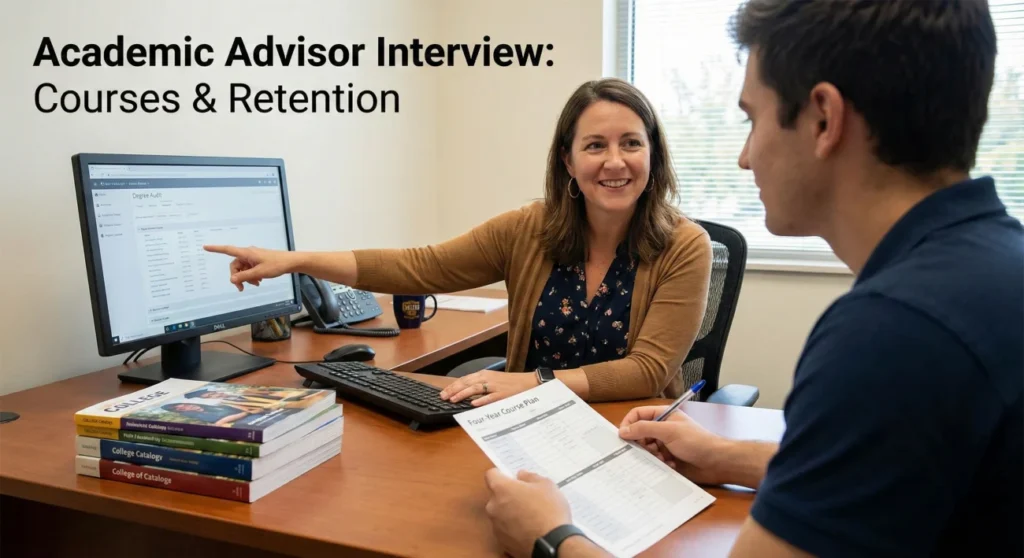
When a Student Says “I’m Lost”
Academic advisor interview questions are built to find someone who can do two jobs at once: interpret policy with precision and make a student feel safe enough to be honest. Advising is not just scheduling, it is problem-solving under time pressure.
Interviewers are watching how you think. Can you triage a crowded caseload, document cleanly, and still keep the conversation human? They want proof you can set boundaries, protect privacy, and collaborate with faculty and support services.
This guide gives you language for the hard moments: probation talks, major changes, parent calls, and the quiet emergencies students bring into an advising office.
Advising Philosophy & Models
Q: Describe your academic advising philosophy.
I subscribe to the “Teaching/Learning” paradigm of advising. I view advising not as a transactional service (signing forms) but as a pedagogical process. My goal is to teach students how to navigate the university system, make informed decisions, and take ownership of their education.
I use a blend of “Prescriptive Advising” (giving clear answers on policy) and “Developmental Advising” (exploring goals and values). I want students to leave my office not just with a schedule, but with a plan and the confidence to execute it. I measure my success by their increasing independence over their four years.
Q: What is “Appreciative Advising” and do you use it?
Yes, I use the Appreciative Advising framework (Disarm, Discover, Dream, Design, Deliver, Don’t Settle). It shifts the conversation from “What is wrong with you?” to “What are your strengths?”
Instead of starting an appointment by listing missed requirements, I start by asking, “What has been your best experience on campus so far?” This builds rapport and helps us design a degree path that aligns with their passions, which significantly increases motivation and retention.
Q: How do you handle “Intrusive” (or Proactive) Advising?
I believe proactive advising is essential for at-risk populations. I don’t wait for students to come to me. I use early alert systems to identify students who are missing classes or failing midterms.
I reach out via email, text, or phone with a supportive message: “I noticed you missed three classes; is everything okay?” This intervention often catches a problem (like car trouble or illness) before it becomes a failure. It shows the student that someone cares if they show up.
Q: How do you support First-Generation College Students?
I recognize that First-Gen students often lack the “hidden curriculum” knowledge that others take for granted (e.g., what “office hours” are, how to withdraw). I explain acronyms and processes explicitly without condescension.
I normalize help-seeking behavior. I don’t just say “Go to the tutoring center”; I walk them there or show them the website. I validate their presence at the university (“You belong here”) to combat imposter syndrome, which is a major driver of dropout rates.
Caseload Management & Scenarios
Q: How do you handle a high caseload (300+ students)?
I triage and use technology. I use group advising sessions for general information (e.g., “Registration 101” workshops) to free up 1-on-1 time for complex issues.
I use scheduling software (like Calendly) to avoid email tag. I keep detailed, concise notes in the student record immediately after every meeting so I don’t have to rely on memory. Organization is my survival skill.
Q: A student wants to major in Pre-Med but is failing Chemistry twice.
I have a “Parallel Planning” conversation. I don’t tell them “You can’t be a doctor.” I ask, “What is your backup plan if Chemistry continues to be a barrier?”
I show them the data on GPA requirements for medical school realistically. Then we explore why they want to be a doctor (helping people, science, money) and find other majors (Public Health, Nursing, Healthcare Admin) that meet those values without the chemistry bottleneck.
Q: A parent calls demanding to know their child’s grades (FERPA).
I strictly adhere to FERPA. I check if there is a signed waiver on file. If not, I say, “I cannot discuss student records without their written consent.”
However, I listen to their concerns. I can speak in generalities (“Generally, if a student misses the final, they fail”) or advise the parent on how they can talk to their student. I aim to turn the parent into a partner in encouraging the student’s autonomy, rather than an adversary.
Q: A student reveals they are homeless or food insecure.
This is a Maslow before Bloom situation. I pause the academic advising immediately. I connect them with the Dean of Students office, the campus food pantry, and emergency aid funds.
I walk them through the process of applying for support. I reassure them that this is more common than they think and they are not alone. Academic success is impossible without basic needs met, so that becomes my priority.
Q: You made a mistake and advised a student to take the wrong class.
I own it immediately. I apologize to the student sincerely. I do not make excuses. Then, I go into “Fix-It” mode.
I contact the Registrar or Department Chair to see if we can substitute the course or waive the requirement. I advocate fiercely to ensure the student is not penalized (financially or time-wise) for my error. I then analyze why it happened to prevent recurrence.
Q: A student is on Academic Probation and is discouraged.
I frame probation as a “Yellow Light,” not a “Red Light.” It’s a warning to slow down and reassess, not a stop sign.
We do a “post-mortem” on the previous semester: Was it time management? Difficulty level? Mental health? We create a strict “Academic Recovery Plan” with achievable goals (e.g., attend tutoring weekly). I meet with them bi-weekly to monitor progress and celebrate small wins to rebuild their confidence.
Career & Transfer Advising
A student wants to transfer to another university.
I support them, even though it hurts our retention numbers. My ethical duty is to the student’s best interest. I ask why – is it fit, major, or cost? If we can solve the issue here, I try.
If not, I help them understand the transfer process (transcripts, articulation agreements). Leaving on good terms is important; they might come back for grad school or speak well of us. A “successful transfer” is still a student success story.
A senior realizes they are one credit short of graduation.
I act immediately. I scour the catalog for any loop-holes, substitutions, or independent study options. I plead their case to the Dean.
If there is absolutely no way to graduate on time, I break the news with empathy and a concrete plan: “You can walk in the ceremony, and we will finish this one course in the summer session online.” I provide a clear, written path to completion so they don’t give up at the finish line.
A student asks “What can I do with a History degree?”
I connect majors to skills, not just job titles. “History teaches research, synthesis, and persuasive writing.” I show them alumni data or LinkedIn profiles of graduates in diverse fields (Law, HR, Tech).
I encourage them to visit the Career Center for an internship. I validate the liberal arts value while encouraging practical experience to build a resume. I help them articulate their skills in “employer language.”
Retention Strategies & Technology
Q: How do you use data to improve retention?
I look for “melt” points. Do we lose students after midterms? Do we lose them between Fall and Spring? I use predictive analytics to generate a “call list” of students who haven’t registered for next semester.
I target specific populations (e.g., students with a GPA between 2.0 and 2.5) who are often overlooked because they aren’t failing but aren’t thriving. A simple check-in can be the difference between staying and leaving.
Q: What is your experience with degree audit software (e.g., DegreeWorks)?
I am highly proficient. I use it not just to track progress, but to run “What If” scenarios for students considering changing majors. I teach students how to read their own audit so they aren’t dependent on me for basic questions.
I also use it to catch errors in the catalog or transfer credits. Technology is a tool for transparency, empowering students to own their timeline.
Q: How do you collaborate with faculty advisors?
I view us as a team. I handle the policy/general education side, while faculty handle the mentorship/discipline-specific side. I provide faculty with cheat sheets on new policies or software updates.
I handle the “triage” so faculty can focus on mentoring. If I see a student struggling in a specific major course, I loop the faculty advisor in (with permission) to provide content-specific support.
Q: Why do you want to be an Academic Advisor?
I want to be an Academic Advisor because I believe higher education is a transformative engine for social mobility, but only if students can navigate it. I love the puzzle of degree planning, but more than that, I love the moment a student realizes “I can do this.” I want to be the person who removes the barriers so they can focus on the learning.
Advising Competency Quiz
Take the 20-Question Challenge
1. FERPA protects:
- Faculty salaries
- Student educational records
- University budgets
- Campus police reports
2. “Prescriptive Advising” involves:
- Psychotherapy
- Giving specific, authoritative answers to questions (rules/policies)
- Asking open-ended questions
- Guessing the answer
3. “Developmental Advising” focuses on:
- Quickly signing forms
- The holistic growth of the student and goal setting
- Developing buildings
- Scheduling only
4. A “Degree Audit” is:
- A financial check
- A computerized report showing progress toward graduation requirements
- A test for the advisor
- A diploma
5. “Intrusive Advising” means:
- Being rude to students
- Proactively reaching out to students rather than waiting for them to ask
- Invading privacy illegally
- Breaking into dorms
6. “Parallel Planning” helps students:
- Double major effortlessly
- Prepare a backup major/career path in case their first choice fails
- Park their cars
- Plan parties
7. “Articulation Agreements” are between:
- Students and professors
- Institutions (e.g., Community College & University) to transfer credits
- Advisors and parents
- The Dean and the President
8. A “Hold” on a student account usually prevents:
- Walking on campus
- Registration or transcript release
- Eating in the cafeteria
- Entering the library
9. “First-Generation” students are defined as:
- The first to arrive in class
- Students whose parents did not complete a 4-year degree
- Students born in the US
- Freshmen only
10. “Gateway Courses” are:
- Courses about gates
- Introductory courses (like Chem 101) that are barriers to entry for majors
- Electives
- Senior capstones
11. “Early Alert” systems rely on:
- Advisors guessing
- Faculty flagging concerns (attendance/grades) early in the term
- Students reporting themselves
- Fire alarms
12. “SAP” stands for:
- Student Advisory Program
- Satisfactory Academic Progress (for Financial Aid)
- System of Academic Planning
- Standard Advising Protocol
13. The “Hidden Curriculum” refers to:
- Secret classes
- Unwritten rules and norms of university life (e.g., office hours)
- The syllabus
- Online courses
14. When a student is “Undecided” or “Exploratory,” you should:
- Force them to pick immediately
- Help them explore values/interests and take General Education courses
- Tell them to drop out
- Pick a major for them
15. “Credit Load” refers to:
- How much money they owe
- The number of credit hours a student takes per semester
- The weight of the books
- Credit card debt
16. “Reverse Transfer” allows:
- Students to walk backwards
- Students to transfer university credits back to a community college to earn an Associate’s
- Returning a degree
- Transferring to a high school
17. A “Transient Student” is:
- A homeless student
- A student taking courses at one institution to transfer back to their home institution
- A student who skips class
- A transfer student
18. “NACADA” is the professional organization for:
- Canadian dentists
- Academic Advising
- North American Colleges
- Career Development
19. “Imposter Syndrome” is:
- Faking a degree
- Feeling like a fraud and that you don’t belong, despite success
- Lying on a resume
- Identity theft
20. The primary goal of “Orientation” is:
- To get money
- To transition students socially and academically into the university culture
- To test students
- To sell books
❓ FAQ
🧩 Do I have to pick prescriptive or developmental advising?
You can blend both. Use prescriptive advising for rules and requirements, then shift to developmental questions to help the student choose a plan they will actually follow.
📈 How do I describe using data or early alerts?
Explain the workflow: review alerts, reach out quickly, document the interaction, and connect the student to the right resource. The key is proactive contact before the student disappears.
☎️ What do I say when a parent calls about grades?
Stay calm and follow FERPA. You can listen and provide general guidance, but you cannot share student records without consent. Offer a path: encourage the parent to speak with the student and invite the student to meet with you.
🗂️ How do I stay organized with a large caseload?
Mention systems, not heroics. Good notes, consistent follow-up tasks, and templates for common issues let you spend your energy on complex cases instead of repeating basic admin work.
🫶 How do I help a student in crisis without becoming a therapist?
Acknowledge the situation, then refer with care. You can walk them to resources, coordinate support, and adjust an academic plan, but you should not try to treat mental health issues yourself.
Final Thoughts
Your best answers show a repeatable process: listen, clarify the goal, check policy, offer options, and follow up. Practice that rhythm with this interview prep list, and you will sound like the advisor who can keep students moving forward, even when the day starts with Academic advisor interview questions.
⚠️ Disclaimer: The interview strategies, sample answers, and negotiation tips provided in this guide are for educational purposes only. Hiring decisions are subjective and vary by company and industry. While these strategies are based on professional HR standards, they do not guarantee a specific job offer or result.