Safety Is a Choice You Repeat
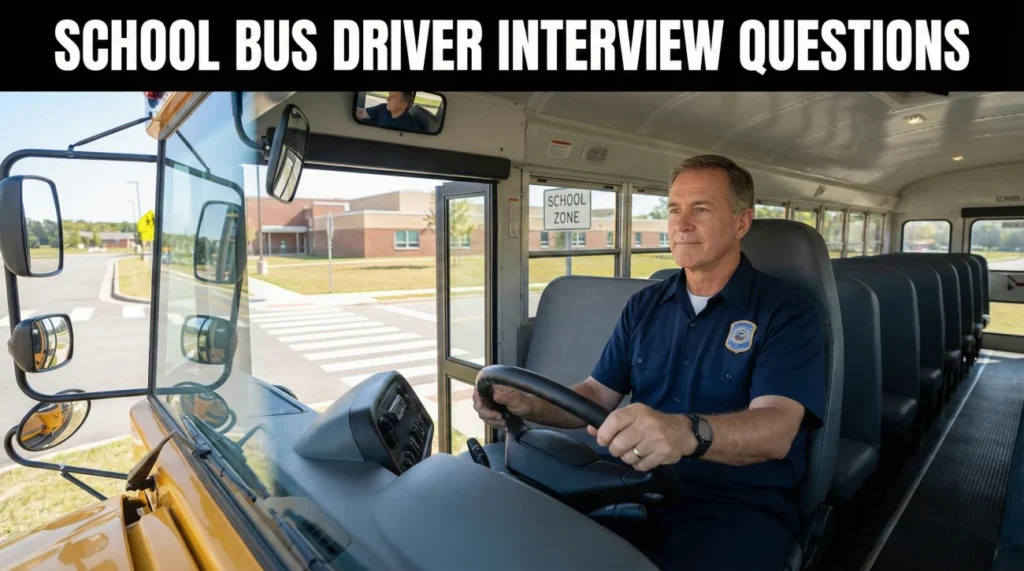
School bus driver interview questions are really a trust test. Anyone can say they drive carefully. The district needs proof that you will do the safe thing every time, even when you are late, even when kids are loud, even when the weather is ugly.
Expect questions about pre-trip checks, railroad crossings, and emergency procedures, but also about people skills. You are managing student behavior while operating a large vehicle, and you are often the first adult a student sees each morning. Your answers should show patience, authority, and the discipline to stop the bus when safety requires it.
This guide focuses on the moments that matter: inspections, student behavior management, communication with dispatch and families, and what you do when something goes wrong. If you speak in clear steps and keep safety as the headline, your interview will feel reliable.
Safety Protocols & Pre-Trip Inspections
Q: Walk me through your pre-trip inspection routine.
I follow a systematic checklist every single day, no shortcuts. Outside, I walk the entire perimeter checking tire pressure and tread depth, looking for fluid leaks, testing all lights including stop arms and amber flashers, and inspecting mirrors and windows for cracks or damage.
Inside, I test every emergency exit and window to ensure they open properly. I verify the fire extinguisher is charged and accessible, the first aid kit is stocked, and the two-way radio works. I check that all seats are secure and the aisle is completely clear. I test the brakes before leaving the lot. If anything fails, the bus does not move until maintenance clears it.
Q: What issues would cause you to take a bus out of service?
Any brake system problem is an automatic no-go. Malfunctioning stop arms or warning lights, because those protect kids crossing the street. Emergency exit failures, steering problems, or windshield damage that obstructs vision. Fluid leaks that could indicate serious mechanical issues.
I do not negotiate on safety. No trip is worth risking children’s lives. I document the issue, report to the maintenance supervisor immediately, and request a replacement vehicle. Some drivers feel pressure to “make it work” but I refuse. My CDL and the kids’ safety matter more than being on time.
Q: How do you ensure students board and exit safely?
At stops, I activate all warning systems: amber flashers when approaching, red flashers and stop arm when fully stopped. I verify all traffic has stopped before opening the door. I watch mirrors constantly. Students crossing in front of the bus must walk far enough forward that I can see their feet, and I wait until they are completely clear before moving.
I count students on and off at every stop. If a count does not match, I investigate before moving. I teach students the danger zones around the bus on the first day of school. For younger children, I may need to physically escort them across or ensure a parent is present at the stop.
Q: What traffic laws specific to school buses do you follow?
School buses have unique legal requirements. I must stop at all railroad crossings, open the door, and listen before proceeding, even if signals show the track is clear. I follow reduced speed limits in school zones exactly. I never pass another school bus that is loading or unloading.
I understand that my stop arm creates a legal obligation for other vehicles, but I never assume they will stop. I watch for violators and report them. I know the state-specific rules about when students must cross in front versus behind the bus. Following these laws is not optional; violating them risks children’s lives and my CDL.
Q: Do you have the required CDL and endorsements?
Yes. I hold a valid Commercial Driver’s License with both the Passenger (P) endorsement and the School Bus (S) endorsement. I have completed the required written tests and skills tests specific to school bus operation. My medical certificate is current, and I pass all required physical examinations.
I maintain a clean driving record with no DUIs or serious violations. I understand that any drug or alcohol violation would disqualify me. I take random testing seriously because impaired driving with children aboard is unthinkable. I keep copies of all documentation current and accessible.
Q: How do you handle adverse weather conditions?
Weather changes everything. In rain, fog, or snow, I reduce speed significantly below normal limits. I increase following distance and brake earlier. I turn on all lights for visibility. If conditions deteriorate beyond safe driving, I pull over and contact dispatch rather than risk an accident.
I check weather forecasts before routes and communicate with dispatch about conditions I encounter. If roads are icy, I report it so the district can decide whether to delay or cancel routes. I never let schedule pressure override safety judgment. Arriving late is always better than not arriving at all.
Student Behavior Management
Q: How do you establish rules and expectations with students?
On the first day of school, I give a brief safety orientation. I explain the rules clearly: stay seated, keep hands and head inside, no throwing objects, use inside voices. I explain why each rule exists, connecting it to safety rather than just authority. Kids follow rules better when they understand the reason.
I post rules visibly on the bus. I am consistent from day one because letting things slide early makes enforcement harder later. I introduce myself, learn names quickly, and establish that I am friendly but serious about safety. First impressions matter with kids just like with adults.
Q: A student refuses to sit down while you are driving. What do you do?
I give one clear verbal warning while keeping my eyes on the road: “Please sit down now for your safety.” If they do not comply, I pull over to a safe location. I cannot drive safely while a student is standing. Once stopped, I address them directly and calmly explain that the bus will not move until everyone is seated.
If the behavior continues, I document it and report to the school. Repeated offenses may result in assigned seating or suspension of bus privileges. I never physically force a student to sit, but I also never compromise by driving with a standing passenger. The inconvenience of being late is nothing compared to what happens if I brake suddenly with a standing child.
Q: Describe how you handled a difficult or disruptive student.
I had a student who consistently bullied younger kids in the back of the bus. I first addressed it directly, moving him to a front seat where I could monitor him. I spoke with him privately about why the behavior was unacceptable and how it affected others.
When it continued, I documented every incident and contacted the school. I also called the parents to discuss the situation collaboratively. We developed a behavior plan together. Over several weeks, with consistent enforcement and communication, the behavior improved. The key was not giving up after one conversation but following through persistently while treating the student with respect.
Q: How do you handle bullying on the bus?
Bullying is not tolerated. If I witness it, I address it immediately by separating the students and making clear the behavior must stop. I document what I observed with specific details: who, what, when. I report to the school administration the same day so they can follow up with appropriate interventions.
I watch for signs even when I cannot see everything: a student who suddenly wants to change seats, kids who seem afraid of certain others, unusual quietness. I create an environment where students feel safe reporting problems to me. Some kids test whether adults will actually do something; I prove that I will.
Q: What do you do about students who miss the bus or are late to the stop?
I follow district policy on wait times, usually about one minute at each stop. I cannot wait indefinitely because it makes the entire route late and affects dozens of other students. If a regular student is not at the stop, I note it and continue.
If parents request special accommodations or route changes, I explain that those requests go through the transportation office. I am polite but clear that I do not have authority to modify routes. I provide the correct contact information. Consistency matters because making exceptions for one family creates problems when others expect the same treatment.
Emergencies & Special Situations
You notice smoke coming from under the hood while driving. What do you do?
I immediately activate hazard lights and pull over to a safe location away from traffic. I turn off the engine, set the parking brake, and open the door. I instruct students to remain calm and evacuate through the rear emergency exit, moving at least 100 feet away from the bus and upwind of any smoke.
I do a headcount to ensure all students are accounted for. I call 911 if there is fire or significant smoke, then contact dispatch. I never open the hood myself if I suspect fire because oxygen feeds flames. I stay with students until emergency services or another bus arrives. Documentation happens after everyone is safe.
A student has a medical emergency on the bus. How do you respond?
I pull over safely and assess the situation. For serious emergencies like seizures, allergic reactions, or loss of consciousness, I call 911 immediately. I have basic first aid training and will provide what assistance I can within my training while waiting for paramedics.
I contact dispatch and the school so they can notify parents. I keep other students calm and away from the situation. For students with known medical conditions, I review their health plans at the start of the year so I know specific protocols, like where a diabetic student’s supplies are kept or how to use an EpiPen if trained and authorized.
You are involved in a minor accident with no injuries. What steps do you take?
First, I check all students for injuries even if the impact seemed minor. I secure the bus with parking brake and hazards. I do not move the bus unless it creates a traffic hazard. I call dispatch immediately to report the accident and request guidance on next steps.
I exchange information with the other driver but do not admit fault or discuss details beyond basic facts. I take photos of damage and the scene if safe to do so. I get contact information from any witnesses. I complete an incident report with detailed documentation. Even minor accidents require proper reporting because what seems minor can have delayed consequences.
How do you handle transporting students with special needs?
Before a special needs student joins my route, I review their transportation IEP accommodations to understand their specific needs. This might include wheelchair securement procedures, harness requirements, sensory accommodations, or behavioral strategies. I communicate with parents and the school about any concerns or questions.
I treat every student with dignity and patience. Some students need more time boarding, specific seating arrangements, or particular communication approaches. I learn what works for each individual. For students with mobility devices, I am trained on proper securement and verify everything is locked before moving. The goal is safe transportation that respects each student’s needs.
CDL & Safety Knowledge Check
20 Practice Questions
1. School bus drivers must stop at railroad crossings and:
- Honk the horn three times
- Open the door, look, and listen before proceeding
- Flash headlights at oncoming traffic
- Speed across quickly
2. The “S” endorsement on a CDL is required for:
- Standard passenger vehicles
- School bus operation specifically
- Semi-trucks only
- Special cargo
3. When loading students, the stop arm should be activated:
- Before approaching the stop
- When the bus is fully stopped and ready to load
- After students have boarded
- Only in school zones
4. A student standing while the bus is moving requires:
- Ignoring until the route ends
- Verbal warning and pulling over if not obeyed
- Continuing to drive carefully
- Physical intervention
5. Pre-trip inspections should be conducted:
- Weekly
- When problems are suspected
- Before every route, every day
- Monthly
6. The danger zone around a school bus extends approximately:
- 5 feet
- 10 feet in all directions
- 20 feet behind only
- 3 feet
7. Students crossing in front of the bus should walk:
- Directly in front of the bumper
- Far enough forward that the driver can see their feet
- Behind the bus
- As quickly as possible
8. Brake failure while driving requires:
- Pumping the gas pedal
- Downshifting, using parking brake gradually, and finding a safe stop
- Turning off the engine immediately
- Jumping from the vehicle
9. In adverse weather, school bus drivers should:
- Maintain normal speed to stay on schedule
- Reduce speed and increase following distance
- Use cruise control for consistency
- Skip pre-trip inspection to save time
10. When evacuating a bus, students should move to a location:
- 10 feet from the bus
- At least 100 feet away, upwind if smoke is present
- Inside nearby buildings
- Across the street
11. Documentation of student behavior incidents should include:
- Only the student’s name
- Who, what, when, where, and actions taken
- Your opinion of the student
- Nothing unless it was serious
12. Fire extinguishers on school buses should be:
- Stored in a locked compartment
- Fully charged, accessible, and checked during pre-trip
- Used only by trained mechanics
- Kept in the driver’s personal vehicle
13. A DUI conviction for a CDL holder results in:
- A warning
- Temporary suspension
- CDL disqualification and inability to drive school buses
- No consequence if off-duty
14. Amber warning lights are activated:
- When approaching a stop to warn traffic to slow down
- Only in emergencies
- When students are crossing
- At night only
15. Wheelchair securement on a school bus must be:
- Done by the student
- Verified by the driver before moving
- Checked only at the start of the year
- Optional if the student prefers
16. After an accident with no injuries, the driver should:
- Continue the route if the bus is drivable
- Secure the bus, check students, contact dispatch, document everything
- Admit fault to speed up the process
- Wait until the end of the day to report
17. Parent requests for route changes should be:
- Accommodated by the driver
- Directed to the transportation office
- Ignored
- Approved if the parent is persistent
18. A student with a seizure disorder requires:
- No special preparation
- Review of their health plan and knowledge of emergency protocols
- Removal from the bus route
- Constant monitoring by a second adult
19. Following distance in normal conditions should be:
- 1 second per 10 feet of vehicle
- At least 4 seconds, more in poor conditions
- Close enough to read license plates
- Whatever keeps up with traffic
20. The most important quality in a school bus driver is:
- Speed and efficiency
- Strict discipline
- Commitment to student safety above all else
- Mechanical knowledge
❓ FAQ
🪪 What license and endorsements are required to drive a school bus?
Most districts require a CDL with passenger and school bus endorsements, plus a current medical certification and background checks. Requirements are state-specific, so mention that you keep credentials current and follow all testing and renewal rules without shortcuts.
⏱️ What are typical school bus driver hours like?
Many routes are split shifts with morning and afternoon runs, plus occasional field trips or activity routes. A strong interview answer shows you are dependable with early starts, consistent with timing, and comfortable with the rhythm of busy peaks and quieter midday windows.
🧰 Do districts train new drivers, or do I need experience first?
Many districts provide training, including safety procedures, route practice, and student management expectations. Interviewers want to hear that you take training seriously and stick to policy, not that you improvise. Emphasize coachability and consistent routines.
🩺 Are health checks and drug testing part of the job?
Yes, school transportation roles usually involve DOT-related medical requirements and drug and alcohol testing. In an interview, lean into this: you understand the responsibility and you welcome accountability because children’s safety is non-negotiable.
👨👩👧 Can I drive routes where my own children ride?
Often yes, depending on district policy and scheduling. If asked, focus on professionalism: you follow the same rules, maintain the same boundaries, and treat every student with the same standard of safety and respect.
Last Word
Answer school bus driver interview questions like someone who has a safety routine, not just good intentions. Be specific about inspections, stopping protocols, and how you handle behavior without taking your focus off the road.
When the panel hears consistency, they feel relief. That is the job: show up, follow procedure, stay calm, and get kids home safely every single day.
⚠️ Disclaimer: The interview strategies, sample answers, and negotiation tips provided in this guide are for educational purposes only. Hiring decisions are subjective and vary by company and industry. While these strategies are based on professional HR standards, they do not guarantee a specific job offer or result.