The Advocate and The Strategist
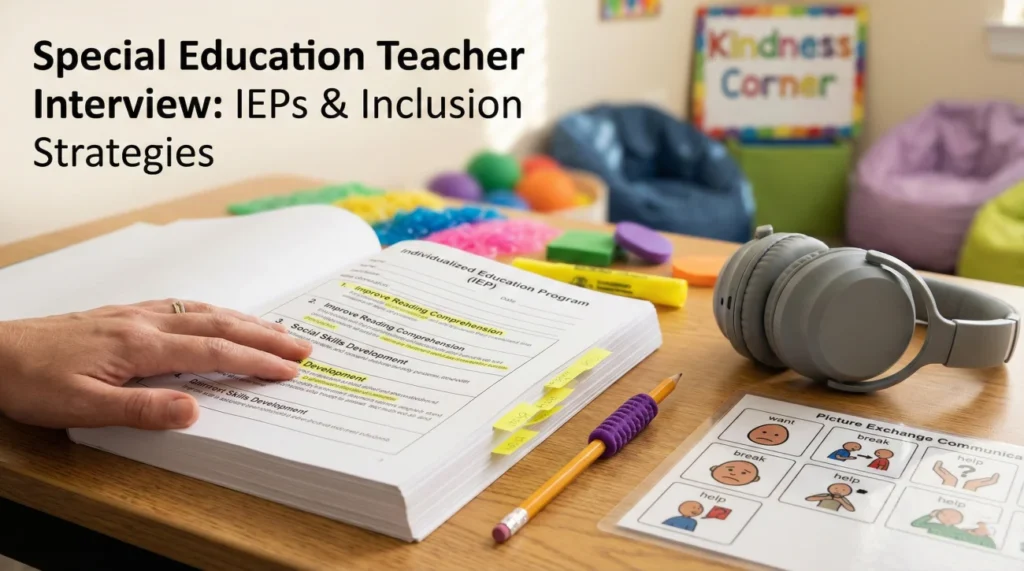
Special education teacher interview questions are among the most rigorous in the education field because the role is a complex hybrid of legal scholar, data analyst, behavioral therapist, and instructional designer. Administrators are not just looking for someone who loves children; they need a professional who understands the legal weight of an Individualized Education Program (IEP) and can navigate the delicate dynamics between general education teachers, worried parents, and district administrators.
The focus has shifted heavily toward “Inclusion” and “Co-teaching.” The days of the isolated resource room are fading. Hiring committees want to know: Can you modify a Grade 10 Geometry lesson for a student with a 3rd-grade reading level? How do you handle a student who flips a desk? Can you write an IEP goal that is legally defensible and data-driven? Your answers must prove that you can balance the empathy required to connect with students with the precision required to comply with federal laws like IDEA.
This guide goes beyond the standard definitions. We dive into the tactical realities of the job, from IEP meeting strategies that diffuse tension to managing paraprofessionals effectively. Whether you are applying for a self-contained classroom or an inclusion specialist role, these strategies will help you demonstrate your expertise in handling behavioral meltdowns and driving student growth.
Legal Foundations & Core Concepts
Q: How do you explain the difference between an IEP and a 504 Plan to a parent?
This is a fundamental question. I explain that an IEP (Individualized Education Program) is driven by the Individuals with Disabilities Education Act (IDEA) and provides specialized instruction and related services for students with one of the 13 qualifying disabilities who need more than just the general curriculum. It comes with strict goals, progress monitoring, and legal procedural safeguards.
A 504 Plan, stemming from the Rehabilitation Act of 1973, is a civil rights document focused on access. It prevents discrimination by providing accommodations (like preferential seating or extra time) to level the playing field, but it does not typically include specialized instruction or modified curriculum. I use the analogy: A 504 opens the door so the student can get in; an IEP redesigns the room and the lesson so the student can learn.
Q: What is your process for writing “Smart” IEP goals?
I adhere strictly to the SMART framework: Specific, Measurable, Achievable, Relevant, and Time-bound. I start with the “Present Levels of Academic Achievement and Functional Performance” (PLAAFP) data. You cannot set a destination if you don’t know the starting point.
For example, instead of writing “Student will improve reading,” I write: “By May 2025, given a 3rd-grade level passage, the student will read 110 words per minute with 90% accuracy across 3 consecutive trials as measured by bi-weekly running records.” This protects the district legally and, more importantly, gives the instructional team a clear target to hit.
Q: Explain “Least Restrictive Environment” (LRE) and how you support it.
LRE means a student should spend as much time as possible with non-disabled peers in a general education setting. It is not a place; it is a principle. My job is to provide the scaffolding – accommodations, modifications, and push-in support – that allows the student to succeed in that environment.
I support LRE by collaborating closely with general education teachers to front-load vocabulary, modify assessments, and provide assistive technology. I only advocate for a more restrictive setting (like a pull-out room) when data proves that the student cannot make progress in the general ed classroom even with maximum support.
Q: How do you track data for progress monitoring?
Special education data collection is the backbone of the IEP. I don’t rely on memory or feelings. I use a mix of methods depending on the goal. For behavioral goals, I might use ABC charts (Antecedent-Behavior-Consequence) or frequency/duration logs. For academic goals, I use curriculum-based measurement probes (CBMs) and exit tickets.
I organize this data into digital folders for each student, often visualizing it with simple graphs. This allows me to show parents concrete evidence of growth or regression during meetings. If the data shows a line remaining flat for 6 weeks, I know I need to change my instructional intervention immediately.
Collaboration & Scenario Management
Q: A general education teacher resists following a student’s IEP accommodations.
I approach this as a partnership, not a policing action. Often, resistance comes from feeling overwhelmed, not malicious intent. I schedule a private time to talk and say, “I know you have 30 students, and tracking Johnny’s extended time is a lot. How can I make this easier for you?”
I might offer to create a checklist for them or modify the tests myself before they are given out. However, if the refusal continues despite support, I firmly but professionally remind them that the IEP is a federal legal document, and non-compliance puts their license and the district at risk. I document our interactions to protect the student’s rights.
Q: How do you handle a contentious IEP meeting with angry parents?
I lead with empathy and data. Anger usually stems from fear that their child is being left behind. I start by validating their feelings: “I can hear how worried you are, and we all want the same thing: for Sarah to succeed.”
Then, I pivot to the evidence. I show work samples and data points that objectively illustrate the student’s current reality. I avoid educational jargon. Instead of saying “He has a deficit in phonemic awareness,” I say, “He is struggling to match sounds to letters.” I ensure the parents leave feeling heard and part of the team, rather than adversaries.
Q: Which co-teaching model do you prefer and why?
While “One Teach, One Assist” is common, I prefer “Station Teaching” or “Parallel Teaching” because they lower the student-to-teacher ratio and increase engagement. In Station Teaching, my co-teacher might lead a group on concept review, I lead a group on guided practice with targeted modifications, and a third group does independent work.
These co-teaching models allow me to provide specialized instruction to students with IEPs without singling them out, as every student rotates through the stations. It truly blends the expertise of both teachers.
Q: How do you manage and utilize paraprofessionals effectively?
Managing paraprofessionals requires clear communication and respect. They are often the ones spending the most time with the students. At the start of the year, I create a “Paraprofessional Handbook” outlining expectations, schedules, and specific student needs.
I treat them as instructional partners, not just clerical help. I explain why an intervention is used, not just what to do. I check in weekly to ask for their observations, as they often notice behavioral triggers that I might miss while teaching the whole group.
Q: How do you differentiate a lesson for a student with significant needs?
I differentiate by Content, Process, and Product. If the class is reading a novel, a student with significant reading delays might listen to the audiobook (Process) or read a graphic novel version (Content).
For the assessment, instead of writing a 3-page essay, they might create a storyboard or give an oral presentation (Product). The key is to ensure they are mastering the standard (e.g., identifying themes) even if the method of access is modified.
Q: How do you determine if a student needs a Behavior Intervention Plan (BIP)?
When a behavior consistently impedes the student’s learning or the learning of others, and standard classroom management isn’t working, I initiate a Functional Behavioral Assessment (FBA). I collect data to identify the “Function” of the behavior: Is it for attention, escape, access to a tangible, or sensory input?
Once we know the why, we create the BIP. If the student flips desks to escape difficult math work, the BIP might teach them to ask for a “break card” (Replacement Behavior) and reward them for completing small chunks of work.
Behavioral Crisis & De-escalation
A student is having a severe meltdown, screaming and throwing items. Steps?
Safety is the immediate priority. I clear the room or move other students to a safe area (“Room Clear”) to remove the audience and potential targets. I stay calm and maintain a non-threatening posture: hands visible, standing at an angle, giving them space.
I use minimal verbal prompts. A dysregulated brain cannot process a lecture. I might repeat a simple “safe phrase” or just wait. I do not physically intervene unless there is an imminent threat of serious bodily harm to themselves or others, following CPI/Safety-Care training protocols. After the incident, when the student is calm, we debrief and document exactly what happened.
A student shuts down and refuses to do any work for days.
I view refusal as a form of communication. They are likely saying, “This is too hard,” “I’m afraid to fail,” or “I’m tired.” I stop focusing on the compliance and focus on the connection. I might sit with them and say, “I see you’re stuck. Let’s just do number one together.”
I often use a “First-Then” board: “First do two math problems, Then you get 5 minutes of drawing.” I look for ways to build momentum with easy wins to rebuild their confidence. I also check with home – did they sleep? Are there issues in the family? Context changes everything.
You suspect a student is being bullied because of their disability.
I have zero tolerance for this. I address it immediately but discreetly to avoid making the student a bigger target. I increase supervision in unstructured areas like hallways and lunchrooms.
I speak with the victim to reassure them and get details. Then, I report it to administration for formal investigation as harassment. Simultaneously, I work on peer education in the classroom (if appropriate and respecting privacy) to build empathy and a culture of inclusion, so other students become allies rather than bystanders.
Caseload Management & Organization
Q: How do you stay organized with the massive amount of Special Ed paperwork?
I live by my “Master Spreadsheet” and digital calendar. At the beginning of the year, I map out every Annual Review and Re-evaluation due date. I set reminders 30 days out, 14 days out, and 3 days out.
I use a “Compliance Checklist” for every file to ensure no signature or procedural safeguard is missed. I also dedicate specific blocks of time in my schedule solely for paperwork – treating it as a non-negotiable appointment – so it doesn’t bleed into instructional time or my personal life.
Q: How do you keep up with changing Special Education laws?
I am a lifelong learner. I subscribe to newsletters from the Council for Exceptional Children (CEC) and my state’s Department of Education. I attend district professional development sessions religiously.
I also consult with my district’s Program Specialist whenever I encounter a gray area. In Special Education, “I didn’t know” is never a valid defense, so I proactively seek out the correct legal interpretations.
Q: What is your strategy for communicating with families who don’t speak English?
I use the district’s translation services for all official documents and meetings. It is their legal right to understand the IEP. I never rely on the student or a sibling to translate, as that breaches confidentiality and puts unfair pressure on the child.
For informal communication, I use apps like TalkingPoints or Remind that automatically translate messages. I make an extra effort to share “Good News” calls, so the only time they hear from me isn’t through a translator about a problem.
Q: Why did you choose Special Education?
I chose this field because I believe that fair does not mean equal; fair means everyone gets what they need. I love the puzzle of figuring out how a student learns. There is no greater feeling than seeing a student master a skill that everyone else said they couldn’t do. I want to be the advocate that ensures their potential isn’t limited by their disability.
Special Education Competency Test
Test Your SpEd Knowledge (20 Questions)
1. What does FAPE stand for?
- Funding for All Public Education
- Free Appropriate Public Education
- Fully Accessible Private Education
- Federal Association of Public Education
2. LRE stands for:
- Learning Resource Environment
- Least Restrictive Environment
- Legal Rights in Education
- Limited Restricted Education
3. An IEP must be reviewed at least:
- Every 3 years
- Annually (Once a year)
- Every semester
- Every month
4. A Re-evaluation (Triennial) occurs every:
- 1 year
- 2 years
- 3 years
- 4 years
5. Which law governs IEPs?
- IDEA (Individuals with Disabilities Education Act)
- ADA (Americans with Disabilities Act)
- ESSA (Every Student Succeeds Act)
- FERPA (Family Rights and Privacy Act)
6. What is the first step before creating a BIP?
- Meeting with the principal
- Functional Behavioral Assessment (FBA)
- Calling the police
- Suspending the student
7. “Accommodations” primarily change:
- What the student is expected to learn (curriculum)
- How the student accesses learning (environment)
- The school’s grading policy
- The length of the school day
8. “Modifications” primarily change:
- The complexity/level of the curriculum content
- Where the student sits in class
- The method of communication
- The format of the test
9. Who is a REQUIRED member of the IEP team?
- The school nurse
- A General Education Teacher
- The librarian
- The guidance counselor
10. “RTI” or “MTSS” focuses on:
- Special education funding
- Multi-tiered interventions before referral
- Testing for gifted programs
- Teacher performance evaluation
11. A “Specific Learning Disability” (SLD) includes:
- Visual impairment
- Dyslexia, Dysgraphia, or Dyscalculia
- Hearing impairment
- Emotional disturbance
12. If a parent refuses to sign the initial IEP:
- You implement it anyway
- Services cannot be provided
- You file for due process immediately
- You expel the student
13. “Procedural Safeguards” refers to:
- Emergency evacuation protocols
- Parental rights under IDEA law
- Teacher contract negotiations
- Standardized testing rules
14. Which is a formal data collection method for behavior?
- Anecdotal notes in a diary
- ABC (Antecedent-Behavior-Consequence) Chart
- Asking classmates for their opinion
- Reviewing last year’s report card
15. “Push-in” services typically mean:
- Student goes to the resource room
- Special Ed teacher joins the General Ed class
- Student works in the hallway
- Paraprofessional takes student to library
16. Assistive Technology (AT) includes:
- Only computers and tablets
- Any item (low or high tech) that increases capability
- Only wheelchairs and ramps
- Only speech-generating devices
17. Federal law requires “Transition Planning” to begin by age:
- 14
- 16
- 18
- 21
18. Extended School Year (ESY) is determined by:
- Parent request only
- Data showing regression and slow recoupment
- Failing grades in math
- Availability of summer staff
19. If a student is suspended for >10 days, you hold a:
- Expulsion Hearing
- Manifestation Determination Review (MDR)
- Parent-Teacher Conference
- Behavior Intervention Meeting
20. “OHI” is the eligibility category often used for:
- Specific Learning Disabilities
- ADHD / ADD
- Orthopedic Impairment
- Intellectual Disability
❓ FAQ
📜 Do I need a specific Master’s degree?
While not always mandatory for entry-level positions, most states require a Master’s in Special Education for permanent certification or licensure. Many teachers start with a Bachelor’s and an initial certificate, then complete their Master’s while teaching.
🤯 How do you handle burnout?
Burnout is high in SpEd due to the paperwork and emotional intensity. Successful teachers set strict boundaries (no email after 5 PM), rely on their team for support, and focus on the small wins. Celebrating the tiny steps of progress is essential for mental longevity.
📂 What is a typical caseload size?
It varies wildly by state and setting. A resource teacher might have 20-30 students on their caseload (tracking paperwork), while a self-contained teacher might have 8-12 students with more intense needs. Legal caps exist in some states but not all.
🤝 How do I collaborate with Related Service Providers?
You are the case manager, so you are the “quarterback.” You coordinate with Speech Pathologists (SLP), Occupational Therapists (OT), and Physical Therapists (PT). You ensure their service minutes are being met and integrate their strategies (e.g., sensory breaks suggested by OT) into the daily classroom routine.
💼 Is the pay different from General Ed?
In most public school districts, the salary scale is the same based on years of experience and education. However, some districts offer a “stipend” or signing bonus for Special Education teachers because it is a critical shortage area.
Final Thoughts
To secure a position, your answers to special education teacher interview questions must show that you are more than just patient; you are a skilled technician of learning. Districts need teachers who can manage the legal complexities of the IEP process while creating a warm, inclusive environment where every child feels valued.
Highlight your ability to collect data, de-escalate behavior, and collaborate with general education colleagues. If you can prove you are a partner who lightens the load rather than adding to it, you will be the candidate they hire.
⚠️ Disclaimer: The interview strategies, sample answers, and negotiation tips provided in this guide are for educational purposes only. Hiring decisions are subjective and vary by company and industry. While these strategies are based on professional HR standards, they do not guarantee a specific job offer or result.