Teaching in the Transition Zone
Middle school teacher interview questions address one of the most challenging and rewarding phases of education: the bridge between childhood and young adulthood. Hiring managers know that middle school (grades 6-8) is a cauldron of hormonal changes, identity formation, and social pressure. They are looking for educators who not only know their subject matter but also possess the emotional intelligence to navigate the “rollercoaster” of adolescent development.
You will be tested on your ability to connect with students who might be apathetic one minute and hypersensitive the next. Can you explain how you handle defiance without power struggles? How do you make ancient history or algebra relevant to a 13-year-old obsessed with social media? Do you understand the team-teaching model often used in middle schools?
This guide dives deep into the pedagogy of the “tween” years. We explore strategies for channelizing adolescent energy into learning, the importance of “advisory” periods, and how to manage the unique discipline challenges of this age group using restorative practices. These answers will help you prove you have the grit and the humor required to thrive in the middle.
Adolescent Psychology & Engagement
Q: How do you engage students who appear unmotivated or “too cool” for school?
Apathy in middle school is often a defense mechanism against failure or social judgment. I tackle this with Relevance and Choice. I don’t just teach the curriculum; I connect it to their world. If we are studying persuasion in English, we analyze the rhetoric of their favorite YouTubers or influencers, not just old speeches.
I also provide “Voice and Choice.” Instead of assigning one type of project, I offer a menu: write a rap, build a Minecraft model, or create a podcast. When students have agency over how they demonstrate learning, buy-in increases. I build relationships first; a middle schooler won’t learn from you if they think you don’t like them.
Q: Describe your understanding of the “Imaginary Audience” concept and how it affects your teaching.
Adolescents often believe everyone is watching and judging them (the “Imaginary Audience”). This creates intense anxiety about public failure. In my classroom, I structure participation to lower the social stakes. I use tools like Pear Deck or Nearpod so students can answer anonymously on their screens before sharing out loud.
I avoid “Cold Calling” unless I’ve given them time to “Turn and Talk” with a partner first. This rehearsal builds confidence. I praise effort privately rather than publicly if I know a student is shy, preventing the embarrassment of being “teacher’s pet.” Understanding this psychological reality prevents me from putting students in situations that trigger a shutdown.
Q: How do you handle the “Drama” (social conflict) that spills into the classroom?
Social conflict is the curriculum of middle school. I don’t dismiss it as “drama”; to them, it feels like life or death. If a conflict disrupts learning, I use a “Parking Lot” strategy. I acknowledge the emotion: “I see you’re upset, and that matters.”
Then I set a boundary: “Right now, we need to focus on this lab. Put the issue in the ‘Parking Lot’ (write it down or mentally file it), and I promise we will discuss it at lunch or during advisory.” This validates their feelings without derailing the lesson. I also incorporate Social-Emotional Learning (SEL) explicitly, teaching skills like perspective-taking and impulse control during advisory periods.
Q: What is your approach to homework for this age group?
Middle schoolers are developing executive function but aren’t there yet. They often have 6-7 different teachers for the first time. I coordinate with my grade-level team to ensure we aren’t all assigning big projects due on the same day.
My homework philosophy is “quality over quantity.” It should be practice of skills learned in class, taking no more than 20 minutes. I post all assignments on the LMS (Google Classroom) so parents can see them, as students often say “I have no homework.” I teach them how to use a planner or digital calendar, treating organization as a skill to be taught, not just expected.
Classroom Management & Discipline
Q: Restorative Justice in Discipline
Punitive measures (suspension) often alienate middle schoolers. I use Restorative Practices. If a student insults a peer, the focus isn’t just punishment; it’s repairing harm. We might have a mediated conversation where the offender hears how their words impacted the victim and the class. They then create a plan to “make it right” (e.g., a genuine apology, a service act). This teaches accountability and empathy rather than just compliance.
Q: Cell Phone Policy
Cell phones are the biggest competitor for attention. I follow school policy strictly but respectfully. If the policy is “off and away,” I use a “Phone Hotel” (pocket chart) at the door. I frame it as a mental health break: “For 50 minutes, you are free from notifications.” If I see a phone, I take it without drama or debate, placing it on my desk until the end of class. Consistency is key; if I let it slide once, the battle is lost.
Q: Public vs. Private Correction
Public shaming creates enemies in middle school. If a student is misbehaving, I use non-verbal cues (the “teacher look,” proximity) first. If I must speak, I whisper. I invite them to the hallway for a “reset” conversation. “You seem off today. What’s going on?” asking for the root cause rather than accusing. This preserves their dignity in front of peers, which is their highest priority, and usually de-escalates the situation.
Q: Managing “The Blurters”
Impulse control is still developing in the prefrontal cortex. For students who constantly blurt out, I use a “Blurt Chart” or “Talk Tickets.” They get 3 tickets per class. Once used, they must write down their thoughts instead. It turns self-regulation into a game. I also make sure to build in plenty of structured talk time (Turn and Talk) so their need to verbalize has a productive outlet.
Q: Handling Defiance
When a student openly challenges me (“I’m not doing this, this is stupid”), I do not engage in a power struggle. I stay calm and detach. I say, “I hear that you’re frustrated. We can talk about that later. Right now, I need you to [simple task].” I walk away immediately to give them take-up time. Hovering demands submission; walking away implies expectation. If they escalate, I use a choice structure: “You can start the work, or you can finish it at lunch. It’s your choice.”
Q: Seating Charts Strategy
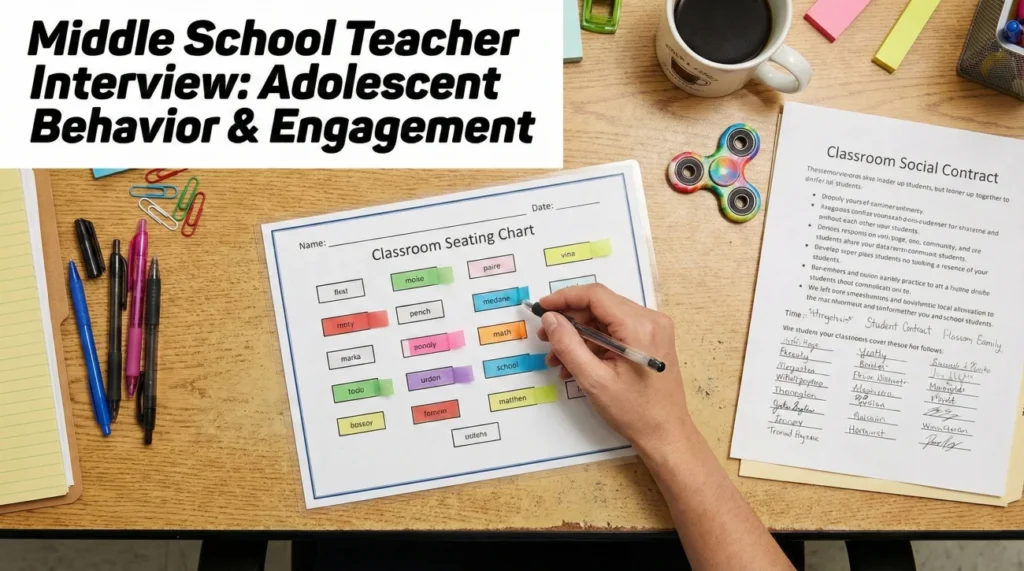
I use strategic seating. I don’t let them choose seats on day one. I mix social groups to break up cliques. I place students who need support near the front or near a “peer model” (a helpful student). I change the chart frequently (every 4-6 weeks) to refresh the dynamic. I frame seat changes as “meeting new people” for collaboration, not as punishment for talking.
Team & Parent Collaboration Scenarios
A parent is upset because their child is failing your class but passing all others.
This suggests a specific disconnect with my subject or my style. I would prepare detailed evidence: graded rubrics, missing assignment logs, and observation notes. I start the meeting by listening. “What does [Student] say about the class at home?”
I look for patterns. Is it a skill gap (e.g., reading level affecting Science)? Is it a behavior issue unique to my time of day (e.g., right after lunch)? I would propose a targeted intervention plan, perhaps inviting the student to attend my office hours or modifying the homework load temporarily. I reassure the parent that we are on the same team to solve this specific puzzle.
You are part of an interdisciplinary team (Team Teaching). Your colleague is not enforcing the shared discipline rules.
Inconsistency destroys middle school management; kids will exploit the “cool teacher.” I would address this directly but professionally in our team meeting. “I’ve noticed that when students come from your class to mine, they struggle to settle down because the expectations are different.”
I would suggest we review our team norms. “Let’s agree on the top 3 non-negotiables (e.g., phones away, no talking during instruction) and commit to enforcing them strictly for two weeks to reset the culture.” I frame it as supporting student success rather than criticizing the colleague’s style.
A student reports being cyberbullied by classmates on a group chat over the weekend.
Even though it happened off-campus, it affects the school environment (cyberbullying laws often apply). I would validate the student for coming forward (“You did the right thing telling me”). I would immediately refer the issue to the School Counselor and Administration, as they handle investigations.
I would not try to investigate the phones myself (liability). My role is to support the victim in class – perhaps moving their seat away from the aggressors or checking in with them discreetly. I would reinforce digital citizenship lessons in my advisory period without naming names.
Instructional Strategies
Q: How do you structure a lesson for short attention spans?
I use “Chunking.” I never lecture for more than 10-12 minutes. My lesson flow is: Bell Ringer (5 min, immediate engagement), Mini-Lesson (10 min, direct instruction), Guided Practice (15 min, group work/activity), Independent Practice (15 min, creation/writing), and Exit Ticket (5 min). Changing the modality (listening -> talking -> doing) every 15 minutes keeps their brains engaged and reduces behavioral issues caused by boredom.
Q: Describe a Project-Based Learning (PBL) unit you might teach.
I love PBL for this age because it answers “Why do we have to learn this?” For a Social Studies/Math collaboration, students might design a “Sustainable City.” They have to research zoning laws and history (Social Studies) and calculate area/budget/resource usage (Math).
The final product isn’t a test; it’s a pitch presentation to a panel (maybe including a local city planner). This authentic audience raises the stakes and motivates them to produce high-quality work. They learn collaboration, research, and presentation skills alongside the content.
Q: How do you support reading across the curriculum?
Middle school is where students switch from “learning to read” to “reading to learn.” Even in Science or Math, I teach literacy strategies. I use Annotation (highlighting claims, circling unknown words). I teach text structures (cause/effect, chronological). I provide graphic organizers to help them digest dense textbooks. I pre-teach tier-3 vocabulary (domain-specific words like “mitosis” or “integer”) so language isn’t a barrier to concept mastery.
Q: What is your view on “Advisory” or “Homeroom” periods?
Advisory is the soul of the middle school model. It ensures every student has at least one adult advocate who knows them well. I use this time not just for announcements, but for relationship building and SEL. We do community circles, discuss current events, check grades together, and organize lockers. It’s the “home base” where they feel safe and connected, which is a prerequisite for academic risk-taking.
Middle School Teaching Knowledge Check
Test Your Middle Level IQ
1. The “Imaginary Audience” refers to:
- Students cheating on tests
- The adolescent belief that others are constantly watching and judging them
- A drama club activity
- Hallucinations
2. Which brain area involved in impulse control is still developing in adolescence?
- Amygdala
- Prefrontal Cortex
- Brain stem
- Hippocampus
3. “Teaming” in middle school typically means:
- Sports teams only
- A group of interdisciplinary teachers sharing the same group of students
- Students working in pairs
- Teachers eating lunch together
4. “Proximity Control” is a management strategy where the teacher:
- Yells from the desk
- Moves physically closer to misbehaving students to stop behavior without words
- Sends students to the office
- Uses a seating chart
5. “Wait Time” should ideally be:
- 1 second
- 3-5 seconds or more after a question
- 10 minutes
- Until the bell rings
6. A “Graphic Novel” is:
- Not real reading
- A valid literary format that engages reluctant readers and teaches inference
- Only for art class
- A picture book for toddlers
7. “Restorative Justice” focuses on:
- Punishment and exclusion
- Repairing harm and restoring relationships
- Ignoring rules
- Calling the police
8. “Exit Tickets” are a form of:
- Summative Assessment
- Formative Assessment
- Hall pass
- Homework
9. “Cyberbullying” often occurs:
- Only at school
- Outside school hours but impacts the school environment
- Only among boys
- Without technology
10. “Scaffolding” means:
- Building a tower
- Providing temporary support to help students reach a higher level of understanding
- Making tests harder
- Giving the answer key
11. A “Flipped Classroom” involves:
- Turning desks around
- Learning content at home (video) and doing practice in class
- Students teaching the teacher
- No homework
12. “Self-Efficacy” is:
- Being selfish
- A student’s belief in their own ability to succeed
- Being efficient
- Self-grading
13. Which is a “High-Yield” instructional strategy (Marzano)?
- Lecturing for 50 minutes
- Identifying similarities and differences
- Word search puzzles
- Silent reading without accountability
14. “Intrinsic Motivation” comes from:
- Candy rewards
- Internal desire to learn or master a skill
- Grades
- Parent pressure
15. “Advisory” is primarily for:
- Extra math practice
- Social-emotional support and advocacy
- Free time
- Sleeping
16. “Tiered Assignments” are a method of:
- Grading
- Differentiation based on readiness
- Punishment
- Scheduling
17. “Think-Pair-Share” increases:
- Noise only
- Student engagement and processing time
- Test scores immediately
- Teacher workload
18. The “Socratic Seminar” method encourages:
- Debate to win
- Student-led dialogue and critical questioning
- Teacher lecture
- Silent writing
19. “Metacognition” is:
- Thinking about thinking
- Thinking about thinking (monitoring one’s own learning)
- Advanced science
- Memorization
20. “Positive Reinforcement” involves:
- Adding something bad to stop behavior
- Adding something good to increase a behavior (e.g., praise)
- Taking away recess
- Ignoring the student
❓ FAQ
📜 Do I need a specific Middle School endorsement?
In many states, yes. You might need a specific subject certification (e.g., Math 5-9) rather than a general Elementary K-6 license. Check your state’s specific requirements, as middle school licensing can be a grey area between elementary and high school credentials.
🤪 Is middle school really that scary?
Only if you expect them to act like adults. They are wonderfully weird, funny, and curious. If you have a sense of humor and don’t take their moods personally, it is the most entertaining age group to teach. You have to embrace the chaos.
🤝 How important is collaboration?
Vital. Middle schools often use the “Team Model” (Interdisciplinary Teams). You will meet daily or weekly with the English, Science, and History teachers who share your kids. You plan interdisciplinary units and discuss student interventions together.
📱 How do I handle social media drama?
You can’t ignore it. Be aware of the apps (TikTok, Snapchat). Don’t try to be the “cool” teacher who follows them, but be the knowledgeable adult who can advise them on digital footprint and cyberbullying. Keep professional boundaries online.
⏰ What about extracurriculars?
Middle schools thrive on clubs and sports. Coaching a sport or leading the Robotics/Drama club is a fantastic way to build relationships with students outside the academic pressure cooker. It makes classroom management easier because they see you as a person.
Championing the Tween
To succeed with middle school teacher interview questions, you must show that you want to be there. Many people view middle school as a stepping stone or a punishment. Administrators want a “Middle School Person.”
Focus on your ability to connect. Share stories of how you turned a disengaged student around by asking about their hobbies. Demonstrate your thick skin and your sense of humor. Prove that you understand the unique developmental window of adolescence and are committed to guiding them through the storm.
⚠️ Disclaimer: The interview strategies, sample answers, and negotiation tips provided in this guide are for educational purposes only. Hiring decisions are subjective and vary by company and industry. While these strategies are based on professional HR standards, they do not guarantee a specific job offer or result.