Where Language Meets Belonging
ESL teacher interview questions are not really about vocabulary lists or perfect grammar. They are about whether you can make a brand new student feel safe enough to take risks out loud, then guide them from everyday conversation into academic language without shame.
Hiring teams listen for practical thinking: how you screen newcomers, set language objectives alongside content objectives, and collaborate with classroom teachers so support feels seamless, not like an interruption. You may hear terms like BICS and CALP, but what matters most is what you do on Monday morning when a student understands the idea but not the sentence.
This guide focuses on the moves that actually show up in strong interviews, like sheltered instruction, clear routines, strategic use of visuals, and respectful family communication. The goal is simple: prove you can build confidence, accelerate language growth, and protect a student’s dignity at the same time.
Language Acquisition Theories & Core Concepts
Q: Can you explain the difference between BICS and CALP and why it matters?
This is a cornerstone concept from Dr. Jim Cummins. BICS (Basic Interpersonal Communication Skills) is “playground language” – the social, conversational fluency that students often pick up within 6 months to 2 years. It is context-rich and cognitively less demanding.
CALP (Cognitive Academic Language Proficiency) is the “classroom language” required to understand textbooks, write essays, and engage in abstract thinking. This takes 5 to 7 years to develop. I explain this to show that I don’t judge a student’s academic potential based solely on their ability to chat with friends. Just because a student speaks fluent English at lunch doesn’t mean they don’t need scaffolding for a history exam. My job is to bridge that gap explicitly.
Q: How do you lower the “Affective Filter” in your classroom?
Stephen Krashen’s theory posits that high anxiety blocks language input from reaching the brain. If a student is terrified of making a mistake, they cannot learn. I lower the Affective Filter by creating a low-stress environment where mistakes are celebrated as proof of learning.
I never force a student to speak before they are ready (respecting the “Silent Period”). I use choral reading or “Think-Pair-Share” so students can practice with a peer before speaking to the whole class. I also decorate the room with diverse cultural representations so they feel they belong. When students feel safe and valued, the filter goes down, and language acquisition goes up.
Q: What is the difference between ESL and EFL?
ESL (English as a Second Language) typically refers to teaching English in a country where English is the dominant language (like the US or UK). The students need English for survival and integration into the community. EFL (English as a Foreign Language) is teaching English in a country where it is not the primary language (like teaching English in Japan). The motivation and context are different. In an ESL context, I focus heavily on cultural survival skills and content-area support, whereas EFL might focus more on grammar and formal structure for future use.
Q: How do you use the WIDA (or your state’s) Standards in lesson planning?
I don’t just look at the content standard; I look at the language function. If the WIDA standard involves “Arguing” or “Explaining,” I determine what language structures are needed for that level. For a Level 1 (Entering) student, the goal might be to “Point to” or “Match” images. For a Level 3 (Developing), it might be to “Describe using simple sentences.” I use the “Can Do Descriptors” to ensure my expectations are challenging but attainable for each proficiency level, ensuring I am teaching language through content, not just in isolation.
Instructional Strategies & Differentiation
Q: What is “Scaffolding” and give examples of how you use it.
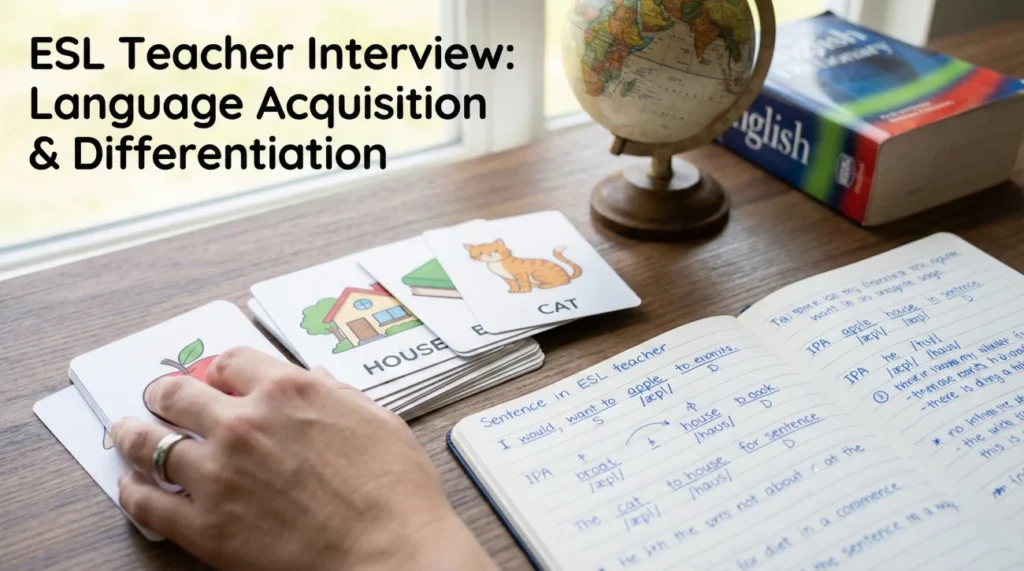
Scaffolding instruction is providing temporary supports that help a student achieve a task they couldn’t do alone. It is not “dumbing down” the content; it is ramping up the access. I use sensory scaffolds (images, videos, realia), interactive scaffolds (partners, small groups), and graphic scaffolds (charts, diagrams).
Specifically, I use “Sentence Frames” or “Sentence Starters” (e.g., “I agree with… because…”) to help students structure their academic speech. I also use “Front-loading Vocabulary” where we pre-teach key terms before reading a text. As students gain proficiency, I gradually remove the scaffolds to foster independence.
Q: How do you support a “Newcomer” with zero English proficiency?
For a newcomer, I focus on survival language and building a sense of safety. I label the entire classroom (door, desk, chair) in both English and their home language. I assign a “Language Buddy” – ideally someone who speaks their language, or a kind peer model.
I use Total Physical Response (TPR), connecting words to actions (e.g., “Stand up,” “Open your book”). I provide a “Survival Keyring” with pictures of essential needs (bathroom, water, nurse) so they can communicate basic needs without stress. My goal is to make the input comprehensible through visuals and gestures, focusing on listening comprehension first.
Q: How do you differentiate a test for different proficiency levels?
I differentiate the method of assessment, not the core concept. If the test is about the Water Cycle, a Level 5 student might write a paragraph explaining the process. A Level 3 student might fill in a cloze passage (fill-in-the-blanks) with a word bank.
A Level 1 student might arrange pictures of the cycle in order and label them. They are all demonstrating knowledge of the Water Cycle, but the linguistic demand is adjusted. I also allow extended time and the use of bilingual dictionaries where appropriate to ensure I am testing their science knowledge, not just their reading speed.
Q: How do you incorporate technology in the ESL classroom?
Technology is a great equalizer. I use translation tools like Google Translate or Microsoft Translator for immediate communication gaps, but I teach students to use them as a bridge, not a crutch. I use apps like Duolingo or Rosetta Stone for supplemental practice.
I also use tools like Flipgrid (Flip) which allows students to record video responses. This is excellent for ELLs because they can re-record until they feel confident, reducing the anxiety of speaking live in front of the class. It builds their oral fluency portfolio over time.
Q: Explain the SIOP Model and how you use it.
The Sheltered Instruction Observation Protocol (SIOP) is a research-based framework for teaching content to ELLs. It emphasizes clearly defined content objectives and language objectives for every lesson. It’s not enough to say “Students will learn about the Civil War.”
I must also plan: “Students will be able to explain causes using causal conjunctions (because, so, therefore).” I consciously plan for interaction, comprehensible input, and building background knowledge. SIOP ensures that language development is woven into every subject, Math, Science, or History.
Q: How do you use a student’s home language (L1) in the classroom?
I view L1 as an asset, not a deficit (“Translanguaging”). Research shows that strong literacy in L1 transfers to L2. If a student knows how to read in Spanish, they understand the concept of reading; they just need the English code.
I encourage students to brainstorm or draft ideas in their home language first if they are stuck. I allow “cognate” studies (words that look similar in both languages). However, I also set clear “English practice times” to ensure they are getting sufficient output practice. It is a balance of valuing their identity while pushing their English acquisition.
Classroom Management & Cultural Scenarios
A regular education teacher complains that an ELL student “just sits there and doesn’t try.” What do you do?
I act as an advocate and a coach. I observe the student in that class to see what is happening. Often, the student is overwhelmed by the speed of speech or the density of the text. They aren’t lazy; they are lost.
I meet with the teacher and explain the “Silent Period” and sensory overload. I offer concrete, low-prep modifications the teacher can use, like providing a copy of the notes, allowing the student to use a translation app, or assigning a peer buddy. I shift the narrative from “defiance” to “access,” helping the teacher see how small changes can engage the student.
You notice tension between students of different cultural backgrounds in your class.
I address it immediately by integrating cultural competency into the curriculum. I don’t ignore it. I might facilitate a “Culture Share” where students present about their home countries, food, and traditions to humanize each other.
I establish “Non-Negotiables” for respect. I model curiosity rather than judgment. If a specific conflict arises, I mediate using restorative justice circles, ensuring both sides feel heard and understood, often addressing how cultural misunderstandings (like body language or volume of speech) might have caused the friction.
A parent wants to help their child but speaks no English. How do you involve them?
I emphasize that they should continue speaking and reading to their child in their home language. Rich vocabulary in L1 supports L2. I tell them, “You teach the concepts in Spanish; I will teach the English labels for them.”
I use apps like TalkingPoints to text parents in their language. I invite them to school events and ensure interpreters are present. I make sure they know they are partners in their child’s education, regardless of the language barrier. Their engagement is a predictor of student success, so I remove the obstacles to it.
Assessment & Advocacy
Q: How do you distinguish between a language difference and a learning disability?
This is the hardest challenge in our field. I look for the “Rule of Exclusion.” Is the student struggling only in English, or in their home language too? If a student cannot read in English but is literate in Spanish, it’s a language difference. If they struggle to process auditory information in both languages, it might be a disability.
I collect data over time (RTI/MTSS). A student learning a language will make progress, even if slow. A student with a disability will often “plateau” despite intense, targeted language interventions. I collaborate with the school psychologist and family to get a full developmental history before jumping to a Special Ed referral.
Q: How do you handle “Error Correction” when a student speaks?
I balance accuracy with fluency. If the goal is communication, I do not interrupt every mistake, as that raises the Affective Filter and silences the student. Instead, I use “Recasting.”
If a student says, “I goed to store,” I reply, “Oh, you went to the store? What did you buy?” I model the correct form naturally without shaming them. I save explicit grammar correction for focused mini-lessons or written work where the student has time to edit and reflect. Constant interruption kills the motivation to speak.
Q: How do you advocate for ELLs in the wider school culture?
I ensure they are included in all school activities, not just siloed in the ESL room. I check that school communications are translated. I advocate for diverse library books that reflect their cultures.
I also provide professional development (PD) for staff on teaching English learners strategies. Many teachers want to help but don’t know how. By sharing “strategies of the week” or modeling best practices, I build the capacity of the entire school to support these learners. I am their voice at the table when decisions about curriculum or scheduling are made.
Q: Why do you want to be an ESL teacher?
I love the moment the “lightbulb” goes on – when a student moves from confusion to connection. I am passionate about equity and believe that language should never be a barrier to a child’s potential. Teaching ESL allows me to see the world through my students’ eyes. I learn as much from them as they do from me. I want to be the person who makes them feel welcome, capable, and heard in a new and often overwhelming environment.
ESL Teacher Knowledge Check
Take the 20-Question Challenge
1. BICS typically takes how long to develop?
- At least 5 to 7 years in an academic setting
- 6 months to 2 years of social exposure
- 10 years or more regardless of context
- Immediately upon arrival
2. CALP stands for:
- Comprehensive Assessment of Learning Plans
- Cognitive Academic Language Proficiency
- Cultural And Language Proficiency
- Communicative Arts Lesson Program
3. The “Silent Period” is best described as:
- A clear sign of behavioral defiance and refusal
- A normal stage where learners listen but don’t speak
- A punishment used for excessive talking
- Evidence of a severe speech disability
4. Total Physical Response (TPR) relies primarily on:
- Writing extended essays and reports
- Coordinating language with physical movement
- Silent reading and independent study
- Memorizing complex grammar rules
5. “Scaffolding” involves:
- Giving the student the answers to save time
- Providing temporary support to assist learning
- Permanently lowering the difficulty of the curriculum
- Ignoring the student until they figure it out
6. The “Affective Filter” hypothesis suggests that:
- Emotional state has zero impact on learning capability
- High anxiety blocks language acquisition
- Students learn best when placed under high stress
- Caffeine is the most critical factor in learning
7. “Realia” refers to:
- Artificial props designed solely for testing
- Real-life objects used as teaching aids
- Abstract concepts without visual support
- Fictional stories about real life
8. ELL stands for:
- Early Learning Literacy Program
- English Language Learner
- Elementary Level Language Student
- Education for Life and Learning
9. A “Newcomer” program is specifically designed for:
- Students who have been in the US for many years
- Recent immigrants with low English proficiency
- Advanced English speakers seeking honors credit
- Parents who want to learn English
10. “Sentence Frames” are used to:
- Restrict students from expressing their own ideas
- Help students structure their speaking/writing
- Decorate the classroom walls with pictures
- Test vocabulary memorization only
11. Which of the following is an example of a “Cognate”?
- Dog / Perro (Different roots)
- Family / Familia (Same root)
- Book / Libro (Different roots)
- Water / Agua (Different roots)
12. The WIDA Consortium is best known for:
- Developing national mathematics standards
- English language development standards and assessments
- Training sports coaches for schools
- Managing school lunch nutrition programs
13. “Sheltered Instruction” focuses on:
- Keeping students inside during recess time
- Making content comprehensible while developing English
- Teaching grammar in isolation from content
- Simplifying content to kindergarten level
14. When a student makes a grammar mistake while speaking, you should generally:
- Stop them immediately to correct every error
- Use “Recasting” to model the correct form naturally
- Publicly point out the mistake to the class
- Deduct points from their participation grade
15. “Translanguaging” encourages:
- Strictly banning the home language in class
- Using the student’s full linguistic repertoire (L1 & L2)
- Forcing students to speak only English at home
- Relying entirely on Google Translate
16. CALP typically takes how long to fully develop?
- 6 months to 1 year
- 5 to 7 years (or more)
- 2 to 3 weeks of intensive study
- It happens instantly with immersion
17. A “False Friend” (False Cognate) refers to:
- A classmate who is not helpful
- Words that look similar in two languages but mean different things
- A word that has the exact same meaning
- A translation dictionary app
18. To assess a student without language bias, you might best use:
- A standardized, timed multiple-choice test
- A portfolio, drawings, or performance-based task
- A long written essay prompt
- An oral debate in front of the class
19. In language acquisition terms, “L1” refers to:
- The target language being learned (English)
- The student’s first or native language
- Level 1 proficiency on the WIDA scale
- The first lesson of the unit
20. The most important factor in long-term ELL success is:
- Forcing them to speak perfect English immediately
- Creating a supportive, low-anxiety environment for risk-taking
- Implementing strict discipline for silence
- Assigning double the amount of homework
❓ FAQ
🧩 Do I have to be bilingual to teach ESL?
No. What matters more is your ability to make input comprehensible, build routines, and respond to mistakes with patience. If you do speak another language it can help with rapport, but strong visuals, modeling, and sentence frames are what carry you in a multilingual classroom.
🏫 When is push-in support better than pull-out?
Push-In works well when students need language scaffolds during grade-level content, like science labs or social studies discussions. Pull-Out can be useful for targeted skill gaps, like writing structure or beginner literacy, as long as it is coordinated so students do not miss core instruction.
🎓 What credentials should I highlight in an ESL interview?
Show your state licensure plus any ESOL or TESOL endorsements, training in sheltered instruction, and experience with language proficiency assessments. If you have co-teaching or newcomer program experience, make it concrete with one example of how you planned and measured growth.
🗣️ Should students be allowed to use their home language?
Yes, strategically. Letting students think and draft in their first language can reduce anxiety and improve ideas, then you can bridge to English with glossaries, partner talk, and translated supports. Set clear expectations so the home language is a tool for learning, not a way to opt out.
📊 How do I grade multilingual learners fairly?
Grade the content standard and the language goal separately when possible. Use rubrics that reward growth and clarity, provide accommodations that match the plan, and collect multiple types of evidence, like oral explanations, visuals, and short written responses that show understanding.
A Closing Note for ESL Candidates
If you want a simple way to sharpen your answers, practice with esl teacher interview questions and respond with one student-centered story, one clear strategy, and one way you measure progress. The strongest candidates make it obvious they can protect confidence while pushing growth, because language learning only happens when students feel safe enough to try.
⚠️ Disclaimer: The interview strategies, sample answers, and negotiation tips provided in this guide are for educational purposes only. Hiring decisions are subjective and vary by company and industry. While these strategies are based on professional HR standards, they do not guarantee a specific job offer or result.